
Your team ships an integration priced per request. The launch works, traffic rises, and the next finance review surfaces an overage nobody budgeted for. Engineering can explain the request count, but not why one endpoint consumed far more infrastructure than another, or why retries turned a seemingly simple forecast into a moving target.
A credit pricing model addresses that mismatch by converting different product events into a shared consumption unit. Buyers plan around a credit envelope, while vendors preserve flexibility beneath it. The model can make variable usage easier to govern, but only when the conversion rules, failure policy, rollover terms, and overage behavior are visible enough to model.
Table of Contents
- When a Credit Pricing Model Makes Sense
- What a Credit Represents
- Credit Pricing Versus Per-Call and Subscription Plans
- Modeling Monthly Cost at Scale
- Two Worked Examples for Real Workloads
- Governance, Free Tiers, and No-Charge-on-Failure Rules
- Best Practices for Predictable Spend
When a Credit Pricing Model Makes Sense
A team usually considers credits after its current pricing plan starts producing bad incentives. Per-call billing treats a lightweight lookup and a compute-heavy generation request as equivalent, even when their underlying costs differ sharply. A flat subscription produces a stable invoice, yet customers may pay for unused capacity during quiet periods and encounter a hard quota boundary when demand returns.
A credit model sits between those choices. Customers purchase a balance and draw it down as they use the product, which can make variable spend easier to budget while giving the vendor a clearer revenue commitment, as described in this overview of credit-based pricing. It works best when one API exposes heterogeneous endpoints, including inexpensive reads, costly generations, long-context requests, or data-heavy responses.
Workloads that benefit
Credits fit workloads with one or more of these conditions:
- Uneven endpoint economics: One credit pool can cover several product actions without requiring buyers to understand each infrastructure cost.
- Variable customer behavior: Seasonal demand, campaign bursts, and unpredictable automation are easier to budget as an allowance than as a fixed request quota.
- Several product lines: Enrichment, reporting, exports, and analysis can draw from one balance instead of requiring a separate subscription for every feature.
- Outcome-oriented packaging: Customers generally care about completing a workflow, not whether the vendor used tokens, compute time, storage, or a specific model behind the scenes.
The broader SaaS market also creates pressure for flexible packaging. One industry guide cites an average of 112 SaaS applications per company, a level of software sprawl that makes overpaying for light use and underpricing heavy use visible in procurement conversations. The figure frames the purchasing problem, but it does not show that credits suit every buyer.
Where credits add friction
Credits are not automatically the clearer option. Low-volume internal tooling may be easier to operate with per-call billing, while a steady enterprise workload may fit a fixed commitment. The conversion layer adds another source of confusion for first-time buyers. If the vendor does not publish how actions consume credits, the prepaid balance offers no reliable way to estimate the resulting work or monthly cost.
Production reviews should therefore test the unit economics, not just the packaging. Convert each common action into a normalized cost, model burst and quiet periods, then check how failed requests, retries, free allowances, rollovers, and overages affect the forecast. Those policy details often create more variance than the headline credit price.
Practical rule: Choose credits when workload variability and endpoint asymmetry create real operating problems. Do not choose them solely because one balance makes the pricing page look cleaner.
What a Credit Represents
A credit is a normalized, prepaid unit of consumption. The customer buys a pack or receives an allocation, and the billing system deducts a defined amount when a product event occurs. That event could be an API request, returned data row, generated artifact, document operation, or another measurable action.
The conversion layer determines the economics. It maps each event to a credit weight and records the debit against the customer's balance. An internal table might assign one credit to a simple read, ten credits to image generation, and twenty credits to a long-context completion. These weights explain the mechanism, not a universal market standard.
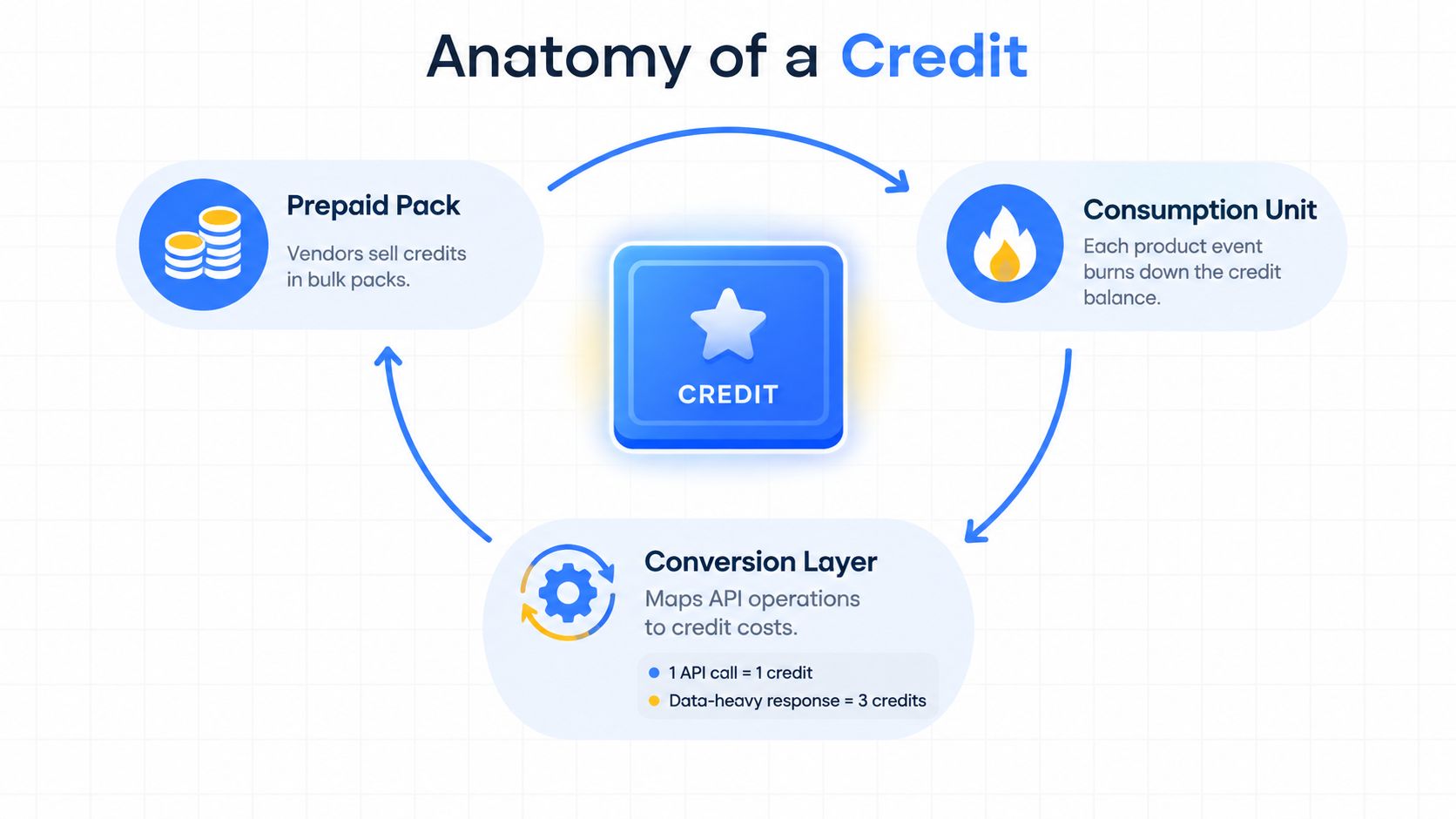
Follow the conversion path
A production review should answer four questions:
- What event is billable? Is the unit a request, successful response, returned record, token band, page, or compute interval?
- What determines its weight? Cost may vary by endpoint, response size, model, data volume, filters, retention, or processing complexity.
- When is the debit committed? The system may reserve credits at request time, charge after success, or reconcile asynchronously.
- What happens when the operation fails? The policy affects customer cost and retry behavior.
The advertised credit price is only one input. The weight table determines the effective rate. Two vendors can sell credits at the same rate while producing very different per-call costs because their burn rates differ. Independent SaaS benchmarking guidance recommends converting discounts, bundles, and credit burn into a net effective unit price before comparing providers, as discussed in this SaaS benchmarking guide.
A credit may represent tokens, requests, compute-seconds, rows, or another underlying unit. It gives customers a consistent budgeting measure while allowing engineering teams to change implementation details. That flexibility requires deterministic mappings and documented changes, so customers can forecast spend and reconcile every debit.
Credit Pricing Versus Per-Call and Subscription Plans
The right comparison depends on workload shape, not on which model sounds simplest. Per-call pricing is easy to understand when requests are uniform and volume is low. Subscription pricing is comfortable when demand is stable and the included allowance closely matches actual use. Credit pricing is strongest when a product combines variable volume with materially different endpoint costs.
| Dimension | Credit Pricing | Per-Call Pricing | Subscription Pricing |
|---|---|---|---|
| Bill predictability | Bounded by the prepaid envelope when caps and alerts are clear | Weak during spikes unless the buyer adds controls | Strong within the included allowance |
| Low-volume cost | Can be inefficient if packs expire or are too large | Usually easy to align with actual use | Can waste unused allocation |
| Medium-volume cost | Often works well when endpoint weights reflect the workload | Transparent, but request growth raises spend directly | Efficient if usage stays near the plan quota |
| High-volume cost | Depends on pack discounts, overage rates, and negotiated terms | Can become difficult to govern | Quota cliffs or expensive upgrades can appear |
| Heterogeneous workloads | Strong fit because actions share one balance | Requires buyers to compare every endpoint rate | Often hides endpoint differences inside a quota |
| Buyer cognitive load | Moderate, higher when weights are opaque | Low at first, higher across many endpoints | Low until the customer approaches a quota |
Per-call pricing
Per-call billing gives buyers a clean relationship between activity and spend. It works well for a small integration with a single operation and a stable request profile. The weakness appears when customers optimize request count instead of business outcome. They may combine calls, suppress useful retries, or avoid a valuable endpoint because every action carries a visible marginal charge.
Subscription pricing
A subscription makes finance planning easier because the recurring charge is known. It can also reward adoption when customers use the included capacity consistently. The trade-off is utilization risk. Slow months create waste, while busy months create an upgrade decision or an interruption at the quota boundary.
Credit pricing
Credits combine a prepaid budget envelope with variable consumption. That middle position is useful for an API with cheap reads and expensive processing, or for a platform that bundles several capabilities. The cost is interpretability. Buyers need a published weight table, examples based on representative workloads, and explicit rules for expiry, rollover, top-ups, and overages.
For a deeper comparison of packaging choices, see this guide to API pricing models. The practical conclusion is straightforward: choose per-call for simple and sparse usage, subscription for stable utilization, and credits when workload variability and heterogeneous actions dominate the buying decision.
Modeling Monthly Cost at Scale
A defensible forecast starts with effective unit price, not the number printed beside one credit. Divide the plan price by the credits consumed under a representative workload. If a workload uses different endpoint weights, calculate the result from the complete mix rather than treating every request as equivalent.
Next, replay the product's actual behavior. Count successful operations, retries, timeouts, partial responses, response-size bands, and any workload variable that changes the conversion weight. A heavy endpoint can consume more credits than many cheap calls, while retries can inflate burn even when the customer sees one user action.
Build three scenarios
Use conservative, expected, and peak cases. The expected case should reflect normal production behavior. The conservative case should include less favorable endpoint mix or larger responses. The peak case should model launch activity, seasonal demand, or a customer workflow that pushes the most expensive paths.
Overage terms then determine the curve after the included balance is exhausted. Tiered packs, soft caps, automatic top-ups, and hard cutoffs produce very different operational outcomes. Orb documents an enterprise pattern that combines pre-purchased usage, negotiated rates, automated balance alerts, and controls as credits deplete, as shown in its enterprise credit management documentation.
| Input | What to Capture | Effect on Forecast |
|---|---|---|
| Plan commitment | Price, included credits, and term | Establishes the base effective rate |
| Endpoint mix | Calls or events by operation | Determines weighted credit burn |
| Workload size | Tokens, rows, pages, domains, or response volume | Raises or lowers credits per event |
| Retry behavior | Rate-limit, timeout, and server-error retries | Can inflate usage unless failures are excluded |
| Overage policy | Top-up price, soft cap, hard cutoff | Changes spend after allocation |
| Credit lifecycle | Expiry, rollover, and reset behavior | Determines whether unused capacity carries forward |
The most useful validation is operational. Replay one week of production logs through the same conversion layer used at billing time, then compare the modeled balance with the ledger. That process produces a range finance can review instead of a single point estimate copied from a pricing page.
Two Worked Examples for Real Workloads
Worked models make credits less mysterious because every result comes from observable product events. The examples below use illustrative weights and volumes, not market benchmarks. Replace them with the vendor's published table and your own logs before using the calculations in a purchasing decision.
Example one, a support assistant
Suppose a support assistant handles a session with many short retrieval calls and a smaller number of generation calls. Assign one credit to a retrieval call and ten credits to a generation call. If a typical session uses six retrieval calls and two generation calls, the session consumes:
6 × 1 + 2 × 10 = 26 credits
At a modeled volume of 1,000 sessions in a month, the workload consumes 26,000 credits. The monthly dollar spend still depends on the purchased plan's effective credit rate, so the correct calculation is:
26,000 × effective price per credit
If prompt length increases the generation weight, or if a fallback path adds another generation call, the session cost rises without any change in the user-facing workflow. A failure policy that doesn't charge unsuccessful calls can keep transient retries from distorting the model.
Example two, document processing
Now consider a document pipeline. It batches input, sends each batch to a heavy parsing endpoint, and periodically summarizes the resulting content. Assume parsing costs three credits per page and summarization costs twenty credits per document. A 40-page document therefore consumes 120 parsing credits, plus 20 summarization credits, for a total of 140 credits before retries or additional processing.
At a modeled volume of 200 documents, the monthly requirement is 28,000 credits. If documents become longer, the parsing component grows with page count. If batching reduces the number of parsing operations but doesn't change page-based billing, the credit total may stay similar. If billing is request-based instead, batch size can materially change the result.
| Workload | Endpoint Mix | Credits per Call | Monthly Volume | Monthly Credit Cost |
|---|---|---|---|---|
| Support assistant | Six retrieval calls and two generations per session | 26 per session | 1,000 sessions | 26,000 credits |
| Document pipeline | 40-page parsing plus one summary per document | 140 per document | 200 documents | 28,000 credits |
The sensitivity check matters more than the tidy base case. For the assistant, test longer prompts and fallback generations. For documents, test page-count distribution, batch size, and summary frequency. A buyer evaluating a data enrichment API should perform the same exercise with records, fields, filters, and response sizes rather than relying on a generic per-credit comparison.
Governance, Free Tiers, and No-Charge-on-Failure Rules
Governance determines whether a credit forecast remains useful after deployment. A free tier, alert, or failure exemption isn't just a pricing-page detail. Each rule changes the relationship between product events, ledger entries, and the invoice.
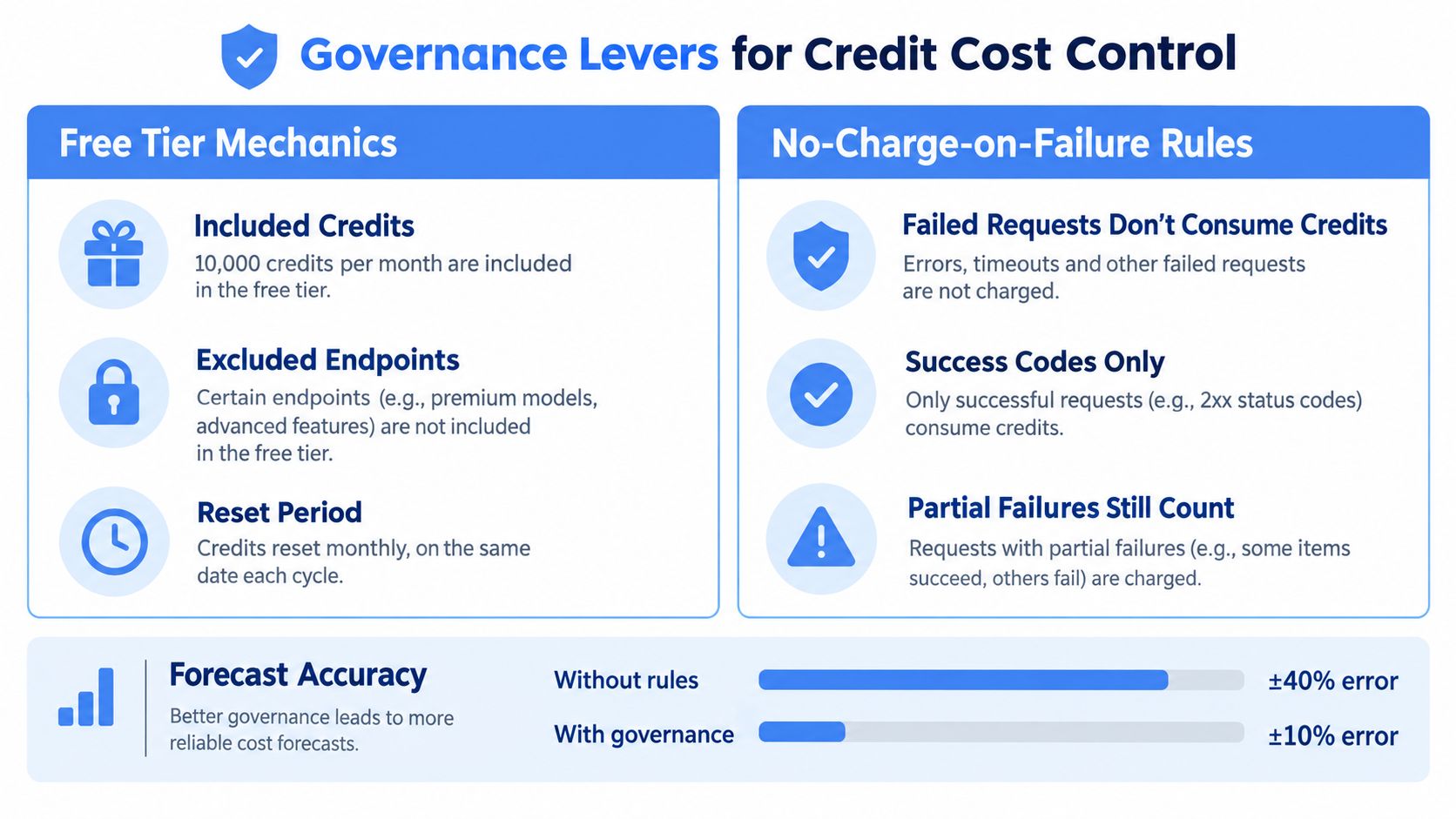
Start with the free allocation. Record how many credits or calls it includes, which endpoints qualify, and when the balance resets. A free tier that excludes expensive operations can help validate basic integration traffic without representing the production workload. A balance that expires at the period boundary can also create waste if the customer's usage is seasonal.
Alerts should trigger action
Usage alerts work only when someone knows what to do after receiving them. Thresholds at 50%, 80%, and 100% of an allocation provide a practical escalation sequence, while a stronger operating policy may add a 95% warning before the final boundary. Those thresholds are policy controls, not evidence of forecast accuracy.
A soft cap can permit controlled overage, while a hard cap can stop requests. Automatic top-ups preserve continuity but move the risk into the overage price. Rollover protects customers with uneven demand, while expiring credits can leave them paying for capacity they couldn't use.
Failed requests need a ledger rule
“No charge on failure” must be tested against logs, not accepted as marketing language. OpenAI documents that a 429 response can represent a temporary rate limit, exhausted prepaid balance, or spending or usage limit, and recommends honoring Retry-After or using exponential backoff with jitter when that header isn't valid, as explained in its 429 troubleshooting guidance.
Similarweb provides a concrete success-based rule. It says returned data points consume credits according to request variables, while error responses such as 401, 403, 429, and other 4xx or 5xx responses aren't charged, as documented in its Data Credits calculations. CryptoQuant separates rate limits from API credits, doesn't charge failed calls, and uses top-up credits after plan credits run out, according to its API credit and rate-limit FAQ.
Use request IDs to reconcile status codes, retries, debits, refunds, and balance changes. That audit trail shows whether governance narrows the gap between forecast and actual spend.
For implementation details around throttling and retry behavior, review this guide to API rate limits. The key test is whether a customer can predict the ledger outcome before production traffic arrives.
Best Practices for Predictable Spend
A production workflow can look profitable until retries, endpoint weights, and overages turn a small unit price into an unexpected invoice. Build the forecast from the effective unit price, then apply endpoint mix, workload size, retry policy, and overage path. A plan is not ready for approval if finance can see only the advertised price per credit.
Set a committed floor that covers 80% of expected usage. Govern the remaining demand with alerts at 50%, 80%, and 95% consumption, giving the team time to investigate drift before a hard boundary or automatic top-up changes the invoice. Document the owner and response for each threshold.

Before signing, record the rules that change the ledger:
- Failure accounting: Confirm whether server errors, rate limits, timeouts, and retries consume credits.
- SLA treatment: Ask whether the vendor refunds credits for an eligible service breach.
- Credit lifecycle: Record expiry, rollover, reset, and one-time pack validity terms.
- Weight transparency: Require the conversion table for every endpoint the product will call.
- Spend controls: Prefer hard caps or bounded top-ups over uncapped automatic billing.
Use the free allocation to replay production-shaped traffic during burn-in. Measure endpoint mix, response size, retry frequency, and actual credit debit. Re-baseline monthly against the observed effective unit price, because endpoint mix drift often creates forecast error.
Fetchin, a B2B data API that turns profile and company URLs into structured JSON, does not charge for failed requests. That gives engineering and finance a specific ledger rule to verify during evaluation, rather than treating failure handling as a pricing-page detail.
Buying test: If you can't explain the credit debit for your highest-volume workflow using the vendor's published rules, the model isn't ready for production procurement.
Before choosing a credit pricing model, replay representative logs and negotiate failure, rollover, cap, and overage terms in writing. If your product needs current public professional data in structured JSON, visit Fetchin to review its B2B data API, credit options, and integration approach.