Your campaigns are reaching the right industry, company-size range, and job titles, yet pipeline quality remains uneven. Sales receives leads from accounts that look ideal on paper but lack the right technology, urgency, budget potential, or internal alignment. Marketing responds by adding more filters, more personas, and more fields, while the underlying problem remains the same: the market was classified once, then treated as permanently accurate.
B2B market segmentation works better as a live operating workflow. It combines company characteristics, technology signals, business needs, account value, professional roles, and engagement behavior, then turns those inputs into routing, messaging, product, and sales decisions. The practical question isn't, “Which companies resemble our customers?” It's, “Which accounts have a similar problem, buying structure, capacity to adopt, and current reason to act?”
Table of Contents
- Why B2B Market Segmentation Decides GTM Success
- Core Criteria That Define Strong B2B Segments
- Data Sources and API Attributes That Power Segmentation
- Building Your Segmentation Workflow From Raw Data to Live Segments
- How to Validate and Prioritize Segments for Product and GTM
- Putting Segmentation Into Action and Keeping It Accurate
Why B2B Market Segmentation Decides GTM Success
A SaaS team can launch one campaign aimed at every software company, every department, and every maturity level. The copy will usually become safe enough for nobody. A technical leader sees a feature list, a finance stakeholder sees an unproven expense, and an operations owner sees no connection to the workflow they manage. The campaign may generate activity, but sales has to rediscover relevance account by account.
A focused segmentation model changes the work. Instead of promoting one generic promise, the team can distinguish between a fast-growing company replacing manual processes, a mature enterprise consolidating tools, and a technically advanced account looking for integration control. Each may need the same product, but they don't need the same proof, channel, onboarding path, or commercial conversation.
The business case is not theoretical. McKinsey's 2023 B2B Pulse research, cited in an industry benchmark summary, found that above-average B2B performers concentrate 67% of net-new revenue in their top three named segments. The same benchmark reports a 1.5x revenue-growth premium for firms using advanced segmentation compared with firmographic-only models, while 71% of B2B buyers expect personalized interactions as a baseline.
Broad segments create expensive ambiguity
A segment that's too broad creates contradictory signals. “Mid-market technology” might include companies with radically different buying processes, technical environments, regional constraints, and customer economics. Your team then averages those differences away and mistakes the average for a strategy.
Overly narrow segments fail differently. They produce elegant descriptions that nobody can reach consistently, measure reliably, or serve profitably. A segment may be intellectually precise but operationally useless if your CRM can't assign accounts to it, your sales team can't recognize it, or your product can't support a distinct use case.
Practical rule: A segment earns its place when it changes a decision. If the segment doesn't alter routing, message, offer, qualification, or product experience, it's probably a descriptive label rather than a GTM tool.
Treat the model as an operating system
The history of B2B segmentation supports this operational view. The 1974 industrial-market framework by Wind and Cardozo introduced a two-stage segmentation process and remains a major foundation of B2B segmentation theory. Later review work formalized segmentation as a continuous cycle covering pre-segmentation, segmentation, implementation, and evaluation, documenting the shift from one-time classification to ongoing management. The University of Twente review provides that historical context.
For SaaS and product teams, good segmentation is visible in daily execution. A new inbound lead can be enriched from a company URL, assigned to one account segment, routed to the right owner, and shown an onboarding experience matched to its use case. A sales representative can see which roles influence the purchase and which evidence matters to each one. Product managers can compare adoption and expansion by segment instead of analyzing one undifferentiated customer base.
Core Criteria That Define Strong B2B Segments
Strong segmentation starts with a hierarchy, not a long spreadsheet of disconnected fields. Firmographics tell you who the account is. Technographics show how it operates. Needs-based data clarifies the problem. Value-based analysis estimates commercial importance. Behavioral signals indicate what the account is doing now.
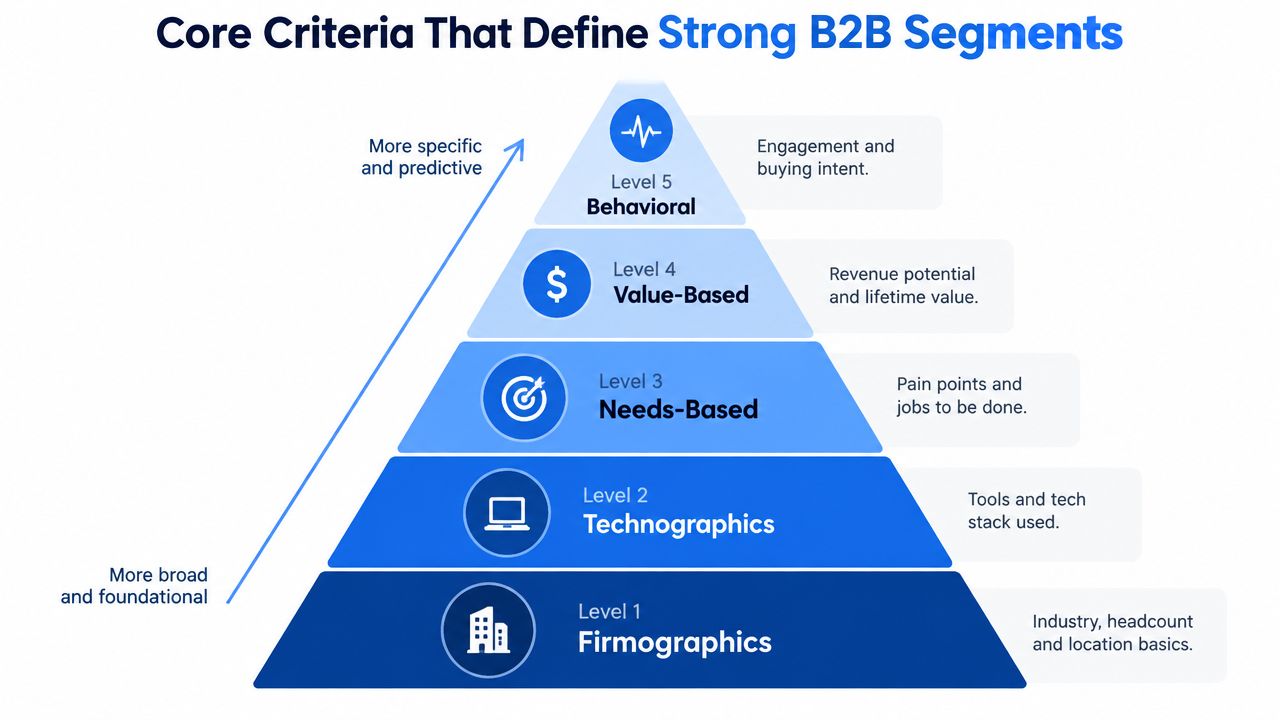
OpenStax's B2B segmentation framework groups the main approaches into firmographic, technographic, needs-based, value-based, and behavioral segmentation. The useful distinction is not choosing one layer. It's knowing what each layer can and can't tell you.
Start with the account's observable structure
Firmographics include industry, employee or headcount band, revenue, location, ownership, headquarters, and organizational structure. These fields are usually the easiest to collect and the simplest to explain to sales. They help define market boundaries and can expose obvious product constraints, such as regional availability or industry-specific requirements.
They rarely explain intent on their own. Two companies in the same industry and headcount range may have different systems, priorities, and readiness to buy.
Technographics add that missing operating context. Capture the tools used for customer relationship management, marketing automation, analytics, cloud infrastructure, identity, support, or collaboration. A product that integrates cleanly with one stack may require substantial implementation work in another, so technology data can affect both qualification and positioning.
Add motivation, economics, and action
Needs-based segmentation groups accounts by the problem they need to solve, the job they need completed, or the outcome they value. Use sales-call notes, product research, support themes, win-loss feedback, and structured qualification fields. The language should describe a business situation, not merely a persona, such as “needs centralized account enrichment for routing” rather than “marketing leader.”
Value-based segmentation estimates the account's commercial importance through potential contract value, expansion opportunity, implementation economics, strategic relevance, and expected retention. Treat this as a prioritization layer, not a promise. A large account isn't automatically a valuable account if adoption is unlikely or service costs are high.
Behavioral segmentation captures engagement and intent. Relevant inputs include product usage, content consumption, event participation, site activity, response patterns, and professional-network engagement. These signals should modify an account's priority or timing, not replace the underlying fit model.
Map the buying center, not just the persona
A B2B account doesn't buy through one profile. The decision-making unit commonly includes six archetypes: initiator, influencer, decider, buyer, user, and coordinator, as described in this advanced B2B segmentation guide.
Model those roles separately from the account segment. The same account may have a technical evaluator who cares about security and integration, a financial buyer focused on commercial risk, and a daily user focused on speed and usability. Segment-level messaging should reflect the shared business problem, while role-level content should address each person's influence and evidence requirements.
Data Sources and API Attributes That Power Segmentation
A segmentation model is only as reliable as the fields behind it. Start by writing the decisions the data must support, then map each decision to a source, field, refresh expectation, and owner. This prevents the common failure mode of collecting hundreds of attributes that never affect routing or messaging.
Build an attribute map by segmentation layer
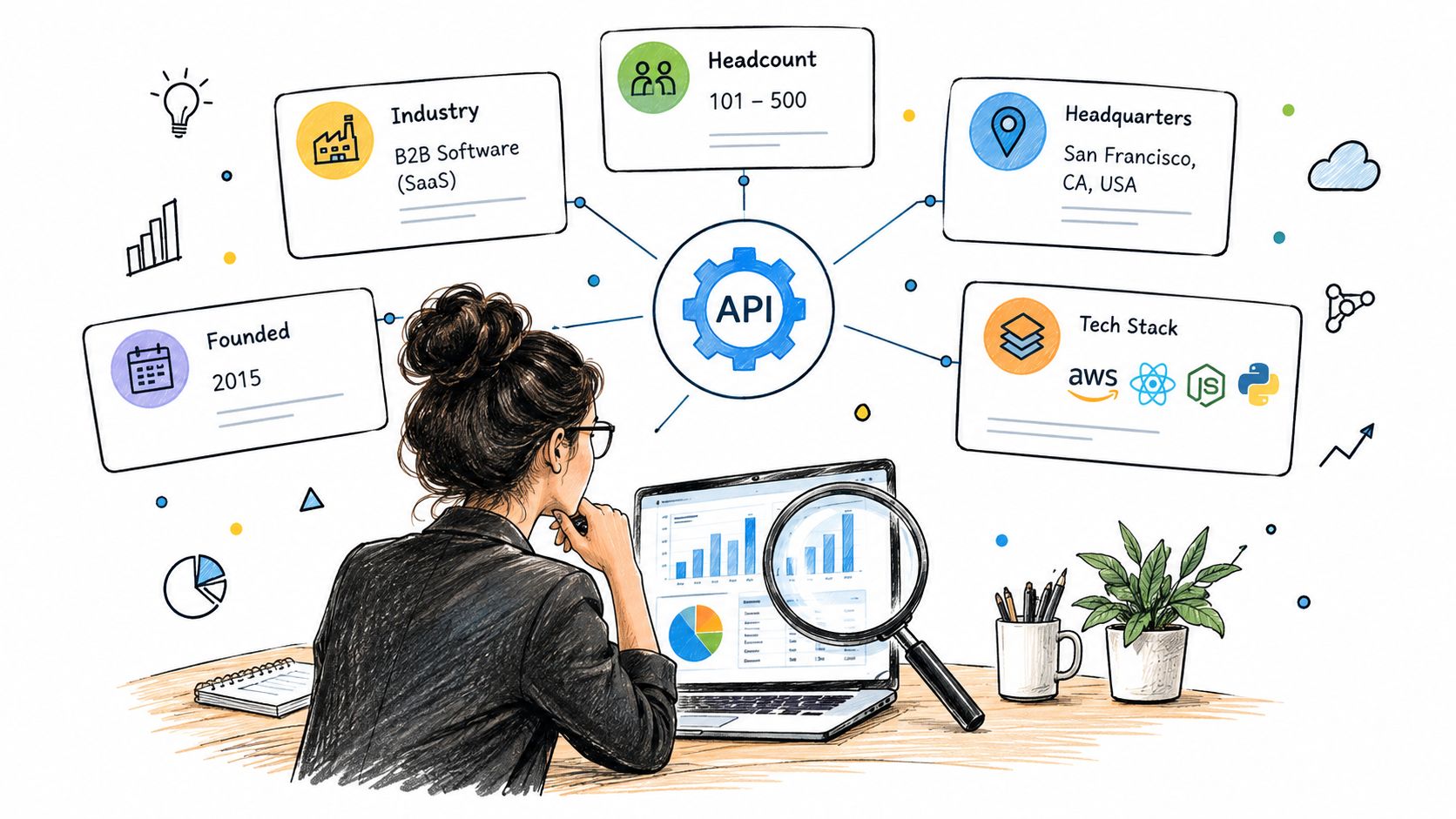
For firmographics, a company endpoint should return fields such as industry, headcount, headquarters, founding year, and verified domain. A verified company domain is especially useful as the join key between enrichment, CRM, product telemetry, and account-based reporting. Normalize industry names, locations, company-size bands, and parent-child account relationships before creating rules.
For contact and role analysis, a profile endpoint can provide positions, education, skills, locations, and contact fields. Positions help identify function and seniority, but don't rely on job title alone. Map titles into normalized role groups, then validate those groups against the person's position history, skills, and relationship to the buying center.
Engagement requires a different source pattern. Posts, comments, and reactions can add context about topics an account's professionals discuss or respond to. Use those signals carefully. A reaction may indicate awareness, while repeated participation around a problem may provide stronger evidence of relevance. Neither should automatically be treated as purchase intent.
Product usage and CRM data complete the picture. Your own systems can reveal workspace activity, feature adoption, trial progression, support history, opportunity stage, renewal status, and previous objections. Public professional data helps you understand the account and its people. First-party operational data should usually carry more weight for decisions about current customer status.
Choose delivery based on the workflow
Live fetching is useful when stale records create routing or matching errors. An inbound enrichment flow may need a synchronous response so the application can classify a lead before assigning the owner or rendering a personalized experience. A large account refresh, historical backfill, or multi-record analysis is better suited to asynchronous delivery, with retries, status tracking, and controlled writes into the CRM.
A B2B data API can return structured JSON directly to product and GTM systems. Fetchin's data enrichment API documentation is relevant to teams that need company and professional profile attributes without building separate integrations for every data type. Evaluate any provider against schema consistency, source transparency, latency behavior, credit handling, rate limits, and failure behavior.
Data quality rule: Store the value, source, retrieval timestamp, normalization status, and confidence or validation state. A field without provenance becomes difficult to audit and dangerous to automate.
Keep data extraction limited to publicly available information and define a lawful basis, retention policy, access control, and deletion process. Compliance with expectations such as CCPA and GDPR isn't a final review step. It belongs in field selection, system design, permissions, and downstream activation.
Building Your Segmentation Workflow From Raw Data to Live Segments
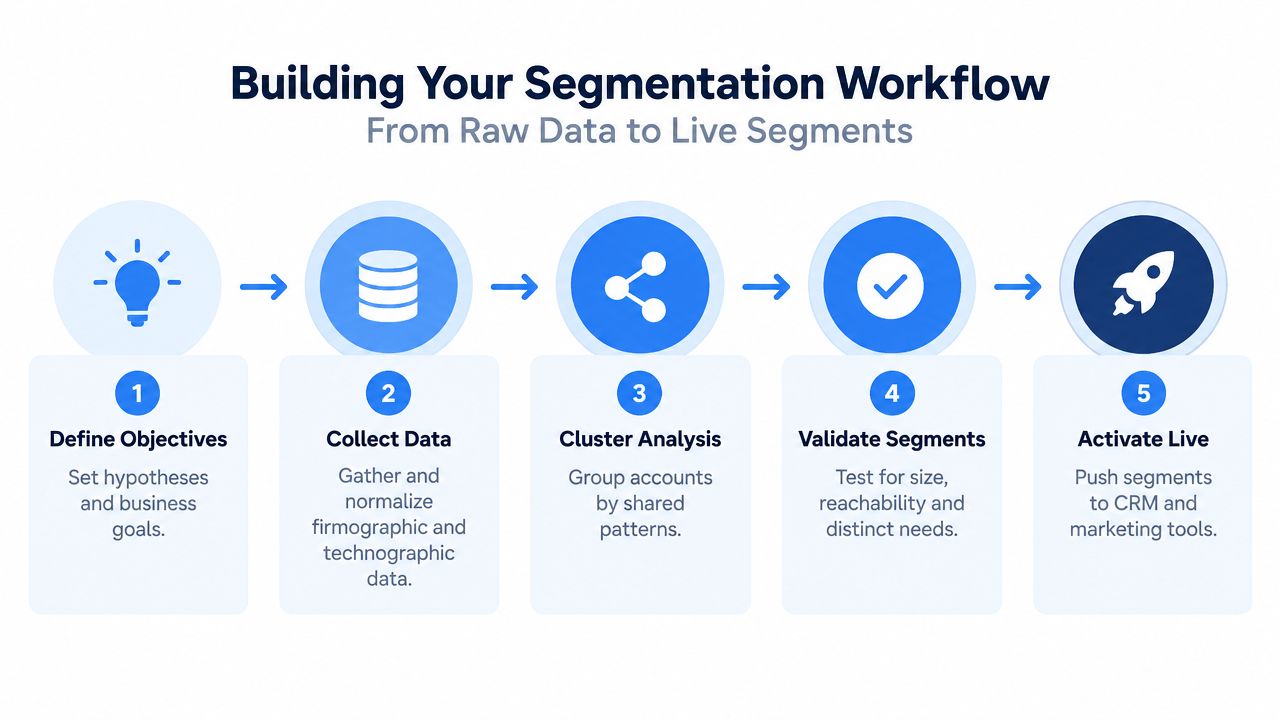
The workflow should begin with a commercial decision, not a data export. Choose the outcome first, such as improving inbound routing, identifying expansion accounts, tailoring onboarding, or selecting a focused account list. Then write a small set of hypotheses that can be tested, for example: companies using a particular technology category and showing engagement around a specific problem may need a different sales motion.
Define the data contract before collecting records
Document the fields required for each hypothesis. Include the source system, accepted values, fallback behavior, refresh rule, and person responsible for resolving conflicts. For example, an account rule might require normalized industry, headcount band, headquarters region, technology category, current opportunity stage, and recent engagement state.
Data ingestion then becomes a controlled process rather than a one-time upload. Resolve company URLs to canonical domains, standardize locations, merge duplicate accounts, and separate current positions from historical positions. For a product-led funnel, enrich an inbound lead from the supplied company URL, match it to an account, and apply the segment rule before sending the record to the CRM.
Company data API workflows can support this pattern when a product needs structured company attributes from a company identifier or domain. The important design choice is not the vendor alone. It's whether the enrichment result enters a repeatable workflow with logs, validation, and clear ownership.
Group accounts by evidence, then write rules
Exploratory clustering can reveal patterns across firmographics, technographics, needs, value, and behavior. But an algorithmic cluster isn't automatically a usable GTM segment. Sales and product teams need to understand why an account belongs, what separates it from neighboring groups, and which action follows.
Turn useful patterns into explicit assignment logic. A rule might prioritize accounts with a defined industry, a headcount range, a technology fit, and a relevant engagement state. Keep exclusions visible. If an account qualifies for multiple groups, use an ordered decision tree or revise the criteria until one primary segment wins.
B2B International's segmentation guidance recommends a manageable range of 3 to 6 segments and says useful segments should be distinctive, recognizable, durable, sizable, and actionable. That range isn't a law, but it reflects an operational constraint. Most GTM teams can support only a limited number of different plays at once.
Assign, activate, and observe
Create one primary segment field at the account level, then add supporting fields for role, use case, buying stage, channel preference, and confidence. Don't overwrite the raw attributes that produced the assignment. Store the rule version and assignment date so engineering and revenue teams can trace changes.
Activation should reach every system that needs the decision:
- CRM routing: Assign account owners, territories, qualification paths, and service levels.
- Marketing orchestration: Change message, offer, proof, suppression, and nurture logic.
- Product experience: Adjust onboarding, prompts, templates, integrations, and education by use case.
- Sales enablement: Give representatives segment-specific discovery questions, objections, and proof points.
- Reporting: Compare pipeline, conversion, cycle progression, adoption, retention, and expansion by segment.
A live workflow also needs monitoring. Flag missing domains, conflicting company sizes, unexplained segment movement, and records that repeatedly fail enrichment. Segmentation becomes useful when the assignment is both automated and reviewable.
How to Validate and Prioritize Segments for Product and GTM
Validation should compare segments against clear tests rather than rewarding the most attractive narrative. Start with distinctiveness. Can a sales representative explain how this group differs from another in needs, technology, buying process, or economics? If the answer is only “these companies are slightly larger,” the distinction may not justify a separate play.
Next test durability. A segment should survive normal changes in job titles, campaigns, and short-term activity. Behavioral signals can change quickly, so use them for stage or priority overlays unless the behavior represents a durable business pattern.
B2B International's research guidance adds a critical clarity rule: segments should be different, big enough, and mutually exclusive, with a company assigned to only one segment. That clean assignment makes performance comparisons possible and prevents two teams from claiming the same account.
Compare priority signals side by side
| Evaluation Criterion | What to Measure | High Priority Signal |
|---|---|---|
| Revenue potential | Contract potential, expansion path, and commercial fit | Strong economics with a credible adoption path |
| Product fit | Required use case, integrations, implementation complexity, and adoption evidence | The product solves a defined problem without excessive customization |
| Win performance | Historical wins, losses, objections, and competitive context | Repeated wins for the same problem and buyer structure |
| Sales efficiency | Stage progression, effort required, and cycle friction | Clear progression with repeatable sales activity |
| Reachability | Valid company identifiers, relevant contacts, channels, and ownership | The buying group can be identified and activated |
| Durability | Stability of the account need and the assignment criteria | The segment remains meaningful as records refresh |
Don't rank a segment on market size alone. A large group with weak product fit may absorb budget without producing useful pipeline, while a smaller group with strong urgency and clear buying roles may deserve the first dedicated play.
Account for committees and channel behavior
The unit of decision-making is often a buying group, not an individual. Recent research reports that 72% of B2B purchases involve complex buying groups, while buyers use an average of ten channels across the journey and expect consistent information across them. Demandbase's State of the B2B Buyer report describes this complexity and the risk created when information changes between channels.
Score the account segment first, then map role influence inside it. Record the initiator, evaluator, economic buyer, procurement contact, user, and coordinator where known. Add channel preference and journey stage as overlays, so the team can distinguish “high-fit account with early research activity” from “high-fit account with an active committee.”
Geography and generation also interact. Forrester's discussion of its 2025 Buyer's Journey Survey reports that 64% of business buyers at manager level and above were Millennials or Gen Z. The same source frames segmentation across persona, function, industry, company size, region, and technology category. Use age-cohort insight cautiously and qualitatively. Region, role, company maturity, and procurement norms may matter more than a broad generational assumption.
For account discovery and list construction, teams can also use a structured B2B company list workflow, provided the resulting records are validated and assigned through the same segment rules as inbound data.
Putting Segmentation Into Action and Keeping It Accurate
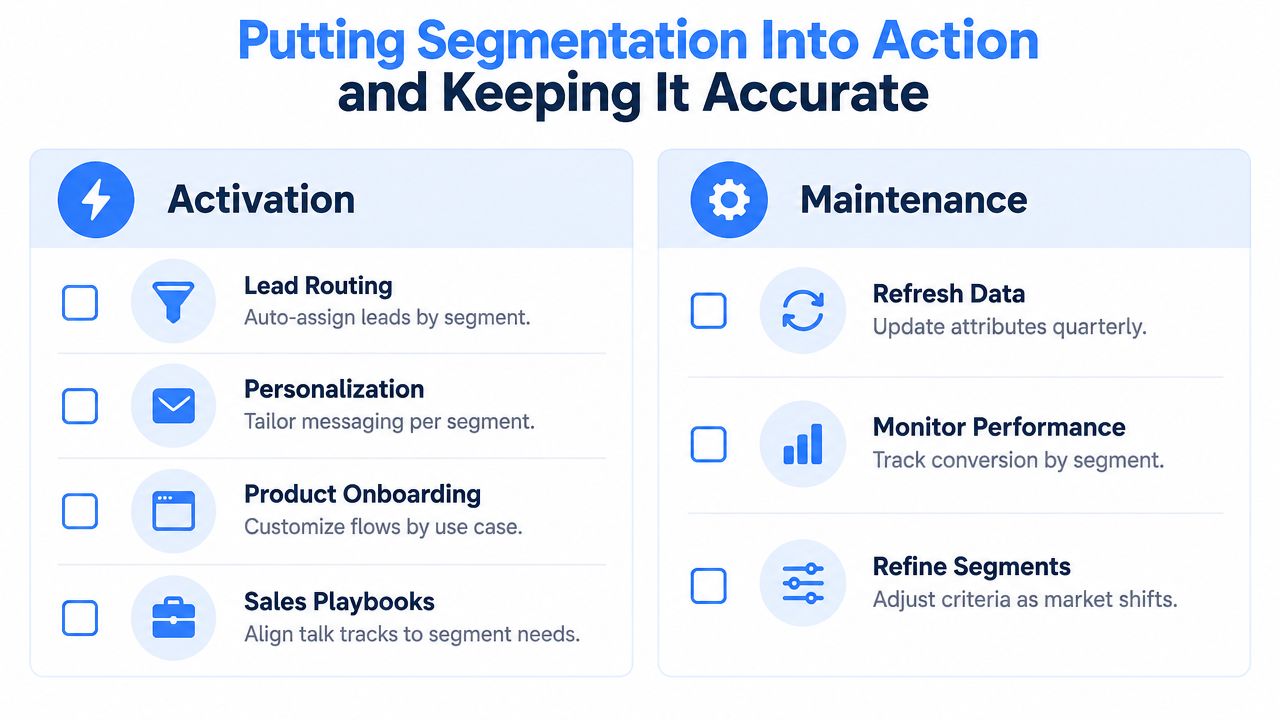
A segment isn't finished when the dashboard shows a label. It becomes real when the label changes what happens next. Lead routing can send a high-fit account to the right representative, marketing can tailor the message and proof, onboarding can emphasize the relevant workflow, and sales playbooks can match discovery to the buying group.
Activate the segment across the customer journey
Make the primary segment available wherever a decision is made. In the CRM, it should influence ownership, qualification, and account planning. In marketing automation, it should control message variations, content paths, suppression, and follow-up. In the product, it can guide onboarding prompts, templates, integrations, and educational content.
Document the segment promise in plain language. A useful playbook states the account pattern, primary problem, buying-group roles, evidence to lead with, objections to expect, product path, and exit criteria. Without that documentation, each team invents its own interpretation and the customer receives inconsistent treatment.
Maintain accuracy through observable controls
Live data fetching helps prevent firmographic and professional records from decaying, but automation still needs governance. Monitor missing values, duplicate accounts, assignment conflicts, sudden segment shifts, engagement anomalies, and records that have exceeded their refresh window. Review the rule when a segment stops producing distinct performance or when the market changes enough to alter the original hypothesis.
Use a practical 30-day launch checklist:
- Days 1 to 7: Define the commercial decision, segment hypotheses, required fields, and ownership.
- Days 8 to 14: Normalize account records, enrich priority accounts, and document assignment rules.
- Days 15 to 21: Validate buying-group coverage, test routing, and create segment-specific messaging and playbooks.
- Days 22 to 30: Activate the segments, inspect data quality, and establish performance reviews and refresh controls.
Keep the model small, auditable, and connected to action. That discipline protects teams from stale assignments, overlapping definitions, and over-segmentation while preserving the flexibility to refine the workflow as evidence changes.
Fetchin offers a professional data API that fetches structured company and profile information from public professional data, including firmographic, role, skills, location, and engagement attributes for segmentation workflows. Visit Fetchin to evaluate how live data extraction can support account enrichment, buying-group analysis, lead routing, and continuously refreshed B2B market segmentation.