The International Labour Organization's 2022 global estimates found that 27.6 million people were in forced labour on any given day, roughly 3.5 people per 1,000 worldwide, according to the ILO global estimates of modern slavery report. That's the number I put in front of any buyer who treats an ethical sourcing policy as a document you publish once and forget.
Most sourcing conversations still run on assertions. A supplier signs a code of conduct, a data vendor points at a privacy page, an audit count goes into a slide deck, and everyone calls it diligence. None of that tells you whether a worker got their recruitment fee back or whether a suppressed person stopped appearing in a data feed. Ethical sourcing standards only mean something when you can name the evidence behind them.
Table of Contents
- Why Ethical Sourcing Standards Matter Now
- Provider Criteria and Verification Steps
- Public Data Is Not Automatically Fair Game
- Privacy Rights and Opt-Out Handling
- Measuring Whether Standards Actually Work
- Confirm the Standard Before You Sign
Why Ethical Sourcing Standards Matter Now
Most forced labour occurs in the private economy, so buyers sit inside the problem, not outside it. The ILO's 2022 estimates cover men, women and children in every region and every economic sector, which kills the comfortable idea that forced labour lives in a handful of high-risk countries. The breakdown matters more than the headline. Private actors imposed forced labour on 17.3 million adults and children in sectors other than commercial sexual exploitation, 6.3 million people experienced forced commercial sexual exploitation, and 3.9 million were subjected to forced labour imposed by the state.
That distribution is why price and quality checks can't establish ethical conduct. A supplier with perfect defect rates and on-time delivery can still be running a recruitment system that traps workers in debt. A data vendor can publish a clean privacy page and still supply fields that should never have entered the workflow. Published policy tells you what a company says it values. Measurable outcomes tell you what changed.
What a standard has to cover
A workable standard assesses recruitment practices, freedom of movement, wage payment, working hours, coercion, subcontracting and worker grievance mechanisms. Those seven areas are the operational scope. Anything narrower is a purchasing policy with a human-rights title.
Demand evidence for each area. Recruitment records should show who paid fees and what workers were told before accepting a job. Wage and hours checks should match payment records and schedules, not manager statements. Grievance mechanisms need a route workers can use without exposing themselves to retaliation. Counting audits tells you activity happened. It does not tell you whether a fee was repaid, a threat stopped, or a repeated violation was corrected.
Risk sits in two places at once: your direct suppliers and the deeper tiers where components, raw materials and labour recruitment happen. A certification badge on a tier-one factory tells you nothing about the labour broker supplying that factory. You need a risk-based model that follows the exposure down the chain. That means asking where recruitment occurs, who controls worker movement, and which subcontractors touch the product before it reaches you.
The legal floor has moved
Ethical sourcing stopped being a voluntary principle in Europe. The European Commission's guidance on the Corporate Sustainability Due Diligence Directive explains that Directive (EU) 2024/1760 was published in the Official Journal on 5 July 2024 and entered into force on 25 July 2024, requiring covered large companies to identify and address actual and potential adverse human-rights and environmental impacts in their own operations, subsidiaries and chains of activities.
The upstream scope reaches design, extraction, sourcing, manufacturing, transport and storage. Companies outside Europe feel it through commercial relationships with covered firms, because those firms push documentation and traceability demands onto everyone they buy from.
A credible standard is a measurable response to a documented problem, not a reputational label you attach to a supplier list.
The same logic applies when the thing you're sourcing is data about people rather than cotton or cobalt. A lawful basis, a defined purpose and a working suppression process matter more than a vendor's broad claim that information is public. Treat every standard as a set of testable controls, then demand proof that those controls operate in practice.
Provider Criteria and Verification Steps
Start with a lookup table, not a questionnaire. Each row names one control, what a well-run provider can produce on request, and the answer that should end the conversation.
Provider assessment criteria and red flags
| Criterion | What good looks like | Red flag |
|---|---|---|
| Lawful basis | Documented purpose and legal basis for each dataset | Claims that public visibility alone permits any use |
| Source provenance | Source type recorded for each field or dataset | No record of where fields came from |
| Data minimization | Only fields tied to the stated purpose are delivered | Full profile dumps delivered by default |
| Transfers outside the EEA | Standard Contractual Clauses in place | No transfer mechanism named |
| Opt-out intake | At least two timestamped request channels | A single email address with no tracking |
| Deletion speed | Suppression applied within 15 business days for California requests | No timeline stated |
| Grievance channel | Local-language access, confidentiality, non-retaliation and a response time | Policy names a channel but reports no cases |
| Outcome tracking | Corrective actions verified and repeat violations measured | Audit count offered as proof of performance |
A provider failing two or more rows shouldn't be trusted on policy statements alone. And a provider can pass every row on paper and still fail in practice, which is why the table is the start of the work rather than the end of it.
Run the verification steps in order
- Request the written sourcing policy. Read it for three things per dataset: the purpose, the legal basis, and the source categories. A policy that describes values without naming a processing purpose isn't a control document. If it reads like marketing, ask for the operational version behind it.
- Ask for a sample provenance record. You want one real record showing source type and collection reason at field level, not a diagram of the architecture. Our explainer on what data provenance means in practice sets out the fields a usable record carries, and it's a fair benchmark to hold any vendor against.
- Submit an opt-out for a test record and time it. Use a record you control, submit through the published channel, and log the timestamp of the request and the confirmation. Compare the elapsed time against the 15-business-day limit. A vendor who can't tell you when the suppression took effect has no working process.
- Confirm the transfer mechanism. Ask which instrument covers data leaving the EEA and get the name in writing. When we transfer data outside the EEA, we use Standard Contractual Clauses approved by the European Commission, and that's the specificity you should expect from anyone else.
- Request a Data Processing Agreement where the provider processes personal data on your behalf. A DPA can be requested by contacting us when we process personal data on the customer's behalf as data controller under GDPR, CCPA or similar laws. Read the subprocessor list and the deletion clauses, not just the signature block.
- Review grievance logs and corrective-action records. You're looking for dated cases with a closure verification, not a paragraph saying complaints are taken seriously. Ask for the last three closed cases with the remedy applied and the date the fix was checked.
- Check whether outcomes get measured at all. Completed audits are an activity count. Ask what changed after the audit, who verified it, and whether the same finding came back the following year.
Where conduct codes fit
Supplier codes of conduct are the backbone of most programmes, and they're worth reading closely rather than filing. Procright's guide on how to score supplier compliance against conduct codes is useful here because it turns clause-level commitments into something you can grade, which is exactly the discipline missing from most supplier assessments. Apply the same scoring approach to a data provider's privacy commitments: clause by clause, evidence attached, gaps written down.
Two practical notes on running this. First, ask for evidence in a format you can store and date, because a screen-share of a dashboard disappears the moment the call ends. Second, separate what the provider asserts from what you tested yourself. The opt-out timing test in step three is the only row where you generate your own evidence, and it's the one vendors least expect.
Buying rule: treat every unverified answer as a fail until dated evidence arrives, and record who at the provider owns each gap.
Public Data Is Not Automatically Fair Game
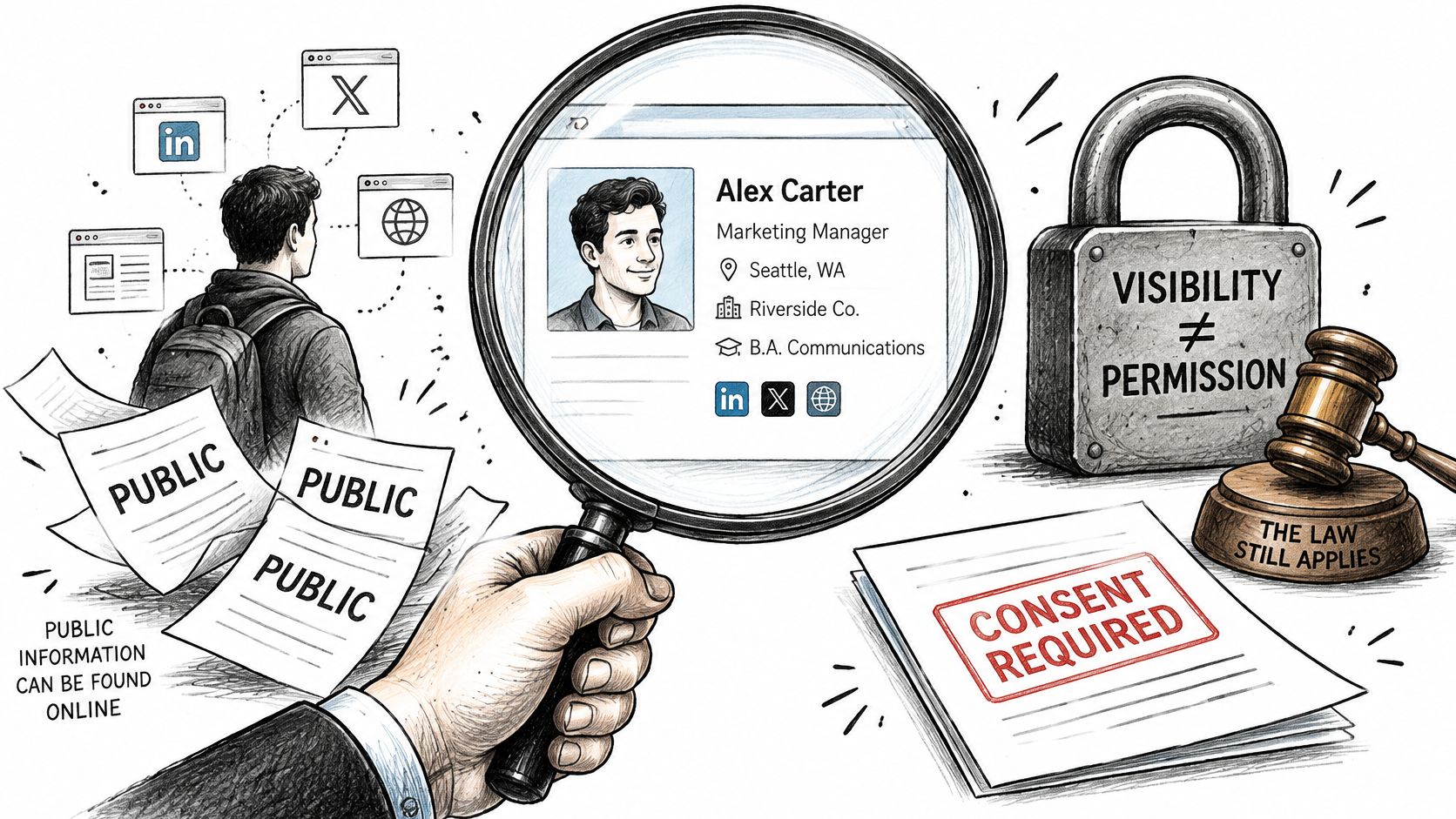
The assumption I hear most often: if a professional profile can be viewed without logging in, the information is free to reuse. It's wrong, and it's the single most expensive mistake in this category.
Public availability and legal permission are two separate questions. A joint statement from the UK Information Commissioner's Office and other regulators states that personal information described as publicly available, publicly accessible or of a public nature on the internet is generally still subject to data protection and privacy laws, and it recommends that organisations be transparent about the measures they use to protect individuals and limit unauthorised collection.
Here's the boundary in visual form.
Why these fields are personal data
Our services process publicly available professional information, which may include names, job titles, company affiliations and professional experience. Every one of those fields identifies a living person or describes their working life. A name plus an employer plus a job history is a detailed personal record, and the fact that someone chose to display it for professional networking doesn't convert it into an unrestricted asset for anyone with an HTTP client.
The European Commission's statement of GDPR principles requires processing to be lawful, fair and transparent, with an identified legal basis, and it says that when data is obtained indirectly the individual should be told where it came from, including whether it came from publicly accessible sources. That creates concrete mechanics: a documented legal basis, a recorded source category, indirect-collection disclosure where required, and a purpose written in language a person can understand.
The test to run on any provider
Pick one specific record from a sample delivery and ask two questions: what's the purpose of processing this record, and what's the legal basis. Then listen to the shape of the answer.
- A real answer names a purpose tied to a product function, names a basis, and points to a source record with a collection date.
- A failing answer says the page was public, so no restriction applies. That's a description of visibility, not a justification for processing.
- A partial answer names a purpose but delivers every available field anyway, which breaks minimization even when the basis is sound. Our note on web data collection practices covers how purpose limitation should shape the field list before extraction runs.
Advisors also conflate two different permissions. Removing identifiers from a record isn't the same as holding a right to license it, and SourceX's guide, data licensing permission explained for advisors, is a clear read on where that confusion causes contractual trouble. Public data is a source you justify, not a permission slip you inherit.
Privacy Rights and Opt-Out Handling
Opt-out handling is where a privacy programme becomes measurable, because the law gives you a clock and a channel count instead of a principle. The California CCPA regulations require businesses that sell personal information to offer at least two designated methods for submitting opt-out requests, including an interactive form reached through a clear and conspicuous opt-out link, and to comply with a request as soon as feasibly possible and no later than 15 business days after receiving it.
The intake design looks like this.
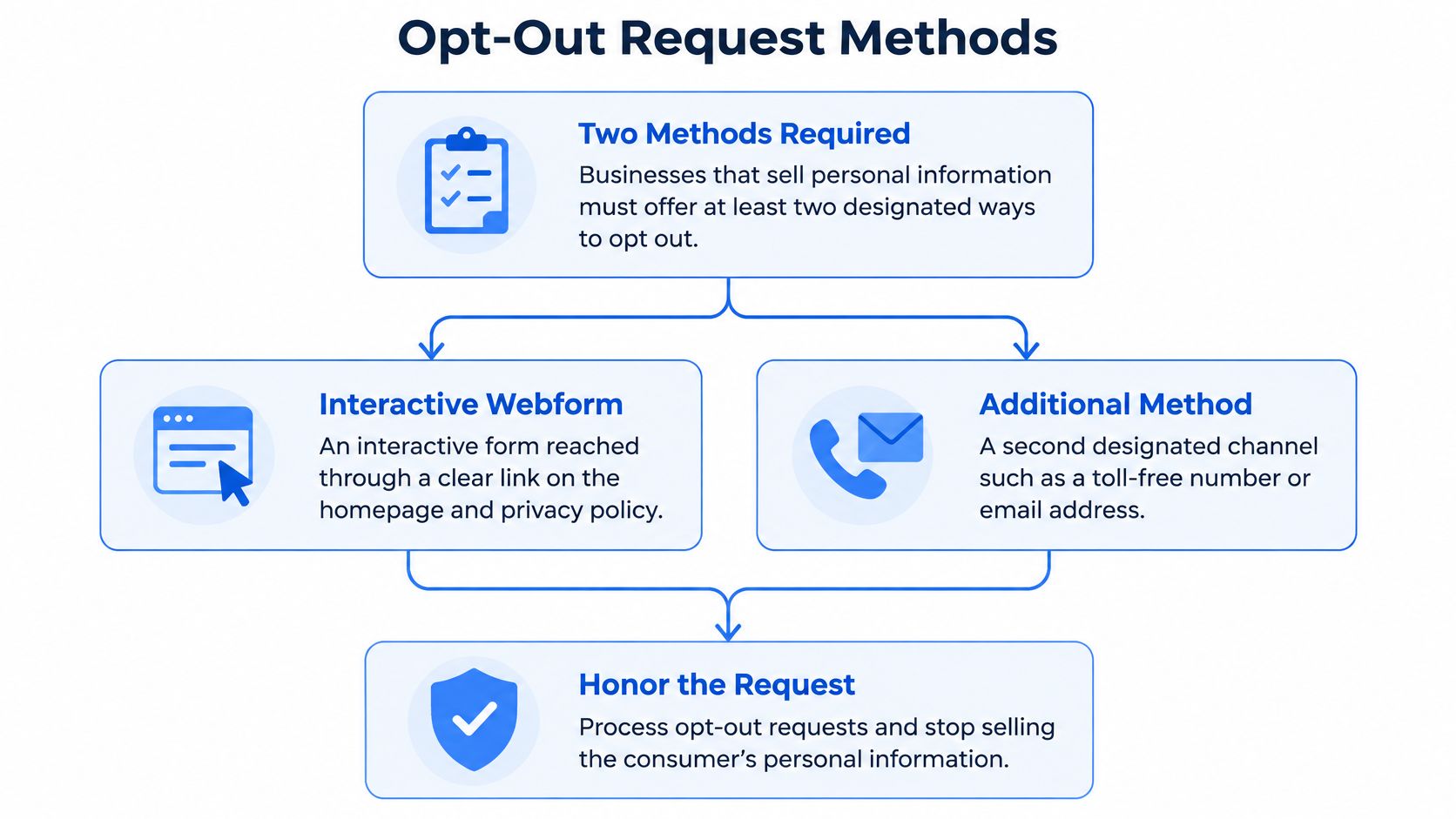
The CCPA statute also gives consumers the right to direct a business that sells or shares their personal information to stop, with a clear and conspicuous website link titled "Do Not Sell or Share My Personal Information" and an explanation of how to submit the request. Note the word sharing. Disclosures to vendors, customers and advertising partners can trigger the right even when no money changes hands.
The workflow, stage by stage
- Receive. The request arrives through one of the designated channels and gets logged with the channel name. Watch for: a shared inbox nobody owns, where requests sit unread over a holiday weekend.
- Timestamp. The clock starts at receipt, not at the moment someone triages the queue. Watch for: systems that record the processing date instead of the arrival date, resetting the deadline.
- Confirm the requester. Match the identity to the record without demanding so much proof that the right becomes unusable. Watch for: verification loops that stall a legitimate request indefinitely.
- Propagate. Push the suppression instruction to every system that produces, stores or serves the data, including caches, exports and downstream customer deliveries. Watch for: the suppression list living in a spreadsheet that the extraction pipeline never reads.
- Confirm completion inside the deadline. Close the case with evidence that the record stopped flowing. Watch for: a confirmation email sent while the record is still being returned by the API.
Stage four is where most providers fail. A suppressed person reappears in a later extraction run because the pipeline fetches live page state and nothing checks the suppression list before returning the result. The fix is a pre-response filter plus a re-check on every scheduled refresh, not a one-time delete.
Structured JSON delivery raises the stakes here. When a record arrives in a clean schema, your customer can push it into a CRM, an ad audience or a partner feed in minutes, so a single missed suppression multiplies across systems you don't control. Our comparison of CCPA and GDPR compliance obligations sets out how the two regimes differ on intake and response, and the GDPR side adds access and objection rights that a provider must answer within the defined period.
This walkthrough covers the request lifecycle in practice.
Run the test yourself: submit an opt-out for a record you control, log the timestamp, then query that record again after the confirmation arrives. If it still comes back, the provider has a policy and not a control.
Measuring Whether Standards Actually Work
Separate inputs from outcomes before you accept any evidence. Policy adoption, supplier training and audit completion are inputs: they show controls exist. Worker-reported safety, wage progression, recruitment-fee repayment and remediation completion are outcomes: they show conditions changed. A provider quoting audit volume is quoting effort.
The measurement gap is wide. In recent Canadian government reporting on forced and child labour in supply chains, 75.9% of reporting organizations said they review or audit policies, while only 37.3% tracked performance indicators such as grievance cases, awareness or resolved incidents, and 36.5% worked with suppliers to measure whether corrective actions were effective, according to the second report on forced labour and child labour in supply chains. Policy review is normal. Outcome measurement is rare.
The cycle that produces real evidence
The OECD's responsible business conduct framework sets out six connected capabilities: embed responsible business conduct in policies and management systems, identify and assess adverse impacts, prevent or mitigate them, track implementation and outcomes, communicate how impacts are addressed, and provide or cooperate in remediation. Each step feeds the next, and skipping tracking breaks the loop because nobody tests whether mitigation worked.
Risk scoring should prioritise severity and likelihood, not supplier size or audit status. Your scarce investigation hours belong where the harm would be worst, which is rarely the supplier with the biggest contract.
Inputs versus outcomes to track
| Measure type | Example | What it proves |
|---|---|---|
| Input | Policy adoption, supplier training, audit completion | That controls exist on paper |
| Outcome | Worker-reported safety, wage progression, recruitment-fee repayment | That conditions actually changed |
| Outcome | Remediation completion and repeat-violation rate | That corrective actions held |
| Process | Grievance cases received, resolved, and time to response | That workers can report problems safely |
| Process | Opt-out requests completed within 15 business days | That privacy controls work in practice |
A defensible programme keeps dated evidence, management decisions, supplier communications, worker input and closure verification. Build the data model to match: each supplier linked to country, sector, product, facility, ownership, grievance cases, corrective actions and evidence dates.
More audits don't mean more ethical sourcing if findings never get corrected and workers can't safely report problems.
Validate the grievance channel itself, not just its existence: local-language access, confidentiality, non-retaliation, response time and remedy rate. A channel with zero cases across thousands of workers isn't a sign of harmony.
Confirm the Standard Before You Sign
Sign only when the provider meets every criterion in the assessment table, has produced dated evidence for each verification step, and shows outcome measures rather than audit counts alone. That's the whole decision rule. Partial compliance is a negotiation, not an approval.
Handle gaps in three moves:
- Request each missing item in writing with a named owner and a response date. Vague promises to improve documentation don't belong in an evidence file.
- Pause data use for any dataset where provenance or purpose stays unclear. You can't retroactively justify processing you never documented, and continued use weakens your position.
- Treat missing evidence on opt-out handling or transfer mechanisms as disqualifying. These affect individuals directly, so they aren't items to remediate after go-live.
Ask for a written commitment on data rights response times and compare it against the California deadline and the GDPR response period. We respond to data rights requests within 30 days, and we protect data with encryption in transit (TLS), secure API key management, access controls and regular security assessments. Hold every vendor to that level of specificity, in writing, before the contract is signed.
Then keep the file alive. Store the evidence with dates, schedule a review of that file in 90 days, and repeat the assessment whenever the provider's privacy policy changes. We post material changes to our privacy policy on our website with a revised effective date, and a revised date on any vendor's policy is your trigger to re-run the checks rather than assume nothing moved.
We built Fetchin as a real-time B2B data API that turns professional profile and company URLs into structured JSON from publicly available information, with documented sourcing, Standard Contractual Clauses for transfers outside the EEA, and a DPA available on request. If you're building enrichment, lead routing or talent intelligence features and need a provider who can answer the provenance and opt-out questions in this assessment with evidence rather than assurances, run your own test record through our API and check the answers yourself at Fetchin.