A user enters a professional profile URL into your SaaS product and expects the dashboard to fill itself instantly. Instead, the company is wrong, the job title is outdated, and the enrichment workflow assigns the record to the wrong account. The interface looks polished, but the underlying data has already undermined the product experience.
That problem raises a practical question for every data-driven SaaS team: what is profile data, and how should it be modeled, fetched, governed, and refreshed? The answer goes beyond names and job titles. Profile data is a structured, multivariate representation of a person or entity, and in a modern B2B product it acts as a live infrastructure layer for enrichment, identity resolution, routing, personalization, and decision support.
Table of Contents
- The Role of Profile Data in Modern SaaS
- Core Attributes and Schema Constraints
- The Time Dimension of Professional Records
- Fetching Live Data via B2B APIs
- Privacy and Ethical Sourcing Considerations
- Product Use Cases and Integration Examples
- Building a Reliable Data Infrastructure
The Role of Profile Data in Modern SaaS
A sales platform receives a professional profile URL and must decide which account owns the contact before routing a lead. The URL identifies a starting point, not a complete record. Your application may need to fetch the current employer, role, location, and other attributes, then apply matching and access rules before those fields reach an automation workflow.
Profile data becomes useful when software can act on a structured representation. A sales platform can route a lead by territory. A recruiting product can compare a candidate's experience with role requirements. An onboarding system can adjust the first experience to a user's function. An identity-resolution service can connect records for the same person or company using several signals instead of one name or email field.
Research on profile data describes profiles as structured sets of correlated information rather than raw records. In practice, that means evaluating field completeness, uniqueness, value ranges, distributions, relationships, and freshness. A profile is a normalized interpretation of multiple fields and quality signals, assembled from one or more sources.
Practical rule: Treat every profile field as an input to a product decision, not as decoration for a record page.
Caching is appropriate for low-risk display, such as showing a previously observed biography. It is a weaker choice when a field drives automation. A stale employer can send a sales sequence to the wrong account. An outdated role can distort lead scoring. A former company can break account matching and create duplicate customer records. The right design fetches live data when accuracy affects an external action, while retaining controlled snapshots where speed and cost matter more.
Profile data now operates at a scale that makes manual review impractical. SaaS teams need explicit schemas, freshness rules, source provenance, and an API layer that retrieves only the fields a product feature requires. Real-time fetching improves accuracy, but it also introduces latency, provider limits, error handling, and compliance checks that the integration must manage.
The strongest design separates three concerns:
- Identity: Who or what does this record represent?
- Attributes: Which facts and signals describe it?
- Policy: Which consumers may access each field, for what purpose, and for how long?
Policy belongs in the data model, not only in application documentation. A field may be public to one service, restricted for another use, or available only within a specific organization. Profile data can describe a person or entity while remaining dynamic and policy-bound. Your product should record those boundaries alongside the values, so downstream workflows do not treat every retrieved attribute as universally available.
Core Attributes and Schema Constraints
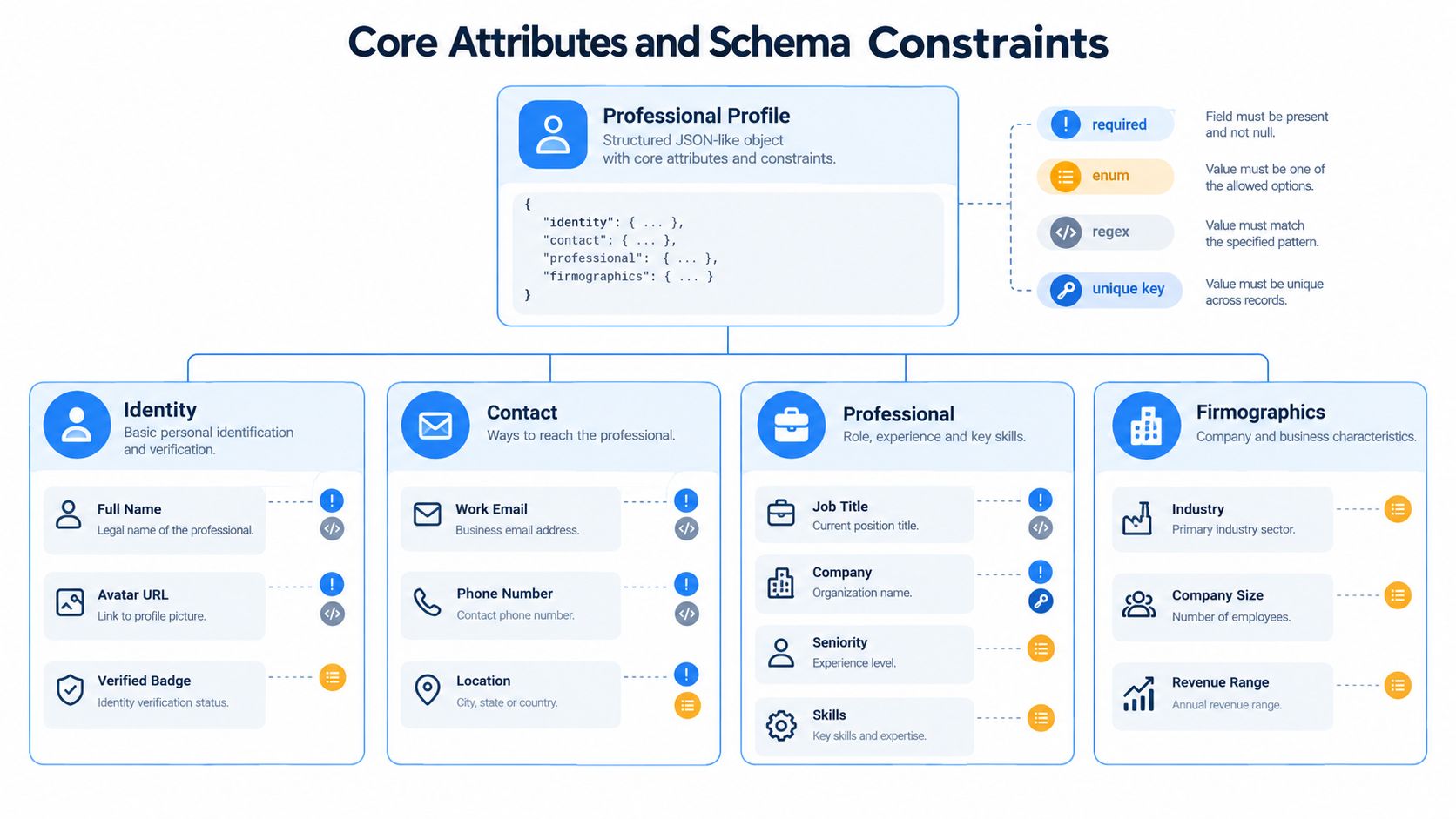
A useful professional profile schema groups related fields instead of treating every attribute as an independent string. A typical model can include identity, contact context, professional history, education, skills, affiliations, company relationships, and behavioral or engagement attributes. The exact fields should follow the feature you're building.
For example, a talent intelligence product may need role history, education, skills, certifications, and location. A sales routing product may prioritize current employer, seniority, industry, company size, and verified domain. A personalization system may need role and account context, but not a complete employment history.
Model fields around product decisions
Start with a stable identifier and distinguish it from display attributes. A person's name can change, be formatted differently, or appear in multiple forms. An immutable provider identifier, a canonical profile URL, or a carefully governed internal key can support matching more reliably.
Then define field semantics:
- Identity fields describe the subject, such as a name, avatar reference, or verified status.
- Contact fields capture permitted business contact context, such as work email, phone, or professional location.
- Professional fields represent title, employer, seniority, skills, education, and role history.
- Firmographic fields describe the associated organization, including industry, headcount, headquarters, founding year, and domain.
- Behavioral fields represent activity or engagement, but they need separate retention and access rules because they can be more sensitive than descriptive fields.
Use typed values wherever possible. A date should be a date, not an arbitrary sentence. A seniority value should use a controlled vocabulary. A location should separate country, region, and city when the use case requires that distinction. A skill list should avoid treating “machine learning,” “ML,” and “machine-learning” as unrelated values.
Constraints create an integration contract
The W3C explanation of profiles and constraints defines a data profile as a named set of constraints on one or more base specifications. In implementation terms, that means your product narrows a broad schema by fixing datatypes, vocabularies, value domains, and validation rules for a particular function.
A profile contract might require an organization identifier, restrict seniority to an approved enum, validate URLs with a pattern, and define whether an absent value means unknown, not applicable, or intentionally withheld. Downstream services can then validate against your smaller contract instead of interpreting a broad and ambiguous source specification.
For practical schema design, document at least these rules:
- Required versus optional: Make only feature-critical fields mandatory. A missing biography shouldn't prevent a lead record from loading.
- Enums and normalization: Define accepted values for seniority, country codes, employment type, and industry.
- Provenance: Store where a value came from and when it was retrieved.
- Confidence: Keep confidence separate from the value so uncertain enrichment doesn't look authoritative.
- Visibility: Mark fields as public, internal, restricted, or unavailable to a given consumer.
- Uniqueness: Specify which keys identify a person, company, employment event, or source observation.
Teams building personality or behavioral extensions can also review Synopsix personality profile examples for ideas about separating descriptive traits from the underlying identity record. The architectural lesson is to keep derived interpretations distinct from sourced attributes, so a model-generated classification doesn't overwrite an observed professional field.
Firmographic relationships deserve their own model rather than being flattened into a person record. A person can hold multiple roles over time, and a company can have several domains, offices, or organizational relationships. A practical reference for separating organization-level attributes from individual records is this guide to firmographic data. Design the relationship explicitly, then let product features decide which current or historical association they need.
The Time Dimension of Professional Records
Professional records are observations, not permanent facts. A person can change roles, update a description, add a skill, remove an affiliation, or correct an earlier entry. The update can happen long after the world event, which means a system that only records ingestion time may misunderstand when the underlying fact changed.
A 2026 NBER study using monthly vintages from 2020 to 2026 found that 19.7% of established U.S. professional-network users retroactively edited the title or description of a job they had already left as summarized in this data profiling reference. The important architectural point isn't only the percentage. It's that a profile can change after the employment event, so a historical snapshot may differ from the current public state even when the underlying event is already in the past.
Why periodic indexing creates product debt
Suppose your application stores a title from a periodic index and uses it for account assignment. The person later edits that title, but your record remains unchanged until the next indexing cycle. During that interval, every dependent workflow may act on an obsolete value.
The resulting errors spread through connected systems:
- A matching service may attach a person to a former employer.
- A recruiting workflow may miss a newly added skill.
- A sales system may route a decision-maker to the wrong segment.
- A personalization rule may show content for a previous role.
- An analytics model may interpret a correction as a new career event.
Snapshots still have a role. They support historical analysis, audit trails, reproducible reports, and cost-controlled batch operations. They shouldn't be treated as the current truth when the product promises current enrichment.
A profile record needs both a value and a time model. Store when you observed it, when the source says it applies, and whether your application has verified it recently.
Choose freshness by consequence
Not every feature needs a live request. A recruiting search index may tolerate background refreshes if the interface clearly presents results as indexed. A lead-enrichment action performed immediately before outreach needs a stronger freshness guarantee. An identity-resolution decision that merges customer records deserves even more cautious handling, including conflict review and reversible updates.
A sensible policy assigns freshness requirements to features rather than to the entire database:
- Display-only fields: Use stored observations with visible retrieval timestamps.
- Workflow triggers: Refresh before an automated action when stale data could cause harm.
- Identity decisions: Require stronger matching evidence and preserve the previous state.
- Historical reporting: Keep immutable observations instead of replacing them with the latest value.
Time-series architecture offers useful patterns for preserving observations, comparing vintages, and separating current state from history. The Snowflake time series outcomes resource from Faberwork LLC provides relevant context for teams designing that kind of analytical layer.
Fetching Live Data via B2B APIs
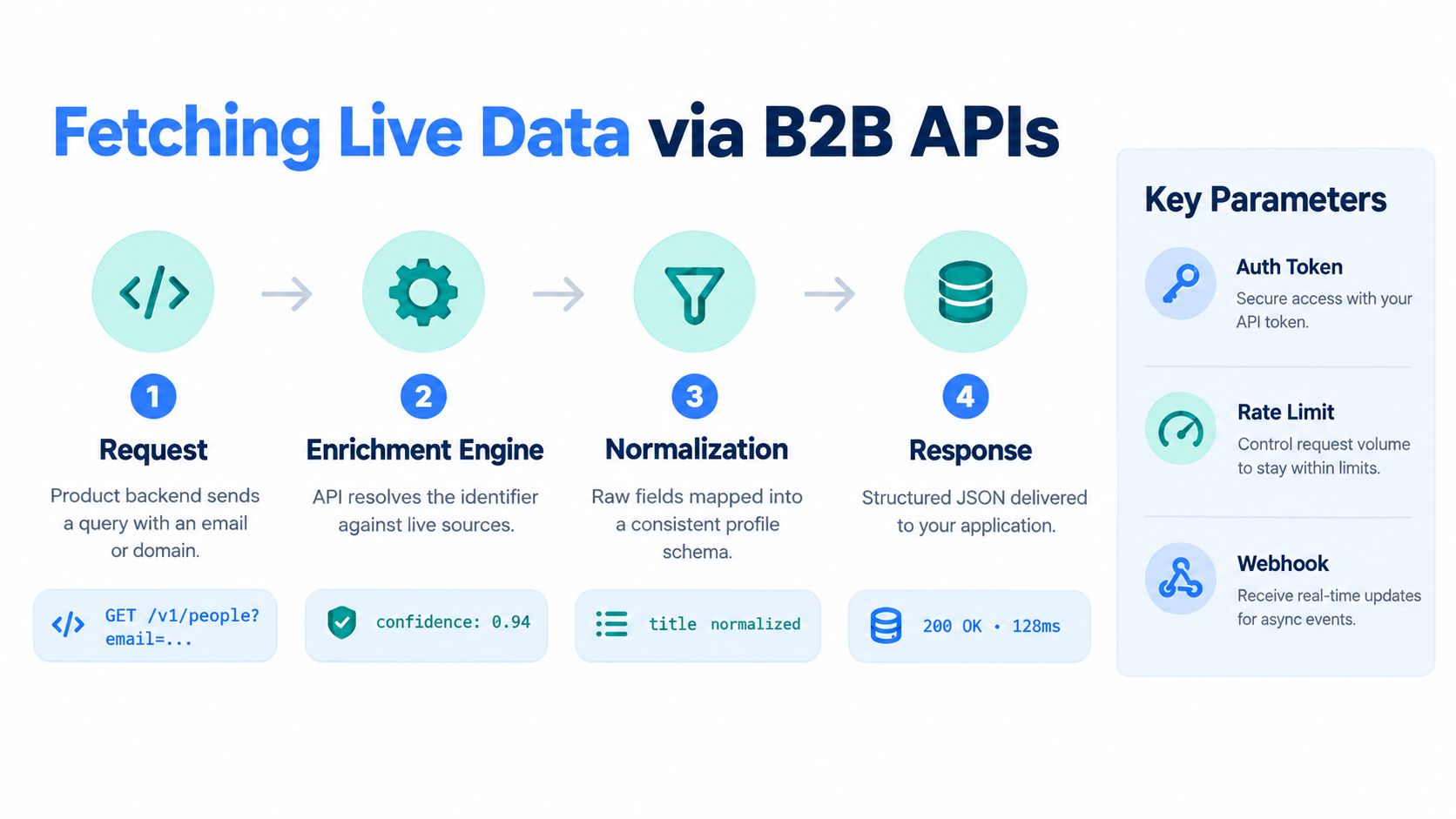
Live profile data is a delivery problem as much as a data problem. A SaaS backend sends a stable identifier to a B2B API, the provider fetches permitted professional or company information, and the response returns structured JSON for the current request. Treat the result as a time-bound, policy-bound observation rather than a permanent biographical record. Your application should request data when accuracy matters and retain only what its feature and sourcing rules allow.
Choose a delivery model
Synchronous delivery fits an interactive screen or workflow where the result determines the next user action. Set a timeout shorter than the page's tolerance, return a clear loading or unavailable state, and keep unrelated application work out of the request path. A timeout should produce a controlled fallback, not an empty record that looks authoritative.
Asynchronous delivery fits batch enrichment, high-latency sources, imports, and workflows that can finish after the user leaves the page. Queue the job, expose its status, and accept the result through a webhook or polling endpoint. Store the provider request ID so support staff can trace a delayed response without exposing the returned profile to the browser.
A practical live-fetch sequence looks like this:
- Validate the identifier: Check the expected profile or company URL format before consuming an API request.
- Authenticate server-side: Keep credentials in the backend and send only the fields required by the feature.
- Set an outcome contract: Distinguish a successful match from not found, invalid input, timeout, authorization failure, and temporary provider failure.
- Return provenance with the result: Include retrieval time, source reference, confidence where supplied, and the request outcome.
- Apply the result deliberately: A failed lookup should not overwrite a previously usable observation or trigger an automated action.
For endpoint details and field coverage, see this overview of the people data API. When evaluating API integration platforms for your stack, compare timeout controls, retries, webhooks, observability, schema mapping, and replay behavior. A lower request price does not offset an integration that cannot explain missing fields or recover a partial job.
Rate limits and quotas constrain different parts of the fetcher. A documented API management explanation describes a rate limit as throughput, such as requests per second, while a quota sets the larger usage allowance for a billing or allocation period. The queue must enforce both: one controls request speed, and the other controls total consumption.
A documented credit model allows 5 requests per second and includes 1,000 free credits at sign-up, with credits separate from the per-second limit according to this rate-limit reference. Token-bucket or leaky-bucket scheduling smooths bursts, while a separate budget check prevents workers from exhausting the account allocation.
Retry only transient failures, using bounded backoff and idempotency keys where the provider supports them. Do not retry malformed identifiers or authorization errors. Log request IDs and sanitized error categories, not sensitive profile payloads, so operators can diagnose delivery failures without creating another copy of personal data.
Privacy and Ethical Sourcing Considerations
Public availability doesn't remove privacy obligations. The relevant question isn't only whether a field can be viewed. It's whether the information relates to an identified or identifiable person, how your product uses it, who receives it, and how long you retain it.
The ICO guidance on personal data under the GDPR explains that personal data includes information relating to an identified or identifiable person, including online identifiers and factors connected to identity. De-identified or pseudonymised information can still remain personal data when re-identification is possible.
That definition reaches beyond names, titles, and email addresses. A behavioral signal, inferred attribute, linked record, or professional URL may become regulated profile data when your system can connect it to a person or use it to evaluate them.
Put purpose before collection
Define the product function before selecting fields. If a routing feature only needs current role, company, and professional location, collecting unrelated behavioral history creates unnecessary exposure. If a candidate search needs skills and employment history, it doesn't automatically need contact details.
A field-level policy should answer four questions:
- Purpose: What product decision does this field support?
- Legal basis: Why is the processing permitted in the relevant jurisdiction?
- Retention: When should the value or observation be deleted?
- Access: Which service, employee, customer, or integration may read it?
Guidance for enrichment workflows emphasizes intended purpose, legal basis, retention, access controls, and user expectations. It also recommends collecting only the public professional fields required for the feature, such as current role, company, professional location, biography, or business contact context in this privacy guidance for enrichment workflows.
Make policy executable
Don't leave compliance in a document that engineers must remember. Add visibility and purpose metadata to the schema. A field can be public, tenant-visible, internal-only, restricted, or withheld. The same value may be acceptable for an internal match but inappropriate for a customer-facing export.
Your data provenance design should record the source, retrieval time, transformation history, and access decision for important fields. That helps support correction requests, investigate inaccurate enrichment, and explain why a workflow made a decision.
Use encryption, tenant isolation, role-based access, audit logs, deletion workflows, and redaction in observability systems. Don't send full profile payloads to application logs or analytics tools by default. Ethical sourcing also means honoring source restrictions, avoiding unnecessary collection, and giving customers a clear explanation of what the product retrieves and why.
Product Use Cases and Integration Examples
Profile data becomes valuable when the schema maps directly to a product action. The same person record can support several features, but each feature should request a different subset of fields and apply its own confidence, freshness, and access rules.
A sales intelligence product may use current employer, title, seniority, industry, and company relationship to route or prioritize an account. A talent platform may focus on skills, education, role history, location, and affiliations. An identity-resolution service may use normalized names, employer relationships, professional URLs, and other matching signals while preserving uncertainty instead of forcing a false match.
| Data Attribute | API Endpoint Focus | Primary SaaS Use Case |
|---|---|---|
| Current role and seniority | Professional profile endpoint | Lead routing, account ownership, personalized onboarding |
| Employer and company relationship | Person-to-company resolution endpoint | Identity resolution, account enrichment, duplicate detection |
| Industry, headcount, headquarters, and domain | Company endpoint | Segmentation, territory planning, firmographic filters |
| Education, skills, and certifications | Professional profile endpoint | Talent search, candidate matching, learning recommendations |
| Professional location | Profile and company context endpoints | Regional routing, localization, recruiting filters |
| Posts, comments, and reactions | Engagement endpoints | Topic monitoring, relationship intelligence, content workflows |
| Retrieval time and confidence | Metadata on every endpoint response | Freshness rules, review queues, auditability |
A single professional data API can reduce the number of integrations your backend has to maintain, but consolidation isn't automatically better. Verify that the provider exposes the endpoint granularity, field provenance, error semantics, and usage controls your product needs. A broad response with inconsistent values can create more engineering work than a smaller, well-defined response.
Design endpoint behavior around the user journey
For a user-facing enrichment form, return the minimum useful profile quickly and let secondary fields load asynchronously. For a batch import, queue requests, deduplicate identifiers before dispatch, and persist partial results. For automated outreach, fetch close to the decision point and require a policy check before using contact or behavioral attributes.
Keep source values separate from normalized values. Store the original title alongside your standardized seniority classification. Preserve the observed employer relationship alongside the internal account ID. This allows you to improve normalization without pretending that an inferred category was directly observed.
Engagement data deserves special care. Posts, comments, and reactions can reveal interests or activity patterns, but their product value depends heavily on purpose and permission. Use them for a clearly defined workflow, restrict access, and avoid turning weak signals into definitive judgments about a person.
A good integration doesn't just return more fields. It returns the right fields, in a stable contract, with enough metadata for your application to decide whether to display, match, route, refresh, or reject the result.
Building a Reliable Data Infrastructure
Profile data should be treated as a live infrastructure layer, not as a static database purchase. The distinction changes how your team designs schemas, manages freshness, budgets API usage, and handles privacy.
A reliable implementation has a few essential properties:
- Explicit contracts: Every important field has a datatype, meaning, visibility rule, and validation behavior.
- Time awareness: Your system distinguishes current state, historical observations, retrieval time, and source updates.
- Purpose limitation: The application requests and retains only the attributes needed for a defined feature.
- Controlled fetching: Queues enforce both throughput limits and account quotas, while retries avoid duplicate work.
- Auditable decisions: Provenance, confidence, transformations, and access events remain available for review.
- Reversible matching: Identity resolution can be corrected without destroying the original evidence.
Start by auditing one workflow rather than rebuilding the entire data platform. Choose the feature most affected by stale or incomplete records, document its required fields, define its freshness policy, and measure failure categories. Then test synchronous and asynchronous delivery against the actual user journey.
Architecture decision: Fetch live data where freshness changes the decision. Keep snapshots where history, analytics, or reproducibility matters.
A professional data API such as Fetchin offers URL-based profile and company retrieval, structured JSON responses, and options for synchronous or asynchronous delivery. Visit Fetchin to evaluate whether its approach fits your enrichment, identity-resolution, or SaaS personalization workflow.