
How do you ship improvements without breaking the customers who depend on your current response schema? Adding /v2 to a URL doesn't answer the difficult parts: which behavior stays stable, who chooses the upgrade date, and what happens to requests already in flight?
API versioning is contract management, not just a naming convention. Customers depend on field types, nullability, pagination, authentication, error responses, and billing behavior. A release can preserve every property name and still break an integration by changing what a successful response means.
The stakes rise when your customers build SaaS products on professional profiles and company records. A signup qualification flow needs predictable matching. A recruiting platform needs incomplete records it can parse safely. An AI agent needs tool responses that don't unexpectedly change shape or consume credits differently.
Postman's 2025 State of the API survey found that 60% of organizations version their APIs, while only 26% use semantic versioning. Publishing a version identifier is common, but customers still need an explicit explanation of compatibility risk.
A useful versioning policy tells customers what won't change, not merely what the latest release contains.
These API versioning best practices focus on that guarantee: explicit selection, careful change classification, additive evolution, account pinning, managed deprecation, consistent delivery, executable contracts, and predictable operating costs.
Table of Contents
- 1. Put an Explicit Version in Every Request Path or Header
- 2. Classify Changes as Breaking or Non-Breaking Before Release
- 3. Design for Additive, Backward-Compatible Evolution
- 4. Use Date-Based Versions to Pin Behavior Per Account
- 5. Announce Deprecations With Standard Headers and Sunset Dates
- 6. Version Asynchronous and Synchronous Delivery Paths Together
- 7. Publish a Machine-Readable Contract and Verify It With Consumer-Driven Tests
- 8. Give Customers Control Over Upgrades, Rate Limits, and Credit Impact
- Comparing the 8 API versioning practices at a glance
- Start Versioning Like a Provider Your Customers Can Trust
1. Put an Explicit Version in Every Request Path or Header
Make contract selection visible on every request. A customer calling /v1/profile should receive the behavior associated with that contract, even while your team develops a replacement.
The Microsoft REST API Guidelines support explicit version selection through a URL path or an api-version query parameter. Header-based selection is another practical option: GitHub uses X-GitHub-Api-Version, while an API you control might use X-API-Version.
The routing model should be straightforward enough to explain in a support ticket.
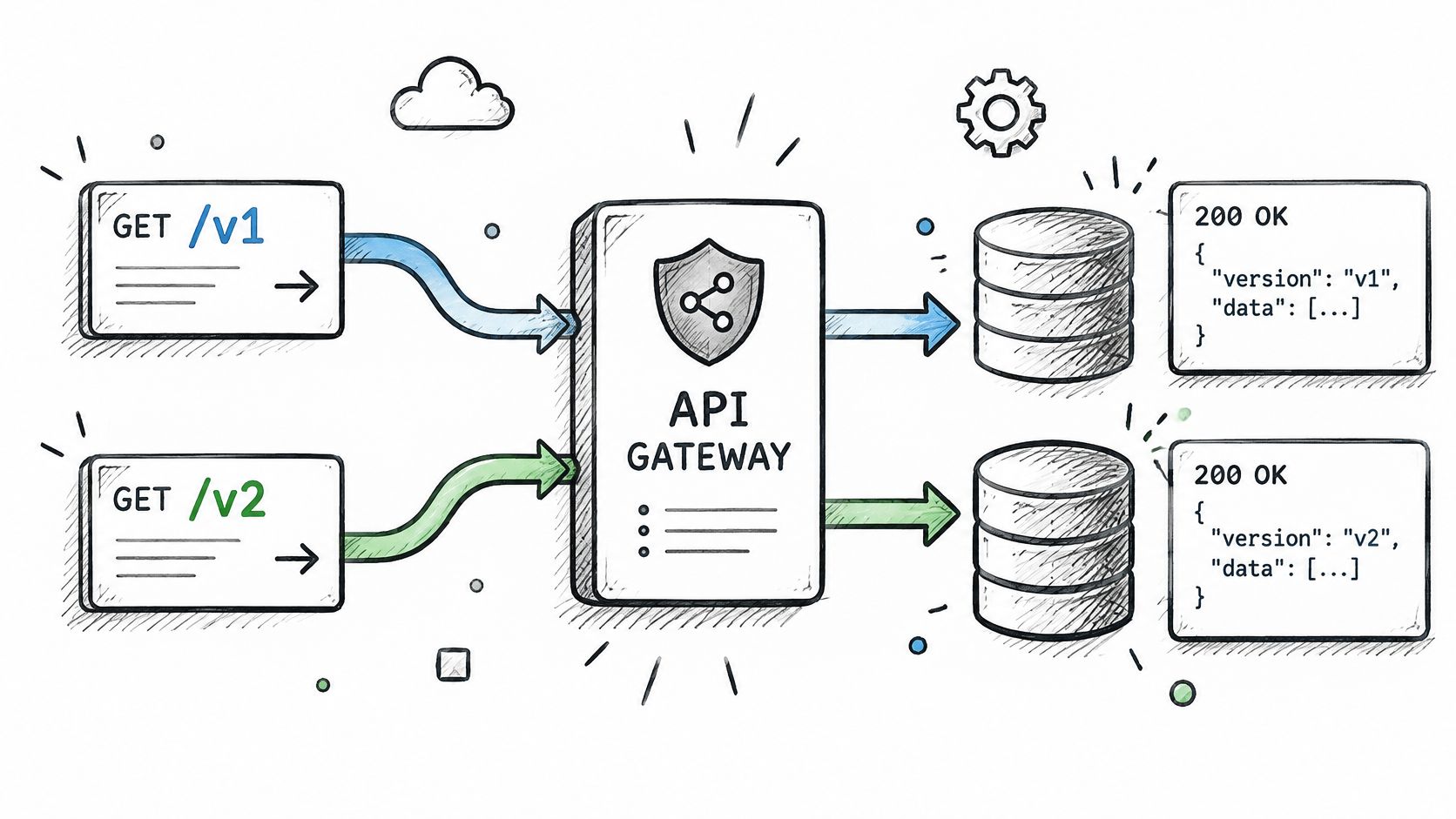
Choose Visibility Over Cleverness
Path versions are easy to inspect in access logs and reproduce with command-line tools. Header versions keep resource URLs stable, but your gateway, cache configuration, and debugging tools must preserve the selected header. Media-type versioning through Accept works too, although it introduces negotiation complexity that many B2B integrations don't need.
Say a SaaS signup flow fetches a professional profile to determine someone's current employer. An explicit contract lets the provider improve matching for new integrations without changing the behavior of that existing signup flow.
- Use one selection policy. Apply it consistently to profile, company, posts, and engagement endpoints.
- Log the resolved version. Record the contract served, not just the value the client submitted.
- Define missing-version behavior. Reject ambiguous requests or use a documented account pin. Don't move established customers to the latest release without notice.
If you accept multiple selectors, define precedence and reject conflicting values. Debugging a request whose path and header select different contracts is avoidable work.
2. Classify Changes as Breaking or Non-Breaking Before Release
Adding headcount_range beside an unchanged headcount field is different from replacing a numeric headcount with an object. The former can preserve existing consumers; the latter breaks code that expects a number.
Classify the change before implementation begins. Otherwise, release pressure turns compatibility review into an argument about whether customers will notice.
A workable definition of breaking covers more than syntax. Altered behavior and changes to error or fault contracts count too, because compatible JSON doesn't guarantee compatible operation. A client that handles your response body perfectly can still break when a documented error code disappears or a retry path starts returning different shapes.
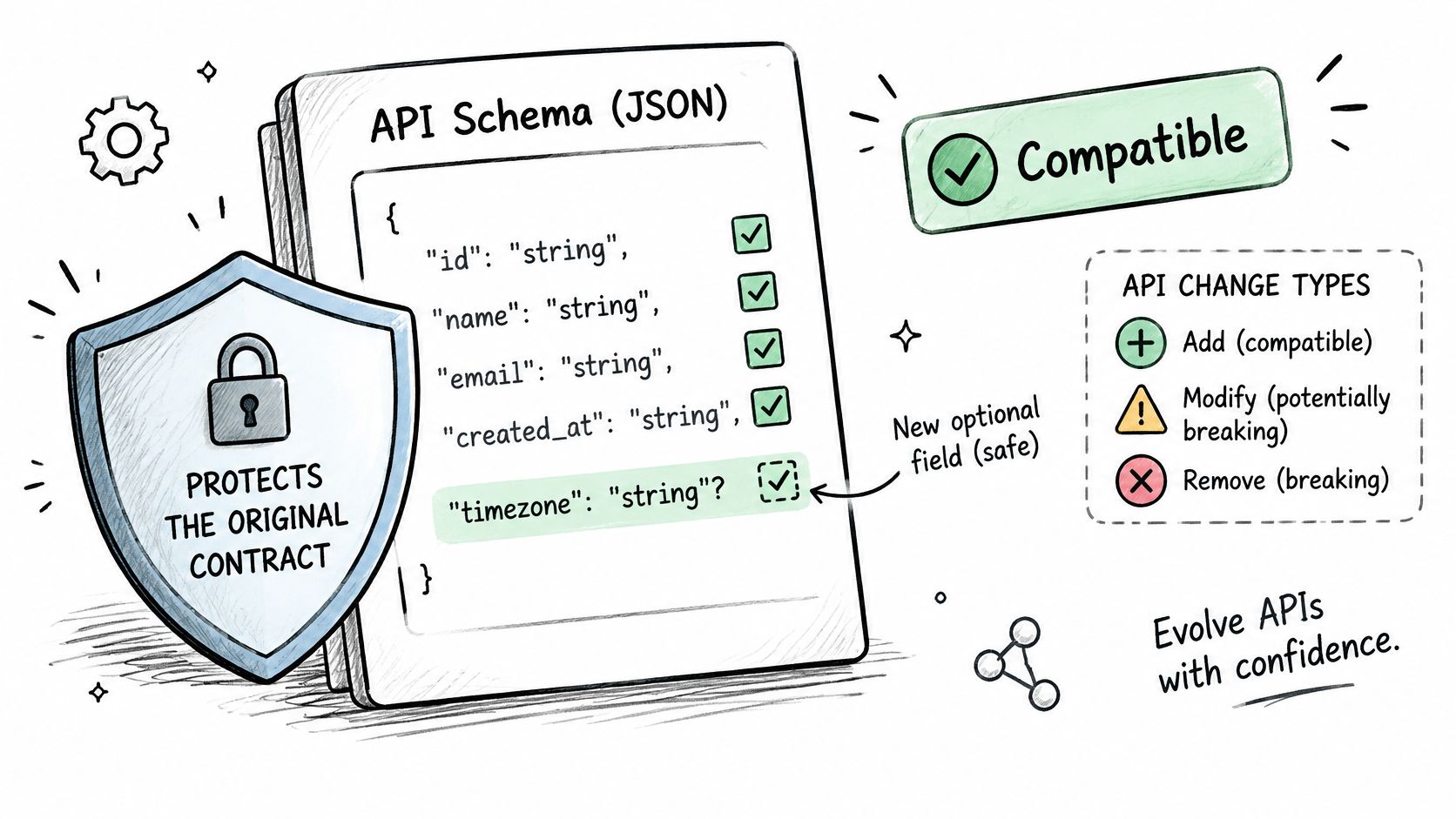
Review More Than Field Names
For a professional profile response with 100+ attributes, review changes by category rather than relying on someone to notice every difference manually.
- Schema changes. Removing properties, changing types, or making request fields mandatory can break consumers.
- Semantic changes. Changing which employer counts as current, what a confidence label means, or how partial results are represented can alter product decisions.
- Operational changes. Authentication, pagination, rate limits, credit consumption, and failure billing belong in the compatibility review.
Operational changes are the ones teams most often misclassify as internal. For a credit-metered API, changing which calls consume credits is a breaking change even when every field name survives. Failed calls that were free yesterday and billed today alter customer spend without a schema change, and a rate limit tuned for synchronous polling behaves differently once customers also consume asynchronous deliveries.
Enum expansion deserves special attention. Adding a value is safe only when clients can handle an unfamiliar value without crashing or making an incorrect decision.
Introducing verified_domain shouldn't require removing an existing company domain field. Keep both meanings explicit, add tests for existing consumers, and document how customers should choose between them.
Publish this classification policy publicly. Your release review should produce a clear answer: compatible addition, opt-in behavior, or breaking change requiring a new contract.
3. Design for Additive, Backward-Compatible Evolution
Add beside existing behavior before replacing it. A new contact attribute can coexist with the old field. An engagement metrics endpoint can coexist with individual posts, comments, and reactions endpoints.
This approach avoids forcing every customer into a migration whenever your data model improves. It also keeps the maintenance burden smaller than cloning the entire API for each enhancement.
The catch is that additive doesn't automatically mean safe. The PublicAPIs discussion of versioning best practices highlights the need to distinguish schema stability from changing data, and to test assumptions about clients ignoring unknown fields.
Practical rule: Treat an optional response field as compatible only after your supported clients have demonstrated tolerant parsing.
Keep Fresh Data Separate From Stable Structure
Say a profile's current position changes between requests. That's record freshness, not a new API contract. Changing positions from an array to an object, however, is a contract change even if the underlying information hasn't changed.
Nullability needs the same precision. An absent contact field, a field containing null, and an empty string aren't interchangeable for a pipeline that distinguishes unavailable data from invalid data.
Use additive evolution deliberately:
- Preserve old meanings. Don't reuse an existing field name for a more convenient interpretation.
- Test tolerant readers. Exercise generated SDKs, strict deserializers, analytics loaders, and AI tool schemas with unfamiliar properties.
- Control payload growth. Offer sparse field selection or explicit
includeparameters when optional data becomes expensive to transfer. - Deprecate visibly. Publish the replacement field, migration example, and removal window before deleting anything.
A recruiting platform should be able to adopt a new contact attribute independently of its position-history parser. Compatibility works best when customers can make small upgrades rather than coordinated rewrites.
4. Use Date-Based Versions to Pin Behavior Per Account
An account-level version pin lets a customer decide when a contract change reaches production. Per-request overrides then give its engineers a way to test the replacement without changing every integration at once.
Date-based identifiers describe contract releases, not record age. A pinned contract can still return fresh professional data. The pin governs structure and behavior, not a frozen copy of someone's profile.
Microsoft's Azure service versioning guidance uses identifiers such as api-version=2020-01-01 and distinguishes stable, backward-compatible versions from breaking-change versions. Stripe's account pinning and GitHub's dated request headers illustrate related approaches to explicit adoption.
The timeline should show supported contracts, not imply that customers must adopt every deployment.
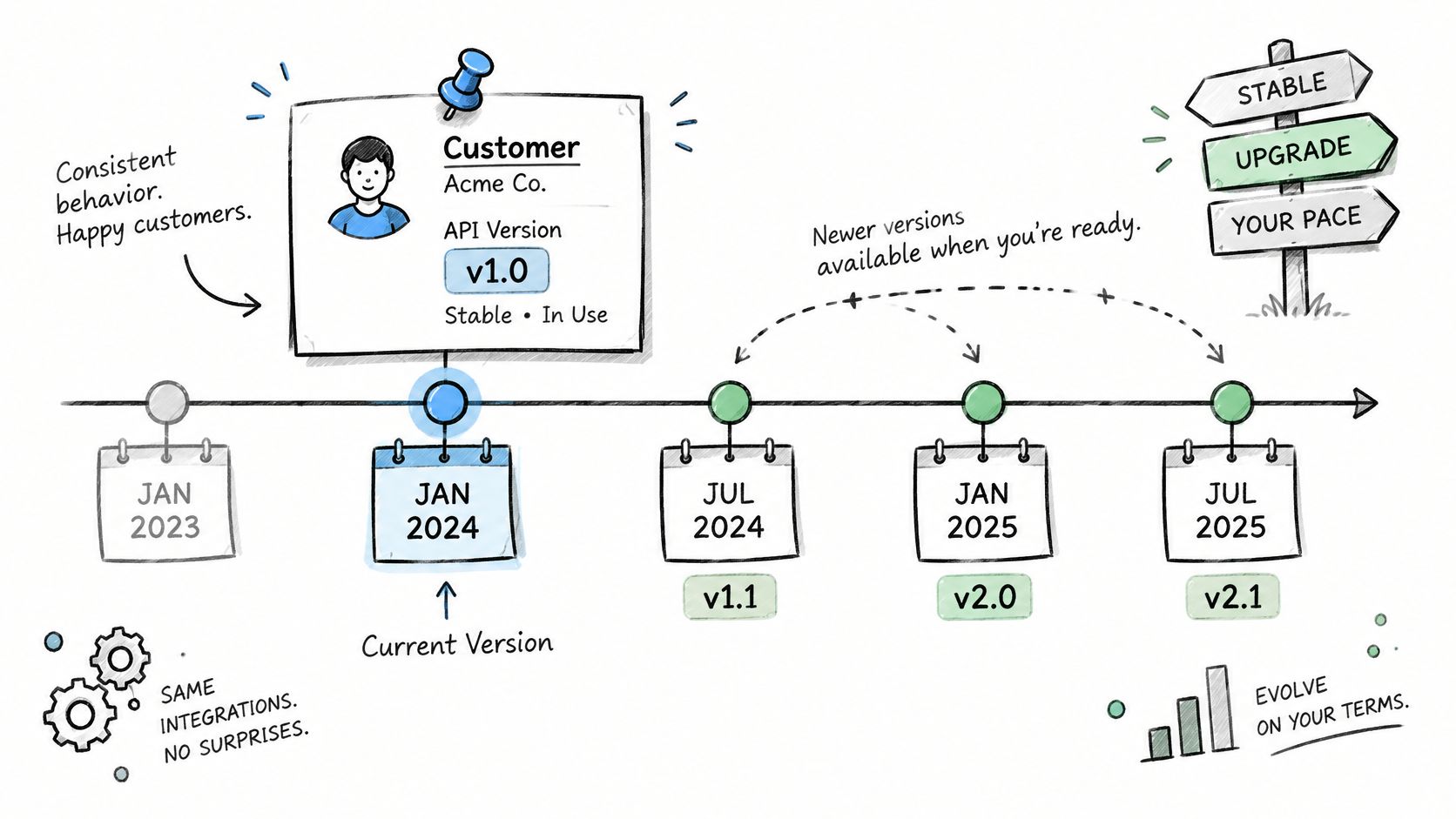
Use Pinning Where It Earns Its Complexity
For a sales intelligence product, a scheduled enrichment workflow might rely on a particular matching policy. Account pinning lets the team compare old and proposed behavior before approving the change.
The trade-off is provider complexity. Every supported pin becomes behavior you must explain, test, and eventually retire. Don't create a dated contract for every internal deployment.
Keep the implementation manageable:
- Define resolution order. A valid request override can take precedence over the account pin, with the resolved version recorded in telemetry.
- Expose the pin. Show it beside usage, credit configuration, and rate-limit settings.
- Announce the support floor. Customers need advance notice when their pinned contract approaches retirement.
- Share internal implementation carefully. Use tested representation transformations where appropriate, rather than copying complete codebases.
A transformation layer can preserve an older response shape. It cannot reliably recreate old matching semantics from insufficient data, so preserve behavior explicitly where transformations aren't enough.
5. Announce Deprecations With Standard Headers and Sunset Dates
Deprecated doesn't mean unavailable. Deprecation tells customers to begin migration; a sunset date tells them when continued use will stop working.
RFC 8594 defines the Sunset response header for resources expected to become unresponsive. Keep that shutdown signal separate from the initial deprecation announcement, and accompany it with a migration guide.
A migration needs a supported destination, not just a warning on the old endpoint.
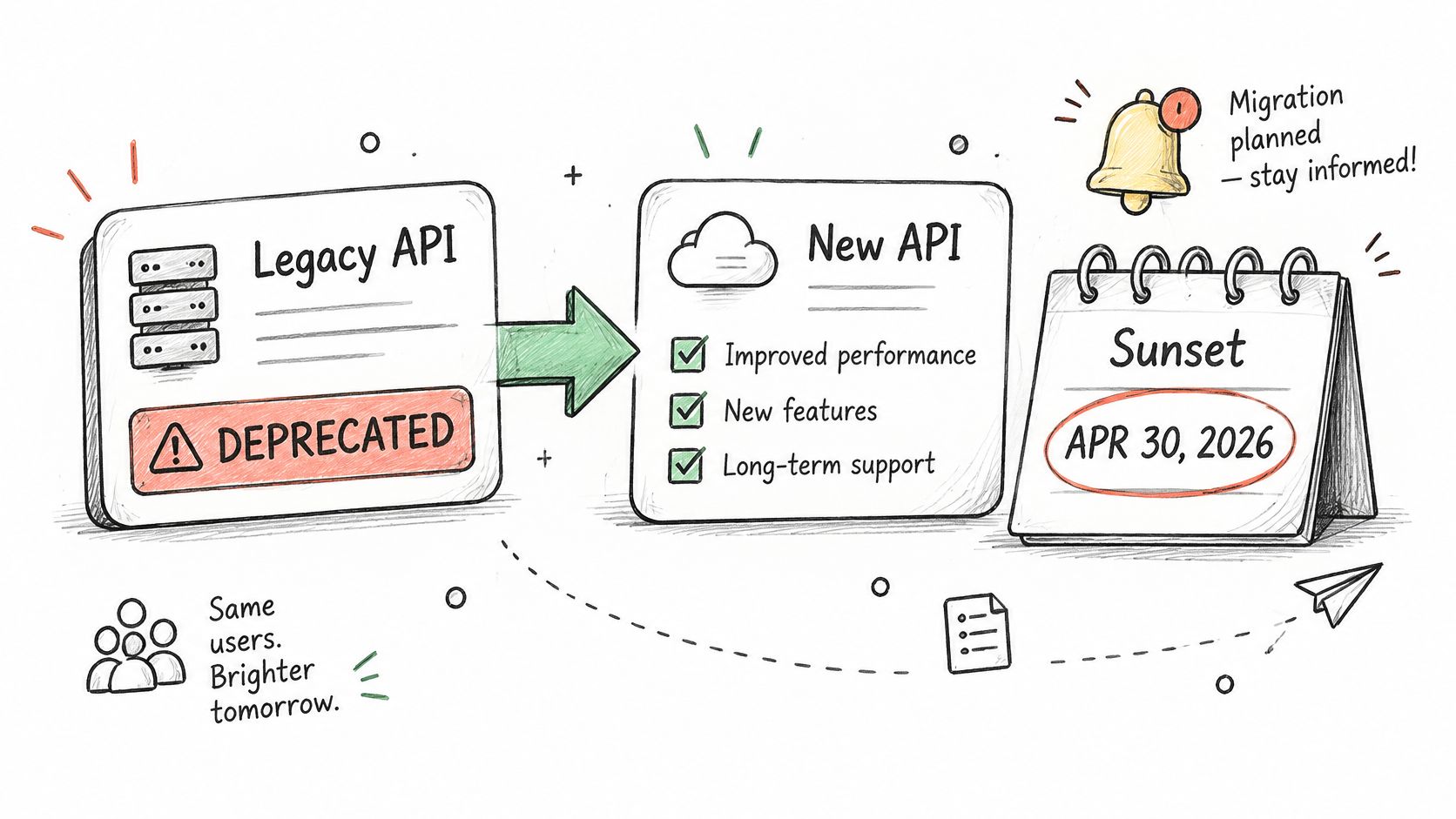
Communicate Through Traffic and Account Ownership
Return machine-readable Deprecation and Sunset signals where appropriate, and use a Link header to identify migration documentation. Reinforce them through dashboard notices and email to registered integration owners.
As a concrete benchmark, Azure DevOps' versioning policy allows a corresponding preview version to be deactivated 12 weeks after the released version becomes available. That's a preview policy, not a universal production support window; enterprise integrations may need longer approval and rollout periods.
Say a company endpoint is being replaced with a contract that distinguishes verified domains from unverified values. Show the same company input against both contracts, explain the changed interpretation, and identify what customer code must change.
- Name the replacement. Include affected endpoints, fields, and the recommended target contract.
- Track remaining consumers. Identify API keys still using the deprecated version and contact their owners.
- Verify migration readiness. Replay representative requests and inspect errors, callbacks, throughput, and credit accounting.
Don't retire a version solely because its deadline arrived. Require an agreed observation window without production use, or explicit owner-approved exceptions with a documented plan.
6. Version Asynchronous and Synchronous Delivery Paths Together
A live lookup succeeds, but the overnight workflow fails while parsing the callback. That can happen when a team updates the synchronous serializer and leaves asynchronous delivery on a different schema.
The selected contract must survive the entire request lifecycle. A job accepted under an older contract should finish under that contract, even if the customer upgrades its account before the result arrives.
Google's API versioning guidance calls for parallel operation during transitions and independent major versions. Apply that independence to result delivery too: a new endpoint contract shouldn't secretly rely on the previous version's callback representation.
Pin the Result When Work Is Accepted
For a recruiting platform submitting professional profile URLs, persist the resolved version alongside the request identifier. Use it when serializing the eventual result, polling response, or terminal error.
- Identify callback contracts. Include version metadata so receivers can choose the correct validator.
- Preserve error semantics. Keep partial results, retryability, and terminal failures consistent with the selected contract.
- Test shared fixtures. Run the same profile and company fixtures through immediate responses and deferred delivery.
- Retain retry behavior. A delivery retry shouldn't reinterpret a result under the customer's newer account pin.
Our API supports synchronous and asynchronous delivery, but bulk enrichment doesn't use a separate batch API or job queue. Customers call endpoints concurrently, so examples involving submitted jobs describe a general API pattern, not an additional product interface.
The synchronous versus asynchronous API guide explains the delivery trade-offs. For versioning, the critical distinction is between delivery timing and contract identity: changing when customers receive data mustn't change what they receive.
7. Publish a Machine-Readable Contract and Verify It With Consumer-Driven Tests
Publish an OpenAPI specification for each supported major contract. Use the same specification for request validation, reference documentation, and SDK generation so those interfaces don't drift independently.
Provider-side schema checks are necessary, but they don't capture every customer dependency. Consumer-driven tests let a SaaS partner express that it requires a nullable employer domain, stable pagination tokens, or a particular error classification.
The Locus integration change-management guide describes combining per-consumer version records, contract tests, deprecation telemetry, and migration deadlines. That combination turns retirement into an evidence-based decision rather than a calendar-only decision.
Test the Assumptions Customers Actually Use
Say a talent intelligence team generates typed models from your specification. Its contract test should exercise a complete record, an incomplete record, an unfamiliar optional property, and a partial failure.
For entity resolution, document behavioral assumptions as carefully as types. A workflow depending on name matching logic across state registries needs representative ambiguous-name fixtures, not merely a schema declaring that the result contains a string.
- Generate a compatibility diff. Flag removed properties, changed types, required-field changes, and altered response codes.
- Run consumer verification. Use Pact-style contracts for important partner expectations, starting with high-volume integrations.
- Store release evidence. Keep sandbox results, production-like replay results, and migration notes alongside the changelog.
- Review semantic changes manually. A schema diff won't detect a changed definition of current employer.
Use this video as a companion to the implementation discussion.
Tests should validate supported guarantees, not exact JSON equality. Otherwise, your test suite will incorrectly reject the additive evolution your public policy permits.
8. Give Customers Control Over Upgrades, Rate Limits, and Credit Impact
A response can remain perfectly parseable while an upgrade changes its operating cost. Credit accounting and throughput deserve the same release discipline as field types.
For our B2B data API, self-serve throughput is 5 requests per second, with dedicated capacity available up to 100 requests per second. Failed requests don't consume credits. Any proposed change to those expectations should be communicated as clearly as a schema migration, rather than hidden in general release notes.
A recruiting platform evaluating richer posts and reactions data should estimate successful billable calls, concurrency, retries, and expected credit consumption before moving production traffic. Reviewing cost per 1,000 credits is useful only when the team also understands which endpoint calls consume those credits.
Make the Upgrade Reversible
Use an explicit test cohort or request override where supported. Compare equivalent workloads against both contracts, including missing records, invalid inputs, exhausted balances, and rate limiting.
A successful upgrade preserves the customer's ability to predict both the result and the bill.
- Document accounting rules. Explain credit consumption, failure treatment, and whether deferred delivery or retries affect billing.
- Separate capacity from compatibility. Buying more credits shouldn't be mistaken for selecting a different response contract.
- Monitor after rollout. Alert on changes in credit consumption, error rates, latency, and throttled requests.
- Provide a rollback path. Keep the previous supported contract available while customers validate the replacement.
Our free tier includes 1,000 credits, which customers can use to validate representative integrations before shifting production traffic. The contact enrichment API guide provides context for evaluating enrichment workflows, but the version review should still cover the customer's actual inputs and failure paths.
Customer control requires explicit options. Don't imply that account pinning, a preview environment, or rollback exists unless you've implemented and documented it.
Comparing the 8 API versioning practices at a glance
| Practice | Primary goal | Main mechanism | Biggest trade-off | Best for |
|---|---|---|---|---|
| Explicit version in every request | Make the expected contract clear | Put a version in the path, header, query, or media type | Can duplicate routes and documentation | APIs that need clear routing, monitoring, and side-by-side versions |
| Classify changes before release | Prevent unexpected client breakage | Review changes against breaking and non-breaking rules | Requires disciplined review and edge-case judgment | Teams releasing schema changes regularly |
| Additive, backward-compatible evolution | Evolve the API without forcing upgrades | Add optional fields and endpoints; retain deprecated fields | Responses and schemas can grow over time | APIs aiming to maintain fewer active versions |
| Date-based versions pinned per account | Let customers control when behavior changes | Pin each account to a dated version, with optional overrides | Supporting many old versions adds compatibility work | Customers needing stable behavior and gradual upgrades |
| Deprecation notices and sunset dates | Make migrations predictable | Send deprecation and sunset headers with migration guidance | Long transition windows increase maintenance | APIs serving enterprise customers and scheduled jobs |
| Version synchronous and asynchronous paths together | Keep delivery modes consistent | Apply the same version to responses, jobs, callbacks, and errors | Adds callback configuration and in-flight job complexity | APIs supporting both real-time requests and background workflows |
| Machine-readable contracts and consumer-driven tests | Verify compatibility before release | Publish versioned specifications and test consumer expectations | Specifications and tests require ongoing maintenance | APIs with many integrations or client-specific dependencies |
| Customer control over upgrades, rate limits, and credits | Make operational and cost changes predictable | Show version, throughput, and credit rules together; notify customers | Adds communication and plan-management overhead | Teams forecasting spend and scaling API traffic |
Start Versioning Like a Provider Your Customers Can Trust
Start with the contract customers already use, not the versioning scheme you'd choose for a new API. Inventory its response fields, request validation, authentication, pagination, errors, delivery modes, credit rules, and throughput expectations. Include behavior customers rely on even when your documentation currently leaves it implicit.
Then choose an explicit selection mechanism and write down how it resolves. A path version may be sufficient. Account pinning can help when customers need independent adoption schedules, but it adds operational work and shouldn't become an excuse to maintain undocumented behavior indefinitely.
Establish the Compatibility Boundary
Fetchin provides a concrete starting point: its profile endpoint is GET /api/v1/profile, and requests authenticate through an X-API-Key header. Those interface details give engineers something specific to document and test, but the path alone doesn't establish a complete compatibility policy.
Write down which changes can ship within that contract. Optional additions may be appropriate when supported clients tolerate them. Removing a field, tightening validation, changing matching semantics, or altering error handling requires a deliberate compatibility decision, not an assumption that the existing URL makes the release safe.
- Publish the policy. Explain breaking changes, supported lifecycle states, and migration responsibilities.
- Automate the evidence. Add specification diffs, consumer tests, and representative fixtures to release review.
- Make retirement operational. Track consumers, communicate deadlines, and verify that customers can use the replacement.
- Expose cost implications. Treat credit rules and throughput as documented expectations.
Our failed calls are never billed, so error handling is part of the operating contract rather than a hidden cost. Every self-serve credit volume also uses the same throughput allowance, regardless of whether customers buy through subscription or pay as you go. Engineers can therefore distinguish integration behavior from purchasing decisions when evaluating a change.
Prefer a Small, Enforceable Policy
You don't need to build every mechanism immediately. Begin with explicit version selection, a public breaking-change policy, and contract tests for the fields your most important integrations consume. Add lifecycle communication, consumer verification, and cost monitoring as you establish the operational processes to support them.
The important boundary is between what your API currently exposes and what you explicitly promise to preserve. Recommendations aren't service guarantees until they're documented and implemented. Customers should be able to identify that boundary without guessing from a version number.
Audit one current endpoint this week. Document its schema as a versioned contract, capture representative complete and incomplete responses, and add a test that fails if the schema changes.
Fetchin turns professional profile and company URLs into structured JSON for data-driven products, with synchronous and asynchronous delivery. Visit Fetchin to evaluate its enrichment endpoints against your application's schema, delivery, and operating-cost requirements before committing production traffic.