
The most common advice about choosing a contact enrichment API is to compare record counts, field counts, and response speed. That's not enough. A fast HTTP 200 response can still contain the wrong employer, an ambiguous identity, or a contact field your application shouldn't store.
Build around a different question: Can this workflow safely use each returned field? That means defining the request, checking the response beyond its transport status, preserving provenance, and making retry and credit decisions explicit. Treat enrichment as a production data contract, not a way to fill empty CRM cells.
Table of Contents
- Contact Enrichment API Endpoint Map
- Request and Response Schemas
- Person Company and Engagement Attributes
- Synchronous Calls or Asynchronous Delivery
- Error Semantics and Credit Rules
- Integration Example With Retry and Credit Logic
- Rate Limits and Pricing Tiers
- Freshness Provenance and Lawful Use
- Pick a Professional Data API for Your Pilot
Contact Enrichment API Endpoint Map
A contact enrichment API is a B2B data API that fetches public professional data on demand and returns structured JSON. Your application supplies an identifier, then receives attributes it can validate and map into a product workflow.
The route matters because person records, company records, and engagement objects answer different questions. A company domain can establish firmographics, but it doesn't identify which employee submitted your form. A reaction can identify someone who engaged with a post, but it doesn't establish their current role.
Contact enrichment API routes
| Route | Minimum input | Main object returned | Usual delivery |
|---|---|---|---|
| Person enrichment | Professional profile URL | 100+ person attributes | Synchronous JSON |
| Company enrichment | Company URL or domain | Firmographics and verified domain | Synchronous JSON |
| Post retrieval | Post URL or URN | Published post | Synchronous JSON |
| Comments on a post | Post URL or URN | Comment objects and authors | Synchronous JSON |
| Reactions on a post | Post URL or URN | Reaction objects and people | Synchronous JSON |
| Reactions by a person | Professional profile URL | Reactions that person left | Synchronous JSON |
| Engagement summary | Post URL or URN | Comments and reactions together | Synchronous JSON, heavier credit |
| People search | Name plus employer or similar filters | Matching profiles | Synchronous JSON |
For CRM fill-in, choose person enrichment. Its attribute families include identity, role history, education, skills, locations, and public contact fields. If your starting record contains only a name and employer, use people search to find candidate profile URLs before enriching the selected match.
For firmographics, choose company enrichment. A company URL or domain leads to industry, headcount, headquarters, founding year, and a verified domain that your application can use when joining account records.
For engagement, choose the object you need. Retrieve a post for its published content, comments for discussion, reactions for responses, or the combined engagement object when the feature needs both comments and reactions.
Choose the smallest useful route
Say a CRM sidebar displays someone's role and employer. It doesn't need every post they've published or every reaction they've left. Requesting unrelated objects increases processing, storage, and privacy exposure without improving that feature.
Email verification is also a separate operation. If your workflow needs to evaluate an email before sending, Mailbeam's email verification API provides a focused reference for that verification step. An email appearing in an enrichment response isn't, by itself, a deliverability result.
Don't assume bulk delivery means a separate batch endpoint exists. Many integrations implement bulk work through concurrent calls to the same synchronous routes, with a worker pool controlling execution.
Before committing to an integration, inspect three parts of its contract:
- Schema: Confirm the actual key names and whether omitted fields have explicit statuses.
- Outcomes: Distinguish a clean no match from an operational failure.
- Capacity: Read the rate and credit rules before promising a throughput target.
Route names are a catalog of capabilities, not permission to fetch everything. Start with the product decision you need to make, then choose the narrowest object that supports it.
Request and Response Schemas
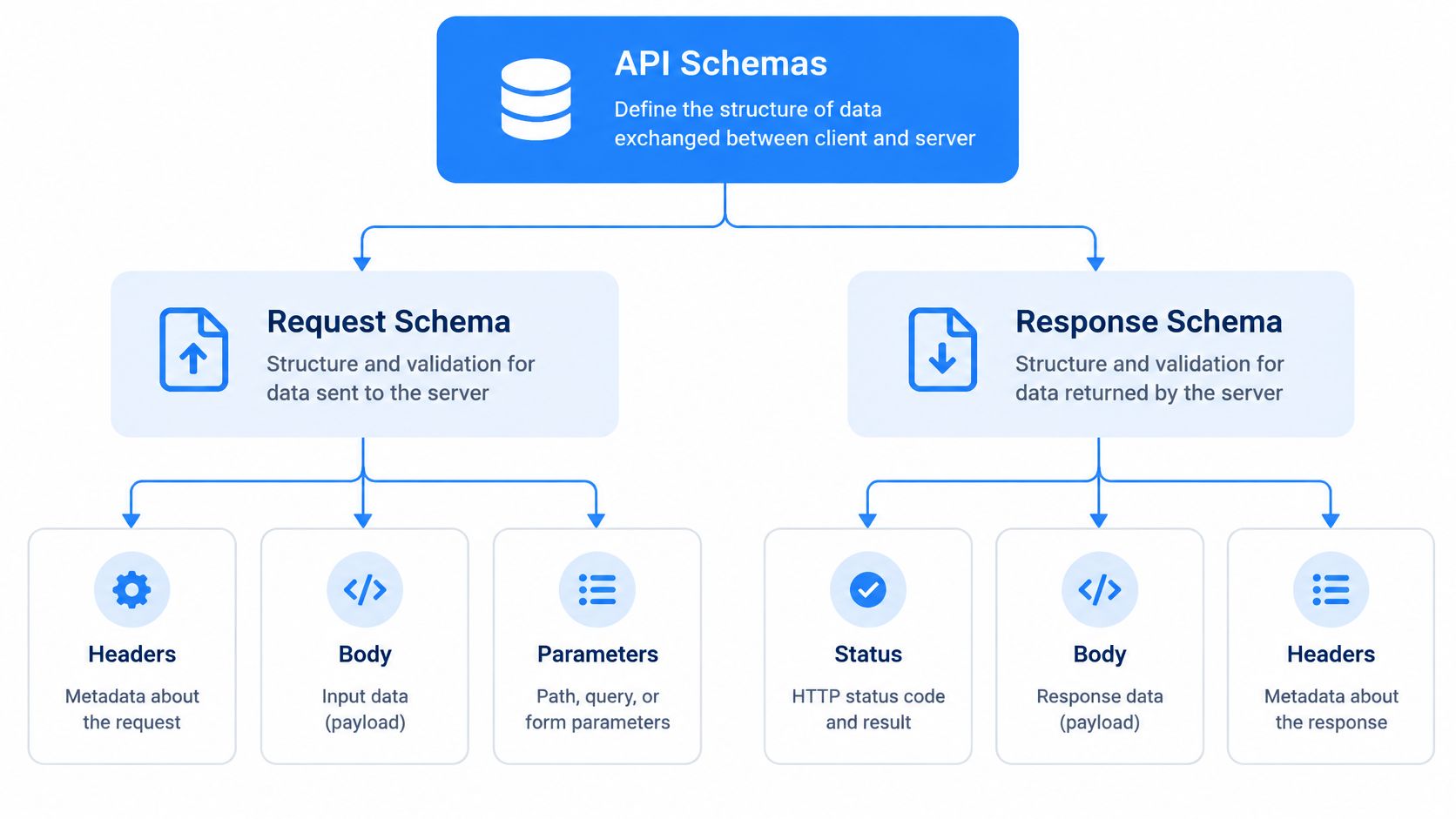
Keep the request small and the response explicit. For a person call, a conceptual JSON body is {"profile_url": profileUrl, "fullProfile": true}, where profileUrl is the professional profile URL already held by your application.
That expression shows the intended fields, not a universal wire format. Replace the key names with those in your provider's documentation, and enable the full record option only when the feature needs history or permitted contact fields rather than a short profile card.
The diagram shows how request and response contracts fit together.
Read the person body in a stable order
Use a normalized application model even when upstream providers use different names. The following sequence makes identity validation happen before downstream decisions:
- Identifiers: Store
person_idand the normalizedprofile_url. - Current role: Read
current_title, thenseniority, thenemployer. - History: Preserve
positionswith titles, employers, date boundaries, andis_current. - Background: Keep
education,skills, andlocationsas distinct collections. - Contact fields: Handle
work_emailandphoneseparately, with their availability and provenance.
A company request should accept a company URL or bare domain according to the documented input schema. Normalize the response into industry, headcount, headquarters, founding_year, and verified_domain; preserve whether headcount is an exact value or a range.
An engagement request uses a post URL or URN. Reactions left by a person are different: that request uses the person's professional profile URL. Comment objects should preserve text, date, reactionCount, replies, and commentUrn, rather than flattening the conversation into a text blob.
Response status values
A single null can't tell your application whether a field was absent, withheld, or temporarily inaccessible. Use explicit states and define whether they apply to the whole result or an individual field.
| Status | Meaning | Handling |
|---|---|---|
not_found |
No matching public record | Prompt the user to check the URL, cache briefly, no credit |
restricted |
Policy or privacy limit on returned fields | Exclude from warehouse, no credit |
unavailable |
Upstream could not return this field now | Retry later if transient, no credit |
partial |
Usable fields returned, some missing | Mark missing fields, charge only if billable |
These credit treatments are contract requirements to verify, not properties implied by JSON. A field-level restriction inside an otherwise usable response must remain visible without disguising the entire record as unavailable.
Include retrieved_at, a permitted source_url or provenance object, and any supplied confidence metadata. Keep retrieval time distinct from an observed employment date: fetching a page today doesn't prove the person started a role today.
For hands-on validation, GoReplay's guide to testing with Postman provides a practical testing reference. Save fixtures for complete, partial, restricted, and unavailable outcomes, then assert their types and statuses rather than checking only whether the request succeeded.
Person Company and Engagement Attributes
A returned attribute matters only if it supports a product decision. Mapping every available field into your CRM creates more opportunities for conflicting updates, unnecessary retention, and accidental use.
Consider a signup that needs an account owner. Current title and seniority may help qualify the person, while employer and company size help determine account fit. Education and engagement history might be irrelevant to that routing decision, even if they're available.
Person attributes need contextual mapping
Current title and seniority can support routing and lead scoring, but they shouldn't be treated as equivalent. A title is a reported label; seniority is a classification that may require interpretation. Preserve the original title so a reviewer can inspect the classification.
Positions tell a different story. A person may hold an operating role, an advisory appointment, and a board position at the same time. Keep an is_current flag on each position, and define which role qualifies as the primary employer for your use case.
Practical rule: Never overwrite a CRM title with the first item in a positions array unless the contract explicitly defines that ordering.
Education records can remain useful without an end date. Mark the date as missing rather than dropping the institution or qualification. Likewise, don't use skills or location alone to resolve identity: many people share the same city and professional vocabulary.
Contact attributes deserve stricter handling:
- Work email: Preserve whether the address was observed, supplied, or inferred. Don't promote a guessed address into a verified fact.
- Phone: Store it only when the feature needs it, with appropriate access controls.
- Field provenance: Associate evidence with the individual value, not just the enclosing person object.
These controls also support data minimization. GDPR Article 5 requires personal data to be adequate, relevant, limited to what's necessary, accurate, and kept up to date, alongside purpose and storage limitations.
Company and engagement objects have different jobs
Industry and headcount help assess ideal customer profile fit. Headquarters can support territory assignment, while founding year provides organizational context. None should replace a customer-confirmed account value without an update policy.
Use the verified domain as a company join key, but preserve conflicts. If the employer domain in a person response disagrees with company enrichment, keep both values and flag the disagreement. A subsidiary, rebrand, or incorrect association may require review.
Engagement objects describe an interaction, not a complete person. Comment text, date, reaction count, replies, and comment URN belong to the discussion. The person identifier attached to a comment or reaction is a pointer for a subsequent person lookup when role and employer are needed.
A recruiting feature might use role history to identify a recent change. A content analytics feature might need only interaction counts and identifiers. Map the fields your feature reads, and leave unrelated attributes outside its storage boundary.
Synchronous Calls or Asynchronous Delivery
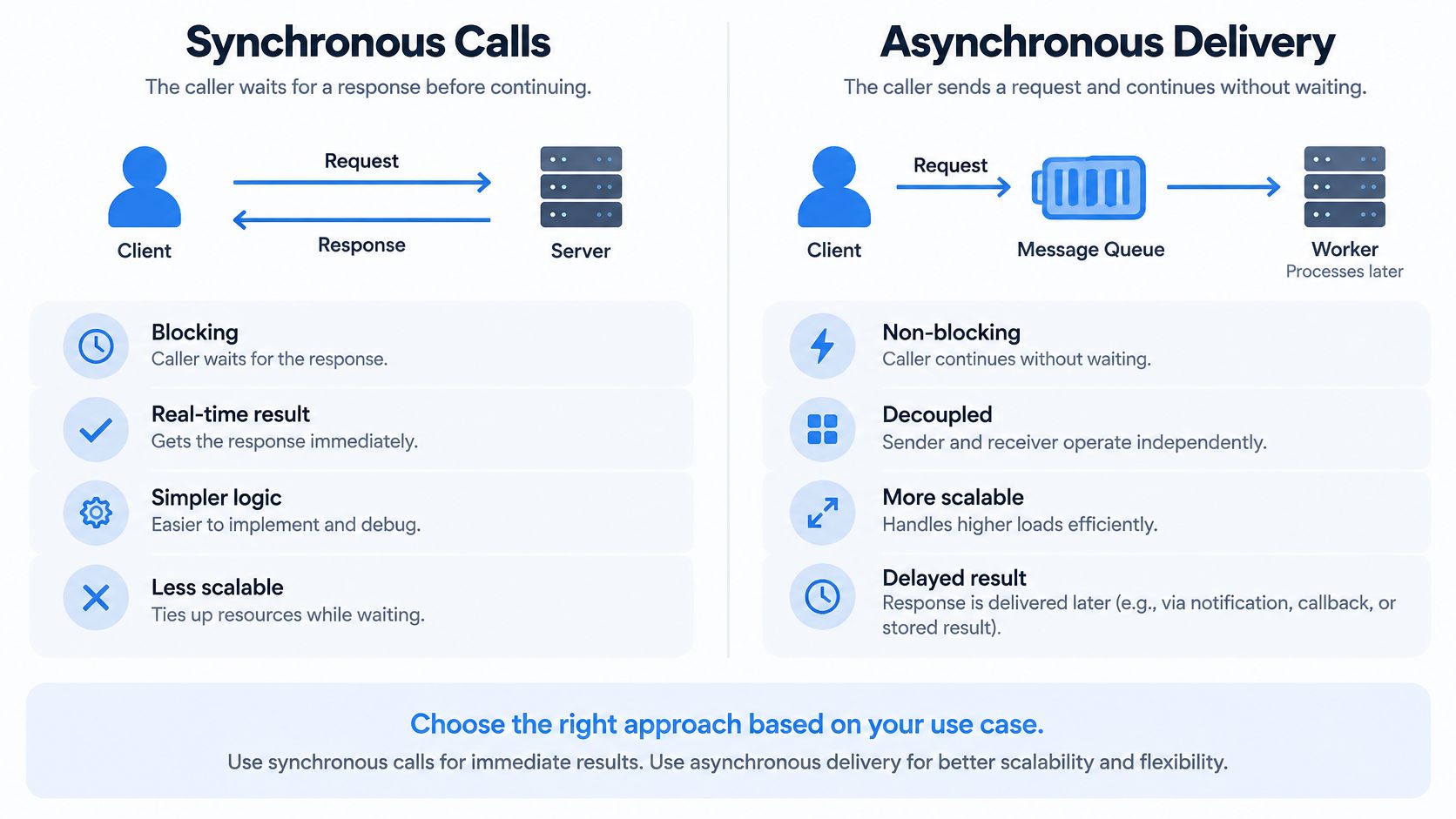
Synchronous delivery is the default for a user waiting on a form, a CRM sidebar, or an agent step. The caller submits an identifier, waits for the response, and decides whether the returned fields are usable.
The delivery choice becomes clearer when you separate interactive work from work that can finish later.
Keep interactive work bounded
For an illustrative acceptance test, you could target a median near one second and a 95th percentile near one and a half seconds. Those are pilot goals to validate under your workload, not a provider guarantee.
Set a client deadline just above the measured tail, allowing for network overhead and your own processing. Don't automatically leave it at 30 seconds: in this example, that would let a stalled dependency occupy workers far beyond the expected response window.
Use separate connection and response deadlines where your HTTP client supports them. Carry the overall deadline through retries so a helper can't keep an interactive request alive after the user-facing operation has already expired.
| Workload | Preferred execution | Completion behavior |
|---|---|---|
| CRM sidebar | Synchronous call | Render usable fields or a recoverable state |
| Agent verification step | Synchronous call | Continue only after validation |
| Scheduled refresh | Worker-controlled calls | Persist results as workers finish |
| Backfill | Bounded concurrency | Track progress and checkpoints |
| Deferred delivery | Documented asynchronous contract | Consume status updates or webhooks |
Use asynchronous delivery only with a real contract
A nightly refresh or backfill doesn't require the user to wait. You can place tasks in a queue you own and let workers make synchronous API calls with bounded concurrency.
That's different from a provider offering asynchronous jobs. Don't invent a batch route or assume a job queue exists because the workload is large.
For documented asynchronous delivery, require:
- Schema parity: The same business fields and problem objects as synchronous delivery.
- Traceability: A job identifier and correlation identifier on status polling and webhook payloads.
- Deduplication: An idempotency key with defined uniqueness and retention semantics.
- Recovery: Documented behavior for delayed, repeated, or out-of-order notifications.
Store correlation identifiers with the relevant CRM operation. Deduplicate webhook delivery transactionally so a repeated notification can't apply the same update twice.
This video provides another format for reviewing the delivery decision.
Interactive paths stay synchronous. Bulk paths use concurrent synchronous calls unless a real asynchronous contract exists. Choosing a queue changes who waits; it doesn't remove rate limits, validation, or failure handling.
Error Semantics and Credit Rules
Enrichment errors, retries and credits
The following is a recommended client-facing contract. HTTP mappings and credit rules should be explicit, especially when a no-match result is delivered successfully.
| Condition | HTTP status | Retry | Credits |
|---|---|---|---|
| Malformed URL or body | 400 | No | No |
| Missing or invalid credentials | 401 | No | No |
| Key not allowed for this route | 403 | No | No |
| No matching public record | 200 with not_found status |
No | No |
| Policy redaction or restricted profile | 403 with restricted status |
No | No |
| Rate limit exceeded | 429 | Yes, backoff with jitter | No |
| Upstream timeout | 504 | Yes, limited retries | No |
| Partial but usable extraction | 200 with partial flag | No | Only if usable fields were returned |
Branch on a machine-readable problem document, not a phrase hidden inside a success response. IETF RFC 9457 defines application/problem+json with fields including type, title, status, detail, and instance.
Use type as the stable problem classification. Keep title readable, use status consistently with the HTTP response, and make instance useful for tracing the particular failure. Human-facing detail can explain what happened, but client logic shouldn't depend on its wording.
Separate absence from failure
A clean no match means the lookup completed but found no matching public record. A timeout means the system couldn't establish the result. Those outcomes need different user messages, cache behavior, and retry decisions.
For not_found, ask the user to check the input and use a short negative-cache expiry. Don't permanently cache absence: a corrected identifier or newly available record may produce a different result later.
Partial extraction can still return HTTP 200 when usable fields arrived. Include explicit missing-field states so the consumer can accept the supported subset without inventing the rest.
Unsupported sources need their own permanent-input classification. They shouldn't share a transient upstream error type, because retrying the same unsupported input won't make it valid. Policy redaction should likewise remain distinct from technical unavailability.
A successful transport response says the server answered. It doesn't say your application received a complete, usable person record.
Make retries and billing independent
Retry transient timeouts and rate limiting with exponential backoff and jitter. Honor a supplied retry delay, apply a fixed attempt cap, and stop when the operation's deadline expires.
Don't retry malformed input, bad credentials, unauthorized routes, or permanent policy denials. Those cases require a changed request or configuration, not another identical call.
Operational failures, authentication failures, and rate limits shouldn't consume credits under the contract described here. Partial results should debit only when the returned fields meet the documented billable-result rule; the credit pricing model explains the distinction between request activity and chargeable output.
Preserve the same problem object in asynchronous job status and webhook payloads. Keep credentials, personal upstream content, and internal extraction details out of detail. Give support the instance and correlation identifiers instead of forwarding sensitive payloads.
Integration Example With Retry and Credit Logic
Say your CRM receives a professional profile URL and needs enough information to assign an account owner. Implement one lookup function with separate branches for transport errors, domain outcomes, and billable output.
A complete client flow
- Build the request. Use the professional profile URL as input. Enable the full record flag only when the feature needs history or contact fields.
- Send from your server. Keep the API key outside browser code. Use the base address, method, and route from the provider documentation rather than guessing an endpoint.
- Inspect both layers. Read HTTP status first, then the body's status. Accept a usable
partialresult with missing-field markers; treatnot_foundas a completed lookup without a person record. - Apply the retry helper. Send rate limits and transient upstream timeouts through bounded backoff with jitter. Stop malformed or unauthorized requests immediately.
- Commit selectively. Write validated fields,
retrieved_at, the response instance identifier when present, and the correlation identifier. Keep negative-cache entries separate from enriched CRM records. - Scale the same function. Run it inside a worker pool with a concurrency ceiling chosen to remain below the request-rate cap.
For a broader contract-design reference, this API design example helps connect request validation, response shape, and consumer behavior.
Billing guardrail: Record the provider's billable outcome once per logical operation. Don't infer a debit from the number of network attempts.
Keep the sidebar's display model separate from server-side storage. A routing service may need provenance and conflict flags that don't belong in the visible contact card.
Rate Limits and Pricing Tiers
Credit tiers and throughput bands
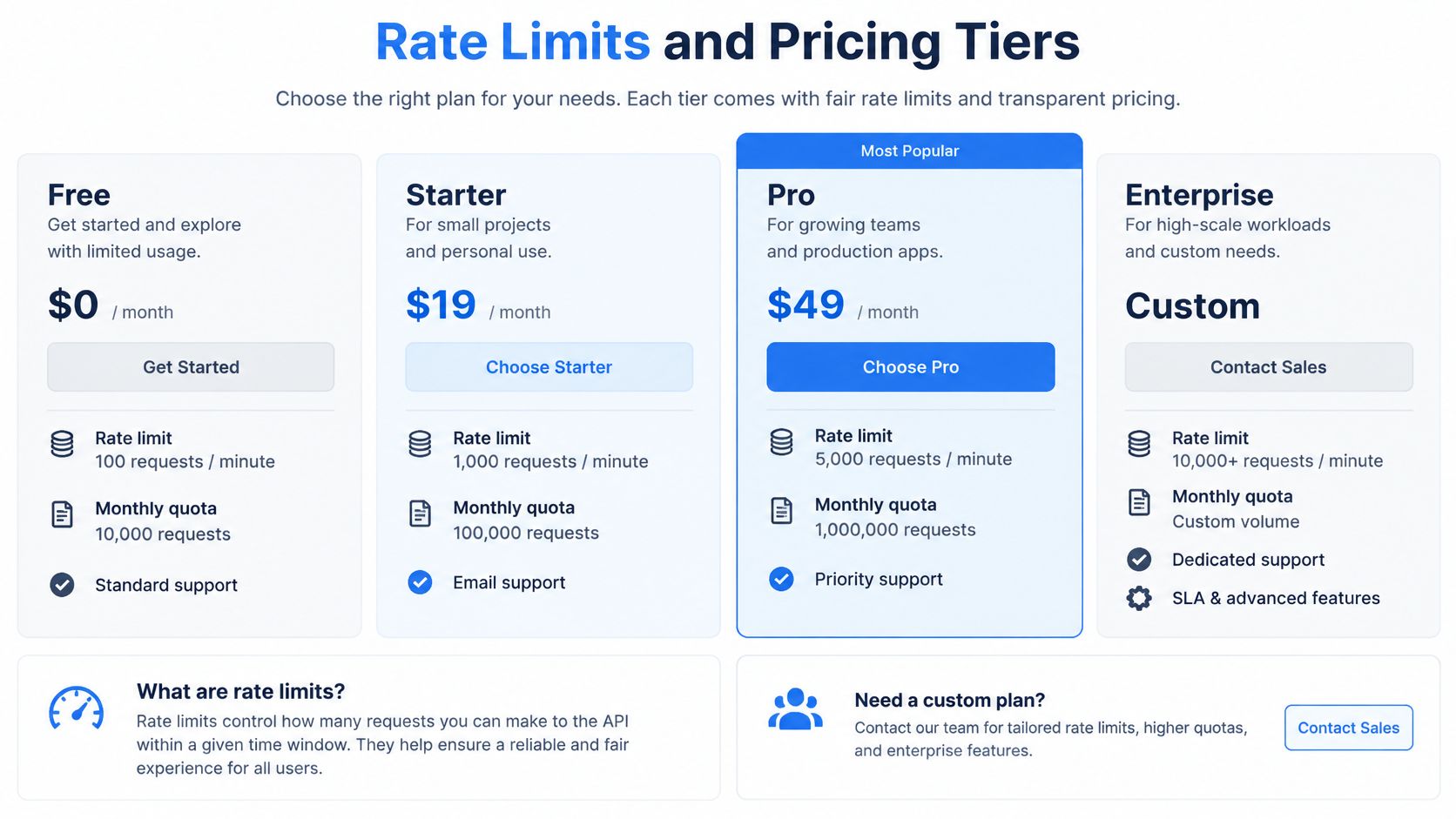
The bands below are an illustrative budgeting model, not a universal price list or a quotation. Use them to structure a cost worksheet, then replace each allowance, weight, and cap with the selected contract's values.
| Band | Credit model | Throughput | Fits |
|---|---|---|---|
| Evaluation | About 1,000 credits | About 5 requests per second | Prototypes and schema tests |
| Monthly credits | Prepaid pool, price visible per 1,000 | About 5 requests per second | Steady product features |
| Pay as you go | Metered per 1,000 credits | Self serve cap | Spiky or agent traffic |
| Dedicated capacity | Contracted volume | Up to about 100 requests per second | Sustained enrichment, provisioned in a few business days |
| Light lookup | Often 1 credit | Counts toward the cap | Company or short person card |
| Full person record | Often 2 credits | Counts toward the cap | History, seniority and contact fields |
| Combined engagement | Often 2 credits | Counts toward the cap | Comments and reactions in one call |
The visual groups the plan choices, but the route weights determine how quickly a workload consumes its allowance.
Calculate calls and credits separately
In a hypothetical workload capped at 5 requests per second, the arithmetic ceiling is 18,000 calls an hour before retries, because 5 × 60 × 60 = 18,000. That's a theoretical request ceiling, not a promise of completed records.
Now suppose every call in that example costs 2 credits. Fully using the hourly request ceiling would require 36,000 credits. Mixing lighter and heavier routes changes consumption even when the request rate stays unchanged.
Use separate worksheet entries for:
- Request volume: Attempts per route, including permitted transient retries.
- Billable volume: Results that meet the contract's charging rule.
- Credit weight: The debit attached to each qualifying route result.
- Capacity: Sustained request rate, burst policy, and concurrency restrictions.
A nonbillable retry can still occupy a rate-limit slot. Conversely, one successful request may consume more than one credit. Combining those quantities into a single calls-per-month estimate hides both operational and financial constraints.
Match the plan to the workload
Prepaid monthly credits fit a feature with predictable usage. Metered purchasing can fit irregular agent activity, but the dashboard should expose the live price per credit unit and current consumption so operators can set meaningful budget alerts.
Dedicated capacity is a provisioning decision, not merely a larger balance. In the illustrative ladder, the higher throughput band requires lead time; schedule deployment around confirmed availability rather than assuming a dashboard change takes effect immediately.
Publish each route's weight beside its description. A combined engagement request does more work than retrieving only one interaction family, while a full person record may expose more attributes than a short card.
There's no automatic batch discount when bulk work is concurrency. Choose the smallest tier whose sustained capacity covers the peak hour, then leave operational headroom for retries and uneven arrivals. Assign zero retry allowance to permanent errors: fixing invalid input belongs in validation, not capacity forecasting.
Freshness Provenance and Lawful Use
A live call doesn't guarantee a good record. The page may be current while the identity match is ambiguous, the employer association is conflicting, or the returned fields are unsuitable for your purpose.
The operational consequences are measurable: Demand Gen Report's coverage of lead-data quality reports that more than 60% of respondents said poor data disrupted lead handoffs or reduced sales productivity. Evaluate enrichment against those downstream failures, not freshness alone.
Use this checklist to connect retrieval evidence with acceptance decisions.
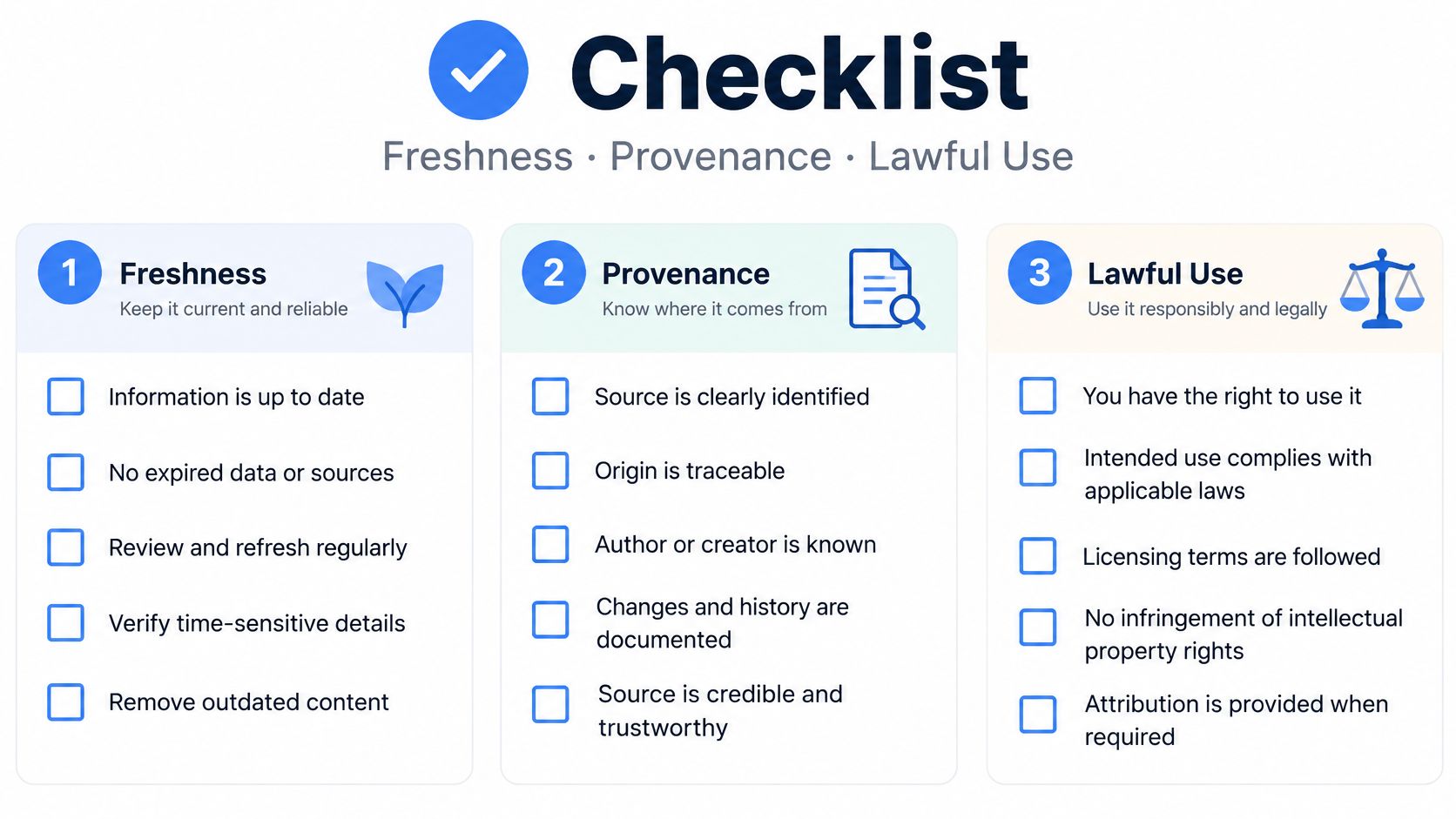
Prove usability at field level
A commonly cited benchmark summarized by Hyperbound's CRM data-decay analysis places annual B2B contact-data decay near 22.5%, equivalent to roughly 11,250 records in a database of 50,000 contacts without maintenance. Treat that as contextual evidence, since definitions of decay differ, not as a forecast for your database.
Track the following against accepted records:
- Field age: Separate retrieval time from the source's observed or verified date.
- Match quality: Measure identity matches, conflicting employers, and domain disagreements.
- Completeness: Track null and unavailable rates without conflating them with restrictions.
- Record hygiene: Monitor duplicates and corrections.
- Product outcomes: Connect accepted fields to bounces, routing failures, or incorrect personalization.
Keep provider confidence when supplied, but don't treat scores from different providers as interchangeable. Define an acceptance policy for each field and use case.
Public availability isn't blanket permission
The California Attorney General's CCPA guidance explains that publicly available information is generally excluded from personal information, including qualifying information lawfully made available to the general public. That exclusion has limits, including biometric information collected without the consumer's knowledge.
The UK position requires a separate assessment. ICO lawful-basis guidance says organizations must determine and document a lawful basis before processing personal information.
For publicly sourced personal data, ICO privacy-information guidance requires relevant privacy information, including the right to object, generally no later than one month after obtaining it, and sometimes sooner for fairness. In the EU, the European Data Protection Board's legal-basis guidance also explains lawful bases and the additional protection afforded to special-category data.
Set retention by field class, separate recruiting and marketing stores where purposes differ, and propagate corrections or deletions through caches and downstream CRMs. Exclude restricted values from warehouse ingestion rather than relying on a later cleanup.
Use the CCPA and GDPR compliance discussion as an implementation companion, not a substitute for a documented assessment. A professional profile URL isn't permission to collect every available field.
Pick a Professional Data API for Your Pilot
Choose a pilot that can fail clearly. A broad demonstration with attractive records tells you less than a narrow workflow tested against ambiguous identities, missing fields, and conflicting company domains.
Run a bounded evaluation
- Pick one job. Choose CRM fill-in for role, seniority, and employer; company firmographics from a domain; or engagement on a post. Define which returned fields would make that job successful.
- Persist the contract. Call only the required route and retain its normalized keys, retrieval evidence, and outcome statuses. Include edge cases in your test fixtures.
- Exercise failure handling. Verify that transient failures reach the retry helper while malformed input and authentication failures stop immediately. Reconcile billable outcomes with the usage ledger.
- Test capacity gradually. Begin below the published limit, raise concurrency deliberately, and measure latency under your own traffic mix.
- Score real inputs. For example, evaluate a few hundred profile URLs, reviewing match quality, conflicting domains, and one downstream outcome. Price the accepted results using route weights, then check peak-hour capacity.
For procurement criteria beyond the HTTP contract, looot's guide on how to choose a data enrichment tool provides a complementary evaluation checklist.
Judge implementation fit
Fetchin offers a Data Enrichment API with documentation showing how its endpoints fit together, and it's a fit to evaluate when the pilot needs live public professional data rather than a stored snapshot. There's no separate batch API or job queue; bulk enrichment uses concurrent endpoint calls.
We protect data with TLS encryption in transit, secure API key management, access controls, and regular security assessments. Include those controls alongside retention, deletion propagation, and field acceptance in your release review.
Run the checklist before connecting the feature to customers. A passing pilot should produce defensible records and predictable failure behavior, not just successful requests.
Fetchin offers a B2B data API that turns professional profile and company URLs into structured JSON for enrichment workflows. Visit Fetchin to review the endpoint documentation and build a pilot that tests field usability, provenance, retry behavior, and credit consumption before release.