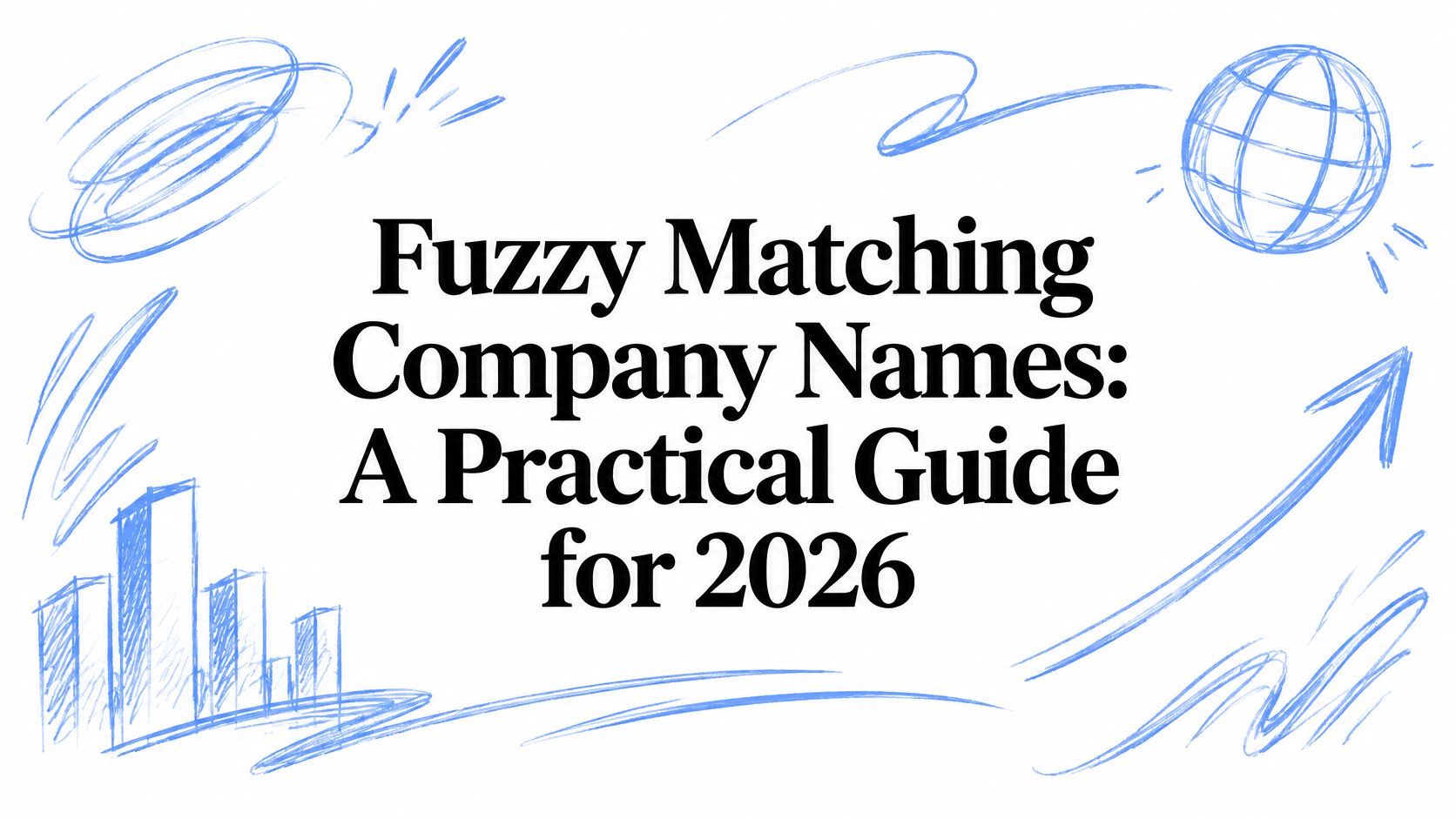
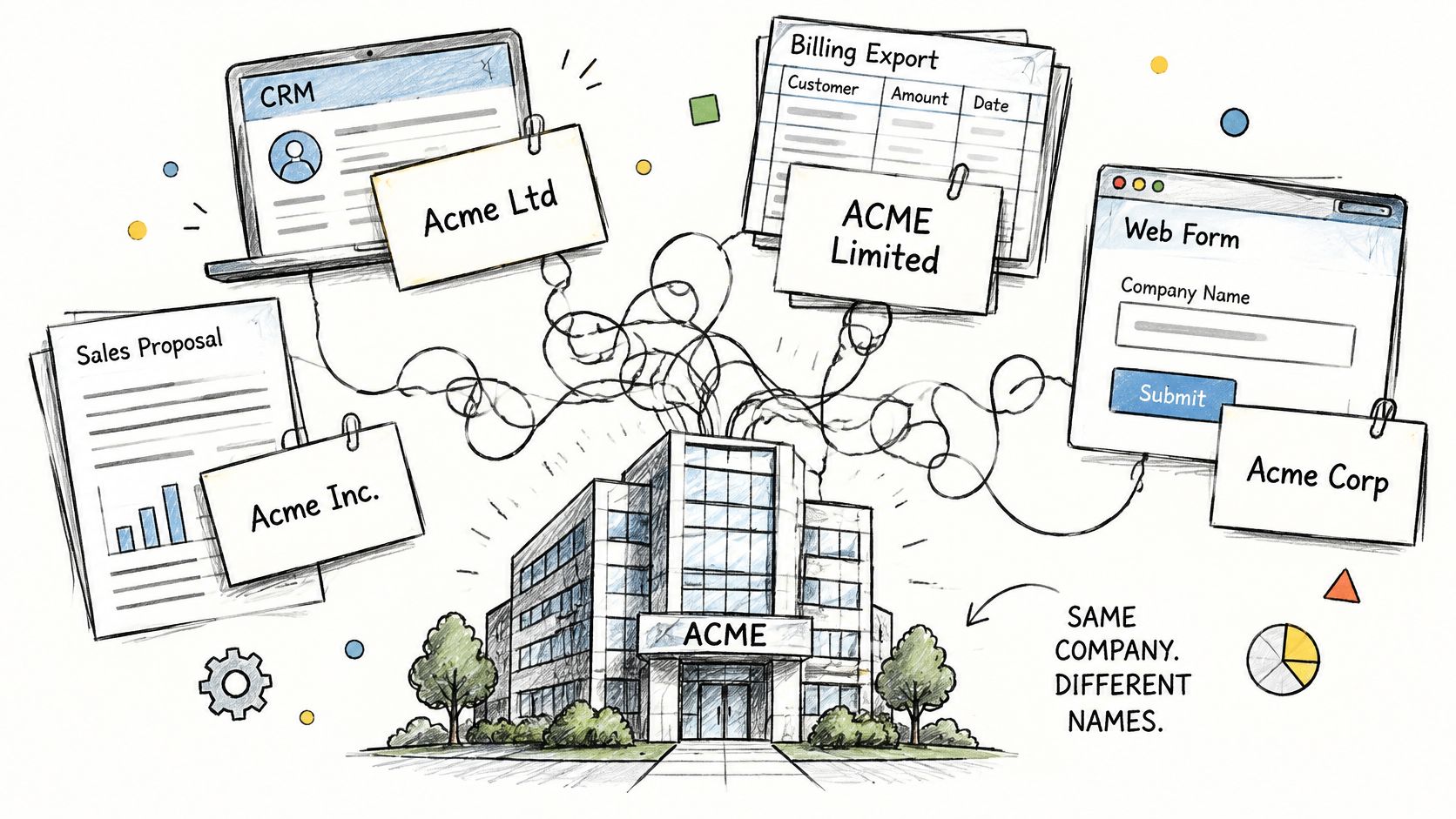
Your CRM has duplicate accounts, your billing export uses different company names, and a signup form has added another spelling. You can compare the strings, but the difficult decision comes afterward: should you merge the records, keep them separate, or ask someone to review them?
Fuzzy matching company names helps you find plausible connections despite inconsistent text. A safe pipeline goes further: it checks independent evidence, preserves ambiguity, and stops a convincing name score from becoming an incorrect company identity.
Table of Contents
- Why the Same Company Gets Several Names
- How to Normalize Company Names Before Comparing Them
- Choosing a Similarity Measure for Company Names
- Blocking Candidates Without Losing True Matches
- Setting Thresholds and Review Bands
- When a High Score Still Means Different Companies
- Using Matching in Enrichment and Compliance Workflows
- Launch Go or No-Go Checklist
Why the Same Company Gets Several Names
Say a single firm appears as Acme Ltd, ACME Limited, Acme Corp and Acme Inc. across a CRM, a billing export and a web form. Your colleagues know which business they mean, but an exact comparison sees different strings. The catch is that those suffix differences could also describe separate legal entities, so you can't assume they're harmless.
These inconsistencies often originate in separate systems:
Common company name variants and why exact matching fails
| Variant type | Example pair | Why exact matching fails |
|---|---|---|
| Legal suffix | Acme Ltd vs Acme Limited | Suffix strings differ although the firm is the same |
| Punctuation and spacing | A.B.C. Consulting vs ABC Consulting | Dots and spaces create different tokens |
| Abbreviation | Intl Logistics vs International Logistics | Short forms replace full words |
| Transliteration | Beijing Tools vs Peking Tools | One Chinese name has several Latin spellings |
| Word order | Global Services vs Services Global | Token position changes the whole string |
| Trading or former name | Acme Trading vs Acme Holdings after a merger | Same firm, different registered label, if continuity is verified |
| Typing error | Northwnd Traders vs Northwind Traders | A single letter is missing |
These are hypothetical variants, not evidence that any similarly named businesses are identical. Legal suffixes require interpretation within a jurisdiction; trading and former names require documented continuity. Transliteration needs known alternatives rather than an assumption that similar Latin spellings establish identity.
A name is a label, not an identifier
Company-name matching belongs to record linkage, determining whether separate records describe the same underlying business. The probabilistic framework formalized by Ivan Fellegi and Alan Sunter in 1969 weighs agreement across fields and distinguishes matches, non-matches and uncertain pairs, as described in this record-linkage review.
That distinction matters: a fuzzy score measures resemblance between strings, not legal identity. Agreement on independently sourced addresses, telephone numbers or identifiers strengthens the decision.
The practical output isn't just a cleaned name. It's a normalized name, candidate set, comparison score and review decision, with enough evidence to explain the result.
How to Normalize Company Names Before Comparing Them
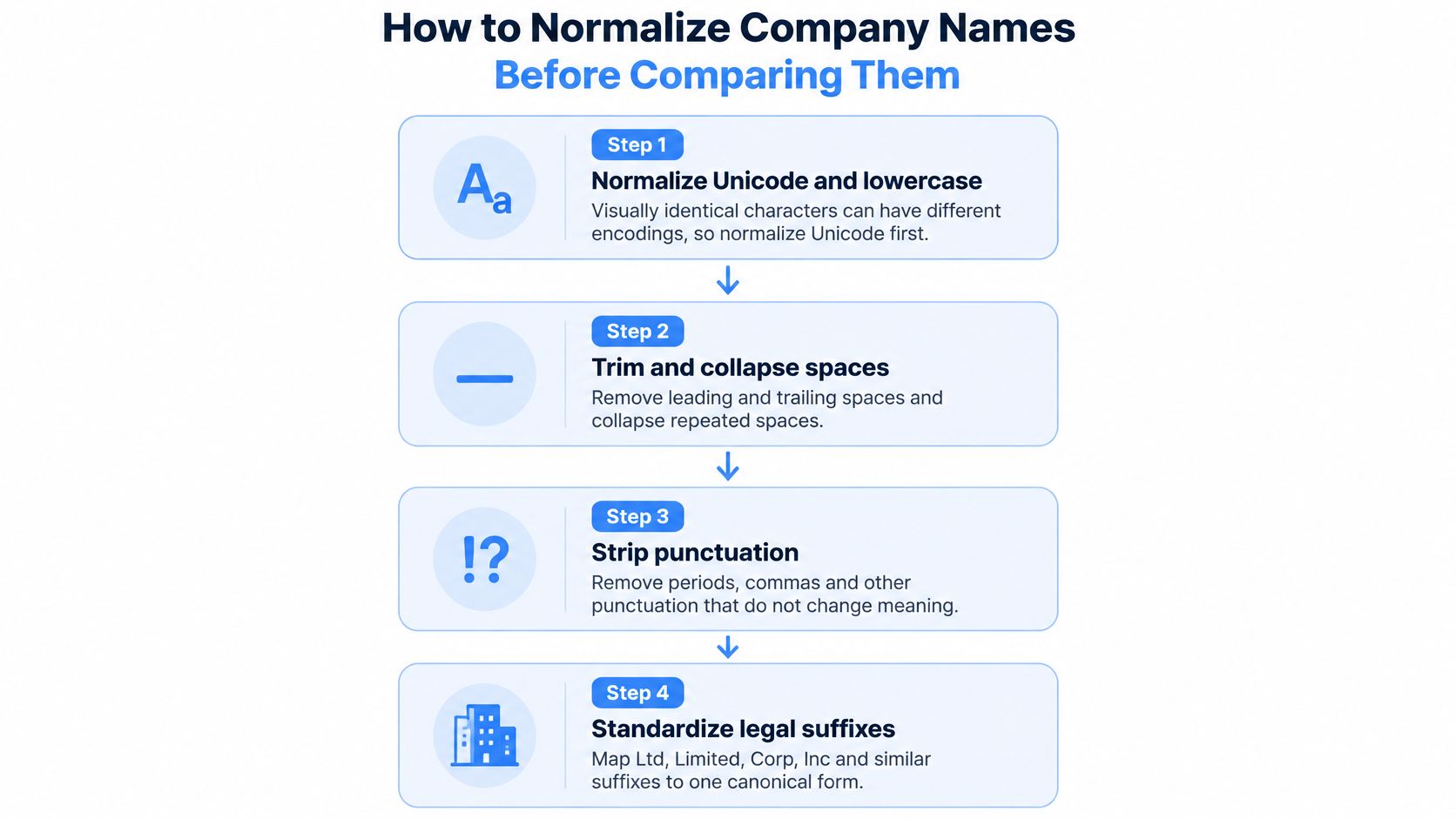
Normalization makes equivalent formatting comparable without erasing useful differences. Run the same versioned routine on incoming records and reference records, and keep changes reproducible.
The basic formatting sequence looks like this:
Keep cleaning separate from interpretation
Normalize Unicode and lowercase the comparison value. Visually identical characters can have different encodings, so use an agreed Unicode normalization policy before case normalization. Don't remove accents indiscriminately, retain an accent-preserving representation alongside any simplified comparison copy.
Preserve the raw name separately. Store the original input before transforming it so reviewers can reconstruct what arrived. Overwriting that value makes a questionable normalization rule difficult to investigate.
Handle punctuation and collapse whitespace. Remove periods inside dotted abbreviations so A.B.C. becomes ABC, and trim repeated spaces. Don't replace every punctuation mark identically: a separator between words may need a space rather than deletion.
Extract legal-form tokens into their own field. Recognize ltd, gmbh, inc, sa and llc using jurisdiction-aware rules, then retain their canonical forms separately. Deleting suffixes permanently prevents later checks of potentially meaningful legal differences.
Expand abbreviations through a local dictionary. Map intl to international and svcs to services when those meanings are appropriate for the market. Avoid global replacements inside words or ambiguous expansions that change a legitimate name.
Create transliteration variants without discarding the original. Use an agreed scheme and store documented alternative spellings beside the canonical representation. Don't treat transliteration as translation or assume every similar rendering refers to the same organization.
Sort or de-duplicate tokens only in comparison copies. These representations help order-insensitive metrics compare reordered names. Keep the stored canonical name in its original word order, because sorting destroys information reviewers may need.
Practical rule: Make normalization reversible through retained fields, not through guesswork.
Aggressive removal of generic words is a common mistake. If you strip Services and International from Global Services International, you're left with Global, a weak basis for distinguishing unrelated firms.
A clean output might contain canonical_name as acme, legal_form as ltd, an independently supplied country_code, and raw_name as ACME Limited. Keep aliases and comparison tokens alongside those fields rather than squeezing every representation into a single supposedly perfect string.
Choosing a Similarity Measure for Company Names
Choose a measure for the variation you're trying to detect, not because its score looks intuitive. The following comparison gives you a starting point, but none of these measures establishes identity on its own.
Similarity measures compared on company names
| Measure | Good at | Weak at |
|---|---|---|
| Edit distance (Levenshtein) | Single-character typos and small spelling slips | Penalises reordered words |
| Jaro-Winkler | Short names and shared prefixes | Overrates names that share a common opening word |
| Token set ratio | Reordered words and extra descriptors | Inflated by shared generic tokens |
| Character trigram cosine | Abbreviations and partial overlap | Noisy on very short names |
| LCS or Smith-Waterman alignment | Order-robust comparison of long names when combined with token-aware processing | Costlier to compute at scale |
| Embedding similarity | Cross-language and semantic variants | Opaque scores that need calibration |
What each score can miss
Levenshtein distance counts edits needed to transform one string into another. It's useful for Northwnd versus Northwind, but Services Global requires substantial editing to become Global Services despite containing identical words.
Jaro-Winkler emphasizes matching characters and shared prefixes. That can help with short spelling variations, but a common opening word such as International can receive more credit than it deserves.
Token set ratio compares word overlap without relying on the original order. It's useful when descriptors appear or disappear, but shared generic tokens can conceal a meaningful difference such as a missing subsidiary name.
Character trigram cosine compares overlapping character fragments. It can recover partial spelling overlap, but short names such as Atlas and Nova offer limited evidence, and unrelated fragments can dominate the result.
LCS and Smith-Waterman identify shared sequences or local alignments. They can help with longer names containing inserted material, but their raw forms aren't invariant to word order; use token-aware preprocessing or combine them with order-insensitive features.
Embedding similarity can retrieve semantic or cross-language candidates. Its failure mode is conceptual resemblance: businesses in the same industry may have related names without sharing an identity.
Combine signals instead of choosing a winner
Consider Northwind Traders Ltd against Traders Northwind Limited. Raw edit distance penalizes the reordered text, while a token-based comparison recognizes the shared core after legal forms are separated. Neither result resolves whether the records describe the same registered business.
For an initial Python implementation, use RapidFuzz for character and token comparisons and a character n-gram vectorizer for broader retrieval. Compare registration identifiers exactly after format validation, and parse addresses into components rather than treating them as company-name text.
Test every feature on labeled pairs before assigning it weight. A weighted model or supervised classifier should learn which combinations are useful, rather than treating different algorithms' scores as interchangeable probabilities.
Blocking Candidates Without Losing True Matches
A true pair excluded during candidate generation never reaches the scorer. You can improve the model indefinitely and still miss that company if your search rules never retrieve it.
The Statistics Canada paper on scalable business-name linkage examines blocking alongside different similarity representations. The engineering trade-off is direct: broader retrieval increases comparison work, while narrower retrieval risks excluding valid candidates.
Blocking cascade from cheapest to most expensive
| Stage | Blocking key | Main purpose |
|---|---|---|
| 1. Exact domain | Verified company domain | High-confidence candidate links at minimal cost |
| 2. Exact name | Normalized name plus jurisdiction | Catches clean duplicates quickly |
| 3. Candidate blocks | Shared character trigrams or rare tokens | Recovers variants with high recall |
| 4. Scored shortlist | Fuzzy features plus headquarters and industry | Ranks candidates and exposes the runner-up margin |
Make the cascade additive
Start with verified-domain candidates, then retrieve exact normalized names within the relevant jurisdiction. For unresolved records, add candidates sharing informative tokens or character trigrams before applying more expensive comparisons.
Don't require every candidate to satisfy every stage. That turns a high-recall cascade into a restrictive intersection, excluding records with missing domains or imperfect country fields.
Also distinguish candidate evidence from identity proof. A corporate group may share a website, and a company may change domains; domain agreement makes retrieval efficient but doesn't settle every legal-entity question.
Measure retrieval separately from decisions
Track these independently:
- Blocking recall: How many labeled true matches reach the shortlist?
- Candidate-set size: How much comparison work does each input create?
- Precision: How many accepted matches are correct?
- Recall: How many true matches does the complete pipeline recover?
- F1: How does the system balance precision and recall?
Inspect candidate-set size by market and name type. Common words such as Services can generate large blocks, while an overly strict country filter can exclude cross-border aliases.
Store the winning candidate, runner-up margin, feature scores and source fields. A close race between plausible candidates deserves different treatment from a clear winner, even when the highest score is identical.
Setting Thresholds and Review Bands
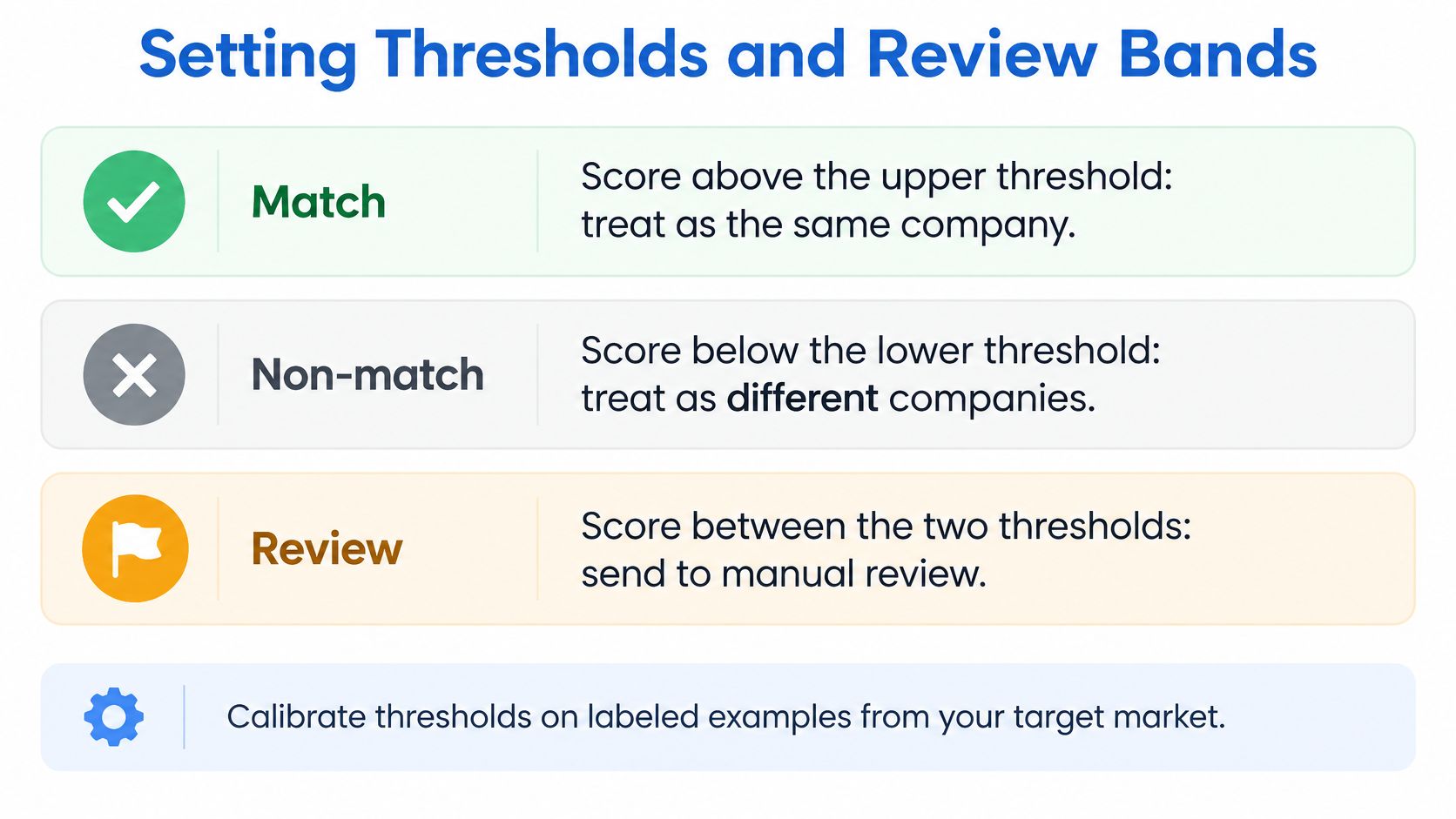
Your classifier needs match, non-match and review outputs. Treat review as an intentional decision, not as a temporary failure to choose.
The Deutsche Bundesbank technical report on company-data linkage combines multiple string-comparison features with name, address and other evidence in supervised classification. That approach supports calibrating decisions on the target dataset instead of selecting a universal name-score cutoff.
Evidence patterns and the decision each one should produce
| Evidence pattern | Decision | Example |
|---|---|---|
| High name score, verified domain agrees, country agrees | Auto-match under a validated entity-specific domain policy | Acme GmbH and Acme Holding GmbH sharing one verified domain |
| High name score, jurisdictions differ, no identifier agrees | Non-match for automatic linking | Atlas Logistics in Spain vs Atlas Logistics in Poland |
| High name score built only from generic tokens | Review | Global Trading Solutions vs Global Trading Solution Ltd |
| Short distinctive name with no second field | Review | Atlas vs Atlas Bio |
| Low name score, registration number agrees | Review | Different spelling, same registration number |
These are illustrative evidence bands, not universal rules. In the opening example, a shared group domain must not authorize a parent-subsidiary merge; auto-match requires a validated mapping to the intended entity level.
Calibrate against labeled decisions
Build a sample covering each country, entity type and difficult name pattern. Include true matches, unrelated lookalikes and ambiguous records, and define whether you're resolving a legal entity, brand or corporate group before labeling.
Use ground truthing to make those labels defensible. As a practical starting exercise, review a few hundred labeled pairs per market and entity type, then expand segments containing rare variants or short names.
Report the labeled-pair count beside every precision figure. A segment containing only a few dozen pairs can't reliably distinguish 90 percent precision from 70 percent precision without examining uncertainty, sampling design and the accepted-match count; treat those percentages as an illustrative comparison, not a measured result.
The decision bands should apply to combined evidence:
Budget for abstention
Set an upper acceptance threshold and lower rejection threshold on held-out labeled examples. Add conflict rules so a strong name score can't override incompatible identifiers.
The review queue should show the top candidate, runner-up, agreeing fields, conflicting fields and source provenance. Record how many pairs enter that band, because choosing a threshold also commits your team to a reviewer workload.
When a High Score Still Means Different Companies
A high score can be the error, not the reassurance. When you merge unrelated companies because their names look convincing, you can misroute leads, combine revenue, distort account hierarchies and attach compliance decisions to the wrong organization.
A U.S. Census Bureau research application reported matches to Census business records for 45% of Massachusetts Business Response Register records and 40% of California records, illustrating the difficulty of linking external files without shared, disambiguated identifiers. Its methodology used multiple passes combining fuzzy names and addresses with employer identification numbers, telephone numbers, industry codes and location.
Three cases that deserve skepticism
- Generic names: United Services, Global Technology and ABC Holdings can describe unrelated businesses. Use a business address lookup to obtain location evidence, then evaluate its source and relevance rather than accepting a name alone.
- Subsidiaries and brands: A subsidiary can resemble its parent and use the same website while remaining a separate legal entity. A brand can also span multiple operating companies, so the correct relationship may be owned by rather than same as.
- Multilingual and cross-border records: Alternate English transliterations and jurisdiction-specific legal names can obscure continuity. WatersTechnology's coverage of entity resolution discusses these difficulties, including multiple English transliterations associated with Chinese state-owned enterprises.
Similar names can justify investigation without justifying a merge.
Preserve identity and relationship separately
Name-variant matching asks whether alternative labels refer to the same entity. Corporate-relationship resolution asks whether distinct entities are connected through ownership, branding or organizational structure.
Represent those outcomes separately. Keep registration numbers together with their issuing jurisdictions, validate tax identifiers and LEI codes, and use ownership records when establishing corporate relationships.
When the evidence doesn't support a decision, retain multiple plausible candidates and record unknown. That's more useful than a forced link that downstream teams mistake for verified identity. A stricter name threshold won't repair a model that confuses corporate relationships with duplicates.
Using Matching in Enrichment and Compliance Workflows
Start with a CRM record containing only an email and a name. At Fetchin, our B2B data API supports CRM enrichment that fills in role, seniority and employer, giving your application more context than a free-text company label.
The enrichment flow connects incoming records with structured company information:
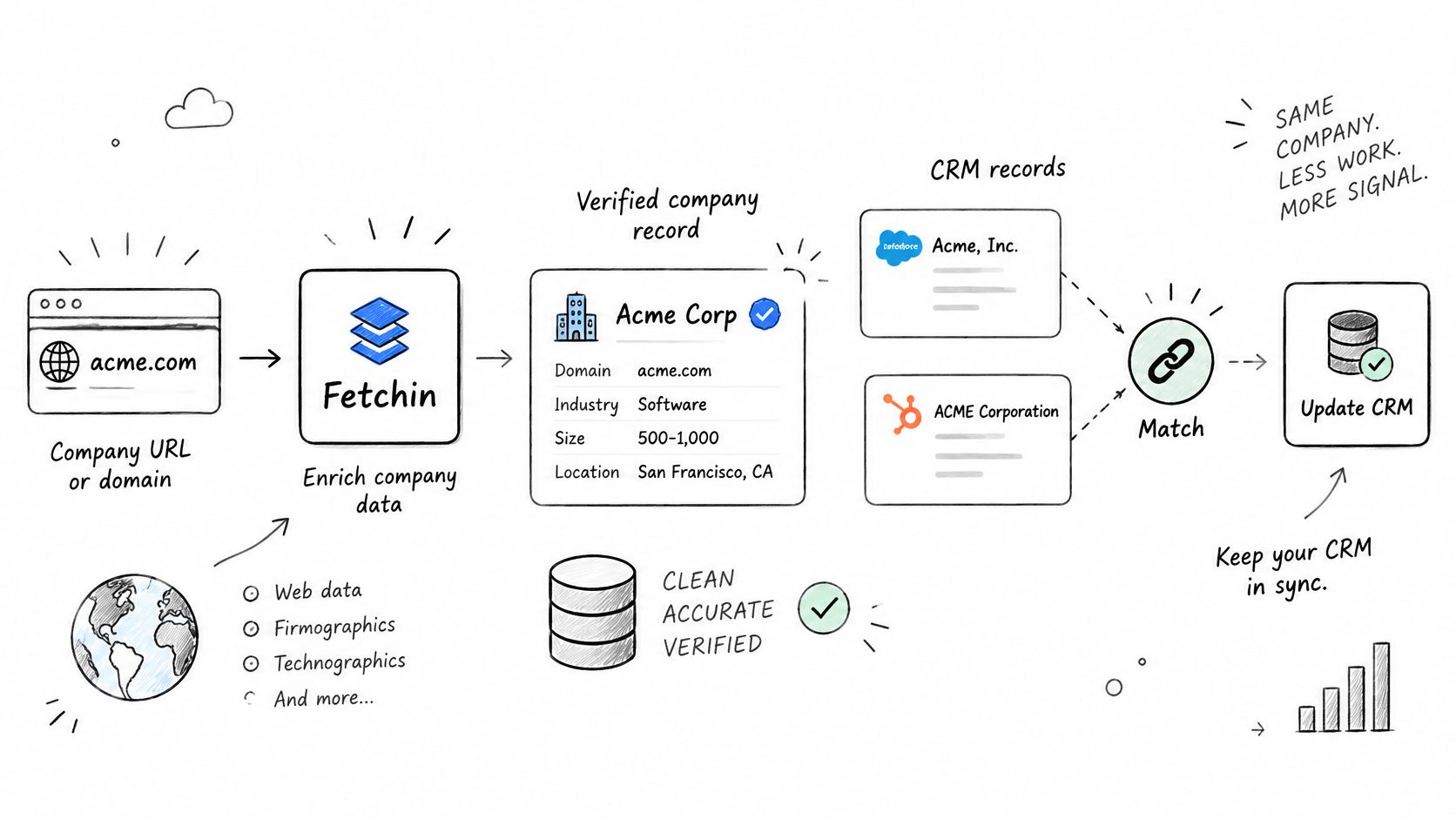
Our company enrichment provides firmographics from a company URL or domain. Use an available verified company domain as the strongest initial blocking key for this workflow, falling back to names when that anchor is missing, while preserving legal-entity distinctions.
For integration planning, the company data enrichment guide provides context for connecting returned attributes to existing records. A company batch entry that isn't found or couldn't be fetched costs nothing, allowing candidate checks without paying for those misses.
Separate enrichment from permission to process
When evaluating complementary datasets, SignalVan's sales database comparison is a useful resource for comparing sales-data options. Evaluate whether each source supplies the identifiers and provenance your resolver needs, not just whether it returns more fields.
The EU's GDPR guidance for businesses distinguishes legal-entity information from information identifying natural persons, including professional email addresses and business telephone numbers. Matching company names therefore isn't automatically equivalent to processing personal data, but attaching identifiable employee information changes the assessment.
Document purpose, fields, sources, retention, access controls and lawful basis. Separate legal-entity attributes from employee-level fields so reviewers can understand which controls apply.
This demonstration provides additional product context:
Make decisions auditable
Write an audit record containing the normalized input, candidates considered, feature scores, threshold, outcome and timestamp. Retain source provenance and pipeline versions, but restrict access and apply defined deletion rules rather than retaining identifiable contact data indefinitely.
The European Commission's GDPR principles provide the basis for purpose limitation, data minimization, accuracy, storage limitation and security. An audit trail should support those controls, not become an uncontrolled duplicate database.
Launch Go or No-Go Checklist
Use this gate before matching results update accounts, trigger routing or attach contact information. A successful API response isn't enough: the returned identity must agree with your intended entity definition.
Confirm operational readiness
- Sample coverage: Confirm that labeled examples cover every market and entity type you'll route, with segment counts sufficient to evaluate performance.
- Candidate recovery: Check blocking recall before tuning thresholds. Investigate known true pairs missing from the shortlist.
- Decision quality: Confirm that segment-level precision, recall and F1 meet your chosen targets, and staff the review queue for its measured volume.
- Audit completeness: Verify that every decision writes the normalized input, candidates, feature scores, threshold, outcome and timestamp.
- Change control: Schedule another labeled evaluation whenever you introduce a market or source.
Run the decisive batch
Make a live company-enrichment call on a small batch of verified domains. Compare returned records against your labeled examples, inspect ambiguous corporate groups, and check that not-found company batch entries aren't billed.
Release gate: No production routing until identity checks, review handling and billing behavior pass together.
If the batch fails, return to candidate generation, evidence rules or thresholds. Don't adjust the scorer alone to hide a retrieval or identity-definition problem.
Fetchin offers company enrichment from a company URL or domain, helping you anchor fuzzy name candidates in structured firmographics. Visit Fetchin to test a small batch of verified companies and validate the returned records before connecting matches to your production workflow.