Ground truthing is the systematic collection of independently verified observations used to determine whether an inferred result reflects reality. In practice, those observations support interpretation, calibration, and accuracy assessment, whether the system analyzes satellite imagery, machine-learning outputs, or B2B records.
A product team can learn this lesson from a single failed enrichment job. The integration returns structured JSON, the schema validates, and the dashboard looks complete. Then sales discovers that a contact changed roles, a company record points to the wrong organization, or a person is attached to a business that no longer exists.
The response wasn't necessarily malformed. The deeper problem is that nobody had an independent reference for deciding whether the returned fields were still accurate. That's the practical definition of ground truthing for a B2B data workflow: compare an inferred or fetched result with documented evidence, record the disagreement, and decide how the system should respond.
Table of Contents
- The Stale Record Problem Every B2B Team Faces
- What Ground Truthing Actually Means
- How Ground Truthing Works in Practice
- Live Fetching Versus Cached Snapshots for B2B Verification
- Common Pitfalls That Hide Behind the Term Ground Truth
- Building Trustworthy B2B Datasets with Verification Controls
The Stale Record Problem Every B2B Team Faces
A valid response can still be wrong
A B2B data API can return a perfectly structured record with a name, title, company, location, and other attributes. JSON validity only tells you that the response fits a format. It doesn't prove that the person still holds the role, that the company still operates under the same identity, or that the URL resolves to the intended entity.
That distinction becomes painful inside a live product. A recruiting platform may route a candidate to the wrong hiring team because an old title remains attached to the profile. A sales application may assign an account to the wrong segment because a company's industry or headquarters is outdated. An AI agent may then use those fields to write a confident message, even though no one has verified the underlying record.
Practical rule: A complete record isn't the same thing as a trustworthy record.
Ground truthing gives the team a reference standard. For a professional profile, that reference might be a current public page, an authoritative company page, a direct confirmation, or a qualified human review. For a company, it might include a verified domain, an official business source, or another documented reference appropriate to the field. The source must be independent enough to test the returned result rather than just repeat it.

Confidence needs an evidence trail
The point isn't to verify every field with the same intensity. A stable location may need a lighter check than a role used to trigger an automated workflow. What matters is that the team can answer a basic question tomorrow: what evidence supported this value, and when was it checked?
That question separates disciplined verification from a labeling exercise that merely creates more rows. The rest of the work follows from it: define the reference, sample records properly, keep evaluation data independent, and count errors by field and class rather than hiding them inside one broad quality score.
What Ground Truthing Actually Means
Start with the distinction
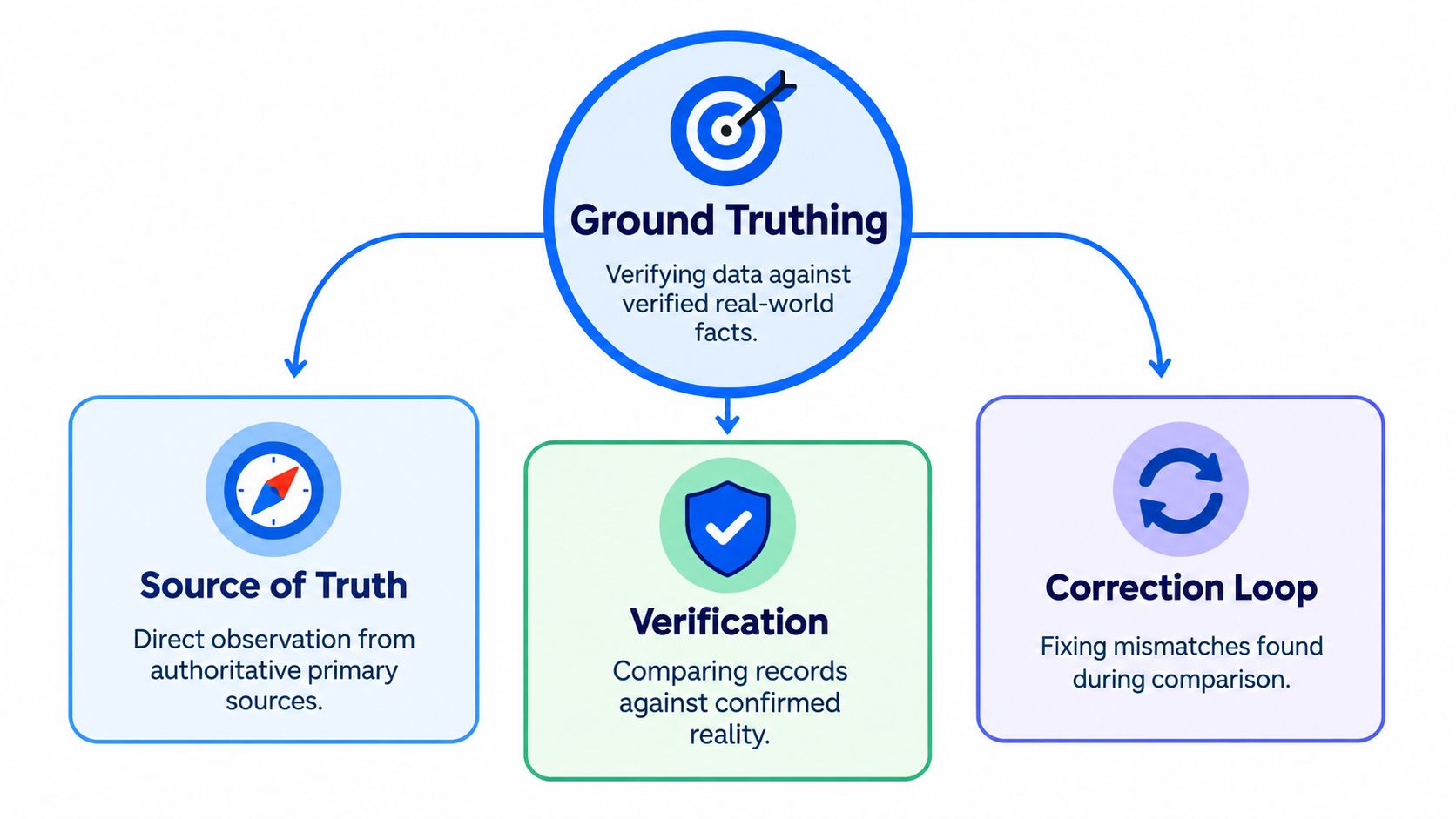
A model, rule, or API response produces an inferred result. Ground truthing creates or acquires reference data that can credibly adjudicate that result. It isn't collecting more data, copying a second provider, or asking the same automated process to confirm itself.
Suppose a system predicts that a professional profile belongs to a senior finance role. The prediction may come from text classification, pattern matching, or an enrichment response. Ground truthing checks that prediction against independent evidence established through direct observation, authoritative records, a calibrated measurement process, or qualified expert review. If the evidence disagrees, the disagreement becomes a recorded error, not an inconvenient result to ignore.
In remote sensing, field observations at an imaged location are compared with satellite or aerial data. Those observations help analysts interpret imagery, calibrate remote sensors, and assess image classifications, as described in the reference definition of ground truth. The same logic transfers to B2B data. A returned title is an inference or observation from a system. A separately checked source is the reference used to judge it.
Independence is the structural requirement
If the same record helped produce the output and later appears in the evaluation set, the result can look better than it is. The reference must remain sufficiently independent from the process being tested. In machine learning, a held-out evaluation set must stay unseen during development so its labels can support an unbiased estimate of generalization performance, according to this ground-truth data explanation for machine learning.
For a B2B team, independence might mean checking a sample against a separately selected primary source rather than trusting a second transformation of the original response. It also means documenting the scope of the claim. Ground truth isn't metaphysical, perfect, or permanent. It is the best documented reference available for a defined field, time, location, population, and measurement protocol.
That's why clear language matters. Some teams use “truth” as though it means certainty. A more accurate mental model is ground reference evidence. It can be strong, weak, current, ambiguous, or wrong. A useful glossary covering support and moderation terms can also help teams standardize operational language around review, disagreement, and decision-making.
How Ground Truthing Works in Practice
A defensible workflow starts before anyone reviews a record. First, define what counts as correct for each field. “Current title” needs a different rule from “company domain,” and a free-text description needs a different review method from a categorical class.
Separate the dataset's jobs
Training, validation, and testing records serve different purposes. Training examples guide interpretation or help a supervised system learn. Validation examples help tune decisions during development. Testing examples remain untouched until the team needs an independent evaluation.
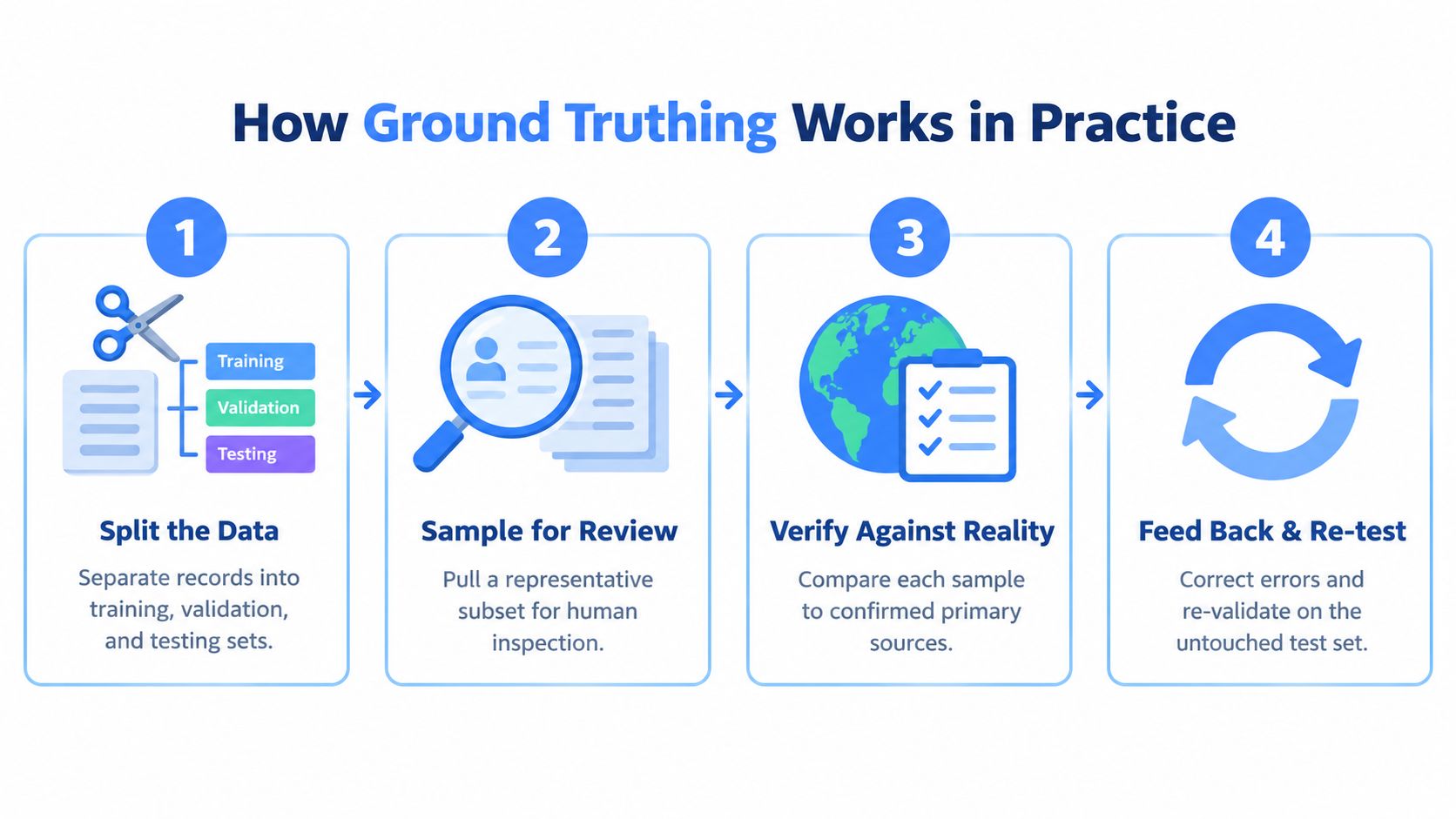
A practical workflow looks like this:
- Split the data: Assign records to distinct development and evaluation roles before model or rule changes begin.
- Sample for review: Select a representative subset, including difficult and business-critical cases rather than only convenient records.
- Verify against reality: Check each selected record against an appropriate reference and capture the evidence, location, and time.
- Feed back and retest: Correct labels or rules, then evaluate again on the untouched test set.
For B2B records, the review log should include the record identifier, field under review, observed value, reference value, source, timestamp, collection method, reviewer or sensor identity, confidence, and the adjudication decision when reviewers disagree. This provenance turns a private judgment into an auditable benchmark. The data API overview provides useful background on how structured data services fit into a product pipeline, but the verification standard still belongs to the product team.
Compare process quality, not just output quality
A weak workflow samples only records that already look clean, lets reviewers change labels without recording why, and evaluates the system on examples used during development. A strong workflow preserves the original output, records every comparison, identifies uncertainty, and keeps the final test set isolated.
For engineers, the immediate check is simple: can you reproduce why a field passed or failed? If the answer is no, the team has a reporting problem even if the aggregate dashboard looks healthy. The following video can provide additional visual context for the workflow:
A benchmark should also expose disagreement rather than flattening it. If two qualified reviewers cannot resolve a role classification from the available evidence, mark the case as ambiguous, define an adjudication rule, or exclude it from a metric that claims high certainty. Hidden uncertainty is more dangerous than visible uncertainty because downstream automation can't account for it.
Live Fetching Versus Cached Snapshots for B2B Verification
A team checking B2B data usually chooses between two operating models. It can fetch a record when the product needs it, creating a time-stamped observation tied to a specific URL. Or it can maintain an indexed snapshot and serve that stored version until the next refresh.
Neither approach is universally correct. The decision depends on how quickly the field changes, how costly stale data is, how predictable response behavior must be, and whether the workflow can tolerate a delayed refresh. A discussion of API caching for entity records is useful when designing the second model, especially for teams balancing repeat access with storage and refresh behavior.
| Criterion | Live Synchronous Fetching | Periodic Cached Snapshots |
|---|---|---|
| Freshness | Checks the source when the request occurs | Reflects the last completed refresh |
| Response latency | Depends on the live source and integration path | Often more predictable after indexing |
| Cost predictability | Can vary with request volume and verification frequency | Easier to forecast around refresh cycles |
| Rate behavior | Must handle source availability and request limits at call time | Concentrates activity during refresh operations |
| Evidence trail | Naturally records a request time and source URL | Requires snapshot timestamps and refresh provenance |
| Operational fit | Suits decisions that depend on current page state | Suits repeated reads of records that change slowly |
Choose according to the decision
Consider an automated agent deciding whether to contact a person about a current role. A live check may better match the independence principle because the response is a fresh observation associated with the request time. The trade-off is that the product must handle latency, failures, retries, and request costs without blocking the user experience.
Now consider an internal reporting view that reads the same company attributes repeatedly. A cached snapshot may be appropriate if the team records when it was collected, displays its age, and knows when the field requires re-verification. The problem starts when a snapshot is presented as current without a visible freshness boundary.
A useful data enrichment API guide can help teams think through integration patterns, but the ground-truthing question remains independent: what does this record claim, what reference supports the claim, and how old can that evidence be before the workflow stops trusting it?
Common Pitfalls That Hide Behind the Term Ground Truth
More labels don't automatically create better evidence. Reference data can contain errors introduced during collection, processing, interpretation, geolocation, or review. Treating every reference value as infallible just moves the original trust problem into a new table.
The reference can be uncertain
A reviewer may misread an ambiguous title. A source may describe a company differently from the taxonomy used by the product. A field may have changed between the reference observation and the system output. In remote-sensing work, valid accuracy assessment requires attention to sampling design, independence, measurable error, and temporal and spatial matching, not just a large pile of observations, as the USGS accuracy-assessment framework explains.
For B2B data, temporal matching is especially important. A current company page can't necessarily validate a historical record from an earlier period, and a profile checked after a role change may not tell you whether an earlier prediction was correct at the time it was made. Store the observation time instead of pretending the field has no history.
Watch for these failure modes:
- Label noise: Reviewers apply rules inconsistently, or the source itself contains an error.
- Ambiguous cases: Multiple values are defensible, but the schema permits only one.
- Class imbalance: Common categories dominate the sample while a critical minority receives little scrutiny.
- Temporal mismatch: The reference and the output describe different moments.
- Spatial or entity mismatch: The evidence belongs to a similar person, subsidiary, domain, or location.
- Evaluation leakage: Development records reappear in the final test set.
One broad score can hide the costly error
A confusion matrix compares predicted classes with reference classes and counts agreements and disagreements. It supports overall accuracy as well as class-specific measures, including producer accuracy and user accuracy, which distinguish omission-type errors from commission-type errors, according to this ground-truth fieldwork guide.
That distinction matters in a B2B workflow. A broad score may look acceptable while the system performs poorly on a small class that triggers compliance review, routes strategic accounts, or controls an expensive action. Break results down by field, class, source, time period, and confidence. Then inspect the disagreements themselves.
A university teaching resource on ground truthing and accuracy estimation makes the central caution explicit: reference data can contain collection, processing, and interpretation errors. Your benchmark needs its own quality controls.
Building Trustworthy B2B Datasets with Verification Controls
Trustworthy B2B data comes from matching verification effort to business risk. A field that only improves display quality may need automated consistency checks and occasional sampling. A field that triggers outreach, eligibility decisions, or an AI action deserves stronger evidence, clearer confidence rules, and faster re-verification.
Turn evidence into a repeatable control system
Start by assigning a reference source to every important field. Don't leave “verified” as a free-text status with no definition. Store the source, observation time, collection method, reviewer or system identity, confidence, and reason for any override.
Then build controls around the record lifecycle:
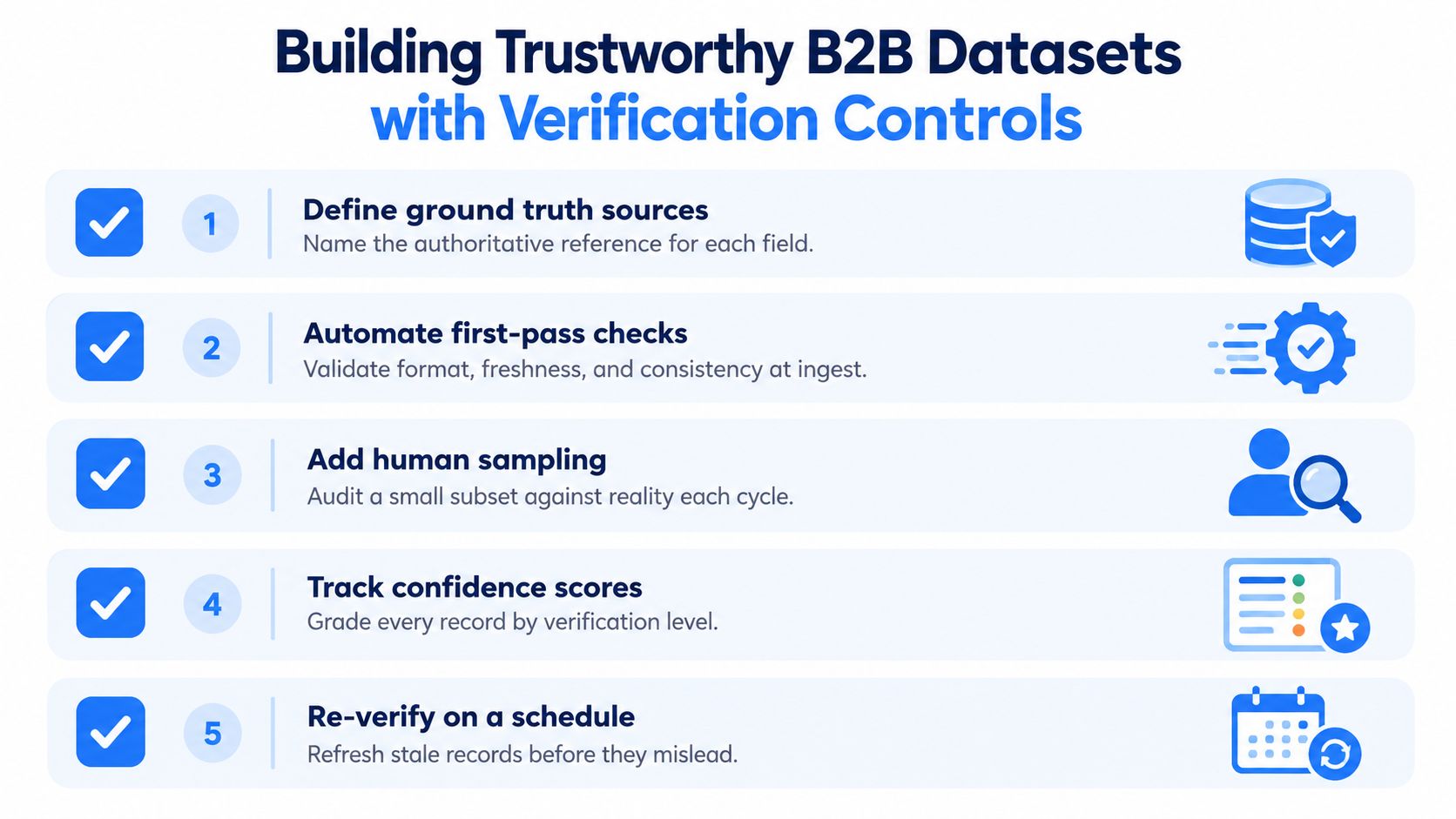
- Define reference sources: Name what qualifies as authoritative for each field and what happens when sources disagree.
- Automate first-pass checks: Validate format, consistency, entity identity, and freshness before human review.
- Add human sampling: Inspect a representative subset each cycle, with extra attention to ambiguous and high-impact records.
- Track confidence: Distinguish directly confirmed values from inferred, stale, or unresolved values.
- Re-verify on a schedule: Refresh records according to change risk rather than treating the dataset as permanent.
Make uncertainty usable
A quality flag should change what the product does. High-confidence records can support automation. Lower-confidence records can prompt review, limit a recommendation, or appear with a freshness warning. This is more useful than hiding all uncertainty behind a single green status.
Teams also need provenance that survives handoffs. The data provenance guide offers relevant concepts for tracing where values came from and how they changed. That trace helps engineers diagnose drift, helps product managers set sensible refresh policies, and gives reviewers enough context to resolve disputes.
Clean records support practical outcomes, including efforts to boost revenue with cleaner email lists, but cleanliness isn't the same as truth. A list can be well formatted and still contain stale roles, duplicate entities, or unsupported assumptions.
Ground truthing is an ongoing discipline, not a one-time labeling project. Each new source, schema change, model version, and product workflow can alter what “correct” means. Review the evidence, preserve the disagreement, and retest the controls before allowing the system to act with more confidence.
Fetchin provides a professional data API that turns professional profile and company URLs into structured JSON for B2B products and verification workflows. Use it when your team needs current public data to compare against existing records, support enrichment, or investigate stale fields. Visit Fetchin to see how it can fit into your data quality pipeline.