How much engineering time do you lose to e commerce datasets that load successfully but can't answer your actual question? A transaction file can support revenue analysis, but it won't tell you which products shoppers ignored. A review corpus can help train text models, but it isn't a substitute for search-relevance judgments or current inventory.
The right dataset matches the decision you're trying to make. For transaction analysis, prioritize invoices, customer identifiers, cancellations, and timestamps. For behavioral modeling, look for ordered events and meaningful interaction types. Search evaluation needs labeled query-product pairs, while multimodal product understanding needs usable combinations of text, images, and structured attributes.
Start with the metric, too. The distinction between revenue, orders, conversion, and customer behavior matters more than download size. Next Point Digital on marketplace KPIs provides useful context for connecting a dataset project to a business dashboard rather than collecting metrics without a decision attached.
- Transactions and analytics: GA4, Online Retail II, Online Retail, and Olist.
- Behavior and recommendations: Amazon Reviews, Retailrocket, Taobao, and Coveo.
- Search relevance: WANDS, with Coveo adding behavioral context.
- Multimodal products: M5Product.
The trade-offs below focus on what you can build, how to access the files, and which assumptions you'll need to resist. A smaller dataset with the right labels usually beats a larger one with the wrong measurement model.
Table of Contents
- 1. Google Analytics 4 Sample E-commerce Dataset
- 2. Online Retail II, UCI Machine Learning Repository
- 3. Online Retail, UCI Machine Learning Repository
- 4. Brazilian E-Commerce Public Dataset by Olist
- 5. Amazon Reviews ’23, McAuley Lab
- 6. Retailrocket Recommender System Dataset
- 7. Alibaba/Taobao Shopping Behavior Dataset
- 8. WANDS, Wayfair Annotation Dataset
- 9. SIGIR 2021 E-commerce Data Challenge Dataset, Coveo
- 10. M5Product, Multimodal E-commerce Product Dataset
- E Commerce Datasets at a Glance
- Choosing Your Dataset and Getting Live Data When Public Options Fall Short
1. Google Analytics 4 Sample E-commerce Dataset
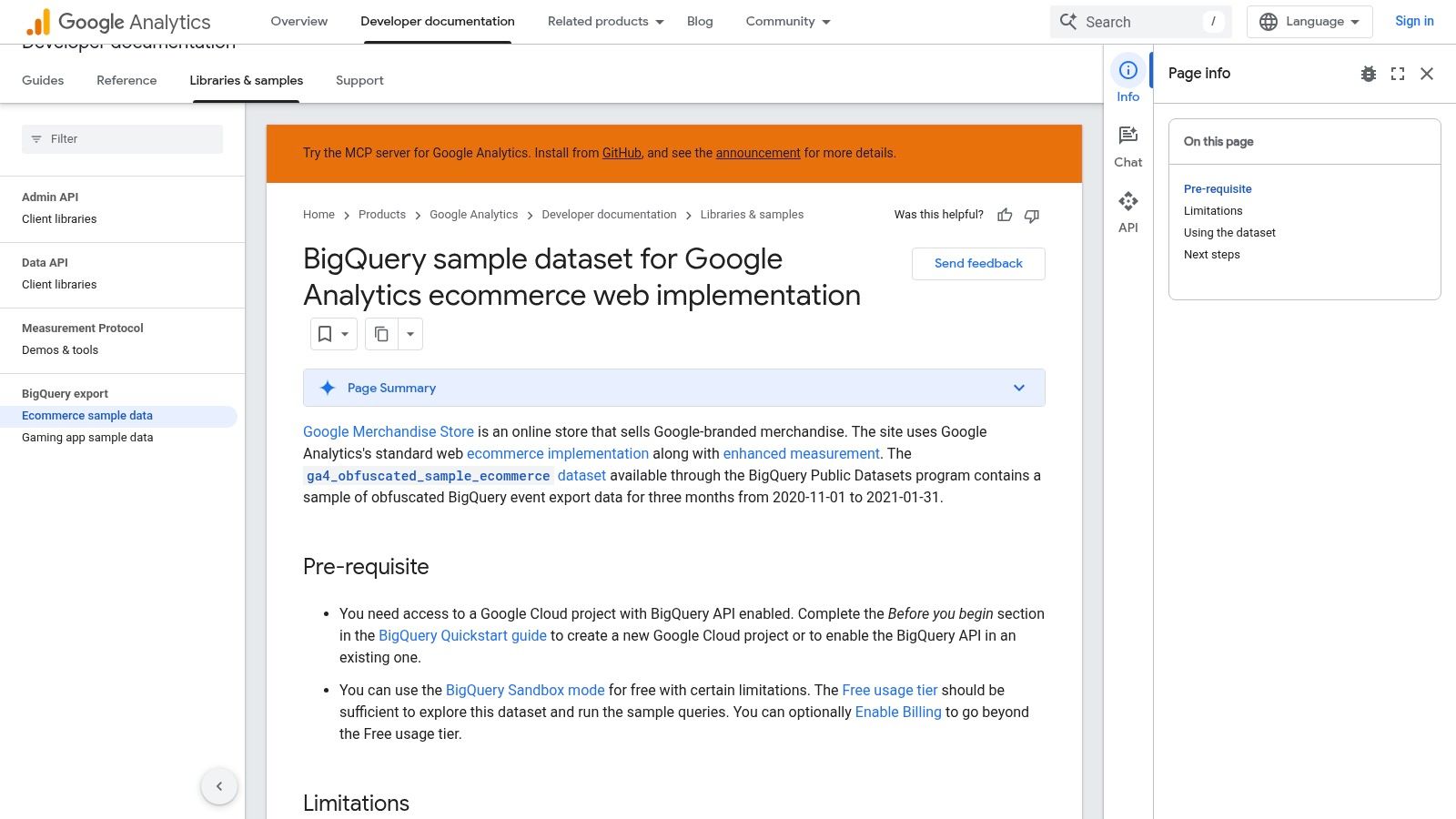
Choose GA4 for SQL practice and customer-journey analysis. The Google Analytics sample dataset documentation describes event-export data from the Google Merchandise Store covering November 1, 2020 through January 31, 2021, hosted in BigQuery.
You can query the data without downloading a large archive. Google also provides sample queries and schema guidance, making this a practical starting point for learning nested event parameters, item arrays, and funnel construction.
Where it works and where it doesn't
Build a session-level funnel, inspect product interactions, or compare event counts with purchase records. Keep event-level and item-level calculations separate: expanding an item array before aggregating can multiply records and inflate totals.
- Access: You'll need a Google Cloud project with BigQuery enabled. Sandbox or free-tier allowances may cover exploration, but usage beyond applicable limits can incur charges.
- Strength: It reflects an actual store's analytics implementation rather than a simplified teaching schema.
- Limitation: The data is obfuscated, includes placeholder values, and has limited internal consistency.
Use it to learn measurement workflows, not to establish a dependable commercial benchmark. The AdLibrarySpy enhanced ecommerce store list offers separate context on store technology adoption, but technology presence doesn't establish whether a store's events are complete or correctly implemented.
2. Online Retail II, UCI Machine Learning Repository
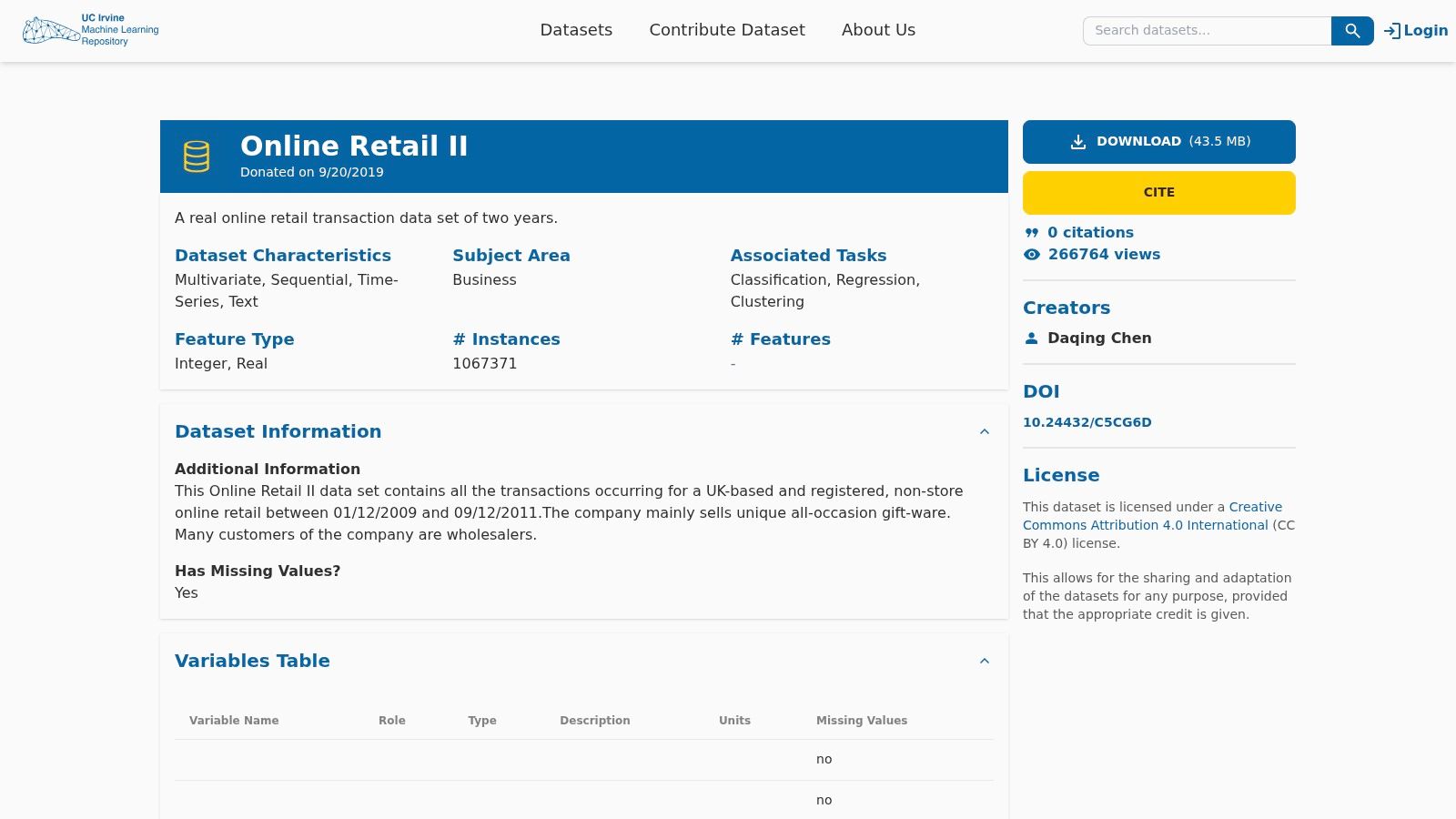
If your project starts with customer value, repeat purchasing, or product performance, Online Retail II is a strong transaction-first choice. The UCI Online Retail II listing contains 1,067,371 transactions from December 2009 through December 2011, recorded by a UK-registered non-store retailer, and offers download access under CC BY 4.0 with attribution.
Its invoice, product, quantity, timestamp, price, customer, and country fields support useful retail analysis without requiring a complex event pipeline. You can access the Excel file or use UCI's Python package, with documentation and citation guidance available.
Clean the accounting before modeling customers
Don't begin by deleting every negative quantity. Separate cancellations and order adjustments from completed purchases, preserve the original records, and define whether your revenue measure represents gross purchases or net sales.
- Best use: Customer segmentation, purchase-frequency analysis, product performance, and time-series exercises.
- Main advantage: More transaction history than the smaller Online Retail alternative.
- Main constraint: Missing values require explicit handling, and a single historical retailer doesn't represent online commerce broadly.
Keep customer identifiers as identifiers rather than continuous numerical features. Document how you handle anonymous transactions before calculating customer-level metrics.
For downstream exports, the distinction between CSV and JSON becomes practical: use flat files for invoice-line analysis and nested structures when your application needs orders containing multiple items.
3. Online Retail, UCI Machine Learning Repository
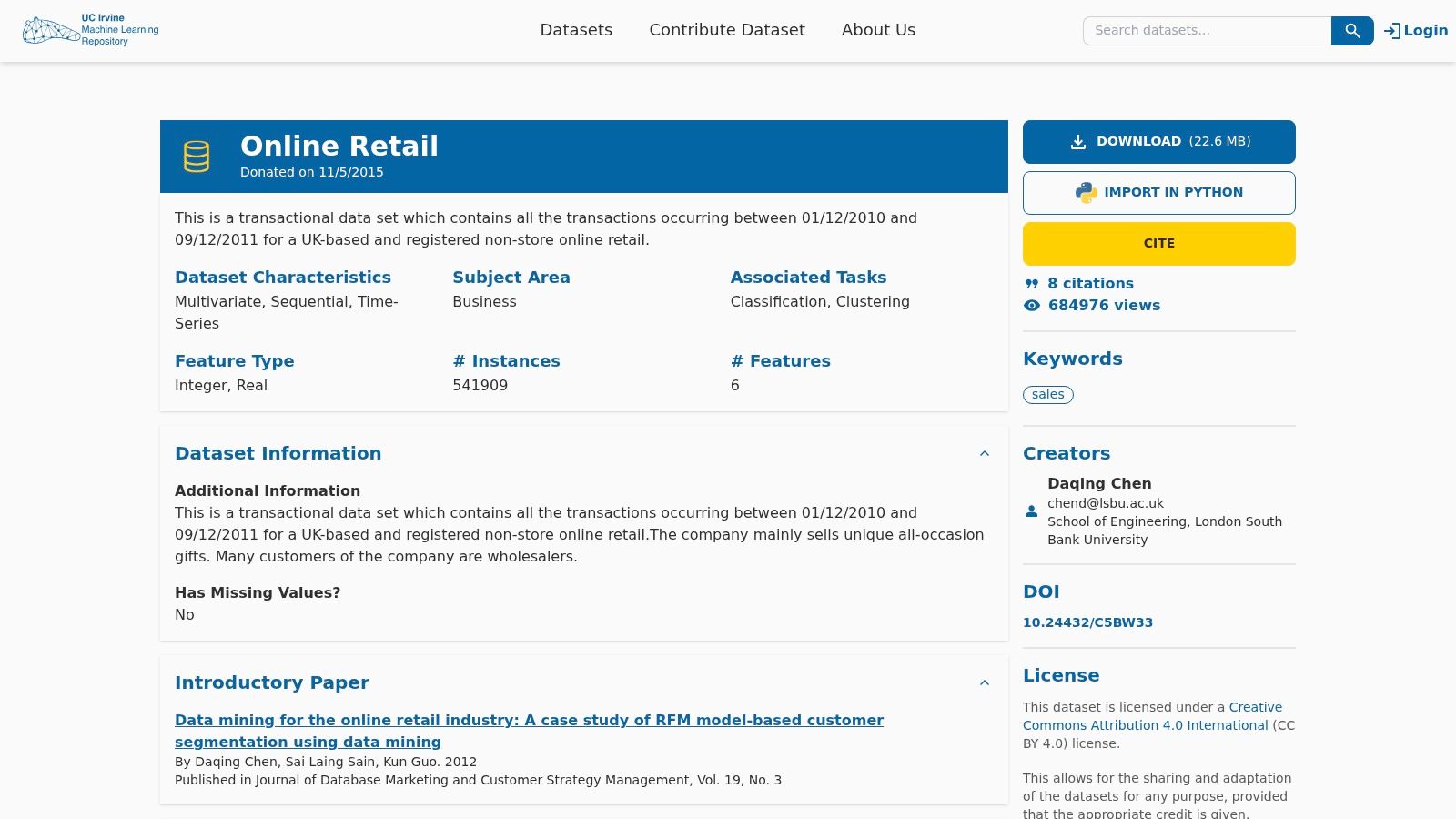
Want a transaction dataset that stays small enough for careful manual checking? The UCI Online Retail dataset covers December 2010 through December 2011, with about 542,000 rows and eight columns: invoice number, stock code, description, quantity, invoice date, unit price, customer ID, and country.
Those fields are enough for transaction cleaning, aggregation, clustering, and carefully defined classification tasks in notebooks or lightweight databases. The grain is invoice lines, so one invoice can contain several products. Treat each row as a line item, then aggregate to order, product, or customer level depending on the question.
Practical rule: Preserve the raw transaction table and build a separate analysis-ready table. You'll need to revisit cleaning decisions when totals don't reconcile.
This is the easier entry point for spreadsheet exploration and local workflows compared with Online Retail II. Its smaller scope lets you spend more time checking assumptions and less time managing files. That trade-off matters when you are learning how cancellations, missing identifiers, and repeated stock codes affect totals.
A useful first project
Create a product-performance report that separates purchased quantities, cancellations, and net revenue. Then build customer summaries using only records with usable customer identifiers, keeping excluded transactions visible in a reconciliation report. This makes the dataset useful for transaction analysis without pretending every row is complete.
- What works: Learning transaction grain, date parsing, missing-value handling, and customer aggregation.
- What doesn't: Treating every row as an order or assuming missing customer identifiers mean new customers.
- Access guidance: Download from UCI and retain the repository documentation with your project.
The main limitation is scope. It is a narrow historical dataset, so treat it as a learning set for cleaning and retail analysis rather than evidence for current shopper behavior.
4. Brazilian E-Commerce Public Dataset by Olist
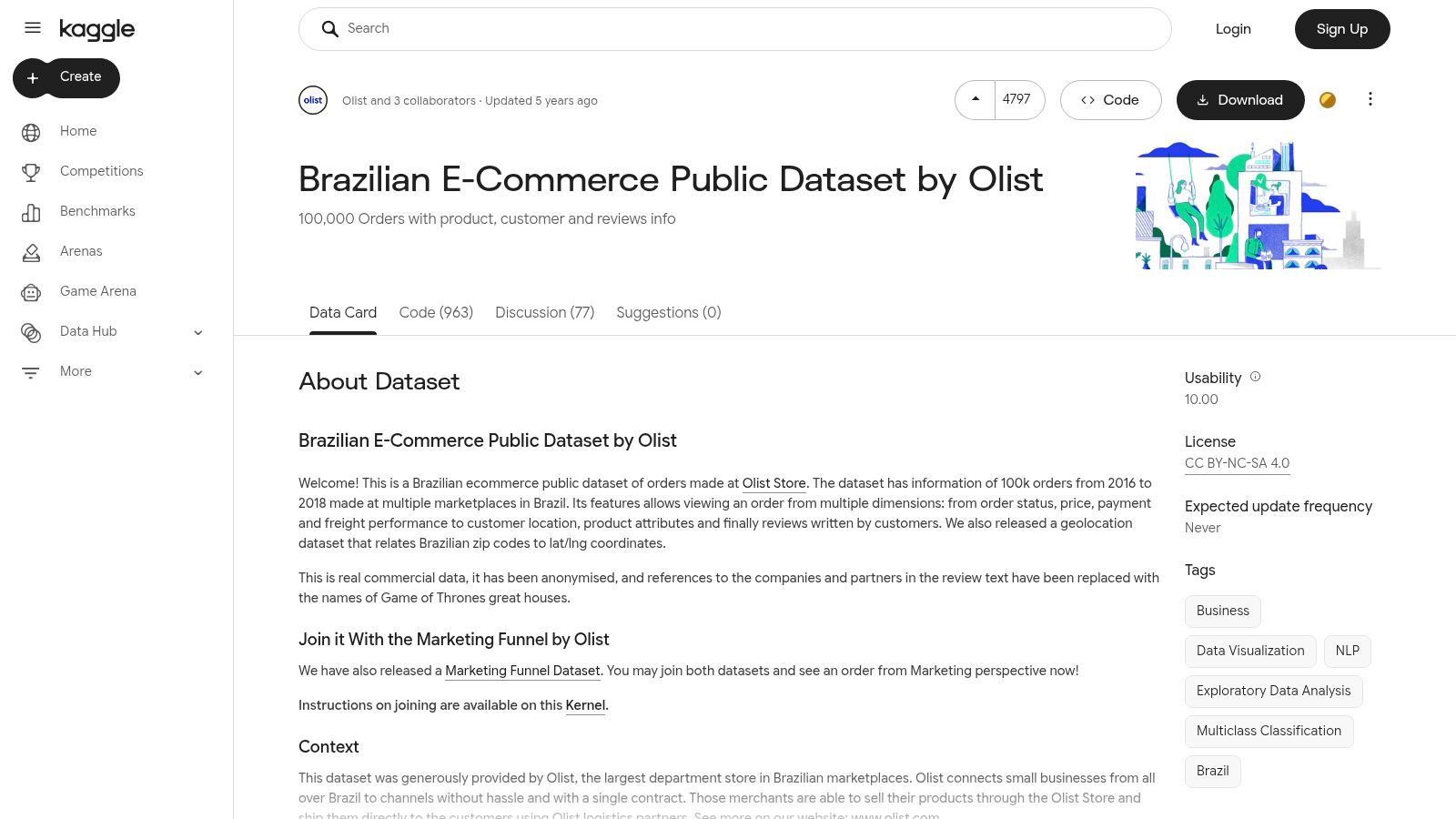
Olist is the better choice when a sales table feels too simple. The Brazilian E-Commerce Public Dataset listing describes roughly 100,000 orders from 2016 through 2018, distributed across related tables, and lists CC BY-NC-SA 4.0, which restricts commercial reuse.
You can connect orders with customers, products, sellers, payments, reviews, geolocation, and order status. That structure supports questions about delivery performance and customer feedback that invoice-only datasets can't answer directly.
The real work is controlling join cardinality
Say you want to compare delivery delays with review scores. First build an order-level delivery table, then attach an appropriately aggregated review table. Joining item rows and payment rows directly can multiply records and distort both revenue and order counts.
- Strength: Rich relational structure for SQL joins, dimensional modeling, and business-intelligence projects.
- Access: Downloadable CSV tables through Kaggle, where an account may be required.
- Limitation: The commercial data is anonymized and historical, not a source for identifying shoppers or measuring current marketplace behavior.
Keep a short record of each table's origin, grain, transformations, and permitted use. Understanding data provenance matters here because a technically correct join can still produce a misleading business interpretation.
I'd choose Olist over the UCI transaction datasets for a portfolio project demonstrating warehouse design. I wouldn't choose it merely to practice basic revenue aggregation.
5. Amazon Reviews ’23, McAuley Lab
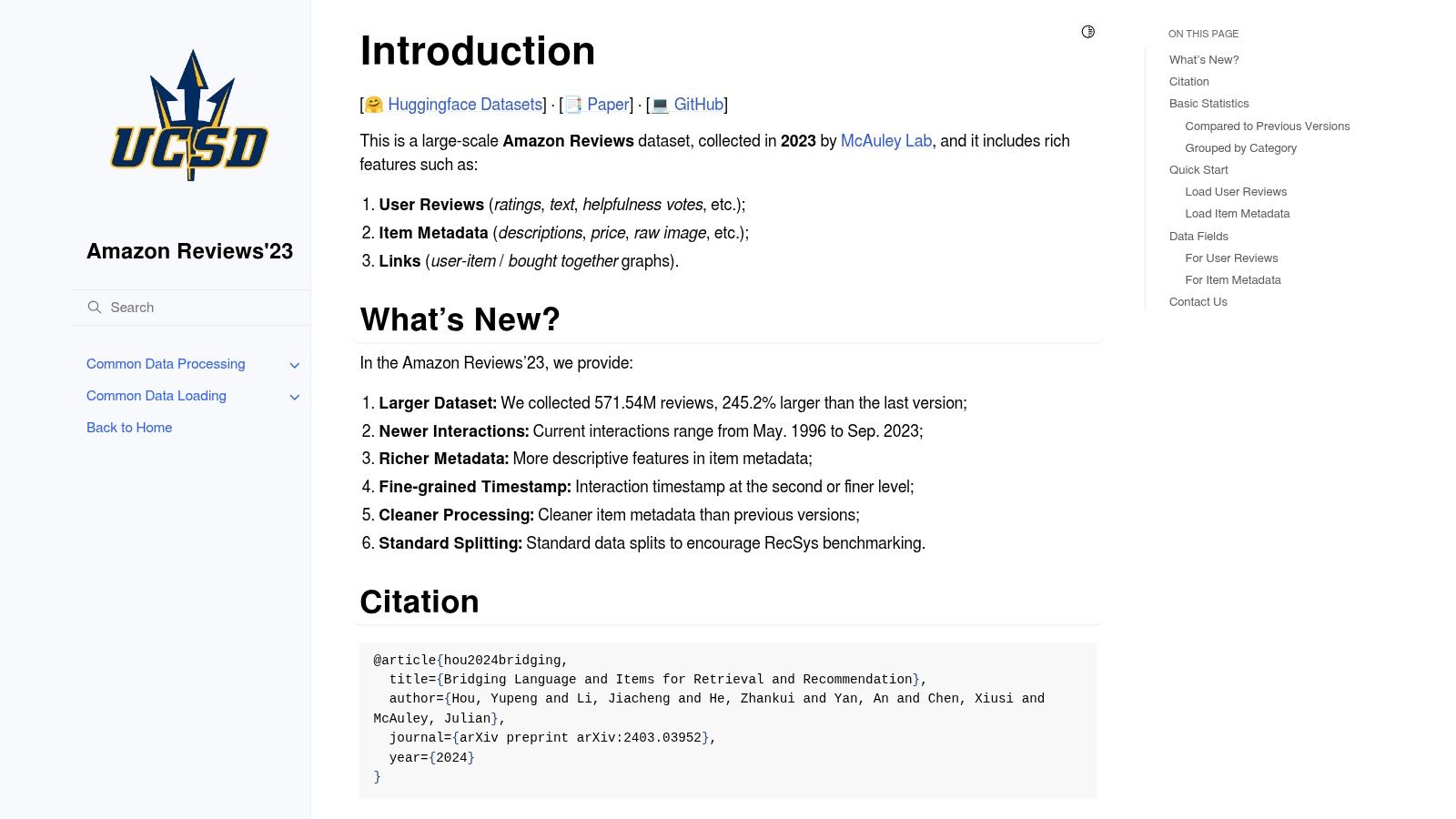
For review mining and recommendation research, Amazon Reviews ’23 offers scale and product context. The McAuley Lab project contains 571.54 million reviews across 33 categories, with interaction history spanning May 1996 through September 2023.
Available information includes review text, ratings, helpfulness information, product metadata, user-item links, fine-grained timestamps, and standardized splits. Category-specific access lets you develop a pipeline before committing to the full collection.
Start with a category that matches your intended task. Parse review and product files separately, inspect identifier coverage, and measure how many review records join to usable metadata before training.
Reviews aren't exposure logs
A review records feedback from someone who chose to leave it. It doesn't tell you which alternatives that person saw, which products were unavailable, or how the store ranked recommendations.
- Good fit: Sentiment analysis, review summarization, product representations, and recommendation experiments.
- Operational cost: Full-scale processing can require substantial storage and compute.
- Reuse boundary: Check the project's access and reuse terms before redistribution or commercial deployment.
Use time-aware evaluation when predicting later interactions, and avoid making future reviews available to historical predictions. Standardized splits are helpful, but you still need to verify that your feature construction respects them.
This is also a historical collection, not a live review or pricing service. It can support model development without supplying the current product state your application needs at serving time.
6. Retailrocket Recommender System Dataset
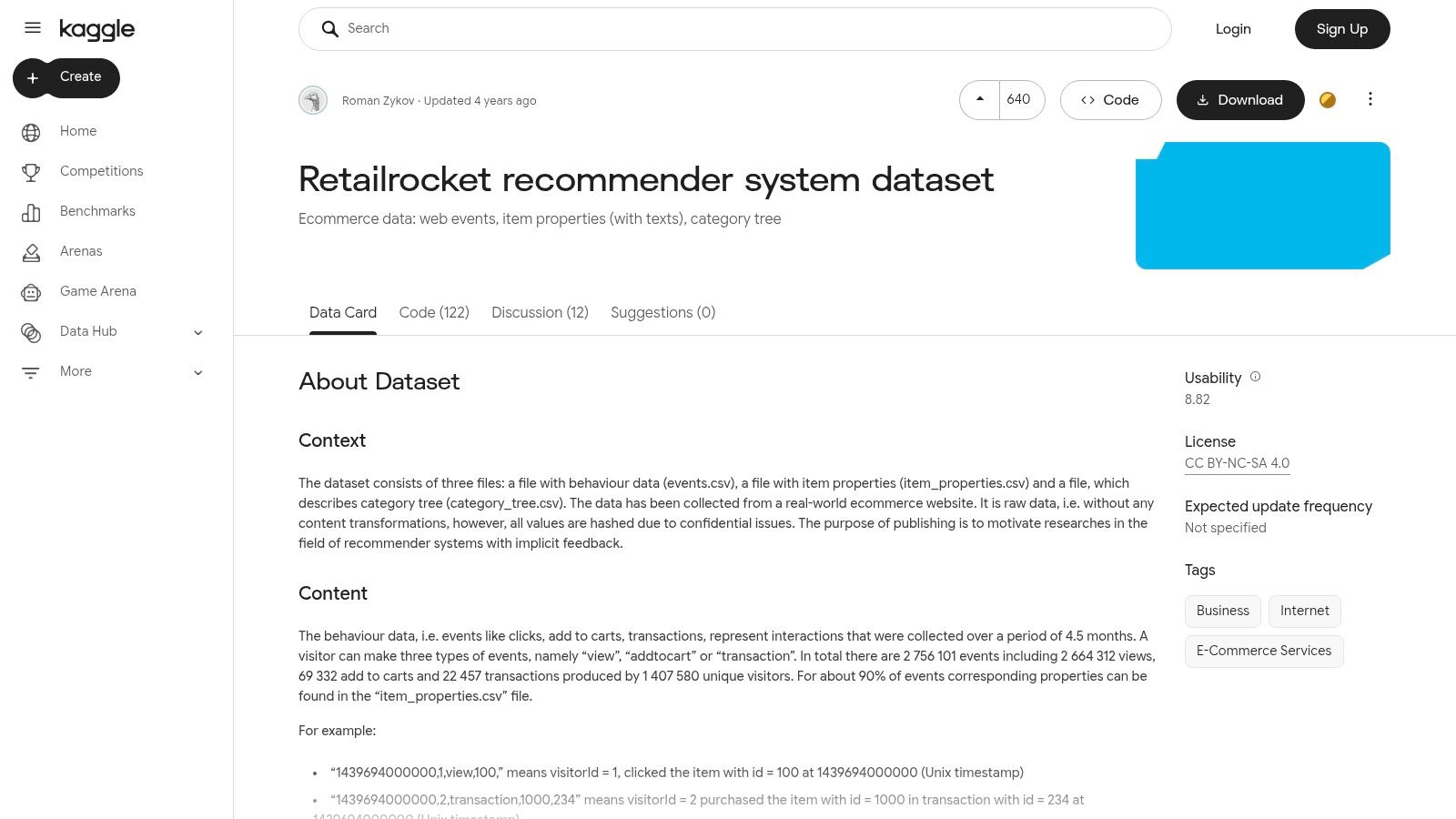
A purchase-only table leaves out much of the decision process. The Retailrocket Recommender System Dataset combines behavioral web events with item-property files and a category tree, making it useful for exploring how browsing relates to products and categories.
Choose it for event-based recommendation prototypes, especially when you want to move beyond customer-product purchase matrices. Downloadable files support local workflows, although preparing the event and product tables takes more work than loading a single transaction file.
- Behavioral value: Explore sequences of interactions rather than completed transactions alone.
- Product context: Join events to item attributes and category relationships.
- Preparation burden: Inspect event definitions, property formats, and timestamp behavior before constructing features.
An item a shopper didn't interact with isn't automatically an item they rejected. Without exposure evidence, missing interaction is an uncertain label.
Build an honest baseline first
Sort events chronologically and define the prediction task before selecting a model. Predicting the next interaction is different from predicting a purchase, even when both use the same event stream.
Compare a popularity baseline with a simple item-to-item method before introducing sequence models. Keep historical product attributes aligned with the event time wherever the files permit it, rather than attaching later product state to earlier actions.
The dataset is a historical snapshot, not a live feed. Check the current Kaggle page for licensing, access conditions, and precise event semantics before using it beyond experimentation.
7. Alibaba/Taobao Shopping Behavior Dataset
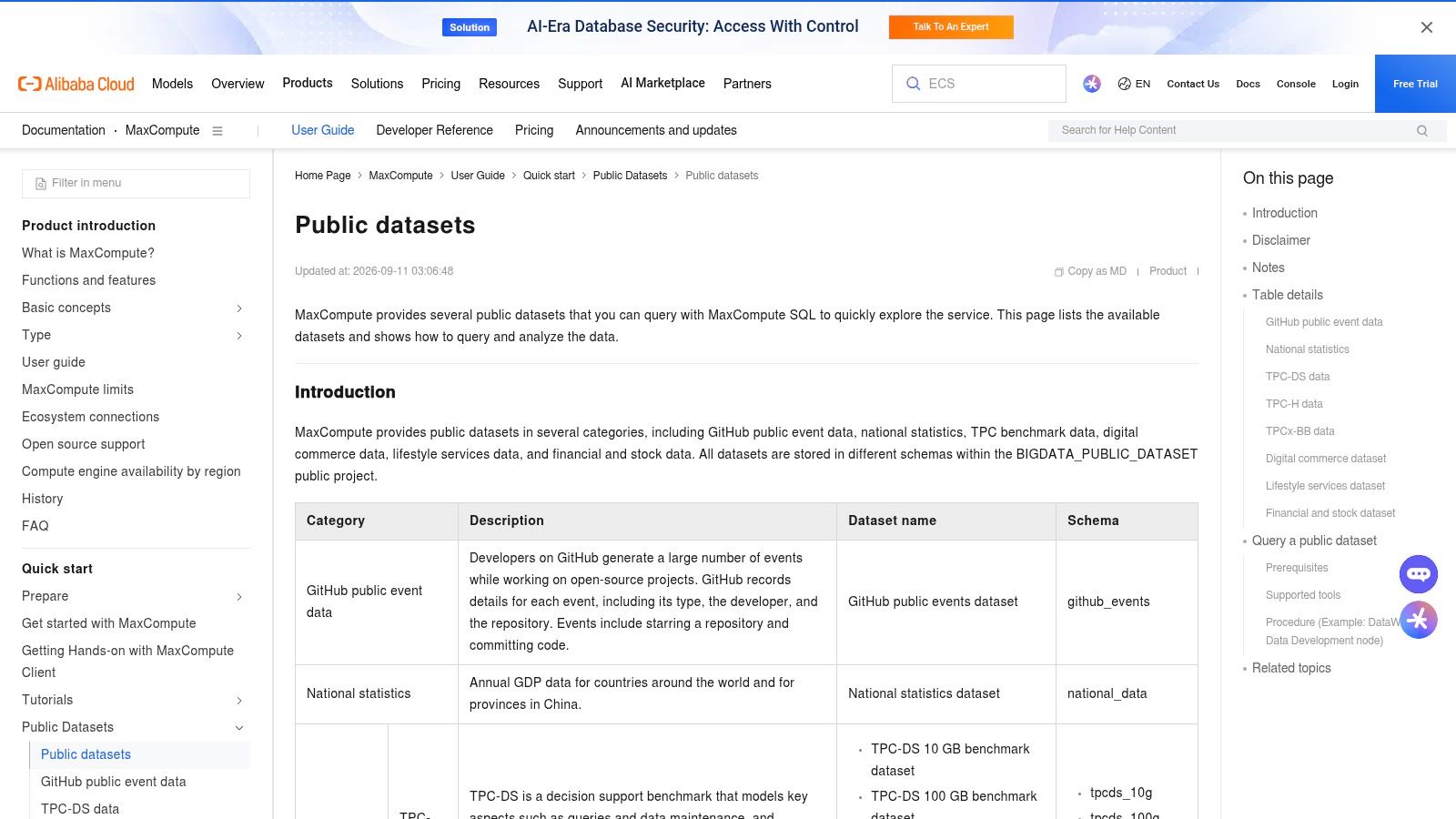
Taobao is the scale-oriented choice for shopping-behavior analysis. Alibaba Cloud's public-dataset documentation describes 100,150,807 behavior records from 987,994 anonymized users and 4,162,024 products, covering November 25 through December 3, 2017.
The actions include browsing, adding to cart, favoriting, and purchasing. Those distinctions let you investigate purchase intent and shopping funnels instead of treating every interaction as equivalent.
Scale doesn't fix a short observation window
The dataset is useful for SQL practice, cloud analytics, and recommendation experiments. Its limited observation period is less suitable for long-term retention, seasonal demand, or durable customer-value estimates.
- Access trade-off: Availability depends on Alibaba Cloud platform, region, and project setup.
- Cost consideration: Platform usage may incur charges, so inspect query scope before running broad scans.
- Modeling advantage: Distinct behavior types support richer features than purchase-only records.
Start by checking event counts by action and timestamp, then construct a user-level sample that preserves complete interaction sequences. Randomly sampling individual rows can remove the events that make a sequence meaningful.
Keep evaluation chronological and define what happens to users or products that appear only in the evaluation period. Don't exclude them and report performance only for familiar entities.
Taobao also broadens the platform context beyond Western retail examples. It still represents a particular marketplace and observation window, not a globally representative sample of online demand.
8. WANDS, Wayfair Annotation Dataset
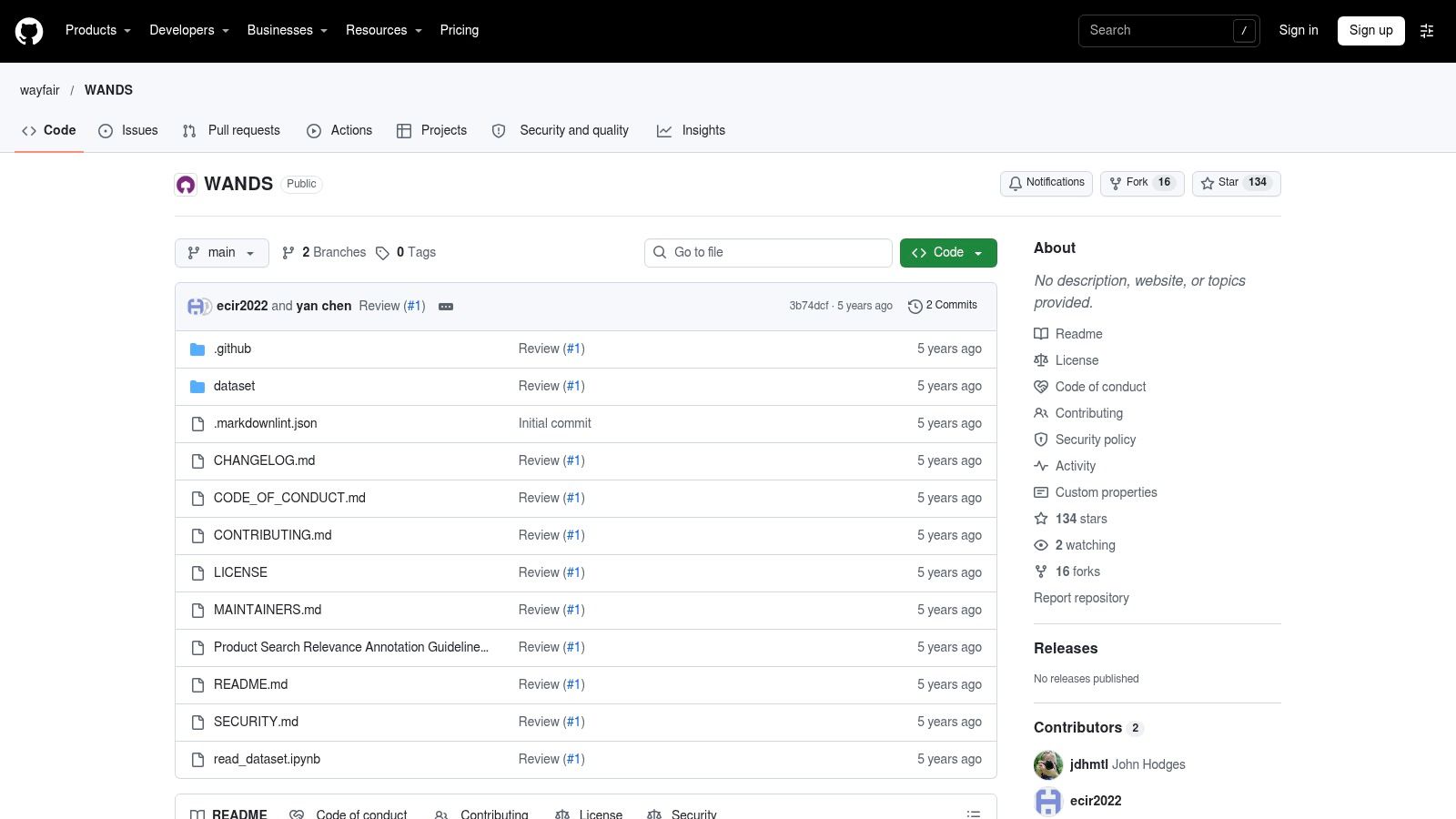
If the question is whether your search engine retrieves relevant products, choose relevance judgments rather than inferring relevance from purchases. The WANDS repository provides 42,994 products, 480 queries, and 233,448 human-annotated query-product judgments, using Exact, Partial, and Irrelevant labels.
Product records include names, descriptions, categories, features, and rating information. Annotation guidance gives you a basis for understanding what the labels mean before turning them into ranking scores.
Evaluate retrieval and ranking separately
Start with a lexical retrieval baseline, then compare it with embedding retrieval or a hybrid approach. Evaluate candidate recall before reranking quality: a reranker can't recover a relevant product that never entered the candidate set.
- Strong fit: Product-search benchmarking and relevance-model evaluation.
- Useful distinction: Graded labels separate partial matches from clearly irrelevant products.
- Important limit: Wayfair's catalog and query context don't represent every retail category or search task.
Reserve held-out queries for evaluation rather than randomly splitting labeled pairs without considering query overlap. Otherwise, your results may overstate how well the system handles unfamiliar searches.
WANDS isn't a conversion dataset, so don't describe improved relevance metrics as demonstrated revenue lift. It helps you test whether products match queries, while business outcomes require evaluation in the application where shoppers use the search system.
The public repository provides data and usage details, making access more straightforward than a gated full-data request.
9. SIGIR 2021 E-commerce Data Challenge Dataset, Coveo
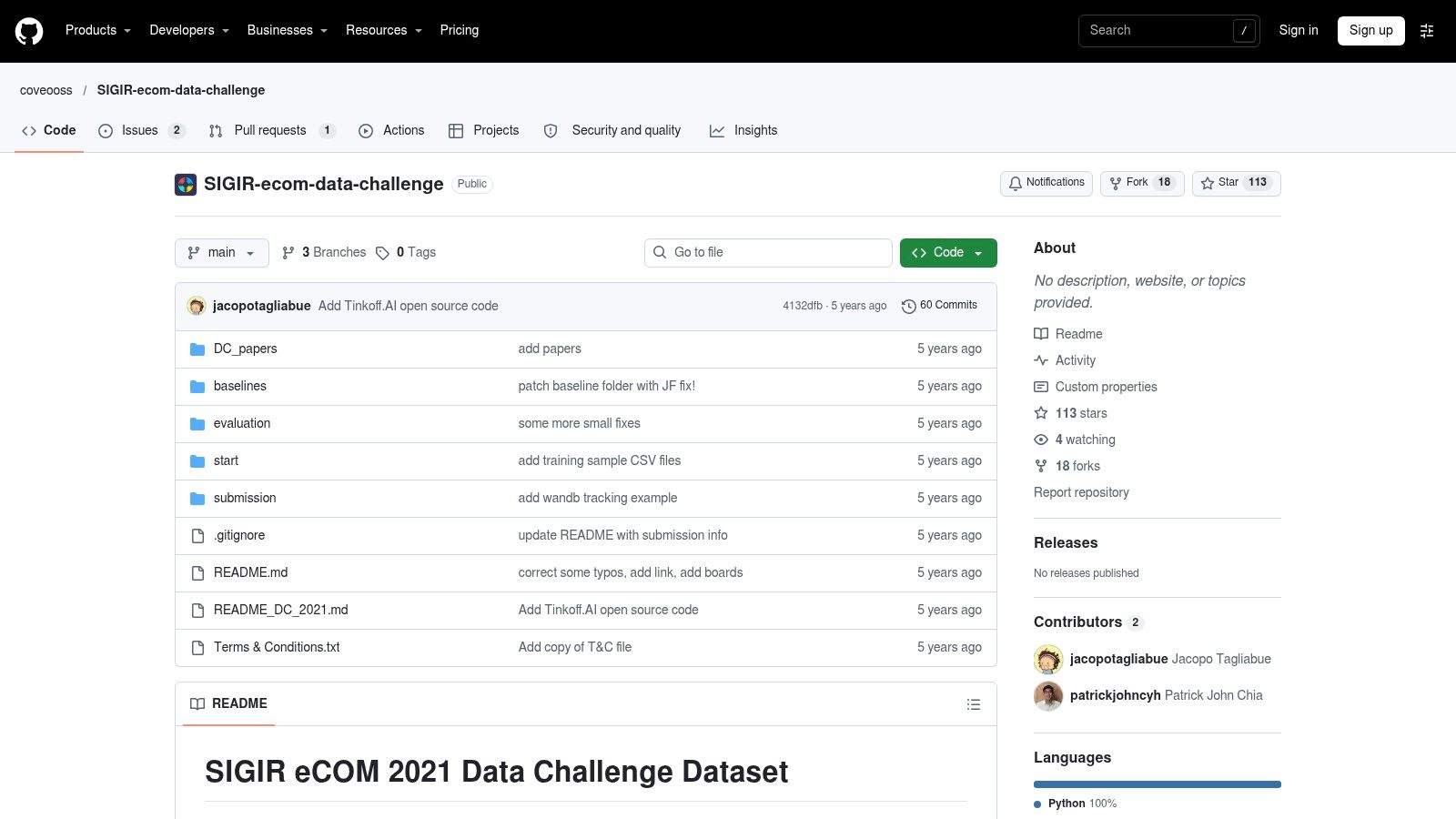
Coveo is useful when you need session context plus search interactions, rather than isolated product feedback. The SIGIR e-commerce challenge repository describes 36 million events and nearly five million anonymized browsing sessions, with product views, adds, purchases, search interactions, and product-content data.
Search records include clicked and unclicked results, which supports more careful analysis than click-only logs. The repository also includes utility scripts, sample data, and research background for recommendation and in-session purchase-intent tasks.
Inspect access terms before building around it
Full-data access requires a form and agreement to research and educational-use terms. It isn't unrestricted commercial-use data, and the project notes that large-file downloads can be difficult.
- Advantage: Connect browsing and search behavior to later actions within sessions.
- Limitation: Anonymized identifiers and processed product representations constrain some interpretations.
- Practical start: Use sample files to validate parsing and task feasibility before requesting the complete collection.
Evaluation warning: For purchase-intent prediction, cut each session at the prediction point. Later cart or purchase events must not become earlier features.
Unclicked results are useful context, but they aren't perfect proof of disinterest. Position, visibility, and the shopper's current task can affect whether a displayed product gets attention.
Choose Coveo over WANDS when your primary question concerns session behavior. Choose WANDS when you need explicit human judgments about query-product relevance.
10. M5Product, Multimodal E-commerce Product Dataset
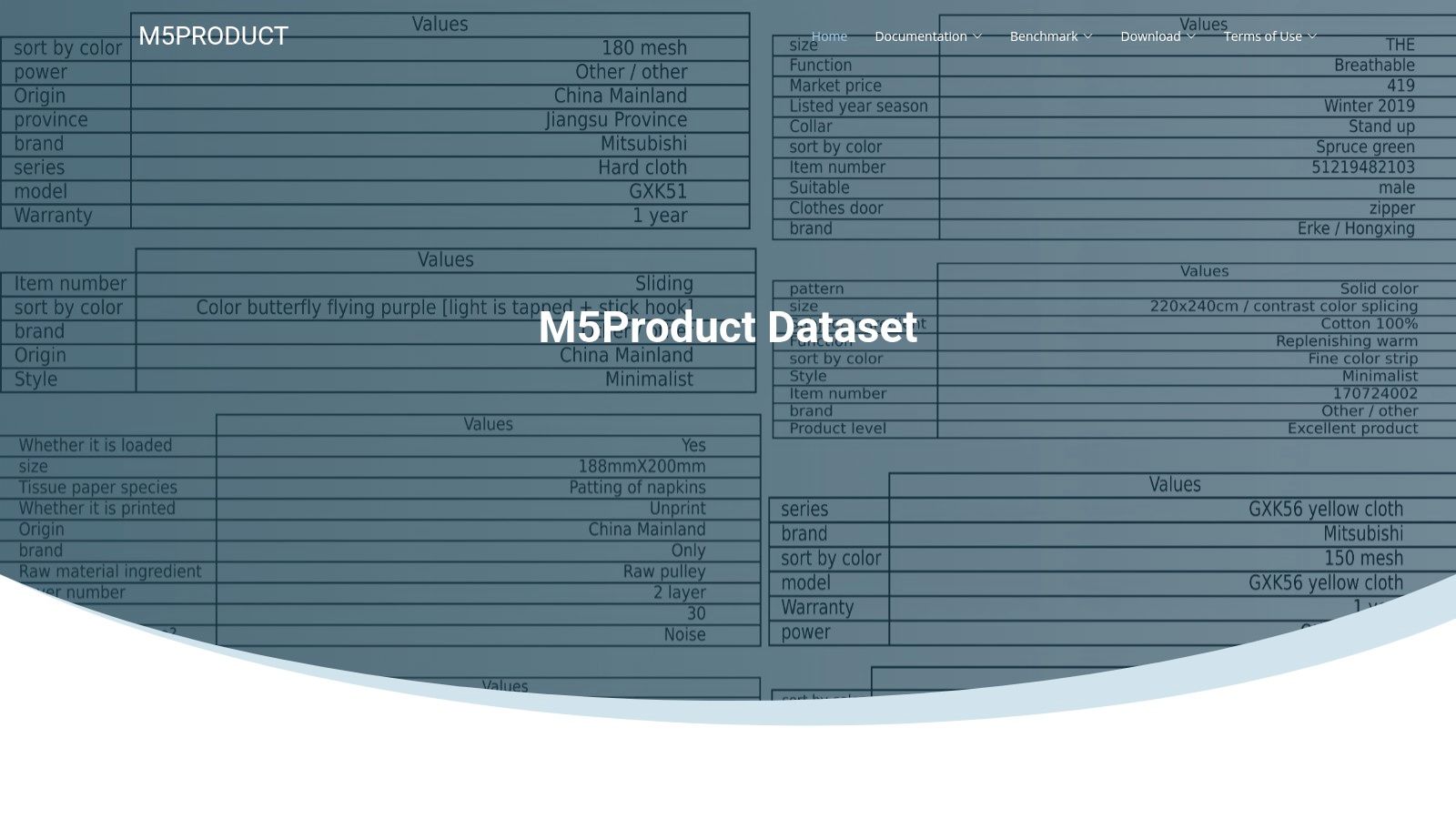
M5Product addresses a different problem: understanding products from their content rather than shopper actions. The M5Product project describes over 6.3 million product samples from more than one million merchants, combining five modalities: image, text, video, audio, and tabular information, with annotations across thousands of product categories.
That combination supports multimodal pretraining and product-representation research. It's a better fit for experiments combining visual and textual product features than for revenue dashboards or purchase-intent modeling.
Audit modality coverage before training
Don't assume every product has every type of media. Build a coverage report, track missing modalities explicitly, and separate unavailable content from failed downloads or parsing errors.
- Research strength: Broad combinations of product media and structured attributes.
- Engineering cost: More storage, preparation, and validation than ordinary CSV datasets.
- Task boundary: No transaction or customer-behavior data for directly evaluating shopping outcomes.
Start with a text-only baseline, then test whether adding images improves your chosen task. Introduce other modalities only when you can measure their contribution and handle missing inputs consistently.
Keep media references, parsed attributes, and derived embeddings connected through stable product identifiers. For application integration, a structured data API can provide a useful interface pattern, but an interface alone doesn't resolve incomplete source content.
Check current download and licensing terms before committing infrastructure. This is a specialized research collection, not a ready-made live catalog service.
E Commerce Datasets at a Glance
| Dataset | Data Type | Scale | Best For | Access and License |
|---|---|---|---|---|
| Google Analytics 4 Sample E-commerce Dataset | Event-level web analytics | Three months of data | SQL practice, customer journeys, and funnel analysis | Hosted in BigQuery; public sample, but BigQuery setup is required and usage may incur charges |
| Online Retail II, UCI Machine Learning Repository | Retail transactions | 1,067,371 transactions across two years | Sales analysis, customer segmentation, and time-series exercises | Download from UCI; CC BY 4.0 with attribution |
| Online Retail, UCI Machine Learning Repository | Retail transactions | About 542,000 rows across one year | Introductory retail analytics and data workflows | Available from UCI; license details are not specified here |
| Brazilian E-Commerce Public Dataset by Olist | Relational order, customer, product, and review data | Roughly 100,000 orders from 2016–2018 | Marketplace, delivery, and end-to-end order analysis | Available on Kaggle; listed as CC BY-NC-SA 4.0, restricting commercial reuse |
| Amazon Reviews ’23, McAuley Lab | Product reviews, metadata, and user–item interactions | 571.54 million reviews across 33 categories | Recommendation research and review analysis | Project website; access and reuse are governed by its terms |
| Retailrocket Recommender System Dataset | Web events, item properties, and category data | Historical snapshot; exact scale not specified here | Recommendation and clickstream exploration | Downloadable via Kaggle; check the dataset page for license and access terms |
| Alibaba/Taobao Shopping Behavior Dataset | Browsing, cart, favorite, and purchase events | 100,150,807 records from 987,994 users | Shopping-funnel analysis and user modeling | Access through Alibaba Cloud; platform setup is required and usage may incur charges |
| WANDS, Wayfair Annotation Dataset | Product catalog and labeled query–product relevance judgments | 42,994 products, 480 queries, and 233,448 judgments | Product-search ranking evaluation | Public GitHub repository; check repository details for usage terms |
| SIGIR 2021 E-commerce Data Challenge Dataset, Coveo | Browsing and search events with product data | 36 million events and nearly five million sessions | Session-based recommendations and purchase-intent prediction | Full access requires a form and agreement to research and educational-use terms |
| M5Product, Multimodal E-commerce Product Dataset | Multimodal product data: image, text, video, audio, and tabular | Over 6.3 million samples from more than one million merchants | Multimodal product understanding and representation research | Project website; check current download and licensing terms |
Choosing Your Dataset and Getting Live Data When Public Options Fall Short
Choose by task, then by access and license, and only then by scale. For learning, start with Online Retail when you want a compact transaction workflow, or GA4 when you want event-level SQL and funnel analysis. Move to Olist when relational modeling and delivery operations matter.
For recommendation research, decide whether your signal is a review, a browsing event, or a complete session. Amazon Reviews supports feedback-rich experiments, while Retailrocket and Taobao support behavioral modeling. Coveo adds session and search context, WANDS supplies explicit search-relevance judgments, and M5Product supports product-content representations.
Make the first experiment small and reproducible
Before training, write down the row grain, target definition, prediction time, and permitted uses. Preserve raw files, record transformations, and reconcile counts after joins so a promising metric doesn't depend on accidental duplication.
- For transactions: Separate cancellations, missing customer identifiers, and revenue definitions.
- For behavior: Preserve chronological sequences and prevent future events from entering features.
- For search: Evaluate candidate retrieval separately from reranking.
- For multimodal inputs: Track missing content and retain stable identifiers across representations.
Public availability isn't permission for unrestricted deployment. Research-only or noncommercial terms can prevent a technically successful experiment from becoming a production feature, so resolve those constraints before building around the dataset.
Separate historical benchmarks from live product requirements
Large collections also need a coverage assessment. Record which countries, languages, platforms, product categories, and payment contexts are represented, and distinguish absent measurement from low adoption. A dataset can be large while remaining poorly matched to your intended users.
Behavioral detail deserves similar scrutiny. A retail privacy study found that 29% of online retail stores in its sample shared at least one piece of users' sensitive private information with a third party, reinforcing the need to review field sensitivity, provenance, retention, and linkage risk before automated use.
Historical benchmarks won't provide current professional or company context for a live SaaS feature. Fetchin is a B2B data API that extracts real-time public data on demand, turning professional profile and company URLs into structured JSON rather than serving periodically indexed snapshots.
We retrieve only publicly available information, act as a data processor for submitted API data, and provide GDPR and CCPA-aligned compliance practices. Public availability doesn't remove your responsibility to establish an appropriate purpose, manage retention, and honor applicable rights.
Use historical e commerce datasets to validate your analytics and models, then add current context where your production feature requires it. Visit Fetchin to explore professional profile and company enrichment APIs that return structured JSON for live SaaS workflows.