Your team has a lead-enrichment feature ready to build. A customer will paste a professional profile URL into a form, and your application needs to return a useful person and company record. The demo sounds straightforward. The production questions aren't: how current must that record be, how long can the customer wait, and what should happen when only part of the data is available?
Table of Contents
- The Integration Choice Every Product Team Faces
- What a Structured Data API Actually Returns
- Synchronous Versus Asynchronous Delivery
- Live Fetching Versus Snapshot Indexing
- Performance, Rate Limits, and Cost Tradeoffs
- Integration Patterns That Actually Work
- Enrichment, Matching, and Engagement Metrics in One API
- A Practitioner Checklist Before You Ship
The Integration Choice Every Product Team Faces
Consider a SaaS founder deciding how to populate that enrichment feature. The engineering team could periodically fetch professional records into a database, then answer customer requests from that local store. Alternatively, the application could call a professional data API when the customer submits a URL and receive structured JSON on demand.
The snapshot pipeline gives the team control over its serving layer. Engineers can index records for search, join them with customer data, and avoid putting an upstream retrieval operation directly in the customer's path. But they also own refresh scheduling, storage, reconciliation, and the consequences of returning an old employer or title.
A live call moves retrieval closer to the moment of use. That's attractive when a recruiting decision or sales workflow depends on current information. It also makes the product's response dependent on what the upstream source can provide at that moment.
Start with the decision, not the endpoint
Before comparing providers, write down the questions that determine your architecture:
- Acceptable age: Could yesterday's company record change today's decision?
- Waiting behavior: Must the form complete immediately, or can the customer receive an update later?
- Minimum usable record: Which missing attributes should prevent write-back?
- Processing purpose: Why does the application need each personal field, and who owns the policy review?
These aren't separate procurement details. They determine your timeout behavior, refresh strategy, validation rules, and spending controls.
Practical rule: Choose the smallest data contract that supports the customer's decision, then choose how and when to deliver it.
A structured data API is therefore more than an endpoint that returns JSON. Treat it as a combination of schema discipline, delivery mode, freshness policy, and recovery behavior. You don't need to choose between snapshots and live retrieval globally. You need to choose deliberately for each workflow.
What a Structured Data API Actually Returns
A structured data API returns named fields rather than a page your application must interpret. Think of it as a labeled shipping container: the schema tells your engineers what belongs inside, how it's organized, and which compartments may be empty.
The object families below illustrate that mental model.
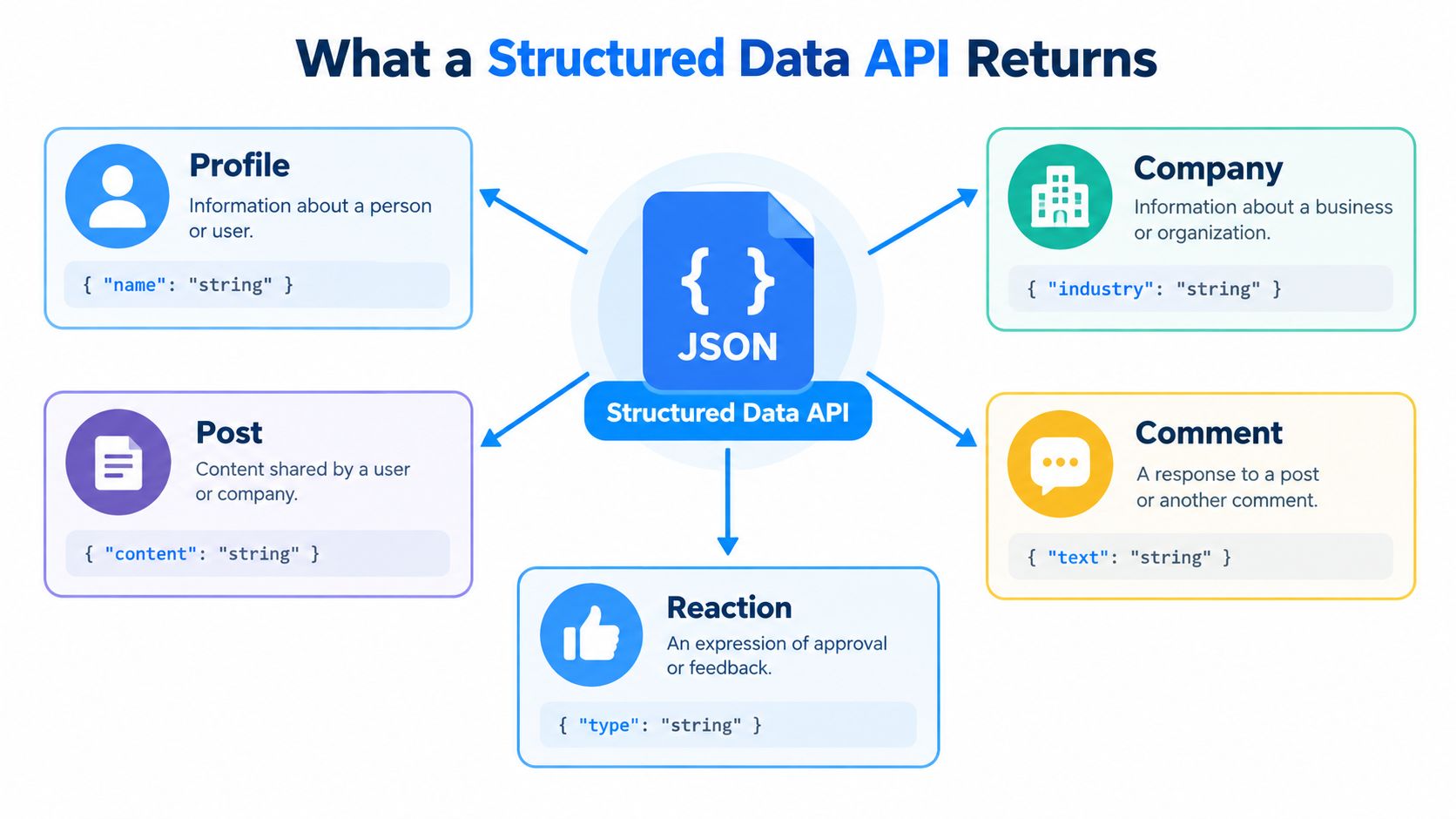
JSON provides the common packaging. Its standardization includes RFC 8259 and ISO/IEC 21778:2017, with portable representations for objects, arrays, strings, numbers, booleans, and null, as documented in the JSON standard and specification references.
Read the contract, not just the example
Consider this illustrative response fragment: {"name":"Example Person","company":{"name":"Example Company"},"title":null}. It shows a string, a nested object, and an explicitly empty value. It doesn't establish which fields the provider guarantees.
Your schema should answer:
- Names and types: Is
companyan object, and isnamealways a string? - Required fields: Must
titleappear even when its value is unknown? - Nullability: Does null mean unavailable, not applicable, or unresolved?
- Evolution: What happens when the provider adds an attribute or changes a field's meaning?
A useful implementation sequence is HTTP-status checking, schema validation, business-rule validation, then downstream write-back. IBM's JSON validation documentation describes validation against deployed schemas at the integration boundary. That placement helps prevent unexpected payloads from spreading through databases and queues.
Separate valid structure from trustworthy content
A valid string can still contain an outdated title. Schema validation establishes shape, not truth, so keep provenance and business checks separate.
For a related implementation perspective, agentcentral's guide to auditable Amazon data writes is a useful companion resource when planning what your application should record around a write.
Use this video alongside the object model to make the JSON packaging easier to visualize.
Synchronous Versus Asynchronous Delivery
Synchronous delivery means the caller waits for the result in the same request. Asynchronous delivery means the caller receives an acknowledgment and retrieves or receives the result later. The difference is where waiting happens, not whether the returned data is structured.
These delivery paths make the distinction concrete.
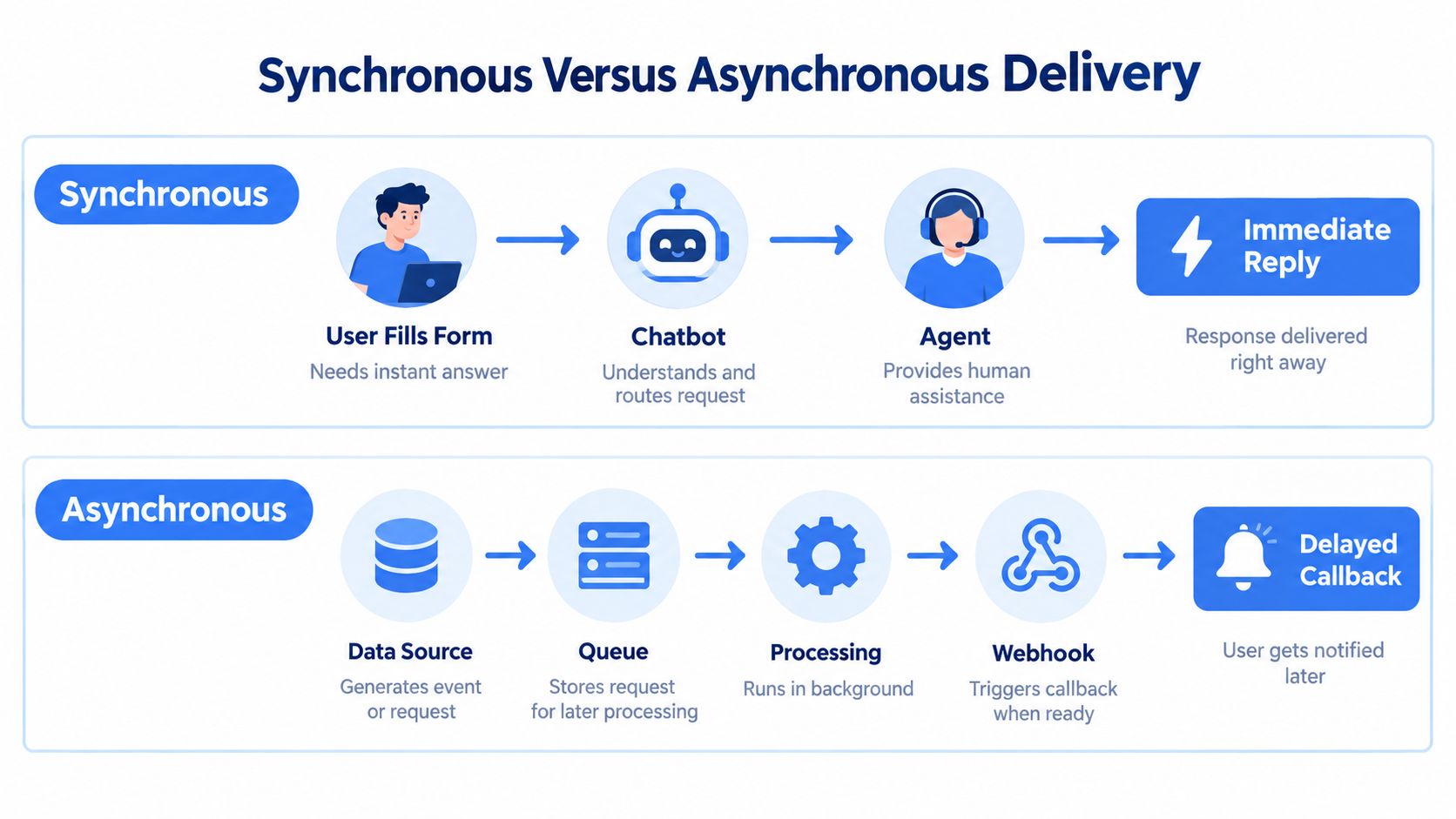
A form-fill enrichment flow naturally favors a synchronous call. The application needs the record before it can show populated fields. A chatbot or agent may have the same dependency: it can't choose its next action until the tool returns.
A company backfill has a different shape. The user can leave the page while workers process records, and the application can display progress rather than hold a connection open.
Compare the waiting behavior
| Decision | Synchronous | Asynchronous |
|---|---|---|
| Caller experience | Waits for the final response | Continues after job acceptance |
| Application state | Loading, completed, or failed request | Accepted, processing, completed, or failed job |
| Natural fit | Interactive enrichment | Batch ingestion and backfills |
| Main engineering burden | Deadlines and immediate fallback | Job tracking and delivery reconciliation |
Those are recommended design shapes, not guarantees every provider implements. Confirm the actual acknowledgment, job-state, polling, and callback contracts before integrating.
Keep delivery separate from retrieval
A synchronous API can return a stored snapshot. An asynchronous job can fetch live data. Don't assume that immediate delivery proves recency, or that background processing means the provider uses an index.
For a closer comparison of caller behavior, consult this synchronous versus asynchronous API guide.
Choose by workflow deadline, payload size, and downstream dependency. If a customer can proceed without enrichment, background completion may be simpler. If the next action requires the record, synchronous delivery may fit better, provided your application has an explicit deadline and a useful failure path.
Live Fetching Versus Snapshot Indexing
A changed job title exposes the difference between retrieval strategies. A snapshot represents what the provider observed during an earlier collection. A live fetch attempts to observe the source when you ask.
Neither strategy guarantees that the source itself is accurate. Live retrieval can establish recent observation, but it can't establish that someone has updated every detail on a public professional page.
This distinction matters because freshness and latency measure different things. IBM distinguishes the age of data from the time needed to deliver it, and its 2025 research found that just under 40% of organizations reported outperforming peers on freshness and related metrics, according to IBM's explanation of data freshness.
Make age part of the record
For decision-sensitive fields, ask for an observation timestamp or field-level timestamps, source provenance, and an explicit stale-data indicator. Set freshness targets by field rather than treating the entire record as equally volatile.
A professional title may deserve a different refresh policy from education history. A company domain may need different handling from headquarters information. Your product team should define those differences from the consequences of using an outdated value.
A slower response with visible observation age can be more useful than a faster response whose age the customer can't inspect.
Snapshot indexing can reduce request-time retrieval work and make serving behavior easier to control. Live fetching places more work on the request path and exposes your application to upstream availability. Neither option has a universal cost advantage once you include refresh work, retries, storage, and operations.
Define the fallback before the outage
If live retrieval fails, choose whether to return an age-labeled cached record, defer completion, or decline to enrich. Never present a fallback as a new observation.
The live data API guide offers further context for this retrieval model. BatchData's how to deliver property enrichment data is also a useful resource for thinking about delivery choices in another enrichment domain.
Performance, Rate Limits, and Cost Tradeoffs
Your customer experiences the whole enrichment path, not just the provider's advertised response time. Measure the application's wall-clock duration, including network time, upstream retrieval, serialization, validation, and write-back.
Use p50 to understand the typical request and p95 or p99 to inspect slower requests. Those measurements belong alongside endpoint, region, status, and error-class dimensions so engineers can distinguish a widespread slowdown from a particular failure path.
Validation deserves its own budget. Json.NET recommends reusing loaded schemas rather than repeatedly parsing them, and notes that streaming validation can reduce memory pressure for payloads larger than 85 KB, as explained in its JSON Schema performance guidance.
Rate-Limit and Cost Variables in a Typical B2B Data API
“Typical range” below describes implementation choices, not measured market pricing or throughput.
| Variable | Typical Range | What It Affects |
|---|---|---|
| Request allowance | Shared account ceiling or dedicated allocation | Admission control and queue growth |
| Burst behavior | Strict ceiling or bounded burst allowance | Handling traffic spikes |
| Batch size | Individual records or bounded batches | Payload size and retry scope |
| Billing unit | Attempt, successful response, record, or credit | Cost reconciliation |
| Failed-call billing | Charged or excluded under contract | Spending during recovery |
| Capacity changes | Configurable allowance or provisioned capacity | Scaling lead time |
Budget useful outcomes, not just requests
For a request-response flow, size capacity around simultaneous customer activity. For webhook-driven processing, control worker concurrency and queue admission. For an AI agent, bound tool calls within each task so repeated attempts don't consume an uncontrolled share of the allowance.
An illustrative synchronous request needs a profile input and deadline. A background request needs bounded company inputs and correlation metadata. An agent tool call needs the target record and the attributes required for its next decision. Verify the provider's actual request fields rather than treating these shapes as endpoint documentation.
OWASP's unrestricted resource consumption guidance recommends limiting interaction frequency and bounding resource-intensive request parameters. Apply those controls inside your application too.
Use this API rate-limit guide when planning admission and backoff. Before selecting capacity, ask how bursts, retries, partial results, and failed calls affect billing. Don't assume that an error response is free.
Integration Patterns That Actually Work
The safest integration pattern is the one your team can explain from customer input to persisted result. Keep the provider-specific adapter separate from your product's internal person, company, and engagement models.
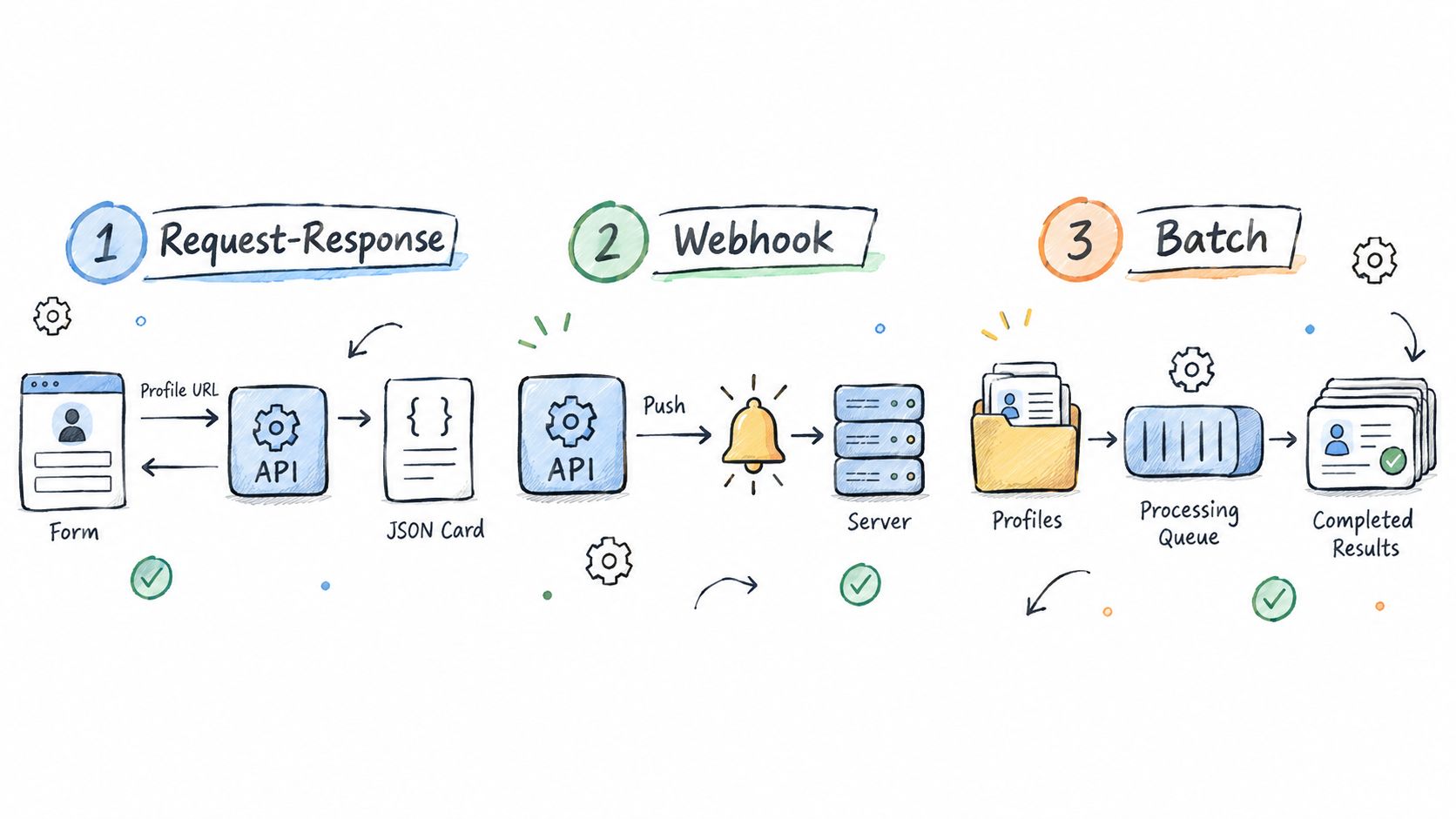
The illustration shows common request-response, webhook, and batch workflow shapes.
Request-response for customer-facing enrichment
A customer supplies a professional profile URL. Your backend authenticates the operation, checks permission, calls the provider, and passes the result through the boundary checks before updating the customer record.
Keep the customer's original input. If enrichment fails, preserve the form state and offer a retry rather than discarding their work. Don't automatically overwrite a customer-confirmed value merely because the provider returned a different one.
Treat the schema as an executable contract, not a document someone read during onboarding.
Webhook-driven processing for background work
A company backfill submits bounded work and receives a job identifier. Store that identifier with the internal batch, then accept results through an authenticated callback handler or retrieve them through the documented polling mechanism.
Make write-back idempotent using a stable delivery or operation identifier. A repeated callback should update the same logical operation, not create another company record. Track unresolved records separately from completed ones so a partial batch remains actionable.
Enrichment inside an agent workflow
An agent should call the API because a task needs particular attributes, not because enrichment is always available. Route the result through the same adapter used by the rest of your product, then expose only the approved fields as tool output.
If the call fails, return a typed failure to the agent. Don't turn unavailable information into a plausible-looking empty result that encourages the agent to continue confidently.
These patterns can share normalization, policy checks, audit records, and internal models. A unified endpoint family can simplify that adapter, but it doesn't remove the need for workflow-specific deadlines or permissions. Keep those decisions in your application, where the product team can control them.
Enrichment, Matching, and Engagement Metrics in One API
A unified B2B data API is useful when several features need related record families. Lead enrichment can resolve a person and employer. Matching can compare stable identifiers and normalized attributes. Engagement reporting can connect posts, comments, and reactions to the relevant entities.
That consolidation can reduce provider-specific integration work. It doesn't make the outputs equally suitable for every decision. A profile suitable for displaying context may still be insufficient for automatically merging customer records.
Give each feature an acceptance policy
For matching, distinguish exact identifiers from approximate similarity. An equal verified identifier can support a different decision from similar names and locations. Route ambiguous candidates to review instead of treating every resemblance as identity.
Wine Labs' match wines across market channels provides a useful cross-domain resource for considering matching as its own capability, separate from retrieving attributes.
For engagement reporting, define the reporting window and retrieval scope. An empty result should mean something documented, not whatever the dashboard designer happens to infer.
- Enrichment acceptance: Which attributes are necessary for the intended customer action?
- Matching acceptance: What evidence allows an automatic merge?
- Reporting acceptance: Can the application distinguish no observed activity from incomplete retrieval?
Don't confuse successful delivery with usable evidence
A valid response can contain missing or old fields. Measure usable completeness and observation age independently from availability, then apply the acceptance policy for each feature.
Public visibility also isn't automatic permission to process personal information. The ICO's lawful-basis guidance requires organizations to determine and document a valid basis before processing and explains the importance of necessity.
That means product teams should involve policy owners before collecting professional attributes, not after shipping. Record the purpose, limit collection to relevant fields, and establish transparency and individual-rights procedures. A shared API integration should centralize these controls, not broaden access merely because more endpoints are available.
A Practitioner Checklist Before You Ship
A successful demo proves that a request can return a useful record. Shipping requires evidence that your application behaves predictably when that request is slow, incomplete, repeated, or unsuccessful.
The operational risk isn't theoretical. An analysis of 2 billion monitoring checks across more than 400 companies and 20 industries found average API uptime fell from 99.66% in Q1 2024 to 99.46% in Q1 2025, according to the Uptrends API reliability report. Your integration needs a recovery contract, not just a happy-path example.
Make the launch decisions explicit
- Pin the contract. Select a versioned schema and test representative responses, including missing optional values and unexpected attributes.
- Set separate quality targets. Define acceptable observation age and minimum usable completeness alongside availability.
- Agree on recovery behavior. Document rate-limit handling, bounded exponential backoff, duplicate delivery, partial responses, circuit breakers, and billing during failure.
- Assign delivery per workflow. Record which customer actions wait and which operations continue in the background.
- Instrument the full path. Capture percentile latency and separate component budgets so the responsible engineer can locate bottlenecks.
Test the failure matrix
| Condition | Expected application behavior |
|---|---|
| Rate limit exceeded | Delay within a bounded retry policy |
| Source temporarily unavailable | Use an approved fallback or defer |
| Required attribute unresolved | Prevent unsafe write-back |
| Duplicate result delivered | Reconcile without duplicating records |
| Contract violation | Quarantine the response and alert |
Add an owner and a test case to each row. A behavior that exists only in a design document won't protect the customer.
Shipping criterion: Every degraded path should produce an understandable product state and an actionable operational signal.
Cached responses are reasonable when their age is exposed and the workflow accepts it. Hidden recency is the problem, not caching itself. Before launch, run the same acceptance tests against live results, stored results, and fallback results so your application doesn't change its standards during an incident.
Fetchin offers a real-time B2B data API that turns professional profile and company URLs into structured JSON from publicly available information. Visit Fetchin to evaluate its response contracts and delivery options against your enrichment workflow, then test representative records and failure paths before committing to an integration.