B2B isn't the smaller side of digital commerce. It's the bigger one. The United Nations Conference on Trade and Development estimated global B2B e-commerce at $21.8 trillion in 2019, equal to 82% of total global e-commerce sales, while the broader market reached $26.7 trillion that year, as summarized in the U.S. Census Bureau reference text. If you've been thinking of business-to-business as a narrow sales category, that number should reset your mental model fast.
That scale matters because B2B explained properly isn't just “companies selling to companies.” It's a way of understanding how organizations buy software, services, data, and operational capabilities through processes that involve multiple people, systems, approvals, and increasingly, software agents. Today, buyers often research vendors through AI search, review platforms, product docs, and machine-readable data before they ever talk to sales, according to G2's 2025 buyer behavior research. If you build SaaS, an API product, or any workflow that touches company and professional data, that shift changes what your product must expose.
Table of Contents
- What B2B Actually Means in Modern Commerce
- B2B vs B2C and Where Each Model Breaks Down
- How Buyers Actually Discover and Choose B2B Products
- The B2B Sales Cycle and the People Inside It
- Core Data Needs for B2B Products and Integrations
- Why Live Data Beats Static Records in B2B
- Product and Engineering Implications for B2B SaaS
- A Practical Checklist Before You Ship a B2B Feature
What B2B Actually Means in Modern Commerce
B2B, or business-to-business, means one organization sells products, services, data, or operational capabilities to another organization rather than to an individual consumer. That includes software subscriptions, logistics services, wholesale inventory, procurement systems, professional data, and API-driven operational workflows. It does not mean a consumer buying shoes, a streaming subscription, or groceries for personal use.
Why B2B is the foundation, not the edge case
The fastest way to understand B2B is to look at where digital commerce started to scale. In the United States in 1999, manufacturing e-commerce shipments totaled $485 billion, or 12.0% of all manufacturing shipments, while online retail sales were just $15 billion, or 0.5% of total retail sales, in the same Census reference. In other words, businesses were digitizing transactions at serious scale before consumer e-commerce became the default story most remember.
That pattern held. In 2000, e-commerce accounted for 18.4% of manufacturing shipments, worth $777 billion, and 7.7% of merchant-wholesaler sales, worth $213 billion. The Census Bureau also reported that 94% of U.S. e-commerce in 2000 was B2B. By 2002, B2B still represented 93% of U.S. e-commerce, with manufacturing e-commerce shipments at 19.6% of the sector's total value, or $752 billion, and merchant-wholesaler e-commerce sales at 11.7%, or $320 billion, according to the 2000 and 2002 Census publication.
What counts as B2B in practice
B2B isn't limited to a website with a cart. It also includes:
- Procurement portals, where approved buyers order from approved suppliers
- EDI workflows, where businesses exchange standardized purchase orders, invoices, and shipping information
- Supplier networks that coordinate replenishment and fulfillment
- Account-based software contracts with usage rules, approvals, and renewals
- API integrations that connect one company's workflow to another company's data or service
Practical rule: If the transaction depends on company identity, role-based permissions, negotiated terms, or operational integration, you're usually in B2B territory.
Five ideas matter from here. First, B2B and B2C create different product constraints. Second, modern discovery starts before sales gets involved. Third, sales cycles are really coordinated handoffs across teams. Fourth, B2B products depend on structured people and company data. Fifth, those realities shape product architecture, pricing, and trust.
B2B vs B2C and Where Each Model Breaks Down
People often explain B2B by saying “it has longer sales cycles” and stop there. That's too shallow. The useful comparison is how each model changes product design, pricing logic, support, data requirements, and implementation risk.
B2B vs B2C at a Glance
| Dimension | B2B | B2C |
|---|---|---|
| Buyer | A company, team, or department | An individual consumer |
| Decision maker | Usually multiple stakeholders | Usually one person or household |
| Purchase trigger | Operational need, compliance, cost, workflow fit | Personal need, preference, convenience |
| Pricing | Negotiated plans, usage pricing, account-level terms | Published pricing, simpler checkout |
| Contracts | Procurement, legal review, approvals, credit terms | Standard consumer terms |
| Sales cycle | Often involves qualification, security review, implementation planning | Often immediate or short |
| Support | Onboarding, admin controls, technical support, renewal management | Customer support for usage or returns |
| Data needed | Company identity, role, permissions, firmographics, usage context | Personal identity, payment, shipping, preferences |
| Product success metric | Activation, retention, expansion, renewal | Conversion, repeat purchase, satisfaction |
| Common failure mode | Friction between evaluation and implementation | Friction at discovery or checkout |
Where founders get confused
The confusion starts when a product has consumer-like UX but B2B economics. A self-serve analytics tool may look like B2C on the surface. Then procurement asks for invoicing, the buyer wants account-level access controls, and the security team asks where your data comes from. The checkout was simple. The business relationship isn't.
There's another breakdown. Founders assume “B2B means sales-led” and “B2C means self-serve.” That's outdated. Recent global B2B commerce summaries report that buyers increasingly expect fast, transparent, intuitive digital experiences, and that organizations are adopting AI in commerce workflows, as discussed in DHL's 2025 B2B e-commerce trends overview. So the divide isn't self-serve versus human-assisted. It's whether the product can support organizational complexity without making the buyer do manual work.
The product trade-off
A B2C app can often optimize around a single smooth path. A B2B product usually needs multiple paths:
- A quick evaluation path for an individual user
- A trust path for legal, procurement, or security
- An operational path for admins and implementers
- A data path that lets the product recognize the right company, user, and context
B2B breaks down when teams copy consumer simplicity without supporting business reality. B2C breaks down when teams add unnecessary process to purchases that should stay simple.
That's why “B2B explained” has to move beyond labels. The model changes what the software must know, who it must satisfy, and how much ambiguity the buyer will tolerate.
How Buyers Actually Discover and Choose B2B Products
The old story says B2B buyers start with a sales conversation and move toward a demo. The modern story starts much earlier, and often without any direct vendor interaction at all.
Discovery now starts in machine-readable public information
G2's 2025 research surveyed 1,100 global B2B decision-makers and found that 79% of software buyers say AI search has changed their research behavior. It also found that GenAI chatbots were the leading source influencing vendor shortlists at 17.1%, while enterprise buyers ranked review sites and AI search as their top two research sources, in the full G2 report. That changes what “discoverability” means.
If an AI assistant can't identify what your product does, who it's for, how it's priced, whether it integrates with other systems, and what kind of data it uses, you may never even make the shortlist. This is the most important reframing in any useful B2B explained article. Buyers aren't just evaluating your message. They're evaluating whether your company is legible to both humans and machines.
A realistic modern journey
A typical buyer journey now looks more like this:
Problem recognition
A founder, ops lead, recruiter, or GTM team realizes a workflow is breaking. Maybe routing is wrong, enrichment is stale, or onboarding requires too much manual research.AI-assisted research
The buyer starts with AI search, review sites, or documentation. They compare use cases, data coverage, product constraints, and implementation complexity.Silent pre-qualification
Before booking anything, they check your site for pricing transparency, API docs, examples, trust signals, and whether your product seems current.Committee validation
A technical stakeholder looks at schemas and integration effort. A business stakeholder checks fit. Procurement or legal may check data source, privacy, and terms.Human contact
Sales often enters after the buyer already has a view on whether you're credible.
Public facts now do part of the selling. If they're missing, stale, or vague, the buyer's research flow stalls before your team gets a chance to explain.
The hidden requirement
For SaaS teams, this creates a hard requirement: expose the current signals that help both buyers and software agents evaluate you. That includes company identity, integration capabilities, pricing logic, support model, security posture, and enough structured product detail to reduce ambiguity. In B2B, your public information isn't just marketing collateral anymore. It's part of the buying interface.
The B2B Sales Cycle and the People Inside It
After discovery comes the part founders usually notice first, the sales cycle. But calling it a “sales cycle” can hide what's really happening. It's a sequence of handoffs between teams that each need different evidence.
A helpful outside reference is this breakdown of pipeline stages at hireSDR.com. It maps the basic flow clearly, and it's useful because many early teams underestimate how many transitions sit between first interest and a healthy renewal.
Who shows up at each stage
Prospecting and qualification usually involve marketing, outbound, or a founder. The main question is simple: is this the right company and the right person? That sounds obvious, but it depends on accurate company identity, role matching, and enough context to know whether the problem is real.
Evaluation introduces more people. A technical buyer checks integration effort. An operator checks workflow fit. A finance or procurement contact checks pricing predictability. In some organizations, security joins before any meaningful trial starts. If you're hiring leadership to manage this motion, the responsibilities look a lot broader than “close deals,” which is why role design matters in guides like this VP of Sales job description.
Here's the embedded overview mentioned above:
Why B2B cycles stretch
B2B revenue economics make this operationally expensive. CAC is calculated as total sales and marketing expense divided by new customers acquired in the same period, and CAC payback measures how many months of gross-margin contribution are needed to recover that investment. One benchmark summary places median blended B2B SaaS CAC around $1,000 to $5,000 per customer, with enterprise acquisition costs commonly 5 to 10 times higher, and notes that enterprise sales cycles can exceed six months, in the Factors.ai GTM metrics summary.
That's why friction compounds quickly:
- Implementation uncertainty slows approval
- Unclear usage costs trigger finance concerns
- Weak data quality creates extra validation work
- Schema instability raises integration risk
- Poor activation hurts retention after the deal closes
In B2B, the sale isn't one moment. It's a chain of proof. Each team asks a different question, and bad data at one handoff creates more work at the next.
Renewal is part of the same system. The same benchmark summary notes gross revenue retention often clusters around 85% to 92%, which is why uptime, freshness, support quality, and predictable usage matter long after the initial purchase.
Core Data Needs for B2B Products and Integrations
When a founder says, “we need B2B data,” they usually mean one of three things and don't separate them clearly. They need people data to identify who matters, company data to understand the account, and engagement data to tell whether anything changed recently.
What a B2B Profile and Company API Returns
| Endpoint | Attribute Groups | Typical Use |
|---|---|---|
| Profile endpoint | Positions, education, skills, locations, contact fields | Identify decision-makers, match roles, enrich CRM records |
| Company endpoint | Industry, headcount, headquarters, founding year, verified domain | Qualify accounts, route leads, segment markets |
| Engagement endpoints | Posts, comments, reactions | Detect activity, prioritize outreach, power signals in product workflows |
That table matters because “data enrichment” sounds abstract until you see the schema. A modern professional data API doesn't just return a name and employer. It may return position history, skills, education, locations, and contact fields at the person level, then pair that with industry, headcount, headquarters, founding year, and a verified domain at the company level. For product teams, that combination is what turns a rough guess into a usable workflow.
Why these attributes matter
A recruiting product uses profile attributes to understand whether a candidate fits a role. A GTM tool uses company attributes to decide whether an account belongs in an enterprise queue or an SMB motion. An AI agent uses engagement data to determine whether a company or buyer has recent public activity that changes the right next step.
The key is that each attribute answers a different operational question:
- Role data helps identify who should receive outreach or approval
- Firmographic data helps determine whether the account matches your ICP
- Domain and URL resolution help connect records across tools
- Engagement signals help decide timing and relevance
One option in this category is Fetchin's B2B rules guide, alongside other tools that structure company and professional records for SaaS workflows. The relevant product distinction isn't branding. It's whether the API returns current, structured fields your system can actually use.
The practical schema test
If your team can't answer these questions with confidence, your data model is probably too thin:
- Who is the person in this account with the right operational role?
- Is this company still the size and type we think it is?
- Can we match this record to the right domain and internal account?
- Has anything public changed that should alter routing or messaging?
That's what B2B data really is in product terms. It's not a list. It's the identity layer behind your workflow.
Why Live Data Beats Static Records in B2B
Many teams still act like B2B records can be refreshed in a nightly batch and treated as reliable the next day. That assumption breaks as soon as the product depends on current organizational identity rather than slow-moving reference data.
Static records fail in quiet, expensive ways
A stale company record can route a lead to the wrong sales motion. A stale role record can send onboarding content to someone who changed jobs. A stale headquarters field can trigger the wrong regional handling. A stale public profile can create personalization that feels broken the moment the user sees it.
Those failures are easy to dismiss because they don't always look dramatic. They look like friction. The SDR questions the record. The recruiter double-checks manually. The operator re-routes the account by hand. The implementation manager asks for another CSV. Every one of those actions adds labor and uncertainty.
For teams thinking through architecture, this real time data sync guide gives a useful conceptual frame for when synchronization has to support operational workflows rather than just reporting.
Reference data and page-state data are different
This is the distinction many first-time founders miss.
- Reference data changes slowly. Founding year is a good example.
- Page-state data reflects a company's or professional's current public presence. Role, activity, and some company details can shift more frequently.
A product that depends only on static reference data can tolerate lag. A product that powers routing, outreach, identity resolution, or AI decision-making often can't. That's why live data API design matters as a product topic, not just an infrastructure one.
Freshness isn't a back-office metric. It shapes whether users trust the workflow in front of them.
Why this changes the buyer experience
The irony is that polished UX can hide stale logic. The interface looks clean. The workflow still misfires. In B2B, that's dangerous because buyers increasingly expect digital self-service while relying on information that must remain current and auditable, a tension highlighted in DHL's B2B commerce trends coverage. If the system can't reflect current people and company signals, the interface only creates false confidence.
Product and Engineering Implications for B2B SaaS
Once you see B2B as a workflow around changing organizational identities, product decisions get more concrete. You're not just designing features. You're deciding how much uncertainty your customer has to absorb.
Controls that reduce buying and implementation risk
A usage-based B2B data product should expose controls that make cost and reliability understandable:
Synchronous versus asynchronous delivery
Use synchronous responses when the product experience depends on immediate results. Use asynchronous jobs when the workload is high-latency and the user doesn't need an instant answer.Rate-limit visibility
RFC 6585 defines HTTP 429 Too Many Requests for situations where a client sends too many requests in a given period, and the response may include a Retry-After header telling the client how long to wait, in the RFC 6585 specification. Good clients should detect 429 responses, honor Retry-After when present, and retry in a controlled way.Failure handling that doesn't waste credits
If the caller pays for failed requests, trust erodes quickly.Transparent pricing and bounded evaluation
A free evaluation tier, visible usage dashboards, and clear per-credit pricing reduce procurement anxiety.
For architecture teams designing shared SaaS infrastructure, this overview of secure multi-tenant app architecture is a useful companion read because throughput, isolation, and cost predictability are tightly connected.
Compliance is about context, not just visibility
If your product fetches public professional data, public availability doesn't erase compliance duties. The California Consumer Privacy Act excludes some publicly available information, including certain government records and information reasonably believed to be lawfully made available to the general public or through widely distributed media, but that still leaves businesses responsible for assessing source, audience restrictions, purpose, security, and related obligations, as described in the California Attorney General's CCPA guidance.
That's the engineering lesson. Reliability, billing logic, and compliance boundaries are part of the product surface in B2B, not back-office details.
A Practical Checklist Before You Ship a B2B Feature
Before you ship any B2B feature that depends on people or company data, run one disciplined review. Don't ask whether the feature works in a happy-path demo. Ask whether it still works when a real buyer, a real account, and a real system dependency are involved.
Five checks worth doing every time
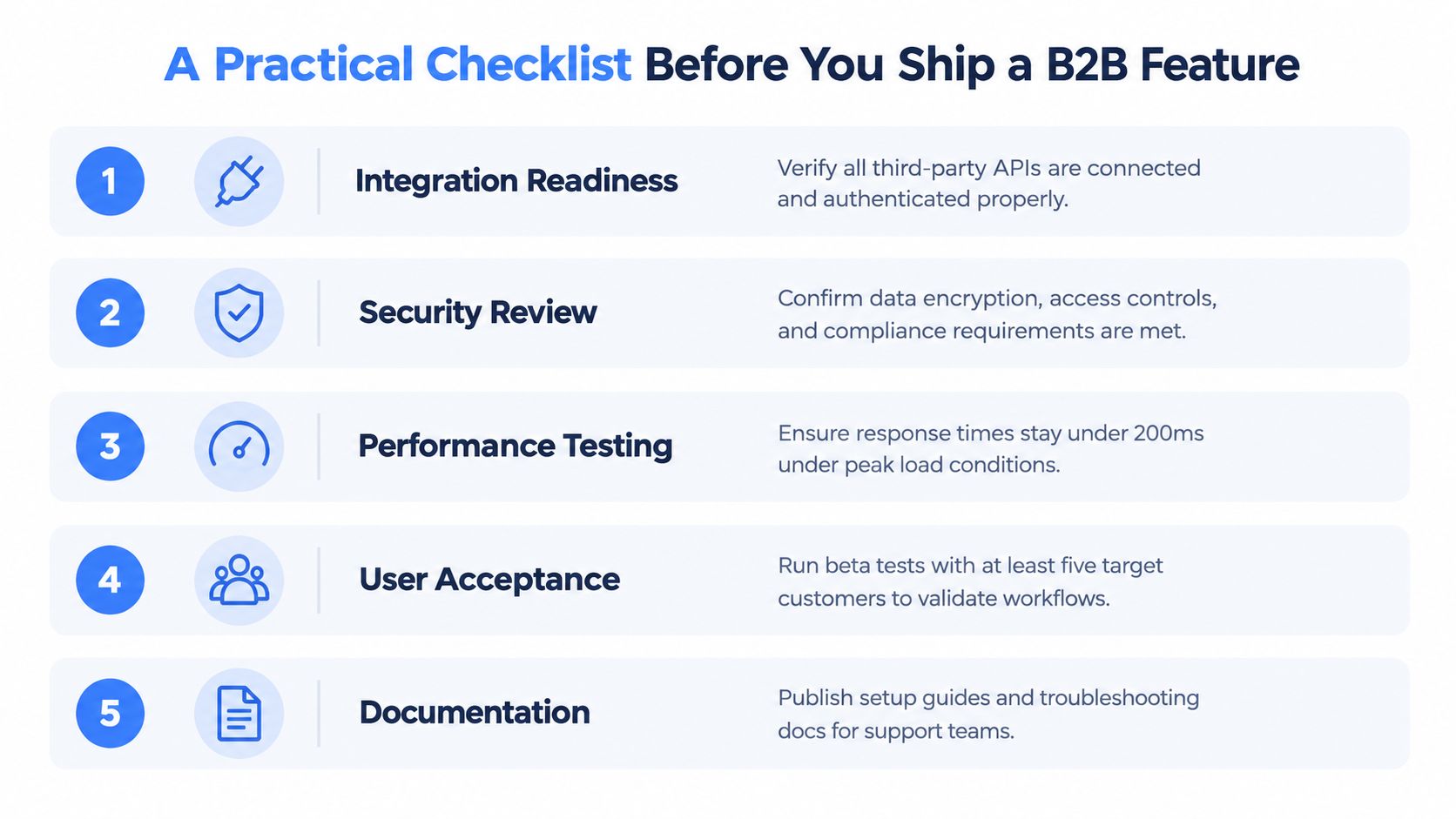
Buyer-journey legibility
Can a human buyer and an AI assistant both understand what the feature does, who it serves, what inputs it needs, and what output it returns? If not, discovery will suffer before sales ever gets context.Sales-cycle mapping
Identify who will touch this feature across qualification, evaluation, procurement, implementation, and renewal. A feature that helps one user but creates uncertainty for security, finance, or ops will slow the whole motion.Attribute coverage
Check whether the feature has the person, company, and engagement fields needed for its actual job. Don't rely on “enough to demo.” Rely on “enough to route, personalize, and resolve identity without manual cleanup.”Freshness and failure behavior
Decide which fields can come from slower reference data and which need live retrieval. Then test rate-limit handling, retries, and what happens when an upstream request fails.Compliance and pricing clarity
Review data source, audience, purpose, and access controls. Then make the pricing logic understandable enough that a buyer can estimate cost without a custom spreadsheet.
The highest-impact B2B improvements often come from removing one hidden uncertainty, not adding one more visible feature.
One useful way to audit your own product
Pick a single workflow in your product. A lead-routing rule, a recruiting match screen, an AI agent action, or a company enrichment step all work well. Then walk through it with this question in mind: where does the system assume the data is current, trusted, and correctly matched?
That's usually where the biggest gap is hiding. Fix that first, and the rest of the workflow often gets simpler.
If you're building a product that depends on current professional or company records, Fetchin offers a real-time B2B data API that turns professional profile and company URLs into structured JSON for enrichment, routing, and workflow automation. Audit one feature in your stack, identify where stale or unclear data creates friction, then use that gap as the starting point for a cleaner, more trustworthy B2B experience.