The labels are often interchangeable on paper, but the actual difference lives in the meter, the rounding rule, and whether failed requests consume credits. Pay as you go emphasizes flexible commitment, while pay as you use usually emphasizes a discrete billable event.
What looks like a terminology question becomes expensive when an API starts handling retries, bursts, partial results, or asynchronous jobs. Two vendors can both advertise usage-based pricing and produce very different invoices because one bills elapsed capacity, another bills returned records, and a third rounds every event to a minimum increment.
For SaaS teams, the practical test is simple: can you explain exactly what creates a charge, when that charge is recorded, and how you can audit it later?
Table of Contents
- Why the Pricing Labels Matter More Than the Names
- How Cloud Billing Evolved From Commitments To Consumption
- What Pay-As-You-Go Means For API Products
- What Pay-As-You-Use Means For API Products
- Comparing Cost Predictability And Billing Control
- When Each Model Wins In Real SaaS Workloads
Why the Pricing Labels Matter More Than the Names
The common assumption is that pay as you go and pay as you use are two completely separate economic models. In practice, the terms often overlap. Cloud computing established the modern distinction, but the difference is usually one of emphasis. Pay as you go highlights the absence of a fixed subscription or long-term commitment, while pay as you use highlights metered consumption based on an event or unit. Amazon's account of AWS cloud computing describes the original access model as enterprise-grade computing without buying hardware in advance.
That distinction matters because buyers don't pay for labels. They pay for requests, records, seconds, gigabytes, capacity, or credits. A professional data API might charge for each successful profile retrieval, while an infrastructure service might charge for active capacity even when no useful response reaches the customer. Both can call themselves pay as you go.
The invoice is shaped by the meter
A pricing page should answer five questions before a procurement conversation begins:
- What is measured? Is it a request, successful result, returned record, attribute, processing duration, storage amount, or allocated capacity?
- When is usage recorded? The event might be logged at submission, completion, delivery, or invoice generation.
- What happens to retries? A network timeout can trigger an automatic retry, creating either one billable event or several.
- How is usage rounded? A service can measure precise consumption but invoice in larger minimum increments.
- Can the customer audit it? A total without endpoint-level records creates disputes, especially when several teams share one account.
For an API that fetches public professional data, these questions are more useful than asking whether the product is “pure” pay as you use. A profile URL, company URL, post, comment, or reaction can represent a distinct unit. But the vendor still needs to define whether an invalid URL, a transport failure, an empty result, and a valid response receive the same treatment.
Practical rule: Treat the pricing label as a starting point. Treat the billable event as the contract.
A team evaluating API pricing models should therefore compare the meter and the controls before comparing headline rates. The model that appears cheaper can cost more if it rounds aggressively, bills failed calls, or keeps capacity active during idle periods.
How Cloud Billing Evolved From Commitments To Consumption
How did cloud billing move from buying infrastructure to paying for measured activity? The answer matters because the same shift now shapes API pricing. AWS launched in March 2006 on the premise that customers could access enterprise-grade computing with a credit card and an internet connection, without buying hardware upfront. Amazon EC2 entered beta in August 2006 with one instance size, one region, and one pricing option, On-Demand. That origin helps explain why pay-as-you-go became associated with flexible access to computing resources, as described in a contemporaneous EC2 launch announcement.
The buyer's financial question changed from “How much infrastructure must we own?” to “How much capacity will this workload consume?” A 2016 survey covering more than 20 public cloud providers among 45 globally considered companies reported entry-level Windows cloud instances at approximately $0.12 per hour, while enterprise cloud prices had fallen by roughly two-thirds since 2013. Data Center Knowledge's coverage of enterprise cloud pricing links that change with scaling capacity up for peaks and down when demand falls.
Consumption still needs a precise unit
Cloud products commonly measure:
- Elapsed time, such as compute hours or active runtime.
- Volume, such as gigabytes stored or transferred.
- Processing quantity, such as successfully processed audio duration.
- Events, such as API calls, jobs, messages, or returned records.
- Provisioned capacity, where an allocated resource can incur charges even when usage is low.
The meter alone does not define the bill. Google Cloud Speech to Text measures audio by the amount successfully processed, using one-second increments, according to its Speech to Text pricing documentation. Confluent Cloud documents hourly accrual and states that usage below one hour is billed for the full hour, with monthly invoicing in arrears. Its billing overview demonstrates why a metered service can still apply rounding and minimum-charge rules.
Commitments added another decision. AWS reported 107 EC2 price reductions between its 2006 launch and April 2021, while one-year or three-year commitment programs offered discounts of up to 72% against On-Demand rates, according to AWS pricing material. Stable workloads may justify a commitment for a lower effective unit cost. Experiments and volatile workloads may justify paying more for the ability to stop immediately. Teams evaluating the trade-off can consult this guide to savings plans for DevOps.
API vendors should publish the meter, event timing, retry treatment, failed-request policy, minimum increment, rounding rule, and invoice treatment beside the rate. They should also retain an auditable usage ledger. A headline price is only useful when customers can trace each charge back to a defined event.
What Pay-As-You-Go Means For API Products
For an API product, pay as you go is primarily a commitment statement. The customer pays for measured consumption without necessarily buying a fixed recurring allowance or accepting a long-term capacity obligation. Google Cloud describes the model as paying only for services used, without upfront fees or termination charges, while noting that product-specific units, billing cycles, and discounts can still apply in its cloud pricing guidance.
The label does not identify the meter. A pay-as-you-go service may bill requests, credits, compute time, storage, traffic, or provisioned capacity. Customers can stop making calls, yet charges may continue while an allocated resource remains active.
The same label can create different exposure
Consider three API designs:
- Request meter: every submitted call creates a usage event.
- Successful-result meter: only a valid completed response consumes a unit.
- Capacity meter: the customer pays for reserved throughput or active runtime.
A bursty enrichment pipeline often fits a request or successful-result meter because spending follows activity. A continuous processing workflow may accept elapsed-time billing when the resource remains productive. A capacity meter can make sense when guaranteed throughput matters, but the buyer must model idle periods.
Pay-as-you-go also does not mean immediate payment. A provider may record events throughout the month and consolidate them into a later invoice. Creem's explanation of billing models for SaaS startups provides useful context because the commercial design includes more than a rate. It also defines the unit, usage reporting, and how customers interpret accumulated charges.
Retries expose the cost of vague rules. A timeout can leave the client unsure whether the server completed the request. If the client retries and both attempts are charged, the customer pays for uncertainty. If the vendor charges only for a completed valid response, the vendor accepts more operational risk but offers a clearer promise.
Failed requests require the same precision. A malformed request, authentication failure, transport error, or server-side failure may each need a different billing outcome. Asynchronous jobs add further events: submission, completion, and returned records. A provider that bills submission may charge even when the job later fails, while a completion-based meter must explain whether partial output counts.
The usage ledger should make every decision auditable. Customers need the event ID, meter type, timestamp, outcome, retry relationship, and applied rounding rule, not merely a monthly total.
Ask before signing: What is the billable unit, when does it become billable, what does a retry cost, how are failed requests treated, and when does the event appear in the usage ledger?
Pay as you go suits uncertain demand and buyers seeking a low-commitment starting point. It becomes expensive when capacity remains active, rounding inflates small events, or reporting arrives too late to control usage.
What Pay-As-You-Use Means For API Products
Pay as you use ties the charge to a discrete usage event. For an API, that might be one successful profile retrieval, one company resolution, or one returned engagement record. The model fits B2B data products when the customer's value arrives as a structured result rather than as access to an always-running service.
The commercial design still depends on the meter's exact behavior. A buyer might purchase credits upfront and consume them as valid records return. Another might receive an invoice after usage. Either way, the provider must define whether billing follows submission, processing, completion, or the returned outcome.
A small example exposes the difference
Consider an enrichment workflow that submits profile requests, retries some timeouts, and receives both valid and invalid inputs. A clear pay-as-you-use policy could apply these rules:
- A valid profile response consumes one credit.
- A malformed URL consumes no credit.
- A transport failure consumes no credit.
- A retry returning the same valid response is deduplicated or marked as related to the original attempt.
- A partial response follows a published rule.
That lets the customer estimate spend from successful records instead of worker runtime. The total bill can still rise sharply with high request volume, but the relationship between delivered output and cost becomes easier to inspect.
Asynchronous delivery needs a separate decision. The provider should state whether a credit is consumed when the job is submitted, completed successfully, or returns a record. A job that produces ten valid records after fifteen internal attempts should identify which event controls the invoice, how partial output is treated, and whether unused or failed work is reversed.
Meter options and their cost behavior
| Meter option | Best for | Cost risk |
|---|---|---|
| Per successful request | Synchronous data retrieval | “Successful” may remain undefined |
| Per returned record | Enrichment and structured extraction | Partial-result rules may create disputes |
| Per attribute | Selective data products | Forecasting becomes harder as fields vary |
| Credit bundle | Prepaid controls and product-led trials | Expiration or non-carryover terms may surprise buyers |
| Submission event | Simple asynchronous job intake | Failed jobs may still consume units |
| Processing duration | Long-running transformations | Retries and idle runtime can increase spend |
The ledger must support reconciliation, not merely display a monthly total. Customers should sample requests from their own logs, match them to usage entries, and check that the sample includes successful, failed, retried, duplicate, and partial outcomes. Repeated gaps in that sample indicate incomplete metering or a reporting delay that finance cannot safely ignore.
NIST describes cloud metering across storage, processing, bandwidth, and active accounts, reinforcing the need for transparent monitoring and reporting in its cloud service evaluation guidance.
For teams assessing a credit pricing model, the practical test is whether one credit has a stable, documented meaning. If it sometimes represents a call, sometimes a record, and sometimes a field group, the label creates confusion instead of pricing clarity.
Comparing Cost Predictability And Billing Control
Buyers often ask which model is more predictable. The better answer is that precision beats terminology. A loose pay-as-you-go meter can create serious exposure during traffic spikes, while a clearly defined pay-as-you-use event can remain manageable at high volume.
Start with the workload, not the vendor's preferred phrase. Estimate successful business outcomes, then add the operational conditions that create extra events.
A practical estimation method
Use this sequence before accepting a quote:
- Count intended outputs. Estimate profiles, companies, posts, comments, reactions, or other records your product needs.
- Model retries separately. Review client timeout behavior, queue retries, and provider retry policies.
- Check failed-request treatment. Confirm whether invalid inputs, transport errors, empty responses, and provider errors consume units.
- Apply rounding rules. Convert actual usage into the vendor's minimum increment, whether that means seconds, hours, records, or credit blocks.
- Add burst exposure. Test what happens if traffic rises suddenly or a deployment loops over the same input.
- Reconcile against the ledger. Ensure finance can match each invoice line to an endpoint, request ID, status, and account.
The formula is straightforward:
Estimated spend = billable successful events × unit rate + rounded operational usage + committed or minimum charges.
The difficult part is defining “billable successful events.” A vendor that charges every submission creates a different estimate from one that charges only completed valid responses. A provider that rounds hourly usage creates a different estimate from one that measures one-second increments.
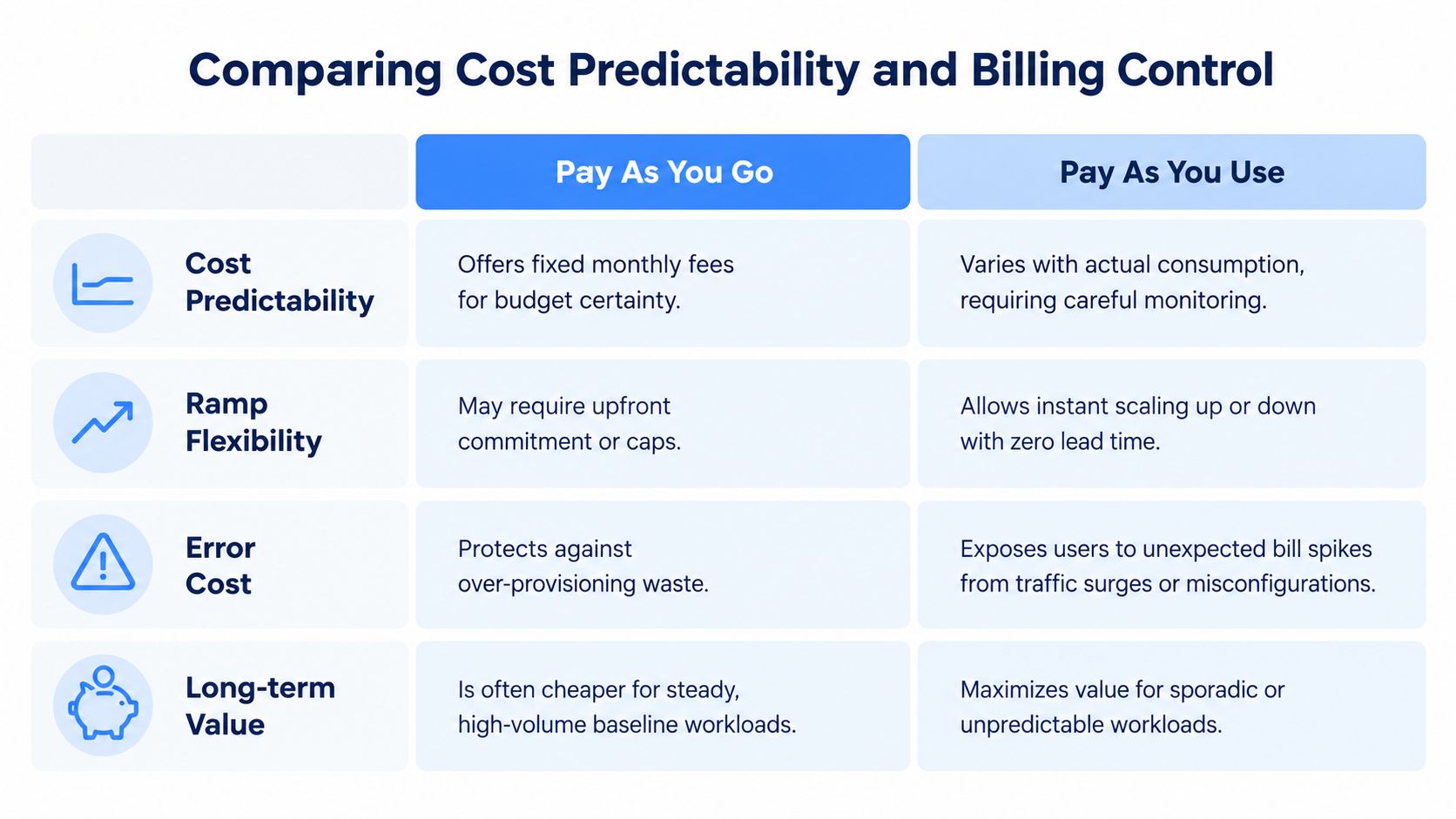
Decision criteria for procurement
| Criteria | Pay-As-You-Go Emphasis | Pay-As-You-Use Emphasis |
|---|---|---|
| Cost predictability | Forecast the meter across a billing period | Forecast the number of discrete events |
| Ramp flexibility | Stop or reduce consumption without a long commitment | Scale event volume up or down immediately |
| Error cost | Check whether active capacity continues billing | Check whether failed calls consume units |
| Accounting | Reconcile accumulated usage to a consolidated invoice | Reconcile each event or credit movement |
| Budget control | Use caps, alerts, and capacity limits | Use credit limits, request caps, and endpoint controls |
| Vendor lock-in | Assess reserved terms and migration cost | Assess credit expiration and schema dependency |
Pay close attention to error policy. Charging for a failed provider response can punish customers for conditions they can't control. Charging for malformed inputs may be defensible if the vendor still performs meaningful work, but the rule must be visible before implementation.
Rate limits also affect the cost model. A customer may send a burst that exceeds the permitted rate, receive errors, and then trigger retries. The API rate limit guidance is relevant because throughput controls and billing controls need to work together. A rate limit that protects the service but causes repeated billable retries creates a poor commercial experience.
Finally, demand a usage export or ledger API. A dashboard total is useful for monitoring, but finance and engineering need event-level evidence. Without it, disputes become a manual investigation rather than a routine reconciliation process.
When Each Model Wins In Real SaaS Workloads
The right model follows workload shape. Teams building an experimental enrichment feature usually need protection from unused commitments. A mature platform with stable demand may prefer a credit allocation or committed arrangement that improves forecasting. Neither preference makes one label universally superior.
Experimental enrichment pipelines
An early-stage product may enrich records intermittently while product teams test matching logic, onboarding flows, or agent behavior. Per-event charging works well here because the buyer can connect a successful response to a discrete unit. A hard credit cap also prevents an accidental loop from turning a small experiment into an uncontrolled bill.
The implementation detail matters more than the label. If a failed profile request consumes a credit, the team must budget for network instability and malformed inputs. If only valid responses consume credits, the vendor carries more failure risk, but the buyer gets a cleaner link between spend and delivered data.
Engagement tracking and periodic refreshes
A product that refreshes posts, comments, or reactions on a recurring schedule has a different demand curve. Usage may arrive in bursts after a scheduled job, then fall quiet. A credit model can handle that pattern, but the team should check expiration, carryover, and whether a refresh of unchanged data still creates a billable event.
For periodic jobs, idempotency is essential. The client should retain a request identifier or source key so a retry doesn't create duplicate output and duplicate charges. The vendor should expose status clearly enough for the client to distinguish “not completed” from “completed with no new records.”
Growing SaaS platforms
As volume becomes more stable, a monthly allocation can simplify budgeting. The customer knows the expected allowance, finance receives a recurring commercial structure, and engineering can monitor overage risk. That arrangement still needs transparent treatment for unused credits, excess consumption, and changes in endpoint mix.
Teams comparing structures can consult this guide to usage based billing for broader commercial context. The useful principle is to align the meter with customer value rather than with whatever internal resource is easiest for the vendor to count.
Enterprise procurement
Enterprise buyers often care about consolidated invoicing, account-level controls, and audit evidence as much as unit price. Pay as you go can satisfy procurement when the invoice clearly aggregates usage by department, endpoint, and period. Pay as you use can satisfy engineering when every successful response has a stable credit meaning.
A hybrid structure often works in practice: a recurring allocation for predictable baseline demand, then transparent usage treatment for bursts. The decision should come from forecast confidence, error exposure, and accounting requirements. It shouldn't come from the assumption that one phrase sounds more modern than the other.
For teams building with a professional data API, Fetchin offers structured JSON extraction from professional profile and company URLs, along with endpoints for posts, comments, and reactions. Its commercial options include monthly credits and pay-as-you-go credit purchases, so buyers should evaluate the exact credit rules, failure treatment, limits, and ledger visibility against their workload rather than relying on the model name.
If you're building enrichment, matching, or engagement features, start by writing down your billable event and retry policy before choosing a pricing plan. Review Fetchin to evaluate a professional data API that turns profile and company URLs into structured JSON, then compare its credit controls with your expected workload and audit requirements.