
The popular advice for a live data API is simple: make every response as fast as possible. That advice is incomplete. A sub-second response from an outdated index can give a product team more confidence in the wrong answer, while a slower request that retrieves current page-state data can support a better decision.
The engineering problem is therefore broader than latency. Teams must define decision-useful freshness, measure tail behavior, choose between live fetching and periodic indexing, and build privacy controls around every field returned. The right architecture serves current data when freshness affects the action, cached data when stability matters more, and asynchronous processing when the workflow can tolerate variable retrieval time.
Table of Contents
- Redefining Freshness in Modern Data APIs
- Live Fetching Versus Periodic Indexing
- Engineering for Tail Latency and Throughput
- Practical Applications for SaaS and AI Agents
- Navigating Privacy and Compliance Boundaries
- Building Resilient Data Integrations
Redefining Freshness in Modern Data APIs
“Real time” often describes how quickly an API answers, not how current the answer is. Those are different properties. Technical freshness concerns the delay between a request and a response. Decision-useful freshness asks whether the returned field is current enough to support the user's next action.
A sales workflow may need a current role and company association before routing an account. A recruiting workflow may care about a person's current location and skills. An engagement workflow can depend on recently published posts, comments, or reactions. A response that arrives quickly but reflects an old snapshot may satisfy a latency target while failing the product requirement.
Measure freshness by field, not by record
Different fields decay at different rates. Headcount and job titles generally change less frequently than posts or reactions, while contact attributes may require stronger validation because users and organizations can update them independently. A useful freshness policy therefore assigns expectations to fields rather than declaring an entire profile “fresh.”
For each returned attribute, store:
- Retrieval timestamp: When the source was checked.
- Source-publication time: When available, when the underlying item appeared or changed.
- Provenance: Which source produced the value.
- Confidence or state: Whether the field is present, missing, or contradictory.
- Time-to-live: How long the value can be reused before another check is required.
Reported API research identifies real-time data consistency as the most common scalability challenge, cited by 92% of respondents, while concurrent request handling affected 88% of respondents, as documented in this analysis of real-time data consistency and API scalability. These findings point to a practical issue: freshness isn't only a retrieval problem. It also depends on how applications reconcile changes, missing values, and conflicting observations.
Practical rule: Define freshness against the business decision, not against the stopwatch.
Write freshness service levels users can understand
A useful freshness service level might say that a current role is checked at the moment of enrichment, while an engagement signal is fetched on demand before an automation rule runs. It can also specify what happens when the source is unavailable: return the last verified value with its timestamp, return an explicit unknown state, or place the request into an asynchronous queue.
Product teams building an enrichment API workflow should expose this context in the interface. A user can then distinguish “current as checked at request time” from “last verified during a previous refresh.” That distinction prevents a fast API from creating false precision.
The best live data API isn't necessarily the one with the smallest median latency. It's the one that tells the application what was checked, when it was checked, which fields are reliable, and whether the result is suitable for the decision at hand.
Live Fetching Versus Periodic Indexing
A periodic index gives engineers a stable operating model. A collector gathers records, normalizes them, and stores a snapshot that product requests can read quickly. This approach works well when data changes slowly, requests are predictable, and temporary staleness is acceptable.
Live fetching reverses that sequence. The application sends a professional profile URL or company URL when it needs an answer, and the professional data API resolves current public information at request time. That reduces dependence on an aging snapshot, but it exposes the product to upstream variability, source changes, rate limits, and incomplete responses.
A 2023 global developer survey reported that 61.6% of developers relied on APIs more in 2021 than in 2020, signaling accelerated dependence on external services during the expansion of cloud software and automation, according to this summary of API usage and growth. As teams move core workflows into APIs, the choice between a snapshot and a live request becomes a product decision, not merely a storage decision.
Architectural trade-offs
| Feature | Live Fetching | Periodic Indexing |
|---|---|---|
| Freshness | Retrieves current public information when requested | Reflects the last completed indexing cycle |
| Latency | Variable, because upstream retrieval affects response time | Predictable after data is indexed |
| Availability | Depends on the source and provider during each request | Can continue serving stored records during source disruption |
| Storage | Can reduce the need for an unbounded raw-data warehouse | Requires stored snapshots and refresh processes |
| Change handling | Detects changes closer to the time of use | Changes may remain invisible until the next cycle |
| Cost control | Costs follow request volume and retrieval complexity | Costs follow indexing scope, refresh cadence, and storage |
| Failure behavior | Needs retries, fallbacks, and explicit unknown states | Needs refresh monitoring and stale-record detection |
The strongest design is often hybrid. Keep normalized fields with a controlled TTL for frequently repeated requests, then use live retrieval when the value is business-critical or the cached result has expired. Don't hide the choice from users. Return the retrieval time and freshness state alongside the data.
Choose delivery mode by workflow shape
Interactive enrichment usually favors synchronous delivery. A user submits one URL, waits for structured JSON, and continues. A batch process that resolves many URLs should use a queue, bounded concurrency, retries, and status callbacks instead of holding open a large set of HTTP requests. Teams evaluating synchronous and asynchronous API delivery should map the mode to the user experience, not force every workload through one endpoint.
Provider behavior matters just as much. A stable schema protects direct integrations, while clear credit accounting prevents failed retrievals from becoming an unpredictable expense. Failed requests not consuming credits is a meaningful operational rule because transient source failures shouldn't increase the cost of a workflow without notice.
Live data also supports proactive workflows. A team that wants to find customer issues before they escalate needs current signals more than a convenient historical snapshot. The trade-off is that current signals require stronger controls around retries, caching, consent, and downstream action.
Engineering for Tail Latency and Throughput
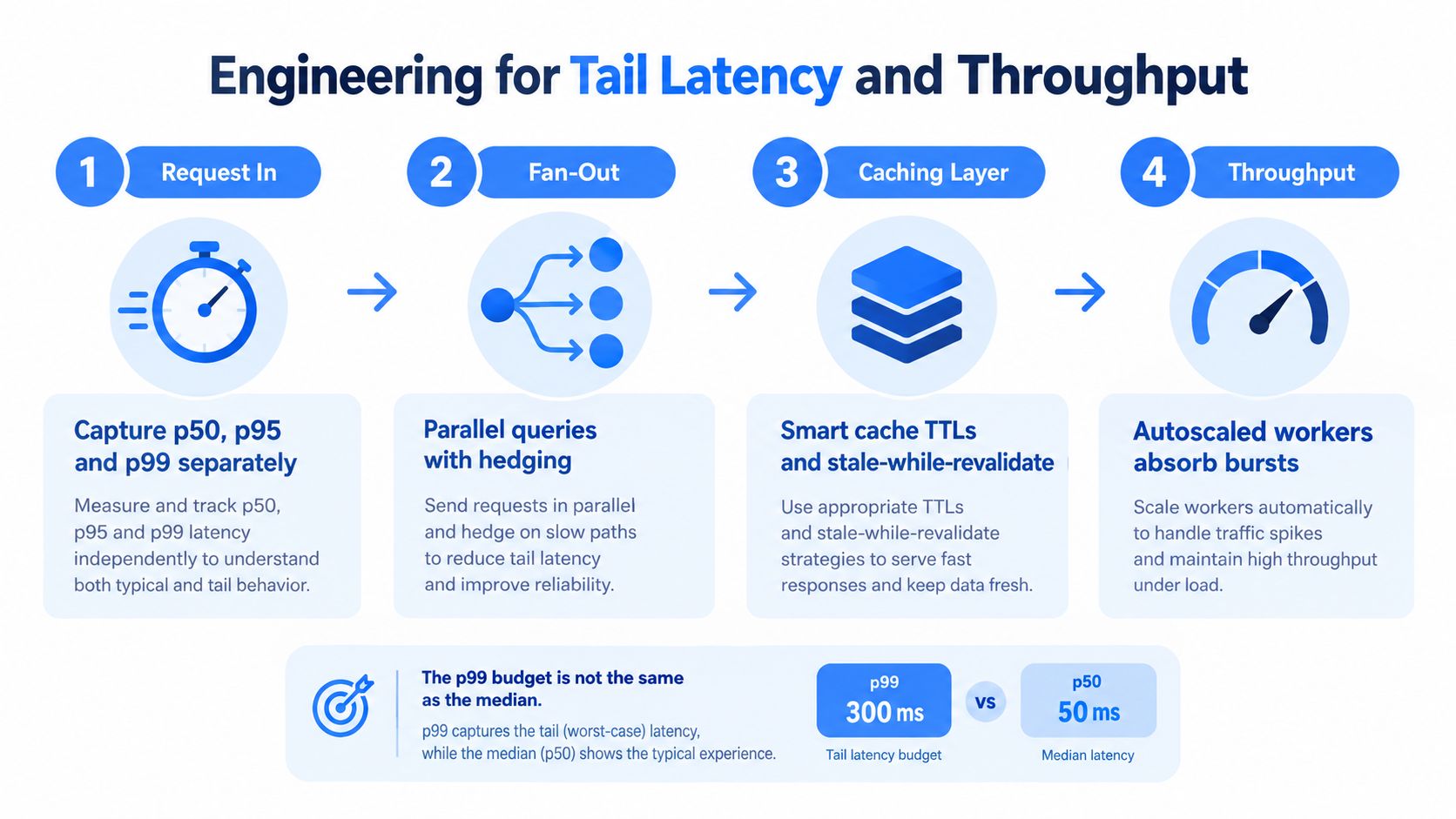
Fast median latency looks good on a dashboard, but production systems fail at the tail. Users wait on the slow request, and multi-step workflows inherit the delay from every upstream dependency.
A published real-time API benchmark reported 45 ms p50, 202 ms p95, and 276 ms p99, which is a useful reminder that the slowest 1% to 5% of calls can be several times slower than the median, as shown in this real-time API latency and throughput benchmark. For product teams using live data, that gap matters more than headline speed because decision-useful freshness depends on predictable completion, not just a fast p50.
Instrument the complete request path
Measure p50, p95, and p99 separately. Record timeout rate, HTTP error rate, provider latency, platform processing time, queue delay, and serialization time. One blended “response time” metric hides the actual bottleneck and makes it harder to tell whether the delay came from the source, the provider, the network, or your own client.
Timeouts should be bounded and deliberate. Set them slightly above the contracted p95, retry only transient failures, and use exponential backoff with jitter so clients do not retry in lockstep. Pair that with idempotency keys or another safe replay strategy, especially when a response may already have triggered a CRM write, workflow event, or billing action.
Tail latency also changes capacity math. At 100 requests per second, a 5% p95 tail represents roughly five potentially delayed requests every second. That is not just a bad user experience. It can turn into queue growth, worker saturation, and stale results if the system keeps accepting traffic at the same rate. Load testing should reflect that reality with both burst traffic and sustained traffic, because the two failure modes look different.
If the data is sensitive, add privacy controls to the same path instrumentation. Log request classes, consent state, and redaction outcomes without storing raw personal data where you do not need it. Fresh data that arrives quickly but crosses governance boundaries is still a production failure.
Use synchronous and asynchronous paths together
Synchronous mode fits single lookups where a person or agent is waiting for an answer. Return structured JSON, the retrieval timestamp, and an explicit status for missing or withheld fields so downstream logic can decide whether the result is fresh enough to act on.
Asynchronous mode fits URL fan-out, queued enrichment, and workloads with variable upstream latency. Create a job, return a durable identifier, and expose completion, partial-result, and failure states. Teams working on managing query fan out for SEO run into the same constraint. More parallelism can reduce wall-clock time, but uncontrolled concurrency increases provider pressure and drags up p95 and p99.
A practical control set includes bounded concurrency, adaptive backoff, idempotent writes, separate capacity budgets for interactive and batch traffic, and explicit degradation rules for cached, partial, queued, or unknown results.
Rate limits need to be visible and testable. Document the difference between shared limits and dedicated capacity, expose remaining quota where possible, and monitor rejection patterns using clear API rate-limit guidance. A low median helps only when the system stays predictable under the traffic pattern your product creates.
Practical Applications for SaaS and AI Agents
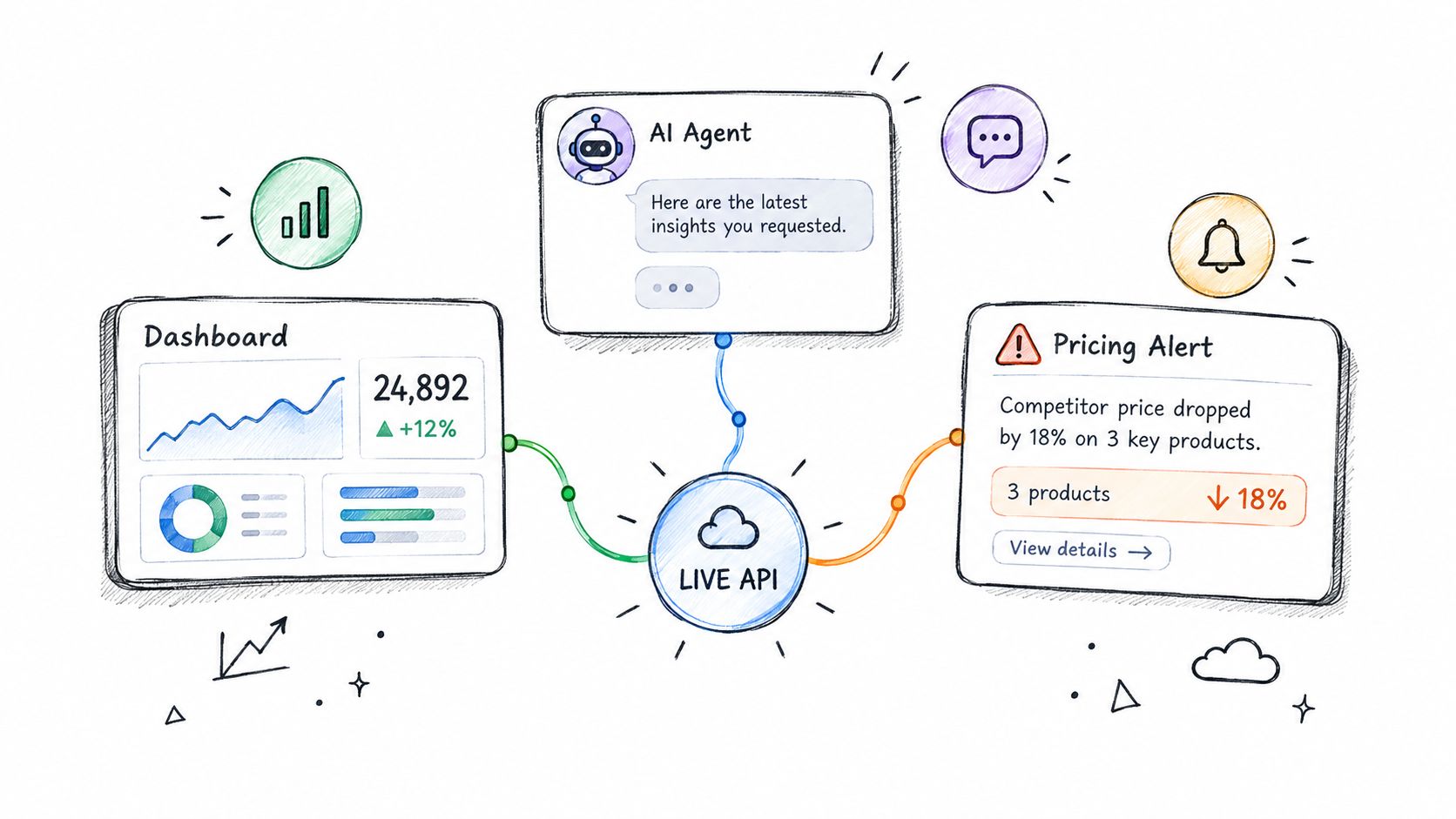
A live data API earns its place in a stack when it removes a decision bottleneck. The common pattern is straightforward: the product receives a professional profile URL or company URL, sends it to one endpoint, and receives structured JSON that can drive the next action.
Enrichment inside a SaaS workflow
A CRM extension can resolve a profile URL when a sales representative opens an account. The response can populate current role, company, location, skills, and business-contact context, then attach retrieval metadata so the representative knows how current the values are.
The important design choice is not to copy every returned field into the permanent customer record. Store the fields the feature needs, preserve provenance, and apply a TTL based on the action. A lead-routing rule may need a current company and role, while a reporting dashboard can tolerate a previously verified value.
Matching for recruiting and talent intelligence
A recruiting platform can use current professional data to match candidates against role requirements. Location, skills, current position, and professional history can support ranking, but the matching system should represent uncertainty rather than treating missing data as a negative signal.
Live retrieval can improve the user experience without becoming the sole source of truth. Fetch current data when a recruiter opens a candidate or when a match is about to trigger outreach. Keep the normalized result and its timestamp for auditability, but don't imply that a profile is permanently current.
Agents that react to engagement
An AI agent can monitor published content and engagement signals, then trigger a workflow such as summarization, account research, or an alert for a customer-facing team. Combining profile, company, posts, comments, and reactions through one structured interface reduces the number of vendor-specific adapters the agent must manage.
Agents need stricter safeguards than dashboards. Require a freshness threshold before an automated action, distinguish observed facts from generated interpretation, and send uncertain or contradictory results to review. The reference for AI-powered data projects is useful for teams designing the surrounding agent workflow, but the integration still needs its own budgets, permissions, and failure states.
A provider such as Fetchin offers a B2B data API that fetches professional profile and company URLs into structured JSON, with synchronous responses and optional asynchronous delivery. That model fits products that need current professional and company information without maintaining separate integrations for every data type.
Navigating Privacy and Compliance Boundaries
Public visibility isn't the same as permission to process data for any purpose. A professional profile URL may be accessible on the open internet, yet the application still needs to define why it collects the information, which fields it needs, how long it retains them, and how it handles correction or deletion requests.
The Dutch data protection authority explains that personal data published on open internet pages remains subject to the General Data Protection Regulation, requiring a lawful basis and a specific legitimate purpose for processing, as described in this privacy authority analysis of publicly available information.
Govern fields at the point of retrieval
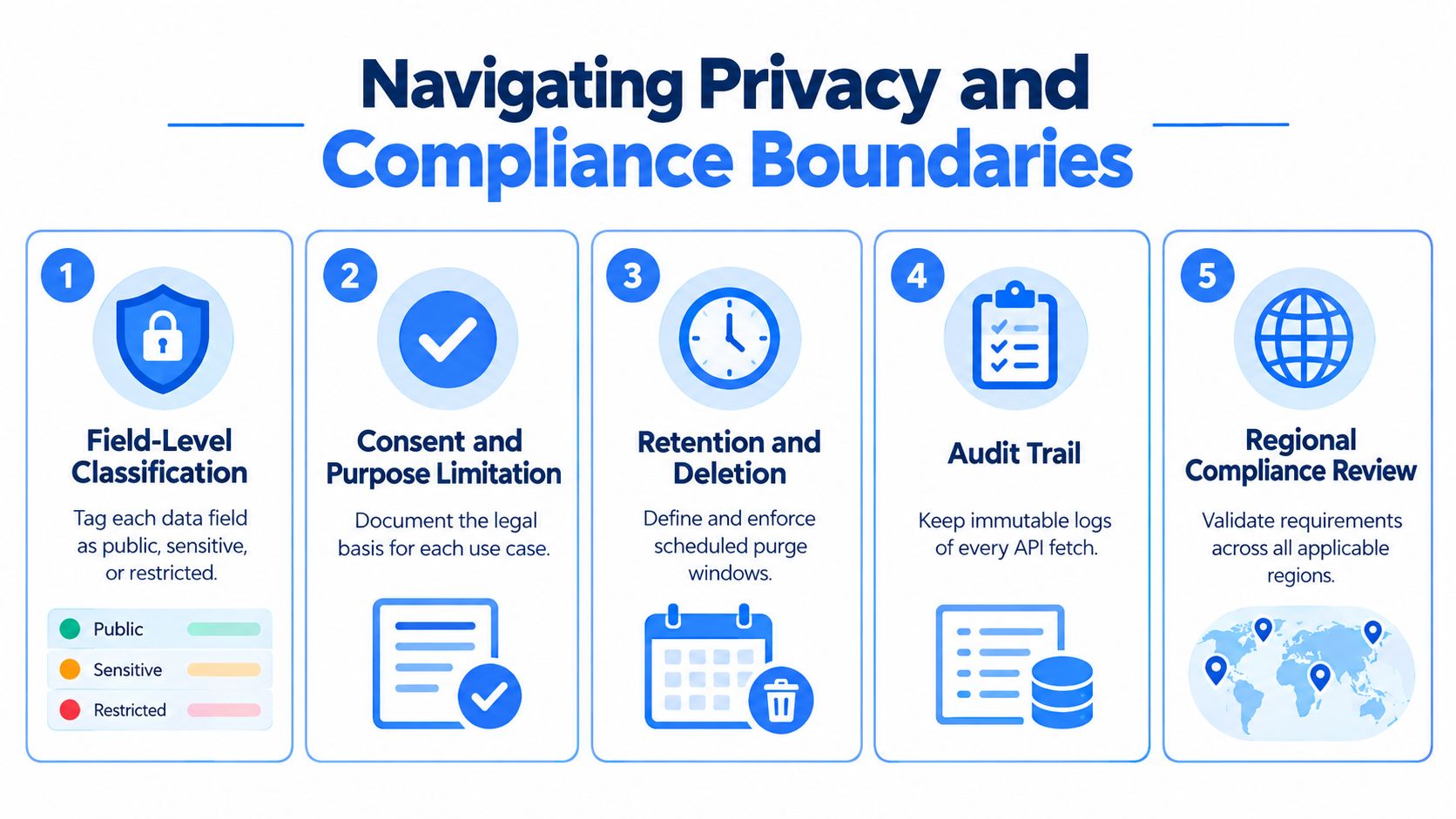
Start with a field-level inventory. Classify ordinary firmographics, professional identifiers, contact fields, inferred attributes, and restricted data separately. Then connect each field to a declared purpose.
- Request only what the feature needs. If the product only routes accounts by current role and company, don't request unrelated contact fields.
- Separate business information from identifiable professional information. Headcount and industry can still relate to an identifiable person when combined with other fields.
- Record provenance and retrieval time. Every normalized attribute should point to its source and fetch event.
- Limit raw-response retention. Store structured outputs with a deletion key and TTL rather than keeping unbounded source material.
- Apply access controls. Use tenant isolation, role-based access, encryption, and audit logging for returned data.
Governance rule: A live request is a new processing event, not a loophole around privacy obligations.
A live architecture can reduce stale-data risk because the application resolves information near the moment of use. It can also increase governance complexity because repeated requests may expose changed personal information. Apply tenant-level retention settings, support opt-out and deletion workflows, and make correction requests traceable across cached and normalized records.
Make regional review part of delivery
Legal treatment varies by jurisdiction and by field. The California privacy authority states that publicly available information is generally excluded from the California Consumer Privacy Act's definition of personal information when it was lawfully made available to the general public, distributed through widely available media, or disclosed without a restricted audience, as explained in the California privacy authority FAQ. That exclusion doesn't remove the need for access controls, purpose documentation, retention rules, or safeguards for information outside the public-information category.
For European processing, document the lawful basis and legitimate purpose, assess whether a Data Protection Impact Assessment is needed, and define how data-subject rights requests reach the provider, your integration, and downstream tenants. Your API contract should also explain missing fields, contradictory values, deletion behavior, and whether cached results survive a source-level opt-out.
Building Resilient Data Integrations
HTTP endpoints have become product infrastructure, not just utility calls. A 2023 Postman survey documented more than 25 million API collections created over time and 1.29 billion API requests created during the preceding year, illustrating the scale at which developers design, test, and consume network-accessible services, according to the 2023 State of the API report.
That scale changes the evaluation criteria for a B2B data API. Freshness matters, but so do schema stability, predictable failure behavior, transparent usage accounting, and the ability to separate interactive requests from batch work.
Evaluate the contract, not just the demo
A reliable provider should make these behaviors explicit:
- Schema discipline: Version structured JSON, document nullable fields, and distinguish absent data from an unsuccessful request.
- Failure semantics: Explain timeouts, upstream errors, retries, partial results, and whether failed requests consume credits.
- Latency reporting: Publish median and tail measurements under stated conditions, rather than presenting a median as an end-to-end guarantee.
- Capacity controls: Document rate limits, concurrency expectations, burst behavior, and any dedicated-capacity option.
- Delivery modes: Support synchronous lookups for interactive features and asynchronous jobs for fan-out workflows.
- Freshness metadata: Return retrieval timestamps, provenance, and field-level state where practical.
- Governance support: Provide controls that help customers minimize fields, retain only what they need, and process deletion or opt-out requests.
Run a proof of concept against your actual workload. Test single lookups, burst traffic, sustained queues, malformed inputs, source changes, partial records, retries, and duplicate callbacks. Validate that your database writes remain idempotent and that a provider outage produces a useful product state rather than an opaque error.
Turn freshness into an operating policy
Don't promise “real time” without defining what it means. Specify which fields are fetched live, which may be cached, how long cached values remain acceptable, and what the user sees when the provider cannot verify a value. Then monitor freshness separately from latency so the team can identify a fast but stale path.
A strong architecture also keeps raw retrieval separate from application state. Normalize the response, store provenance and timestamps, enforce retention, and make source changes observable. This gives product teams a way to improve matching and automation without turning every external response into permanent, ungoverned storage.
The practical target is not maximum speed at any cost. It's a system that returns data current enough for the decision, quickly enough for the experience, and transparently enough for engineering, legal, and operations teams to trust.
Fetchin provides a real-time B2B data API for fetching professional profile and company URLs into structured JSON, with synchronous responses and optional asynchronous delivery for higher-latency workflows. Review the available capabilities and integration approach at Fetchin, then test the freshness, tail-latency, schema, and governance requirements that matter to your product.