69% of CRM users reported data-quality problems in their organizations. That's why crm data enrichment has to be treated as an ongoing maintenance workflow, not a one-time import.
Poor records distort outreach, create duplicate contact attempts, and push teams toward decisions based on stale or incomplete information. A practical enrichment program fixes that by keeping records current, auditable, and usable at the point where sales and marketing act on them.
Table of Contents
- Why CRM Data Quality Is a Business Problem
- Choosing a B2B Data API for CRM Enrichment
- Mapping, Normalization, and Deduplication Workflows
- Synchronous Versus Asynchronous Delivery Models
- Managing Cost, Rate Limits, and Compliance
- Measuring CRM Enrichment Impact
- Building a Durable CRM Enrichment Operating Model
Why CRM Data Quality Is a Business Problem
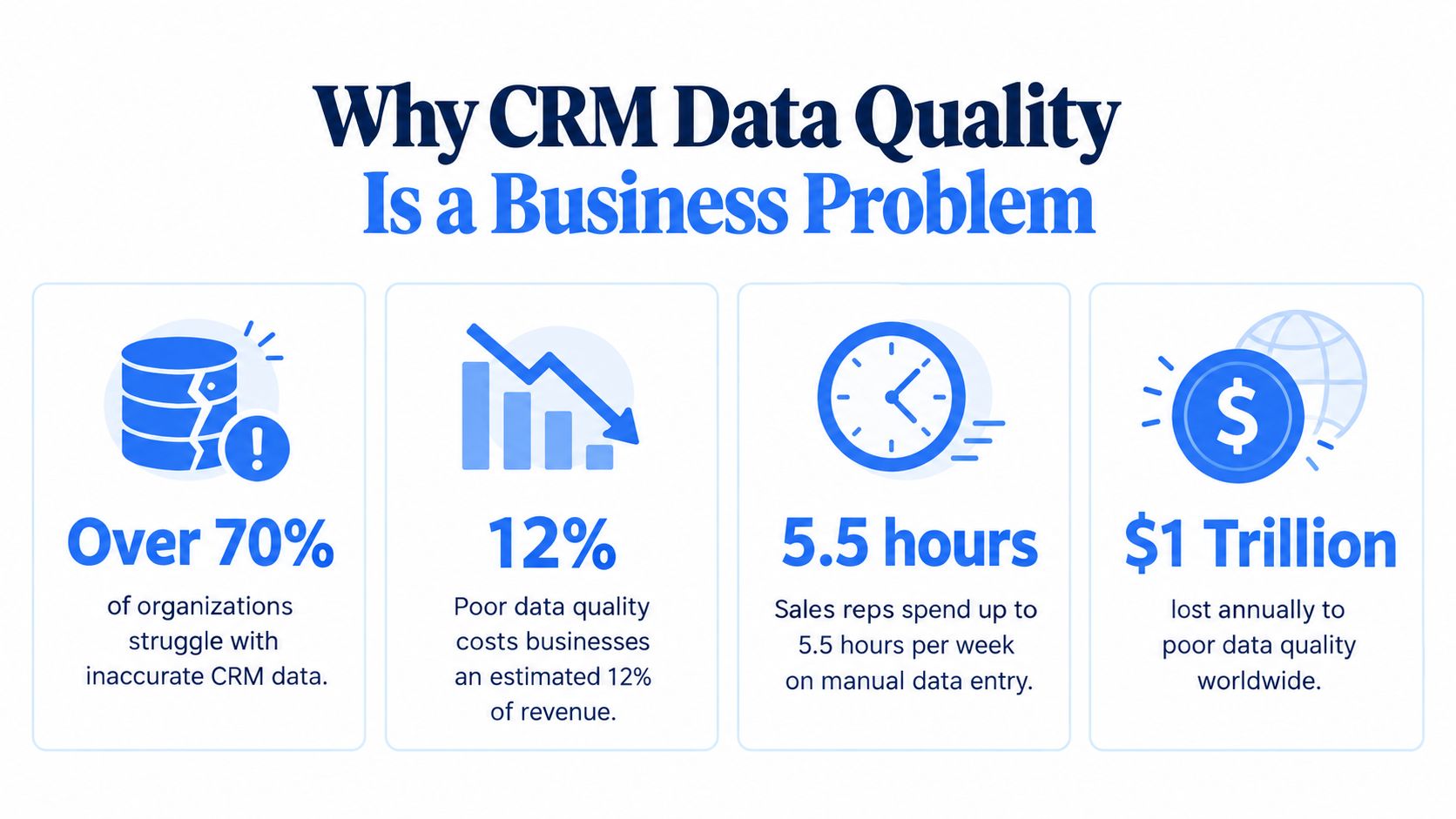
CRM data quality fails in the same places revenue teams feel the pain most: routing, outreach, and qualification. In the 2022 global study, 75% of respondents said poor data quality caused duplicate or inadequate outreach that cost their companies customers, half said they lost new sales, and 44% estimated revenue losses of more than 10% for the same reason. Those aren't housekeeping issues, they're pipeline issues, and the study's sample of 1,241 CRM users and stakeholders makes the pattern hard to dismiss (State of CRM Data Management 2022).
The right way to think about crm data enrichment is maintenance. A record that looked usable last quarter can become misleading after a role change, a company move, or a domain change, and that stale data leaks straight into segmentation, lead routing, and rep workflow. For a practical framing of how enrichment fits into the broader system, the pipeline optimization guide is a useful adjacent read, because enrichment only pays off when the downstream process is clean.
Practical rule: enrich records before they reach scoring and assignment, not after a rep has already acted on bad information.
The internal baseline also matters. A good starting point is the primer on what data enrichment is, because the operational question isn't whether fields can be filled, it's whether the filled fields are current enough to trust.
Choosing a B2B Data API for CRM Enrichment
A serious enrichment stack starts with the API contract, not the vendor logo. You want a professional data API that can fetch live person and company attributes in structured JSON, preserve provenance, and map cleanly to your CRM schema. For teams integrating enrichment into product flows, connect apps with Fullenrich is one example of how a workflow can be wired into an existing app layer without rebuilding the surrounding system.
The first decision is endpoint fit. Person-level enrichment needs a profile endpoint that can resolve role, employer, location, and other contact fields. Company-level enrichment needs a company endpoint that resolves firmographics like industry, headcount, headquarters, founding year, and verified domain. If your CRM stores contacts and accounts differently, the API has to support both objects cleanly, or you'll spend time post-processing fields that should have arrived in the right shape.
What to preserve in every response
Don't stop at the visible fields. Keep the retrieval timestamp, source URL, schema version, and confidence metadata in the record or in a sidecar store. That metadata is what lets ops teams audit a mismatch later, compare provider behavior, and roll back a bad update without guessing.
Operational preference: live fetching works better for volatile attributes like current role and company status, while cached datasets are usually fine for stable firmographics and warehouse reporting.
A good implementation also expects structured JSON outputs, because unstructured notes become brittle as soon as you need deduplication or field-level validation. The data enrichment API guide shows the sort of product pattern that works well here, especially when you need repeatable outputs instead of manual interpretation. If the API can't return predictable fields at low friction, it'll become an integration tax rather than an enrichment layer.
Mapping, Normalization, and Deduplication Workflows
The dangerous mistake is joining data before you've normalized it. Start by profiling completeness, validity, uniqueness, consistency, and freshness, then standardize names, domains, phone numbers, addresses, and country codes. After that, use deterministic keys such as a verified email or company domain before you let probabilistic matching weigh weaker signals.
A safer matching order
- Deterministic first: verified email and company domain should outrank fuzzy name matches.
- Ambiguous matches go to quarantine: don't overwrite production records when two candidates look plausible.
- Confidence stays with the field: keep a field-level score, not just a record-level pass or fail.
- Provenance never disappears: retain the original value, source timestamp, and retrieval context.
That order matters because enrichment vendors can return multiple people or companies with similar names, and false merges are expensive to unwind. A quarantine state gives your team a review path without corrupting the source record, and it's far safer than auto-merging everything that looks “close enough.”
The table below is a simple field strategy that works well in production.
| Enrichment Field Strategy | ||
|---|---|---|
| Field Category | Examples | Refresh Strategy |
| Identity fields | verified email, company domain | validate on every touchpoint |
| Volatile role fields | job title, employer, seniority | refresh frequently and audit changes |
| Firmographic fields | industry, headcount, headquarters | refresh on schedule or on trigger |
| Stable background fields | education, founding-year-related attributes | refresh less often unless confidence drops |
A few implementation details matter more than they first appear. Idempotency keys keep retries from creating duplicate updates, and retry-safe writes prevent asynchronous jobs from overwriting each other. If the pipeline can't prove what changed, when it changed, and why it changed, the enrichment layer becomes harder to trust than the raw CRM.
Synchronous Versus Asynchronous Delivery Models
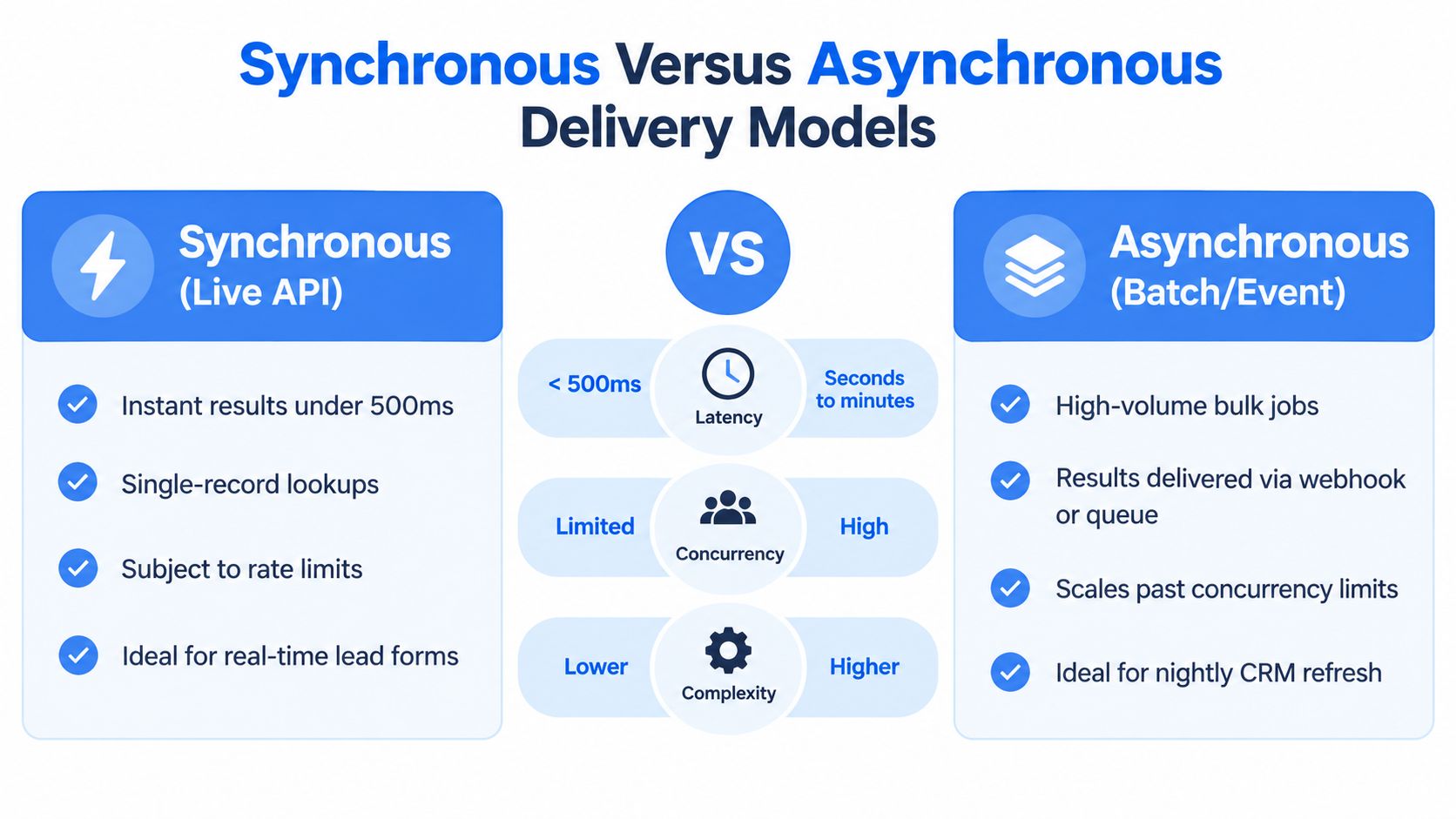
A live enrichment call makes sense when a rep is staring at a form submission, a routing rule has to fire, or an agent needs an answer before the next click. Queue-based jobs fit better for backfills, nightly refreshes, and other bulk work that should not slow the user path.
The trade-off is plain. Synchronous delivery gives immediacy, but it exposes latency, rate limits, and user experience right in the request path. Asynchronous delivery gives more throughput and resilience, but the data arrives later and needs tighter orchestration. The right setup is usually hybrid, with live enrichment for volatile fields and background jobs for bulk updates. For a deeper comparison of delivery trade-offs, see the synchronous vs asynchronous API guide.
Infrastructure behavior matters once volume rises. A 2025 API infrastructure study measured an event-driven model at an average response time of 95 milliseconds, throughput of 3,000 requests per second, and a resilience score of 0.94. Under rising load, its latency stayed below 200 milliseconds up to 8,500 users, while the synchronous model exceeded 500 milliseconds after about 1,800 users (API infrastructure study). That is a clear signal to plan concurrency instead of treating enrichment as a simple lookup.
The integration layer also has to fit the rest of the stack. The marketing automation CRM integration guide is a useful reference because enrichment only works when it cooperates with routing, scoring, and downstream automation.
Here is the practical split:
- Synchronous delivery: live lead forms, agent lookups, one-record resolution.
- Asynchronous delivery: nightly refreshes, backfills, bulk segmentation jobs.
- Hybrid routing: send urgent, volatile fields live, then reconcile non-urgent fields later.
Managing Cost, Rate Limits, and Compliance
Cost control in enrichment is mostly about avoiding waste. If failed requests consume credits, your team pays twice, once for the lookup and again for the retry. If rate limits are too low for the actual load, the pipeline becomes a bottleneck and ops starts batching work just to stay inside the cap.
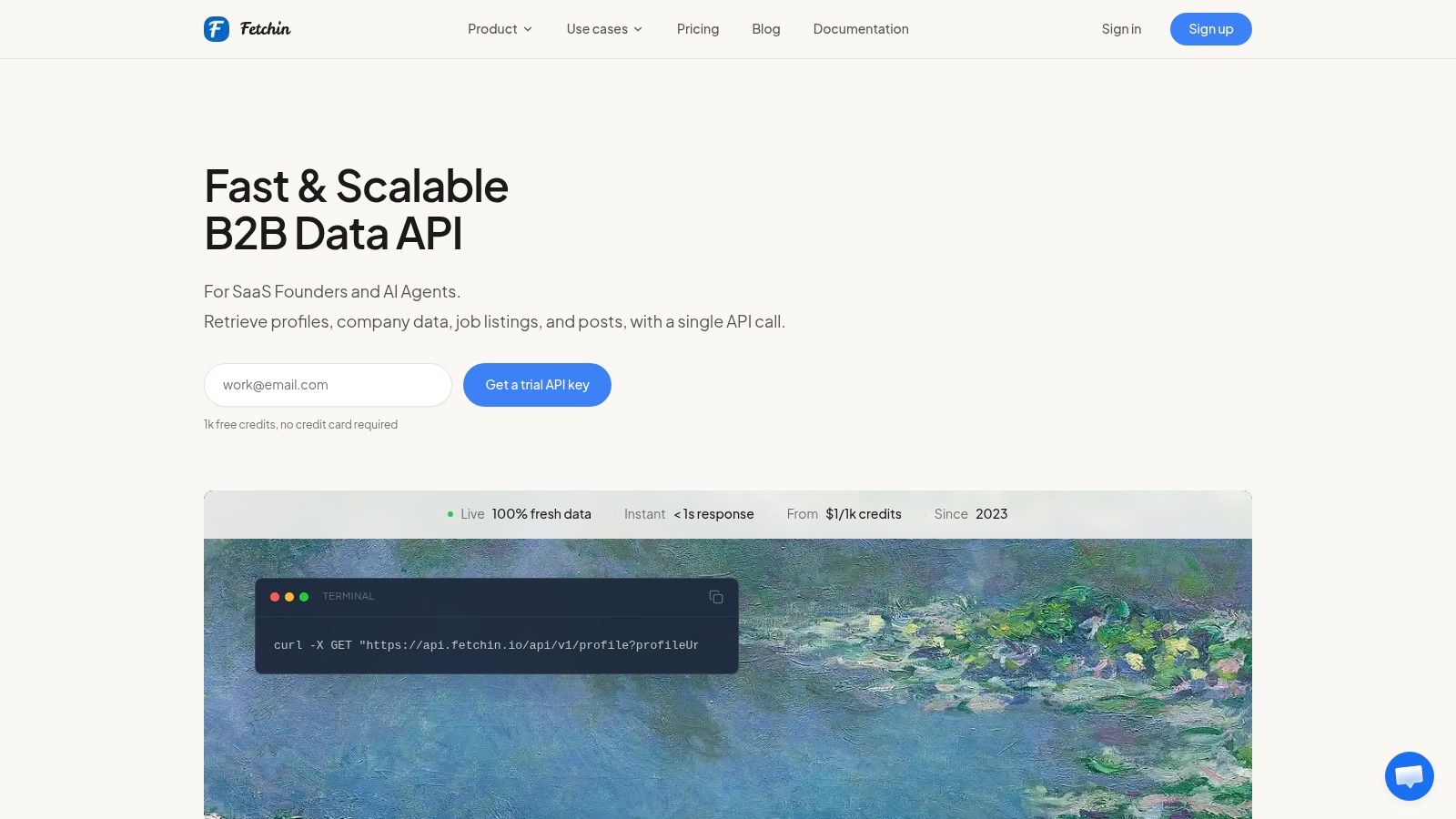
Fetchin's operating model is useful here because it pairs live fetching with pricing controls, rate limits from 5 req/s self-serve up to 100 req/s on dedicated capacity, and failed requests that do not consume credits. It also offers a free tier of 1,000 credits, monthly credits, pay-as-you-go, and enterprise terms, which makes budgeting more predictable when usage is uneven.
The compliance side is just as important. Public availability doesn't automatically make data usefully reusable for every purpose, and CCPA guidance distinguishes between public information and categories that remain protected even if a business can technically access them. A practical policy keeps enrichment limited to lawfully available public data, preserves the source context, and avoids assuming sensitive fields are fair game just because they're visible somewhere online (European Commission comparison guide).
A useful budget model is simple, track request volume by workflow, then separate interactive lookups from background refresh so you can see where credits actually go.
The best teams also ask for dedicated capacity only when sustained throughput makes it necessary. That keeps smaller workloads cheaper and lets higher-volume systems scale without pretending every workload has the same performance profile.
Measuring CRM Enrichment Impact
Populated fields are not proof of quality. A record can look richer and still be wrong, stale, or misjoined, which is why enrichment needs to be measured like a data-quality intervention. The first thing to define is a baseline cohort, then compare completeness, duplicate percentage, valid-contact percentage, match precision, and time-to-refresh before and after enrichment.
A controlled design helps separate enrichment impact from normal sales motion. Keep a control group untouched, enrich only records that meet explicit eligibility rules, and validate a meaningful sample against human review or trusted first-party evidence. A 2025 survey of 602 CRM users and administrators found that 76% said less than half of their CRM data was accurate and complete, while only 32% said their company had a data-quality problem. That gap is the signal, teams often lack diagnostic methods more than they lack tools (MediaPost survey summary).
The measurement surface should stay downstream, not just upstream. Routing accuracy, deliverability, meeting rate, and conversion tell you whether enrichment changed behavior. Keep false-merge monitoring in the dashboard too, because a high fill rate can still hide a bad join.
Guardrails worth setting before launch
- Write down acceptance rules: define what qualifies for auto-apply, review, or rejection.
- Separate unknown from negative: a missing phone number isn't proof that no phone exists.
- Track provenance on every update: source, timestamp, and confidence should stay attached.
- Set rollback triggers: if validation metrics deteriorate, revert quickly.
The strongest teams also track record refresh as a living process, not a campaign. That's the only way to know whether enrichment is improving the CRM or just making it look fuller.
Building a Durable CRM Enrichment Operating Model
A durable enrichment program starts with source selection and ends with rollback readiness. The middle is where many teams underbuild: normalization rules, provenance storage, confidence thresholds, and a refresh policy that treats fields differently based on how fast they decay. If those pieces are missing, the CRM gets populated, but it doesn't get more reliable.
In practice, the operating model looks like a loop. Ingest a new record, normalize identifiers, enrich only the fields that matter, route by confidence, and then recheck the record on a schedule that matches field volatility. That loop matters because role changes, company changes, and contact changes are exactly the sort of events that make a static database feel current right up until it isn't.
The deeper shift is organizational. Sales needs enriched records for prioritization, marketing needs them for segmentation and deliverability, and AI workflows need them as structured inputs that can be trusted at runtime. Once those consumers depend on the same source-linked data, enrichment stops being a cleanup task and becomes shared infrastructure.
Practical rule: if a field can change a rep's next action, it deserves provenance and a refresh path.
Fetchin fits that kind of operating model because it fetches live public professional and company data on demand and returns structured fields that can be audited in downstream systems. That makes it a useful option for teams building production pipelines that need current role, employer, location, and firmographic data without turning every enrichment event into a manual research task.
If you're building enrichment into a CRM, product flow, or automation stack, Fetchin can give you the live data layer underneath it. Visit Fetchin to see how a real-time B2B data API can support current records, cleaner routing, and more reliable downstream decisions.