A database-backed enrichment platform can report up to 95% accuracy, yet that figure won't tell you whether its job titles, phone numbers, or employer matches are reliable for your market. Static contact data also decays continuously, while a real-time B2B data API fetches current public professional data on demand instead of relying only on a stored snapshot.
That distinction changes how you should evaluate ZoomInfo data enrichment. ZoomInfo has built a large, verified data operation, but scale isn't the same as universal accuracy. A live API has a different trade-off: it can retrieve the page state available at request time, but it won't automatically provide the breadth, historical coverage, or account intelligence of a mature database.
The right question isn't “Which platform has the highest accuracy?” It's “What is the match rate and field-level accuracy for my ICP, geography, and workflow?” That answer requires testing records by country, segment, seniority, field, and use case.
Table of Contents
- Why B2B Enrichment Matters for Modern Teams
- How ZoomInfo Builds Its Data Pipeline
- Testing Enrichment Quality for Your Use Case
- ZoomInfo vs Real-Time Data APIs
- Pricing, Limits, and Integration Patterns
- Building Your Enrichment Strategy
Why B2B Enrichment Matters for Modern Teams
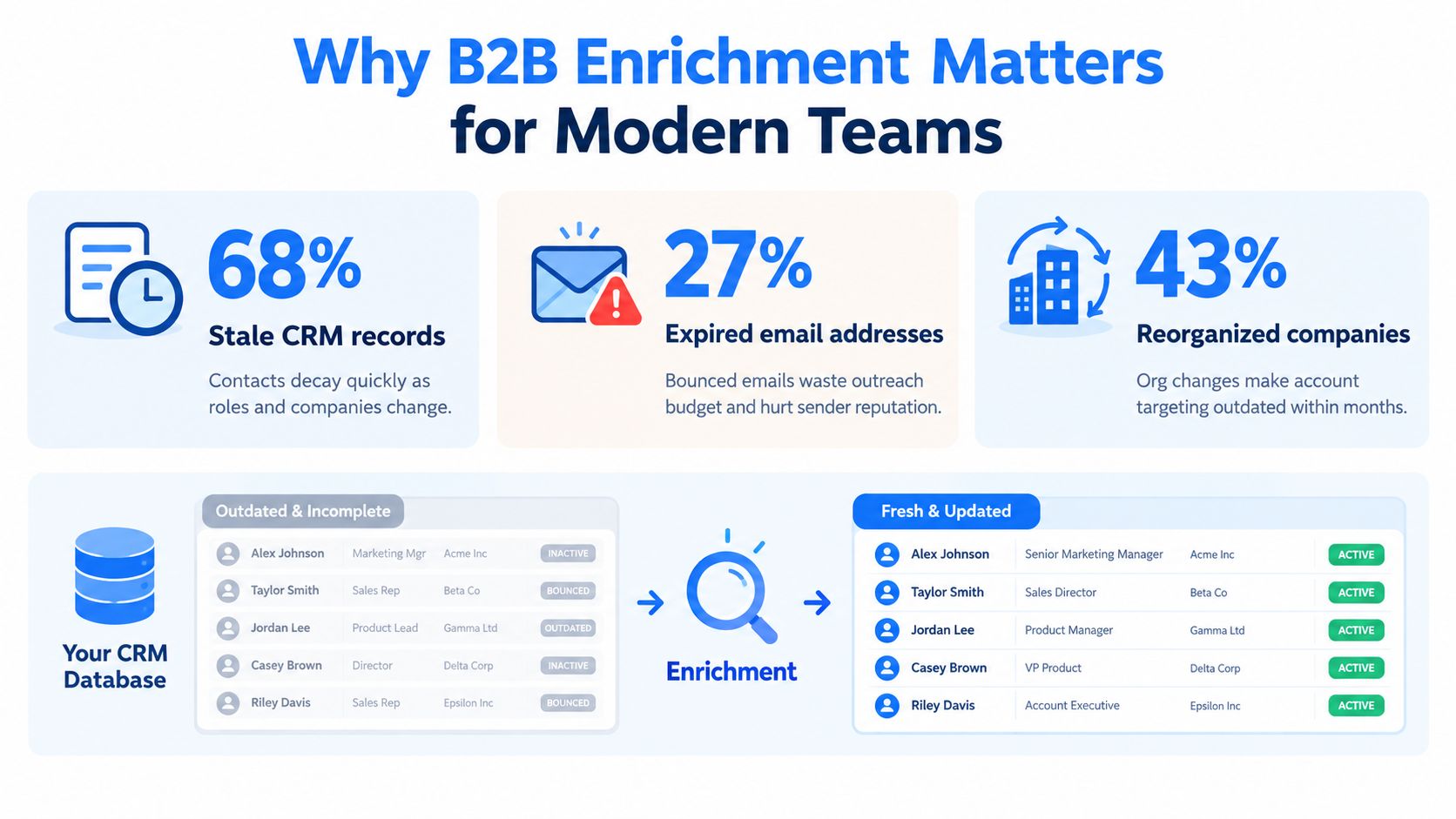
A revenue operations manager can open a CRM and see a complete-looking record: a senior contact, an employer, a title, and an email address. Six months later, the contact may have changed jobs, the company may have reorganized, and the address may no longer accept mail. The record still exists, but its operational value has changed.
B2B contact records decay as people move between employers and organizations restructure. Industry benchmarks place annual decay near 22%, or approximately 2.1% per month when compounded, while other estimates put yearly inaccuracy between 25% and 30% (CUFinder's B2B data quality statistics). These figures are benchmarks, not universal constants, so a responsible team measures its own correction, bounce, and match rates.
The cost of treating enrichment as cleanup
A stale title can send an account to the wrong buying persona. An outdated employer relationship can distort account ownership. An expired email can waste outreach capacity and create deliverability problems. Forecasting models also inherit the CRM's assumptions, so missing or incorrect firmographic fields can influence segmentation, routing, and pipeline analysis.
This creates a tension between two operating models:
- Database-backed enrichment: A provider matches records against a large indexed dataset, then appends or refreshes fields according to its update cycles.
- Live retrieval: A professional data API fetches publicly available information at request time from a professional profile URL or company URL.
- Hybrid workflows: A team uses a database for broad discovery and a live lookup for records where freshness matters most.
Practical rule: Treat enrichment as a recurring data-quality workflow, not a one-time import.
ZoomInfo's own architecture reflects this problem. Its stated process combines automated collection, machine-learning verification, and human review, while its public materials say professional records receive confidence scores. That means a successful person or company match is only the beginning. The email, title, employer, phone, and location can each have different quality levels.
The most useful measurement is therefore not one platform-wide accuracy percentage. It's a field-level distribution showing where your data works, where it fails, and how quickly the results become stale.
How ZoomInfo Builds Its Data Pipeline
ZoomInfo's enrichment quality depends less on headline database size than on how its pipeline matches identities, scores evidence, and keeps individual fields current. That distinction matters because real-world enrichment is a distribution problem. A vendor can resolve many records while still varying widely on title accuracy, phone freshness, employer linkage, or domain assignment across your ICP.
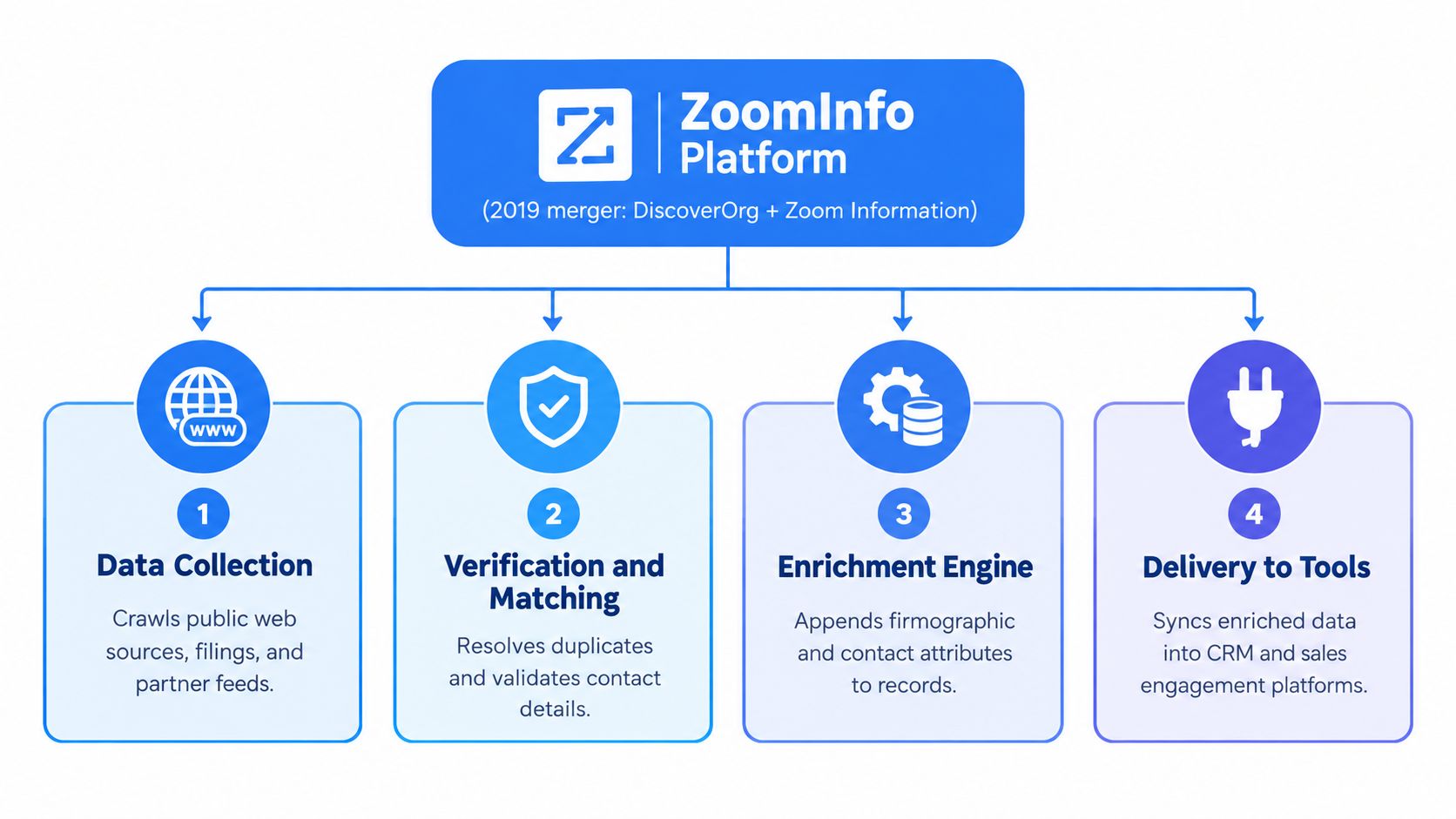
ZoomInfo's current platform grew out of the 2019 combination of DiscoverOrg and Zoom Information. Public company material describes how that merger brought together firmographic, organizational, and professional datasets, and the business had already added products such as RainKing and NeverBounce over time, as outlined in its fact sheet and newsroom material. From a data engineering perspective, that acquisition history suggests a layered operating model. The platform is assembling multiple collection and verification capabilities, then normalizing them into one enrichment system.
Collection, verification, and confidence
ZoomInfo claims to scan more than 38 million online sources daily, including company websites, news, SEC filings, job postings, and press releases, according to its data sources overview. The same public material says the company uses natural language processing, machine learning, and confidence scoring before data is published. That is a useful description of the workflow, but it is still a vendor claim. The company has not published an independently audited methodology or a reproducible benchmark design that would let buyers validate those scale and quality claims on a like-for-like basis.
That limitation changes how you should read a successful enrichment result. A resolved person or company record means the platform found a plausible match. It does not prove that every appended attribute is equally reliable. One field may be current while another is already stale.
For production systems, treat each output column as its own quality problem. Preserve field-level timestamps, confidence indicators, provenance, and overwrite rules whenever the integration exposes them. If your CRM only stores the final value, you lose the ability to audit whether the title came from a recent source, whether the phone was inferred from older evidence, or whether the company-domain mapping reflected a parent entity instead of an operating subsidiary.
A practical way to frame this architecture is to separate collection, identity resolution, normalization, and downstream delivery, which is also the core distinction explained in this guide to web data collection. Teams building enrichment into scoring, routing, or automated outreach should also examine the surrounding decision layer, especially if data quality issues propagate into models or workflow logic. This overview of modern AI consulting is useful in that context.
ZoomInfo works best as a managed intelligence layer across many records and systems. Evaluate it as a set of field-specific production pipelines, each with its own match rate, accuracy profile, and decay pattern.
Testing Enrichment Quality for Your Use Case
The first mistake in vendor evaluation is treating match rate and accuracy as synonyms. Match rate measures how many submitted records a provider can identify and enrich. Accuracy measures whether the returned attributes are correct. A provider can resolve many records and still return incorrect titles, affiliations, phone numbers, or domains, as explained in this CRM accuracy benchmark discussion.
ZoomInfo publishes a first-party-data accuracy claim of up to 95%, but “up to” describes a ceiling, not an expected result for every geography, field, or customer dataset. Independent commentary available in the research also notes the absence of controlled tests covering accuracy, freshness, deliverability, and export cleanliness. That makes your own benchmark essential.
Build a representative test set
Don't give a provider a convenient sample of recently verified North American accounts and treat the result as your global baseline. Stratify the test set by:
- Geography: Include each target country or region, with particular attention to markets where coverage may be thinner.
- Account segment: Separate startups, mid-market firms, enterprise companies, and other ICP categories.
- Seniority: Test executives, managers, individual contributors, and specialist roles.
- Field: Evaluate email, phone, title, employer, industry, headcount, headquarters, founding year, and verified domain independently.
- Record state: Include complete records, partial records, old records, duplicate candidates, and records with ambiguous company names.
Establish a ground-truth process before sending records to the provider. Your reference value should come from a defined source and a documented verification date. A practical explanation of ground-truthing can help teams separate a genuine validation set from an unexamined assumption.
Measure the fields, not just the response
For each field, record whether the provider matched the entity, returned a value, and returned the correct value. Calculate match rate and accuracy separately. For emails, add bounce outcomes where your compliance and messaging processes permit it. For titles and employer relationships, compare the returned value with the reference state on a known date.
Your report should include:
- Match rate by segment and country
- Field accuracy by segment and country
- Freshness age, meaning the time between the provider's source observation and your test
- False-positive rate, where the system returns a plausible but incorrect value
- Time-to-staleness, measured by repeating the test over an agreed interval
- Confidence intervals, so small samples don't create false certainty
A 95% aggregate claim can conceal poor performance for the exact field or market that drives your revenue.
Run the same protocol against a live professional data API if freshness is central to your product. A query-time response can be current when requested, but it still needs validation for missing fields, ambiguity, access failures, and regional variation. The useful comparison isn't “database versus live API” in the abstract. It's the observed distribution of correct and incorrect fields under your actual workload.
ZoomInfo vs Real-Time Data APIs
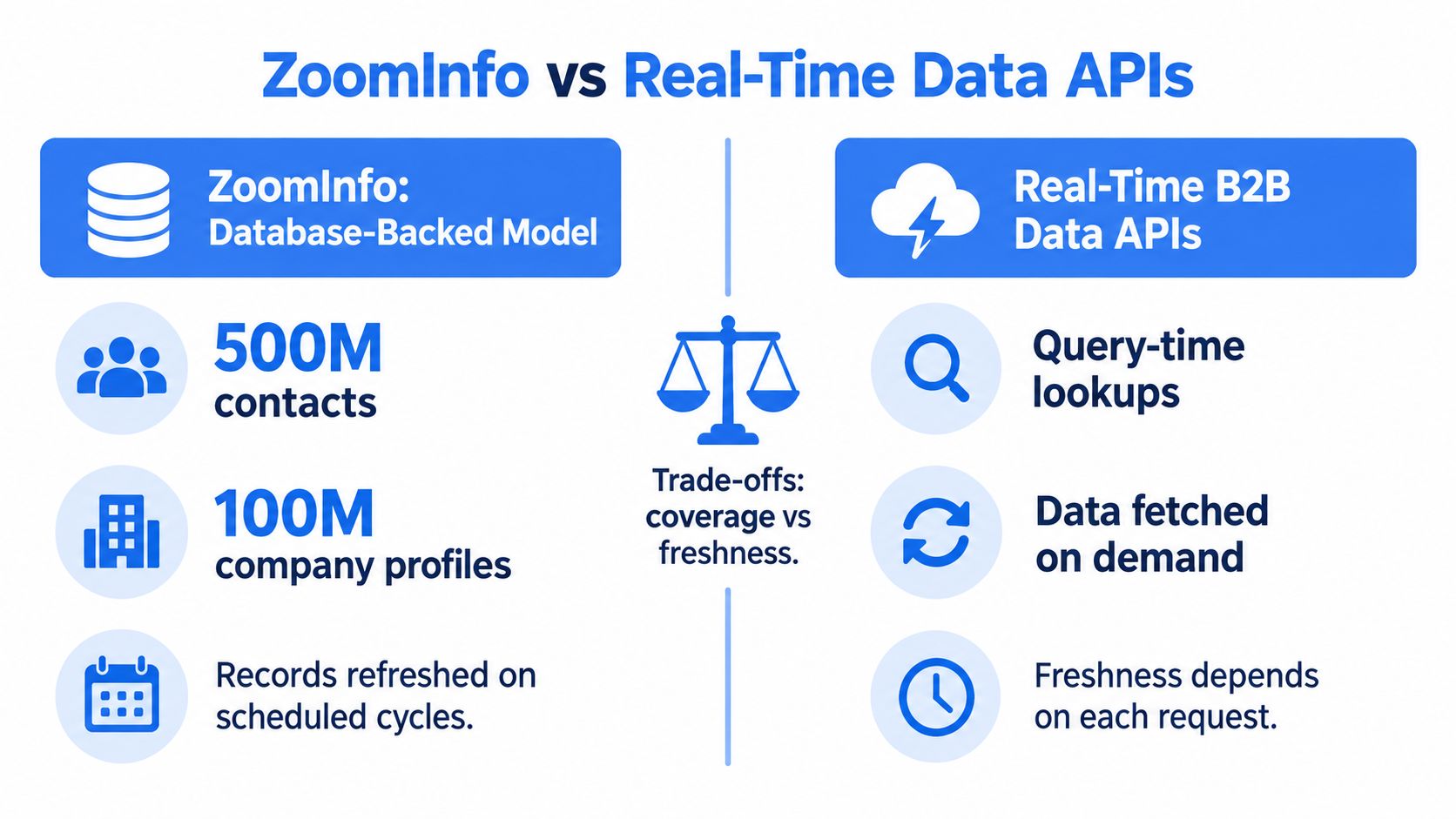
ZoomInfo and real-time B2B data APIs solve different parts of the enrichment problem. ZoomInfo offers a large database-backed model with managed verification and broad company intelligence. A live API fetches public professional data on demand, often from a professional profile URL or company URL, so freshness is tied to the request rather than a scheduled database refresh.
ZoomInfo's published coverage includes 500 million contacts, 100 million companies, more than 135 million verified phone numbers, and more than 200 million verified business emails. It also states first-party accuracy of up to 95% and support from more than 300 human researchers in its published enrichment materials. These are company-published figures, not independent universal measurements.
Where each model fits
A database-backed platform is a natural fit when you need broad discovery, standardized company intelligence, historical context, and managed workflows across a large CRM. It can reduce the engineering burden of assembling identity, firmographic, and verification systems yourself.
A real-time API is more attractive when your application needs current page-state information at the moment of a request. Fetchin, for example, accepts professional profile URLs, company URLs, domains, or emails and returns structured JSON with profile and firmographic attributes. Its published operating model includes median response times around one second, optional asynchronous delivery, and no credit charge for failed requests.
| Evaluation dimension | Database-backed enrichment | Real-time B2B data API |
|---|---|---|
| Freshness | Depends on source collection and refresh cycles | Depends on the information available at request time |
| Coverage | Broad indexed records and company intelligence | Targeted retrieval from supplied identifiers |
| Latency | Varies by connector, endpoint, and workflow | Designed for synchronous or asynchronous request flows |
| Cost model | Commonly subscription and credit based | Can include free tiers, monthly credits, pay-as-you-go, or enterprise terms |
| Engineering | Managed integrations can reduce custom work | Structured JSON can support direct product integration |
| Compliance | Requires review of provenance, lawful basis, and controls | Requires review of public-data sources, consent expectations, and usage policy |
The trade-off is not just coverage versus freshness. A database can be more useful for finding accounts you don't already know. A live API can be more useful when you already have an identifier and need the current public state. A mature stack may use both, with database enrichment for account universe construction and live retrieval for high-value refreshes.
Teams should also inspect failure behavior. If an API request fails without consuming credits, retries and error handling become easier to budget. If a vendor returns a successful match with incomplete fields, your application needs field-level null handling and confidence logic. The data enrichment API guide provides useful context for designing those request and response patterns.
Pricing, Limits, and Integration Patterns
Pricing is really a question of usage distribution. Crunchbase's company profile reports $293 million in 2019 revenue, compared with $144 million in 2018 in 2018. That growth helps explain why ZoomInfo is typically sold as an operational data product rather than a simple lookup utility, but company revenue does not tell you what your enrichment program will cost.
Cost depends on how often your workflow asks for data, how many records match, and which fields you write back. The same vendor can look efficient in a quarterly cleanup and expensive in a routing flow that enriches every inbound lead, retries weak matches, and triggers downstream validation. That is why pricing should be tested as a distribution of events and outcomes, not as a single seat or subscription number.
Model total cost of ownership
Start with the trigger. A new lead import, a form submission, a scheduled refresh, and a correction loop all create different request volumes and different tolerance for null returns. Then map cost to the unit the vendor charges for.
- Refresh cadence: One-time backfills and recurring refreshes create very different consumption patterns.
- Credit consumption: Check whether credits are spent per request, per record, per field, per export, or only on a successful match.
- Failure handling: Ask how retries, timeouts, and no-match responses are billed.
- Integration work: Include connector setup, schema mapping, monitoring, and ongoing maintenance.
- Validation costs: Email verification, manual review, and remediation often sit outside the enrichment contract.
Many evaluations go wrong here. Buyers compare list prices, then discover that a low nominal rate becomes expensive when a workflow produces many partial matches or duplicate lookups. Field-level economics matter more than headline packaging.
Integration pattern also changes the operating model. A CRM connector fits teams that want managed synchronization and standard object mapping. A custom API workflow fits product and data teams that need enrichment inside their application, warehouse, routing layer, or agent workflow. Batch jobs suit periodic hygiene. Synchronous requests suit point lookups and form-time decisions, but only if latency and failure handling are acceptable.
Run timing matters. If enrichment happens after routing, stale or missing attributes can affect assignment logic before correction. If it happens before routing, the enriched record can drive segmentation and ownership rules first, but only if your system can handle no-match cases, protect system-owned fields, and apply write rules at the field level. That is the practical limit buyers should test. Not whether the platform can return data, but whether it can do so within the cost, latency, and accuracy bounds your ICP requires.
Building Your Enrichment Strategy
Start with the business event, not the vendor. Decide which records need enrichment when a new lead enters the system, when a contact changes role, when an account is reassigned, or when email validation fails. Each trigger should have a defined freshness objective and a fallback when no reliable match is returned.
Then create an output schema that preserves evidence. Store the returned value alongside its source or verification status, retrieval timestamp, confidence metadata, and match state. A missing field should distinguish between “not available,” “not requested,” “not matched,” and “request failed.” Those states lead to different remediation actions.
Benchmark the distribution
Build separate scorecards for each target market and ICP segment. Measure match rate, field accuracy, bounce outcomes, correction rate, and time-to-staleness. Don't let a strong aggregate result hide weak performance for a specific country, seniority group, or fast-moving startup segment.
Use a database-backed provider when you need broad discovery, standardized company context, managed integrations, and a large operational data layer. Consider a real-time professional data API when your application already has a profile or company identifier and needs current public information on demand. The decision should reflect latency, coverage, compliance requirements, engineering capacity, and the cost of repeated refreshes.
For teams working directly in a CRM, a practical guide to implement data enrichment in CRM can help translate the strategy into field mappings, triggers, and governance rules. The implementation should begin with a controlled segment, compare returned values with a documented reference set, and expand only after the error patterns are understood.
A durable enrichment system also needs monitoring. Track unresolved records, false positives, overwrites, stale values, failed requests, and credit consumption. Review the distribution regularly because the quality you measured at launch may not represent performance after your market, data sources, or workflow changes.
Fetchin provides a real-time B2B data API that fetches public professional and company information from supplied URLs or identifiers and returns structured JSON for product integrations. Visit Fetchin to evaluate live profile and company enrichment against the fields, markets, and freshness requirements that matter to your ICP.