You're probably here because the role is open, revenue pressure is real, and the current job description for VP Sales reads like it could fit any company on earth. It says things like “drive growth,” “lead a high-performing team,” and “partner cross-functionally.” None of that tells a serious candidate what they're walking into.
That's how companies waste a quarter. They post a generic req, attract polished resumes, run loose interviews, and end up choosing between a charismatic mismatch and a safe non-decision. The fix isn't adding more bullets. It's writing a stage-specific mandate that matches the business you have.
Table of Contents
- Why Most VP Sales Job Descriptions Fail
- Core Components of a Strong VP Sales Job Description
- Startup VP Sales Job Description Template
- Scale-Up VP Sales Job Description Template
- Enterprise VP Sales Job Description Template
- Comparing Startup, Scale-Up, and Enterprise Templates
- Interview Questions That Separate Operators from Talkers
- The Hidden Cost of Overloading a VP Sales Job Description
- Build Your Own VP Sales Job Description in One Hour
Why Most VP Sales Job Descriptions Fail
A familiar pattern goes like this. The CEO needs a sales leader, HR pulls an old template, a few lines get updated, and the posting goes live by Friday. Three weeks later, the pipeline of candidates looks decent on paper. Five people can talk about “building teams.” One strong candidate bows out after the interview because the company still can't explain what the role owns.

That failure usually starts in the job description, not in sourcing. Most job descriptions for VP Sales try to cover every possible version of the role. They end up describing a mythical executive who can close deals personally, build the org chart, run forecasting, fix CRM discipline, coach managers, design territories, align marketing, and present to the board, all without any context about company stage.
The four failure modes
The misses tend to cluster in four places:
- Vague revenue ownership: “Own growth” is not a mandate. Candidates need to know the revenue baseline, target motion, and whether they own a company number or a segment.
- Missing tool expectations: If the role depends on Salesforce, HubSpot, Gong, Clari, Outreach, or a professional data API, say so. Good operators want to know the stack they're inheriting.
- No reporting cadence: A startup weekly forecast call is a different job from a board-ready enterprise reporting rhythm. If you don't define the cadence, you hide the complexity.
- Unmeasurable KPIs: “Improve performance” sounds safe and means nothing. New ARR, quota attainment, pipeline coverage, win rate, and ACV are useful because they can be inspected.
Most bad VP Sales hires weren't bad sales leaders. They were bad matches for the stage.
A weak posting also creates a bad interview loop. The company asks broad leadership questions, the candidate gives broad leadership answers, and nobody gets concrete until late. By then, time is gone and urgency takes over judgment.
Context beats comprehensiveness. A good job description for VP Sales doesn't try to describe every VP Sales role. It describes this one.
Core Components of a Strong VP Sales Job Description
A VP Sales search usually goes sideways before the first interview. The posting says “own revenue,” “lead the team,” and “partner cross-functionally,” then the hiring team wonders why they get polished candidates who sound right and fit badly. At this level, ambiguity is expensive. Good operators screen the role as hard as you screen them.
The fix is simple. Write the job description like an operating brief with clear scope, numbers, systems, and decision rights. Candidates should understand what they are inheriting, what they are expected to change, and how performance will be judged in the first 12 months.
Six Core JD Components and What They Reveal
| Component | What to Write | Signal It Reveals |
|---|---|---|
| Revenue mandate | Current revenue run rate, growth target, and whether the role owns total revenue or a slice of it | Whether the hire is expected to build, scale, or optimize |
| Sales motion | Outbound, inbound, partner-led, enterprise, PLG assist, or a mix | Whether the candidate has operated in this motion before |
| Segment and territory scope | SMB, mid-market, enterprise, named accounts, region, or vertical | How much deal complexity and variation sits inside the role |
| Team design | Current org chart, open hires, manager layer, and rep-to-manager ratio | Whether the job is frontline leadership, second-line leadership, or both |
| Operating cadence | Forecast calls, pipeline reviews, QBRs, annual planning, board prep | How disciplined the environment needs to be |
| Success metrics | New ARR, expansion, quota attainment, coverage, win rate, ACV, ramp time | Whether success is inspectable from day one |
These six components do more than improve the posting. They force the company to make choices. If you cannot state whether this VP owns managers or individual reps, inherits a process or builds one, or carries a company number or a segment number, you are still defining the role.
One more point matters here. The same title covers three different jobs. A startup VP Sales may still jump into late-stage calls and clean up CRM hygiene personally. An enterprise VP Sales may spend more time on manager quality, forecasting accuracy, and cross-functional planning than on direct selling. That is why one generic template fails so often. The article's startup, scale-up, and enterprise versions work because the stage changes the job.
A weak version hides all of that. “Lead the sales team and drive growth” tells a candidate almost nothing. A useful version names the actual work: own new ARR for mid-market and enterprise, lead three regional managers, run a weekly forecast, inspect pipeline by stage, and present a monthly revenue readout to the CEO.
If your team is debating whether you need a true VP or a senior operator with narrower scope, this breakdown of a director of sales and operations helps clarify where the line usually sits.
For teams hiring for this role for the first time, it can also help to find VP of Sales talent and compare real candidate backgrounds against the mandate you wrote. That exercise exposes a common mistake fast. The title says VP Sales, but the scope mixes founder-led selling, RevOps cleanup, and frontline management into one unrealistic job.
A practical test: after reading the JD, a strong candidate should be able to answer four questions without guessing. What number do I own? What team do I inherit? What systems do I need to run? What cadence will I be held to? If the posting does not answer those, it is still too vague to use.
Startup VP Sales Job Description Template
Early-stage companies need a working leader, not a ceremonial executive. The startup version of a job description for VP Sales should attract someone who can sell, build, and coach while the system is still messy.
What startup founders should optimize for
At this stage, polished enterprise credentials can mislead you. A candidate who inherited RevOps, enablement, and mature pipeline inspection may struggle when the CRM is half-built and the founder still jumps into late-stage calls.
What works better is a generalist with strong judgment under imperfect conditions. They should be comfortable building the playbook while carrying visible revenue responsibility.
Copy-paste startup template
Role title
VP of Sales
Role summary
We are hiring a VP of Sales to build and lead our sales function. This leader will own revenue execution, personally support strategic deals, establish forecasting discipline, and hire and coach the early team. This role reports to the CEO.
Key responsibilities
- Own revenue execution: Carry the sales number with direct accountability for new business performance.
- Sell alongside the team: Join discovery, pricing, negotiation, and close plans on important deals.
- Build core process: Set up CRM standards, stage definitions, pipeline inspection, and forecast routines.
- Hire early talent: Recruit, onboard, and coach account executives and sales managers as the team grows.
- Align cross-functionally: Work closely with marketing, product, and customer success on positioning, handoff, and feedback loops.
Required experience
- Experience selling into the same buyer type or segment we serve.
- Success building process before formal infrastructure existed.
- Comfort working directly with founders and handling ambiguity.
- Ability to coach reps while also stepping into deals.
The three KPIs that matter most
For teams at this stage, I'd keep the scoreboard short:
- New ARR
- Quota attainment
- Pipeline coverage
Everything else matters, but these three force clarity. If the candidate can't speak concretely about how they inspect those numbers, they're probably not right for a startup seat.
What to avoid
Don't overload the posting with territory design theory, board language, and heavyweight governance if the job is still hands-on. You'll attract people who want to supervise a machine, not build one.
Scale-Up VP Sales Job Description Template
A lot of companies miss on this hire at the same moment they think they have outgrown founder-led sales. The pipeline is real, the board wants faster growth, and the team has enough reps to create noise but not enough management discipline to create consistency. If the job description still reads like a startup template, you will hire the wrong person.

Scale-up is a different seat. The VP of Sales is no longer proving the company can sell. The job is to make sales repeatable across managers, segments, and quarters. That usually means tighter forecasting, cleaner pipeline rules, stronger manager coaching, and fewer heroics from the CEO.
The operating scope also widens. Core responsibilities often include forecasting, quota setting, recruiting, onboarding, coaching, CRM discipline, budget ownership, and coordination with marketing and customer success, as outlined in this sales leader job description breakdown.
The practical trade-off is simple. Add too much process and you slow the team down. Add too little and every forecast call turns into storytelling. Good scale-up VPs know where inspection helps and where it becomes bureaucracy.
Recent commentary on the role points in the same direction. Buyers do more homework before they ever talk to sales, so the VP has to improve rep execution, message quality, and coaching cadence, not just ask for more top-of-funnel, according to this discussion of the changing VP Sales role.
Copy-paste scale-up template
Role title
VP of Sales
Role summary
We are hiring a VP of Sales to scale a repeatable revenue engine. This leader will own forecast accuracy, manager effectiveness, pipeline hygiene, quota design, and cross-functional alignment across marketing and customer success. This role reports to the CRO or CEO.
Key responsibilities
- Run a forecast the CEO can trust: Lead weekly forecast calls, inspect deal movement, and maintain a credible commit backed by evidence in the CRM.
- Raise productivity per rep: Improve output through coaching, manager development, call review, and better qualification standards.
- Standardize pipeline rules: Define stage entry and exit criteria, clean up slippage patterns, and hold the team to CRM hygiene.
- Build the operating cadence: Set quotas, KPI reviews, manager one-on-ones, and inspection rhythms that hold up as headcount grows.
- Work across the GTM team: Partner with marketing on lead quality and conversion, and with customer success on expansion signals and handoff quality.
Required tools and data fluency
Candidates should be comfortable with Salesforce or HubSpot, Gong, Clari or equivalent forecast tooling, and spreadsheet-level fluency in funnel inspection. If your team uses enrichment or territory support tools, list them. That can include tools like ZoomInfo, Clay, Common Room, or a B2B data API such as Fetchin when the role depends on current public professional data for account mapping or hiring analysis.
A quick visual primer can help hiring teams think about what scalable leadership really looks like:
KPIs to name explicitly
At scale-up, vague language creates expensive misunderstandings. Put the scoreboard in the job description so candidates know whether you need a builder, an optimizer, or a manager of managers.
- New ARR
- Quota attainment
- Pipeline coverage
- Win rate
- ACV
I would also expect a serious candidate to explain how they inspect each metric, where they pull it from, and what action they take when one starts to drift. That answer usually tells you more than the resume does.
Enterprise VP Sales Job Description Template
Enterprise VP Sales hiring is less about finding a heroic closer and more about finding a leader who can run a commercial system. The job is broader, more political, and less forgiving of weak process control.
Historical and market evidence shows the role has become highly data-driven. One benchmark based on 643 disclosed job postings found VP Sales base pay clustering between $167,000 and $250,000, while another using 739 executive sales postings found a base range of approximately $167,000 to $251,000. A 2026 salary guide also noted average core compensation of $383,800 and average total compensation of $487,083 in one U.S. dataset, according to this VP Sales job description and compensation analysis.
Copy-paste enterprise template
Role title
VP of Sales
Role summary
We are hiring a VP of Sales to lead a multi-layered sales organization with accountability for planning, forecasting, regional execution, and executive reporting. This leader will manage sales managers and senior leaders, coordinate with finance, legal, marketing, and operations, and maintain a disciplined revenue operating cadence.
Key responsibilities
- Lead the operating plan: Translate company strategy into quotas, territories, coverage, and leadership accountability.
- Manage through managers: Develop second-line leaders, inspect regional execution, and enhance bench strength.
- Run executive reporting: Deliver annual, quarterly, and monthly revenue reporting with clear assumptions and risk visibility.
- Own governance: Partner with finance and legal on deal approvals, policy adherence, and commercial guardrails.
- Oversee budget and systems: Ensure CRM discipline, tooling alignment, and budget control across the sales organization.
What the enterprise candidate is screening for
Serious enterprise candidates read the posting for three things:
- Reporting line: CRO, CEO, or another executive
- Management depth: direct reps versus managers and directors
- Forecast ownership: whether they merely submit numbers or defend them at the executive table
Board-facing language belongs in the posting only if the person will actually present, defend, and answer for the number.
Experience filters that matter
Write for leaders who've operated in matrixed environments, managed cross-regional complexity, and handled structured reviews with finance. Don't hide behind “strong communication skills.” Say they must manage executive reporting cadence, territory oversight, and cross-functional governance.
That's what separates an enterprise operator from a big-title candidate with a mid-market background.
Comparing Startup, Scale-Up, and Enterprise Templates
Most hiring mistakes happen when companies mix stage signals. They write a startup title, scale-up KPI list, and enterprise governance language, then wonder why no one qualified says yes.
The cleaner move is to choose the stage first, then write the role around that reality. If your team is still deciding which systems belong in the req, this overview of B2B sales intelligence tools is useful because the tool stack often reveals the true stage of the business faster than the org chart does.
Stage-by-Stage VP Sales Comparison
| Dimension | Startup | Scale-Up | Enterprise |
|---|---|---|---|
| Primary mandate | Build the motion while carrying visible revenue ownership | Make the motion repeatable and measurable | Run a large revenue engine with governance |
| Candidate profile | Generalist builder | Operator with coaching and forecast rigor | Executive leader managing layers and complexity |
| Preferred tools | CRM, basic reporting, call recording, prospecting tools | CRM, forecast tooling, call intelligence, dashboards | CRM, forecast systems, finance-aligned reporting stack |
| Reporting cadence | Tight founder rhythm, usually weekly | Weekly forecast, monthly review, quarterly planning | Formal monthly, quarterly, annual executive cadence |
| Compensation mindset | Usually tied to risk tolerance and build stage | Balanced around scale and execution | Structured around scope, management depth, and executive accountability |
| Biggest hiring risk | Hiring an enterprise manager who won't build | Hiring a recruiter's “safe” candidate who can't upgrade the system | Hiring a founder-seller who can't run governance |
The shortcut I'd use
If the person must personally rescue deals, you're closer to startup. If they must increase output per rep and make forecasting trustworthy, you're in scale-up. If they spend more time with managers, finance, and executive reporting than with frontline deals, you're hiring for enterprise.
That simple framing prevents most blended, unusable JDs.
Interview Questions That Separate Operators from Talkers
A good job description for VP Sales should shape the interview. If the JD says the leader owns forecast discipline, pipeline hygiene, and coaching, the interview should test exactly that. Not charisma. Not war stories. Actual operating behavior.
For broader hiring packs, I like using curated sets of sales assessment interview questions as a supplement, then rewriting them so they match the stage-specific mandate.
Revenue ownership questions
Ask: Walk me through the last forecast miss you owned. What changed, when did you know, and what did you do next?
A strong answer includes inspection cadence, deal movement logic, and communication upward. A weak answer blames marketing quality, the economy, or “a few deals slipped.”
Ask: How do you translate an annual target into monthly operating decisions?
Strong candidates talk about coverage, conversion assumptions, rep ramp, segment mix, and hiring timing. Weak ones stay abstract.
Pipeline governance questions
Ask: What does healthy pipeline hygiene look like in your CRM?
You want specifics. Stage definitions. Exit criteria. Aging discipline. Next-step quality. Forecast categories. If they can't explain how they inspect the system, they probably managed through personality rather than process.
Ask: Which tools do you rely on most in forecast review, and what bad data do you usually find?
Good operators know where the data breaks. They'll mention call intelligence, CRM inspection, activity-to-stage mismatches, or weak close plans.
If every answer sounds polished but nothing sounds inspectable, keep digging.
Leadership and coaching questions
Ask: Tell me about a manager you upgraded. What changed in their behavior, and how did you coach it?
Strong answers focus on observable changes like review quality, one-on-ones, or pipeline inspection habits. Weak answers describe motivation speeches.
Ask: When do you step into a deal, and when do you stay out?
That separates leaders who enable from leaders who create dependency.
A simple scoring lens
Use three buckets:
- Operator: concrete, measurable, repeatable answers
- Talker: broad language, low inspection detail
- Mismatch: solid leader, wrong stage for your business
That's enough to improve hiring quality fast.
The Hidden Cost of Overloading a VP Sales Job Description
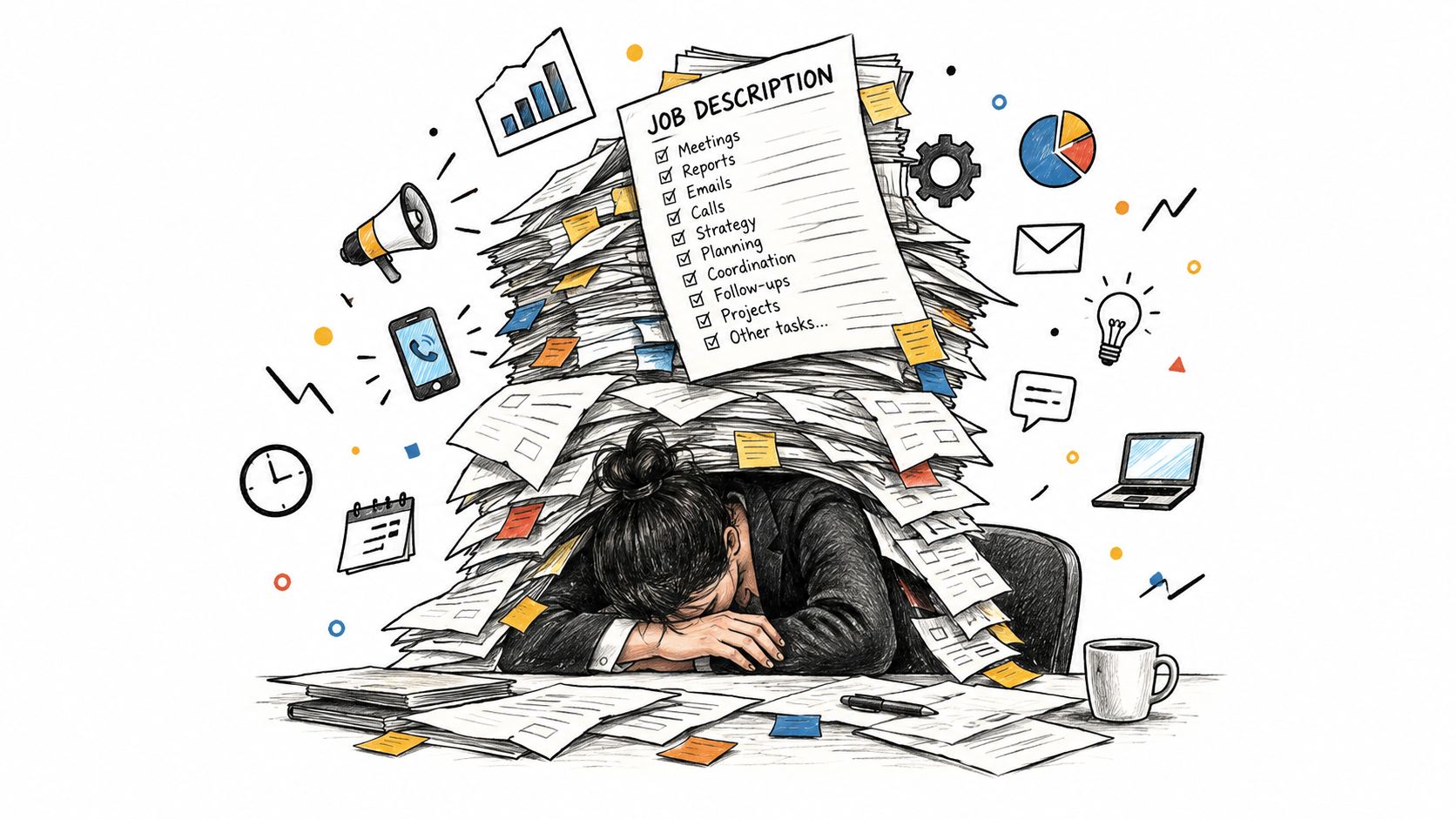
The worst VP Sales postings read like someone dumped the entire go-to-market org chart into one role. Own revenue. Build partnerships. Launch enablement. Run pricing. Fix RevOps. Improve retention. Manage demand gen alignment. Present to the board. Hire ten reps. Open a new market.
Top candidates read that and see confusion.
Why broader usually performs worse
A bloated posting repels disciplined operators because disciplined operators want a clear mandate. The candidate you want is asking, “What am I accountable for in the first ninety days, and what levers do I control?”
The candidate who loves a blurry req is often someone who's comfortable narrating impact instead of producing it.
If your internal systems are still fragmented, this is also where teams often benefit from better B2B data enrichment, because weak account, company, and people data can turn a focused sales leadership role into a cleanup role by accident.
Before and after language
Overloaded version
Lead all revenue functions, expand into new markets, manage all sales operations, drive enablement, optimize retention, oversee strategic partnerships, and build world-class forecasting.
Sharper version
Own new business revenue performance, forecast cadence, and manager coaching for the mid-market sales team. Improve pipeline hygiene, quota attainment, and cross-functional handoff quality.
The second version is narrower, but stronger. It tells candidates what success looks like. It also makes interviewing easier because you can test for those exact outcomes.
Write responsibilities as outcomes, not as a catalog of executive-sounding duties.
One rule worth keeping
Every line in the JD should answer one question: What will this person be accountable for in the first ninety days? If a responsibility doesn't survive that test, cut it or move it below the fold as context.
Build Your Own VP Sales Job Description in One Hour
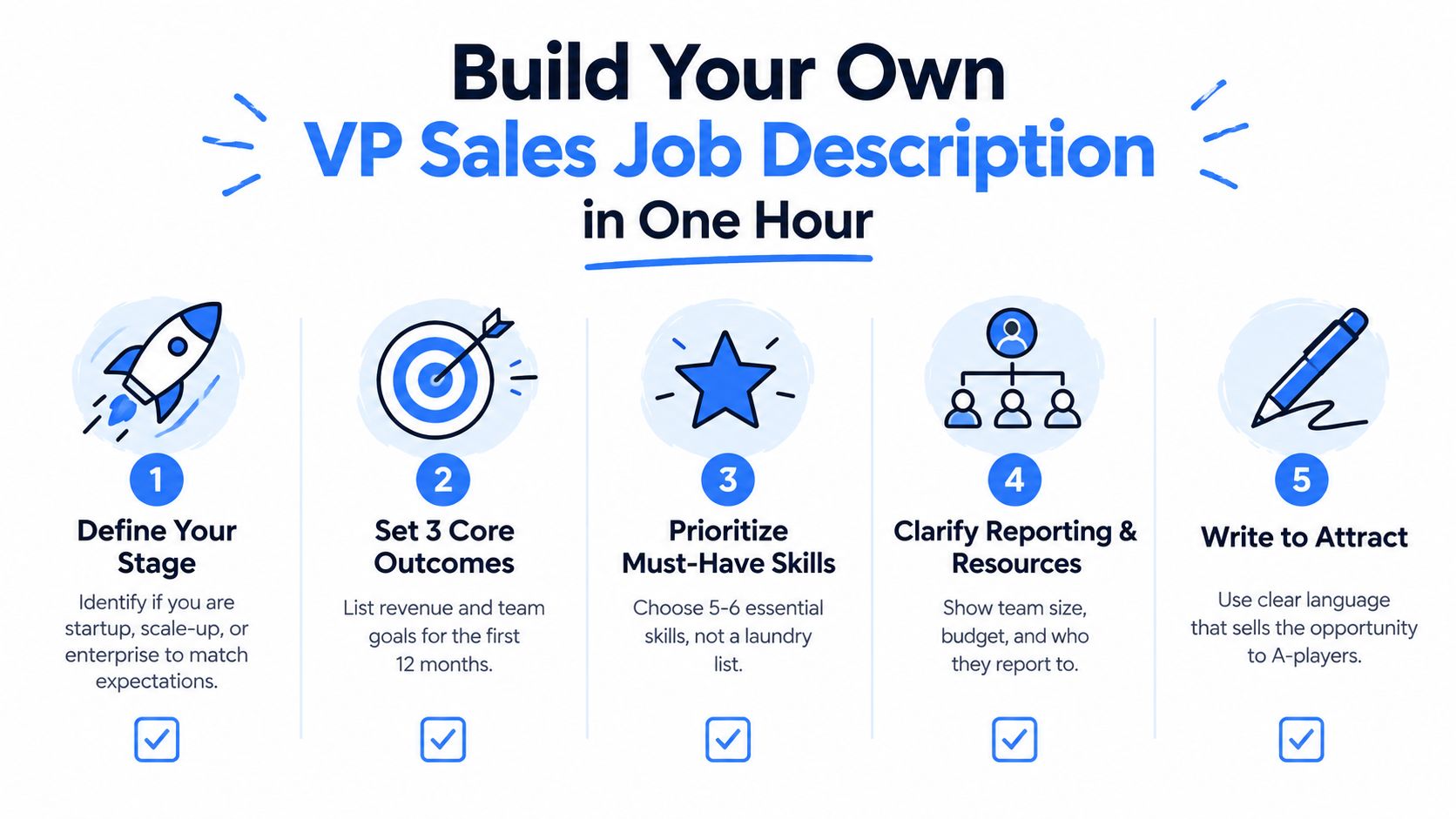
You don't need a blank page. You need a disciplined fill-in exercise. Most strong VP Sales reqs can be drafted in under an hour if you force decisions in the right order.
The one-hour build sequence
Choose the stage
Pick startup, scale-up, or enterprise. Don't blend them.Define the revenue outcome
State the baseline, the target motion, and whether ownership is company-wide or segment-specific.Name the top three KPIs
Keep it tight. If you list eight, the role isn't focused.List required tools and operating cadence
CRM, forecast systems, call intelligence, dashboards, and reporting rhythm belong in the posting.Write responsibilities as measurable outcomes
“Improve forecast accuracy” beats “lead forecasting.” “Coach managers to improve quota attainment” beats “develop team performance.”
Five-question validation checklist
Before you publish, check the draft against these questions:
- Stage match: Would a candidate instantly know whether this is startup, scale-up, or enterprise?
- Metric clarity: Are the KPIs measurable and named plainly?
- Scope honesty: Does the reporting line and team structure match the title?
- Tool visibility: Can the candidate see the operating environment they'll inherit?
- First-quarter accountability: Would both sides know what good looks like inside ninety days?
If the answer is no on any of those, the JD still needs work.
A strong job description for VP Sales doesn't try to impress candidates with complexity. It earns trust with precision.
Fetchin gives teams a way to turn public professional profile and company URLs into structured data through a real-time Fetchin B2B data API. If your hiring or GTM workflow depends on current role, company, and profile data, it's a practical way to support cleaner targeting, enrichment, and research around sales leadership searches.