Your sales team is growing, the board wants a cleaner forecast, and the CRM has started to feel like a junk drawer. Reps say pipeline is healthy. Managers say deals are slipping because stage definitions are fuzzy. Finance wants a number they can plan around. Founders want to know whether the answer is a better dashboard, a RevOps hire, or a true Director of Sales and Operations.
That's usually the moment this role becomes real.
In SaaS, you can get pretty far with a sales leader, a CRM admin, and a few spreadsheets. Then headcount rises, territories overlap, and every forecast call turns into a debate about whose numbers count. The problem isn't effort. The problem is that nobody owns the system behind revenue.
A good director of sales and operations fixes that. They don't just help sales move faster. They design the operating model that makes growth more predictable, from territory design and CRM rules to pipeline inspection and reporting discipline. When the role is scoped well, reps spend less time fighting process and leaders stop making decisions off conflicting reports.
Table of Contents
- Introduction to the Director of Sales and Operations Role
- What a Director of Sales and Operations Actually Does
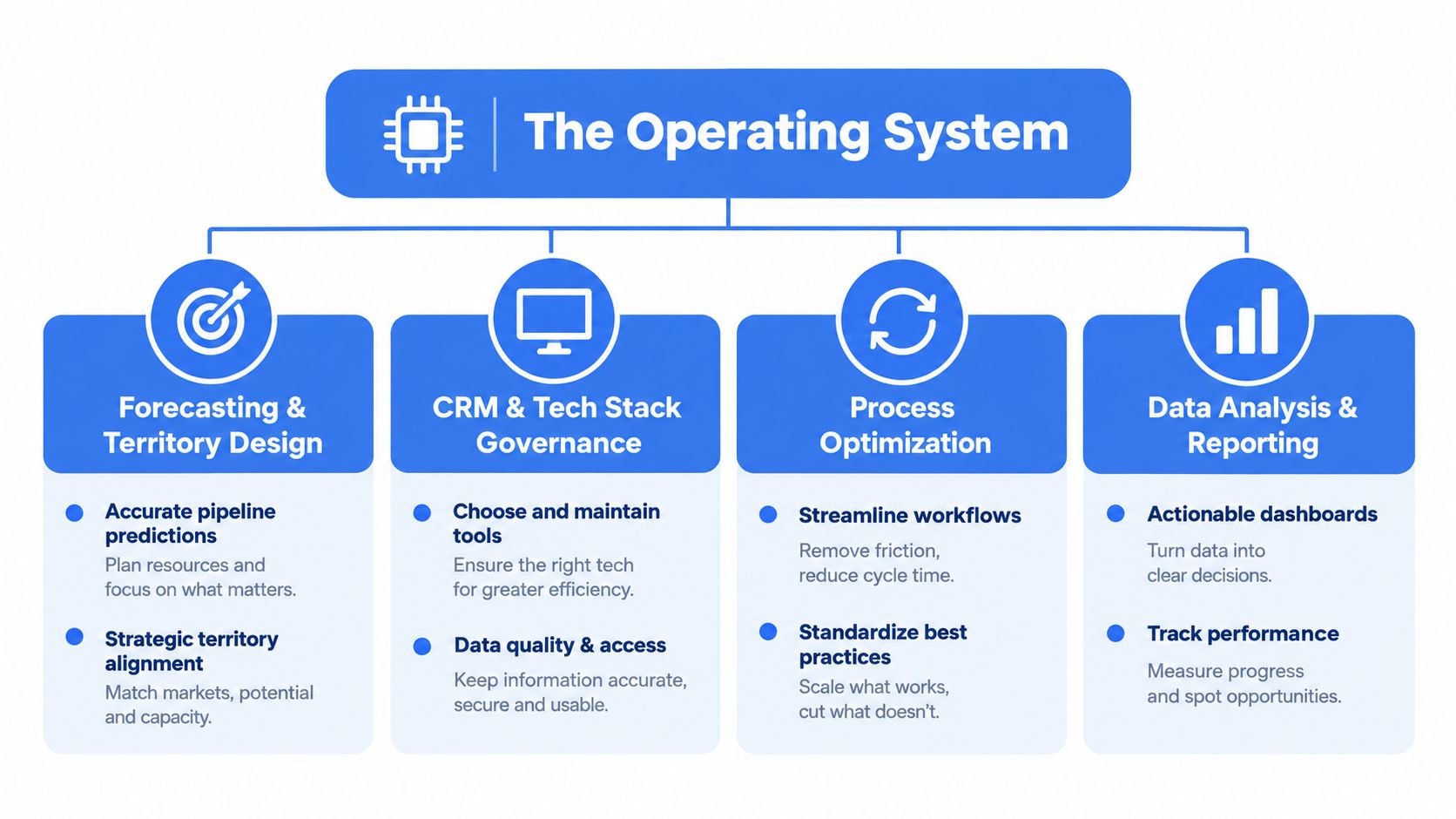
- Four Pillars That Define the Operating System
- Where the Role Sits and How It Relates to RevOps
- A Day in the Life and Core Weekly Cadences
- KPIs That Prove the Function Is Working
- Skills Experience and Compensation Benchmarks for Hiring
Introduction to the Director of Sales and Operations Role
A common SaaS story goes like this. You hire strong account executives, add a BDR team, and start seeing real pipeline. For a while, growth hides the cracks. Then small issues pile up. Two reps claim the same account. Forecast categories mean different things to different managers. The CRM has duplicate companies, missing close dates, and stale opportunities that should've been closed out weeks ago.
Sales leadership feels the pain first.
They spend Monday morning rebuilding reports, Tuesday arguing about commit numbers, and Wednesday trying to explain to finance why the forecast moved again. None of that means the team is weak. It means the company has reached the point where sales needs an operator, not just more sellers.
Why the role shows up later than people expect
Early teams often think this role is administrative. It isn't. A real director of sales and operations acts more like the architect of the revenue engine. They decide how pipeline gets measured, how territories are divided, how quotas get assigned, and which workflows belong inside the CRM versus outside it.
That matters because sales performance depends on system quality. If account ownership is messy, reps waste time. If stage rules are loose, forecasts drift. If dashboards pull from unreliable fields, leaders stop trusting reports and go back to gut feel.
Practical rule: When sales leaders spend too much time reconciling numbers instead of coaching reps, the company usually has an operations design problem, not a reporting problem.
What makes this role worth understanding
This role sits in a strategic pay band because companies treat it as revenue-critical leadership, not clerical support. One salary tracker reported an average annual salary of $198,140 as of September 1, 2026, with the middle 50% earning between $179,060 and $215,050 and the 10th percentile starting at $161,689, according to Sales Operations Director salary benchmarks from Salary.com.
That salary level makes sense once you see the scope. The person in this seat influences forecast quality, rep capacity, territory fairness, compensation logic, and CRM trust. In other words, they own the machinery that turns activity into revenue.
What a Director of Sales and Operations Actually Does
The simplest way to understand the role is this. Sales leadership drives the car. The director of sales and operations builds the dashboard, tunes the engine, and makes sure the fuel gauge tells the truth.
They usually don't own the biggest deals. They own the conditions that let the team win deals predictably.
The role is system ownership, not deal ownership
A frontline sales manager asks, “How do I help this rep close this quarter?”
A director of sales and operations asks, “Why are reps in this segment consistently missing stage progression, and what should change in process, data, or coverage?”
That distinction matters. The role is measured less by single opportunities and more by whether the entire sales machine runs with fewer surprises.
A useful primer on how Sales Ops drives revenue makes the same point from a GTM perspective. The function creates advantage because one process improvement can help every rep, every manager, and every forecast cycle at once.
What falls under the job
In practice, the role usually includes:
- Forecast discipline: Running a forecasting process leaders can trust, with clear definitions for commit, best case, and pipeline risk.
- Territory and quota design: Deciding who covers which accounts, how segments are split, and whether quotas reflect real opportunity.
- CRM governance: Defining required fields, stage exit rules, account hierarchies, and ownership logic.
- Reporting infrastructure: Building dashboards that sales, finance, and executives can use without reworking the same data every week.
- Tool orchestration: Managing how systems like Salesforce, HubSpot, Gong, Clari, Outreach, or BI tools connect and support the motion.
Many teams also rely on external data and enrichment to keep routing, scoring, and account records current. One option in that toolset is B2B sales intelligence tools for SaaS teams, especially when ops needs fresher company or professional data to support workflows.
If sales is the offense, sales operations is the playbook, scoreboard, and field markings.
What the role is not
It's not a glorified spreadsheet job. It's not executive assistant work for the CRO. And it's not just CRM administration, even though CRM governance is a major piece of the puzzle.
The director's value comes from design choices. They decide which inputs matter, which workflows are mandatory, and how reporting turns into action. That's why the best people in this role think like operators, analysts, and product managers at the same time.
Four Pillars That Define the Operating System
Most descriptions of this role stay vague. That's a mistake, because the title only makes sense when you break the work into technical ownership areas.
One industry breakdown describes the role as roughly 60 to 70 percent strategic planning and 30 to 40 percent tactical execution, with the core scope spanning forecasting and territory design, CRM and tech stack governance, process optimization, and data analytics, as outlined in this director of sales operations role breakdown.
Forecasting and territory design
Forecasting isn't just a weekly call. It starts upstream with account coverage, segment rules, and realistic capacity.
If one rep has a patch full of active buyers while another has thin territory potential, your forecast will look like a performance problem when it's really a design problem. Strong operators look at territory shape before they judge rep output. They ask whether coverage is fair, whether named accounts are sensible, and whether white space was assigned on purpose or by accident.
Segmentation work also sits here. A lot of teams improve planning by tightening market logic and account grouping before they touch quotas. A structured approach to B2B market segmentation becomes useful for deciding which accounts belong in enterprise, mid-market, or velocity motions.
CRM and tech stack governance
Think of the CRM like a factory floor. If tools, labels, and handoffs are inconsistent, every downstream report becomes suspect.
Good governance means:
- Field discipline: Required fields are there because they drive action, not because someone once asked for them.
- Ownership rules: Account and opportunity ownership are explicit, with escalation paths when conflicts appear.
- Lifecycle logic: Stages reflect actual buying progress, not rep optimism.
- Integration hygiene: Systems pass the right data to each other without duplicating or overwriting key records.
This is the least glamorous pillar, and often the most valuable.
Process optimization and analytics
Process optimization is where the role stops being theoretical. The director looks for friction in lead routing, deal inspection, approval paths, and handoffs between BDRs, AEs, solutions consultants, and customer success.
Analytics sits right beside it. Not reporting for reporting's sake, but analysis that answers practical questions:
| Pillar | What it controls | What breaks if it's weak |
|---|---|---|
| Forecasting and territory design | Coverage, capacity, planning | Unfair quotas, noisy forecasts |
| CRM and tech stack governance | Data structure and tool trust | Bad dashboards, poor adoption |
| Process optimization | Workflow consistency | Slow handoffs, rep friction |
| Data analysis and reporting | Decision quality | Late decisions, hidden risk |
Strong sales ops teams don't just collect data. They decide which data deserves trust.
The strategic-heavy split exists because this role isn't there to click around inside every deal. It exists to build the system that keeps deal execution from becoming random.
Where the Role Sits and How It Relates to RevOps
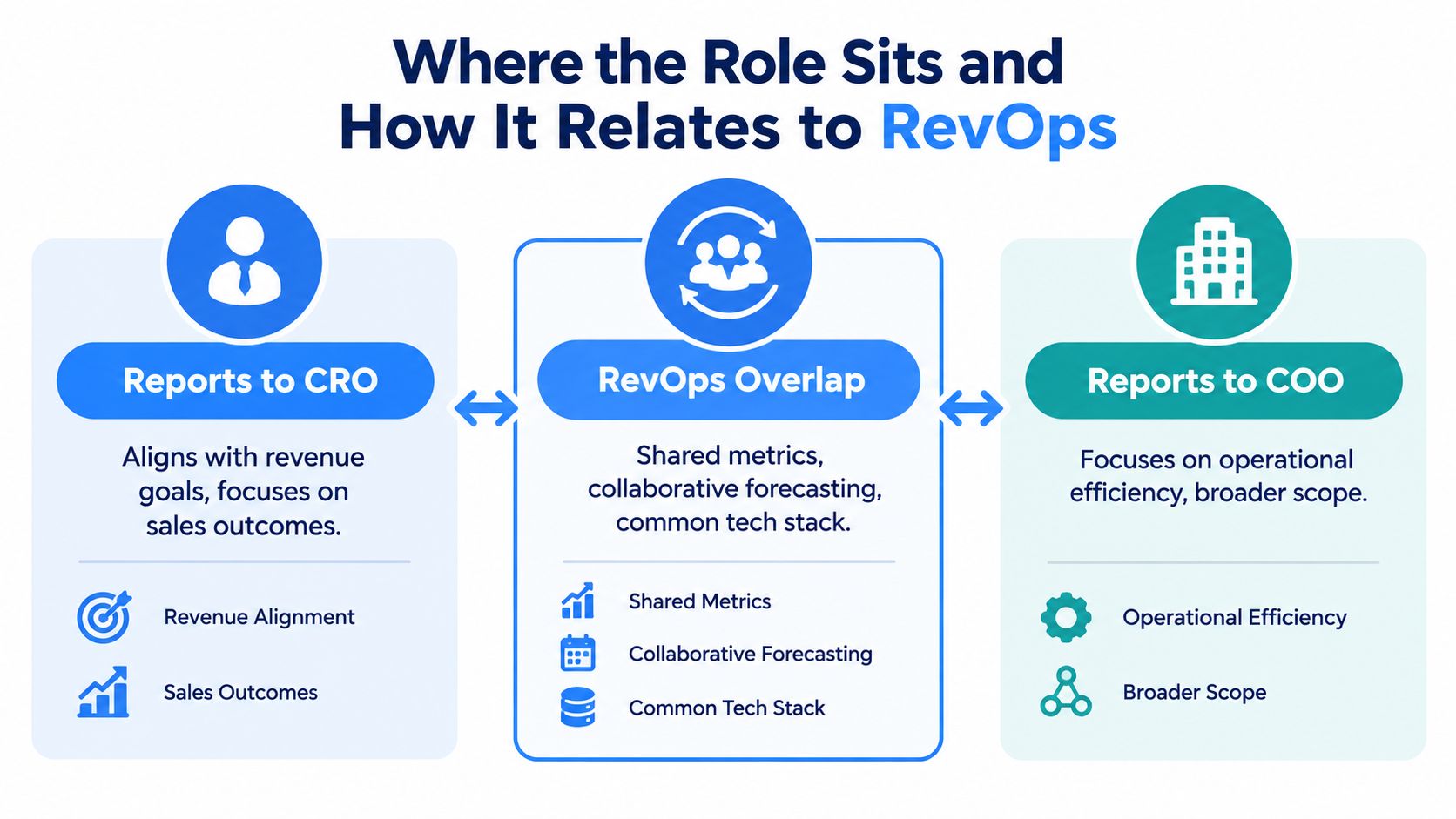
A lot of teams get stuck on title before they've solved for scope. Should this person report to the CRO, the COO, or sit inside a broader RevOps function? The answer depends on what problem the business is trying to solve.
Sales operations is still very much a live category. In job-posting analysis of 1,890 real postings, sales operations accounted for 41% of RevOps openings, ahead of marketing operations at 28% and revenue operations at 21%, according to RevOps career path analysis based on real job postings. That's a useful reality check. Many companies still need classic sales ops leadership, even if they talk about RevOps as the long-term model.
The org placement changes the flavor of the job.
Reporting to a CRO
Under a CRO, the role usually leans hard into forecast accuracy, pipeline inspection, territory design, quota setting, and CRM rules for the sales org. This model works well when the biggest need is tighter selling execution.
The advantage is speed. The downside is that marketing and post-sale ops can drift into separate systems and separate definitions.
Reporting to a COO
Under a COO, the role tends to carry broader operational authority. The director may shape process across planning, tooling, finance coordination, and handoffs beyond the pure sales motion.
That can help when the company has grown fast and needs consistency across departments. The tradeoff is that the role can get pulled into too many general operations problems unless revenue ownership is kept sharp.
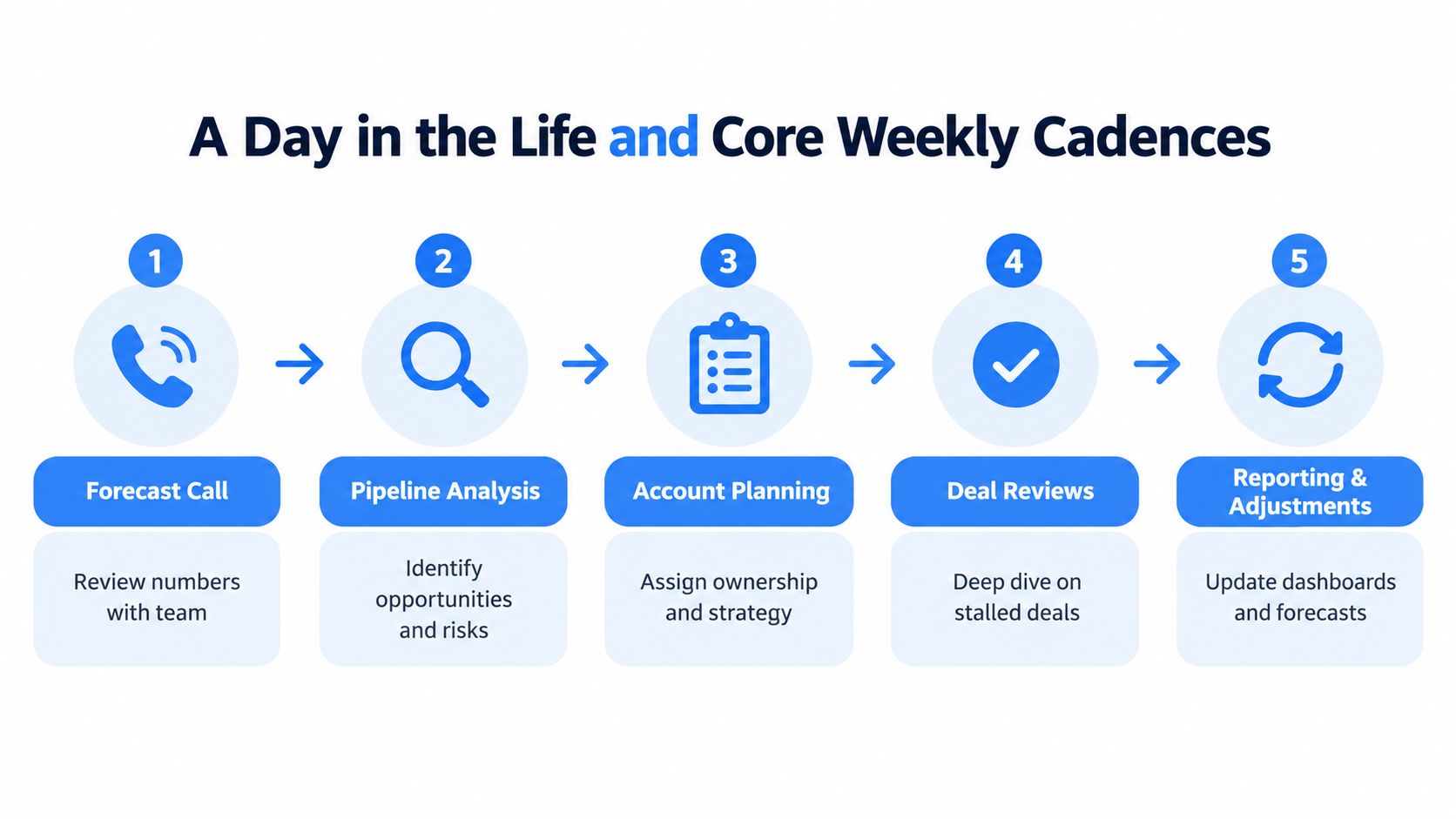
A practical way to compare structures is to look at weekly operating rhythms in action:
The overlap with RevOps
RevOps usually expands the lens. It connects sales, marketing, and customer success under a shared operating model. But in many SaaS companies, the center of gravity still starts with sales operations because pipeline visibility, forecast trust, and CRM structure need fixing first.
The cleanest org charts don't start with a trendy title. They start with a clear owner for data, planning, and process decisions.
If your biggest pain is sales forecast variance, patch design, and CRM confusion, a director of sales and operations can be the right first move. If those are stable and cross-functional handoffs are the bigger issue, RevOps may be the better umbrella.
A Day in the Life and Core Weekly Cadences
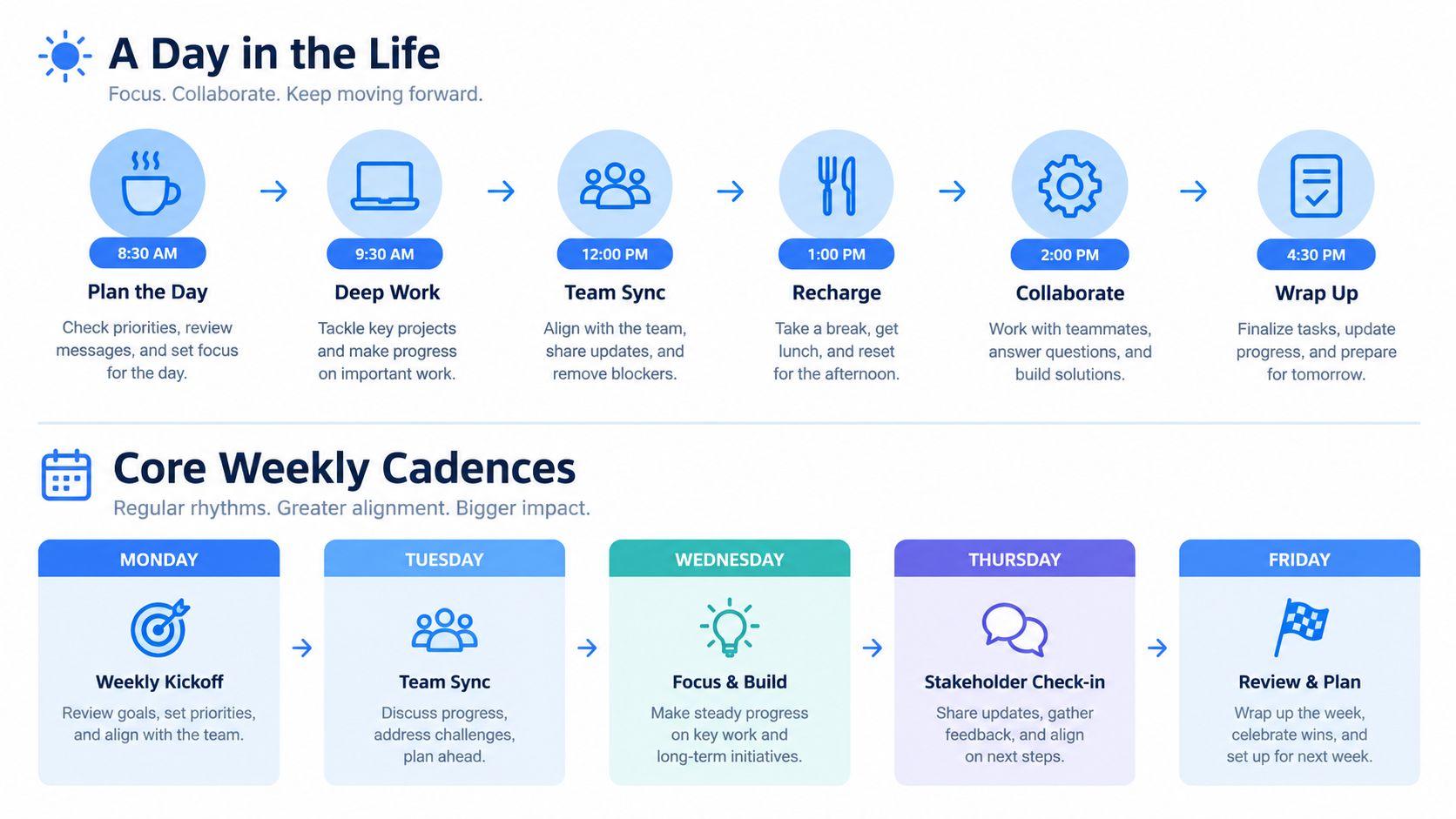
This role looks strategic from the outside, but the calendar tells the truth. A director of sales and operations lives in recurring cadences. The week is less about heroic one-off projects and more about keeping the revenue machine calibrated.
A major job description lists weekly and quarterly forecast work, pipeline analysis and development, account planning, quota and budget allocation, and data governance as core responsibilities in GitLab's sales operations role description.
What the week usually includes
Monday often starts with a forecast review. Not just checking whether the number went up or down, but asking why. Which deals changed category? Which manager has stale pipeline? Which segment is short on coverage?
Midweek usually shifts toward process and inspection work.
- Pipeline analysis: Looking for stage congestion, low-activity deals, and opportunities that don't meet exit criteria.
- Account planning: Reviewing strategic accounts with sales leadership to check ownership, engagement, and next-step discipline.
- Data governance: Cleaning up field usage, validation gaps, duplicate accounts, and broken reporting logic.
- Quota and budget alignment: Working with finance and leadership when headcount, territory shape, or targets need adjustment.
The people side of the role
This isn't a back-room analyst job. The role is team-facing.
One job description says the sales operations director manages the entire sales ops team so day-to-day work gets done, while another notes the director may manage and lead a high-performing team while overseeing CRM strategy, forecasting, and strategic initiatives, as summarized in this sales operations director job description overview.
That means the calendar includes hiring, coaching, prioritizing analyst work, and translating executive goals into tasks that admins, analysts, and systems owners can execute.
A healthy ops cadence turns surprises into exceptions. An unhealthy one discovers problems only after the quarter closes.
For teams building a more disciplined management rhythm, this guide to OKR operating rhythm is useful because it shows how recurring reviews, decisions, and accountability loops fit together.
What a strong day feels like
Not glamorous. Clear.
A strong day might include fixing an opportunity stage rule in Salesforce, reviewing a dashboard in Looker, joining a manager forecast call, then helping finance understand whether a hiring plan matches territory capacity. The role sits at the intersection of systems, planning, and execution. That's why the best operators are comfortable moving from board-level questions to field-level data checks in the same afternoon.
KPIs That Prove the Function Is Working
The role isn't working because the CRM looks cleaner or because more dashboards exist. It's working when leaders can trust revenue signals and make decisions earlier.
Forecast accuracy is the clearest benchmark. Multiple industry sources treat 85%+ as a strong target and 90%+ as a mature-ops threshold, while mature teams are often judged by being within 5 to 10% of committed forecast, based on director of sales operations forecasting benchmarks from Apollo.
Core KPIs for a Director of Sales and Operations
| KPI | Strong Target | Director Ownership |
|---|---|---|
| Forecast accuracy | 85%+ | Forecast process, inspection cadence, model quality |
| Mature ops threshold | 90%+ | Cross-functional forecast discipline and CRM trust |
| Variance to committed forecast | Within 5 to 10% | Stage rules, pipeline hygiene, manager accountability |
Those numbers are useful, but they can mislead if you treat them like dashboard decorations. Forecast accuracy is an output. The work sits underneath it.
What actually moves the KPI
Strong directors usually build multiple forecast views instead of trusting one number. Common models include bottom-up input from reps and managers, top-down planning views, weighted pipeline logic, and trend-based checks. Each method catches a different failure mode.
For example:
- Bottom-up forecasts catch local context from managers, but can absorb rep optimism.
- Weighted pipeline views force consistency by tying probability to stage behavior.
- Trend-based models help spot whether the current quarter is pacing unlike normal historical patterns.
- Top-down models reveal whether the pipeline shape can plausibly support the target.
Clean data matters here. So does enrichment when records are incomplete or stale. Teams often pair CRM discipline with workflow support like B2B data enrichment for revenue systems so routing, segmentation, and account context stay more reliable over time.
The less obvious KPIs
A director of sales and operations also influences compensation design, quota setting, territory mapping, and capacity modeling. Those aren't vanity metrics. They determine whether incentives match company goals and whether headcount plans make sense against revenue expectations.
If forecast accuracy is poor, don't start by blaming reps. Start by checking stage criteria, stale records, coverage logic, and whether the forecast model has more than one view of reality.
When those foundations are weak, every revenue number becomes negotiable. When they're strong, leaders spend less time debating data and more time acting on it.
Skills Experience and Compensation Benchmarks for Hiring
Hiring this role well means screening for a mix that's harder to find than it looks. You need someone who can think like a strategist, work like an operator, and communicate like a manager. Pure analysts often miss the field reality. Pure sales leaders often underweight system design. Pure admins can keep tools running but struggle to shape the commercial model.
What strong candidates usually show
Look for evidence in these areas:
- Analytical judgment: They can explain how they diagnose forecast variance, inspect conversion by stage, and decide whether a dashboard can be trusted.
- CRM governance skill: They've owned system rules, field architecture, and adoption discipline in tools like Salesforce or HubSpot.
- Planning ability: They've worked on territory design, quota logic, compensation alignment, or capacity planning.
- Cross-functional credibility: They can work with finance, sales leadership, and systems teams without turning every question into a ticket queue.
- Team leadership: They can run analysts, admins, and project work, not just do the work themselves.
The market context supports why this role has become more strategic. A 2025 industry report estimated the global SalesOps market at USD 3.28 billion in 2024 and projected growth to USD 11.05 billion by 2033, representing a 14.8% compound annual growth rate from 2025 to 2033, according to Director of Sales Operations salary research and market context from Payscale. That projection reflects growing demand for analytics, automation, and more disciplined forecasting.
How to think about compensation
Comp varies a lot by company size, geography, industry, and how a source treats base versus total compensation.
One salary source reported a $198,140 average annual salary as of September 1, 2026, with a middle 50% range of $179,060 to $215,050 and a 10th percentile starting point of $161,689, based on Salary.com compensation data for Sales Operations Director roles.
Another salary source reported a lower average of $126,841 in June 2026, with most salaries ranging from $94,500 to $164,500 and the 90th percentile reaching $182,500, according to Payscale research for Director of Sales Operations compensation.
A practical hiring checklist
If you're hiring, pressure-test the role with three questions:
- Does this person own a business system or just tasks
- Can they improve forecast trust, not just report on it
- Will sales leaders change behavior because this person set better rules, not because they sent another spreadsheet
If the answer is yes, you're likely hiring a real director of sales and operations. If not, you may only be filling an admin gap with a senior title.
Fetchin offers a Fetchin B2B data API that turns professional profile URLs and company URLs into structured JSON, which can help sales ops teams support CRM enrichment, lead routing, and account data upkeep with live public professional data. If your revenue system depends on current role, company, and firmographic data, it's worth evaluating as part of the ops stack.