Most advice about lead enrichment tools starts with database size. That's the wrong starting point. The biggest index isn't automatically the best fit if your team needs live lookups during signup, synchronous API responses inside a product, strict retry behavior, or region-specific compliance controls.
The underlying problem is real. B2B contact data decays quickly, and one 2026 industry guide cites a 2.1% monthly decay rate, compounding to 22.5% annually for B2B contact records, which is why one-time CRM cleanup no longer holds up for active pipelines (Apollo's guide to B2B data enrichment). That reality changes how you should evaluate vendors. Freshness requirements matter. So do input types, match logic, delivery mode, rate limits, credit rules, and the shape of the output JSON.
The market has also matured beyond niche tooling. One market report says data enrichment solutions reached USD 2.37 billion in 2023 and are projected to grow at a 10.1% CAGR through 2030, with lead enrichment spending projected to reach roughly USD 1.2 billion by 2025 and the broader lead-generation market projected to rise from USD 5.59 billion to USD 32.1 billion by 2035 (MarketsandMarkets lead enrichment trends). Buyers now have to choose between live APIs, indexed databases, batch services, and identity platforms, not just compare who claims the most records.
That distinction matters more than most comparison lists admit. Recent industry coverage points to a shift from batch enrichment toward real-time enrichment and AI-driven orchestration, but product teams still need to separate inbound form-fill use cases from programmatic API workflows, where freshness, latency, and schema stability matter more than static database size (Databar's 2026 enrichment trends overview).
Table of Contents
- 1. Fetchin
- 2. Clearbit (by HubSpot)
- 3. ZoomInfo Enrich
- 4. Apollo.io (Enrichment API)
- 5. Lusha (API)
- 6. Cognism (API and DaaS)
- 7. People Data Labs (PDL)
- 8. FullContact (Resolve + Enrich APIs)
- 9. Coresignal
- 10. Dropcontact
- Top 10 Lead Enrichment Tools, Side-by-Side Comparison
- Choose by Data Job, Not Vendor Size
1. Fetchin
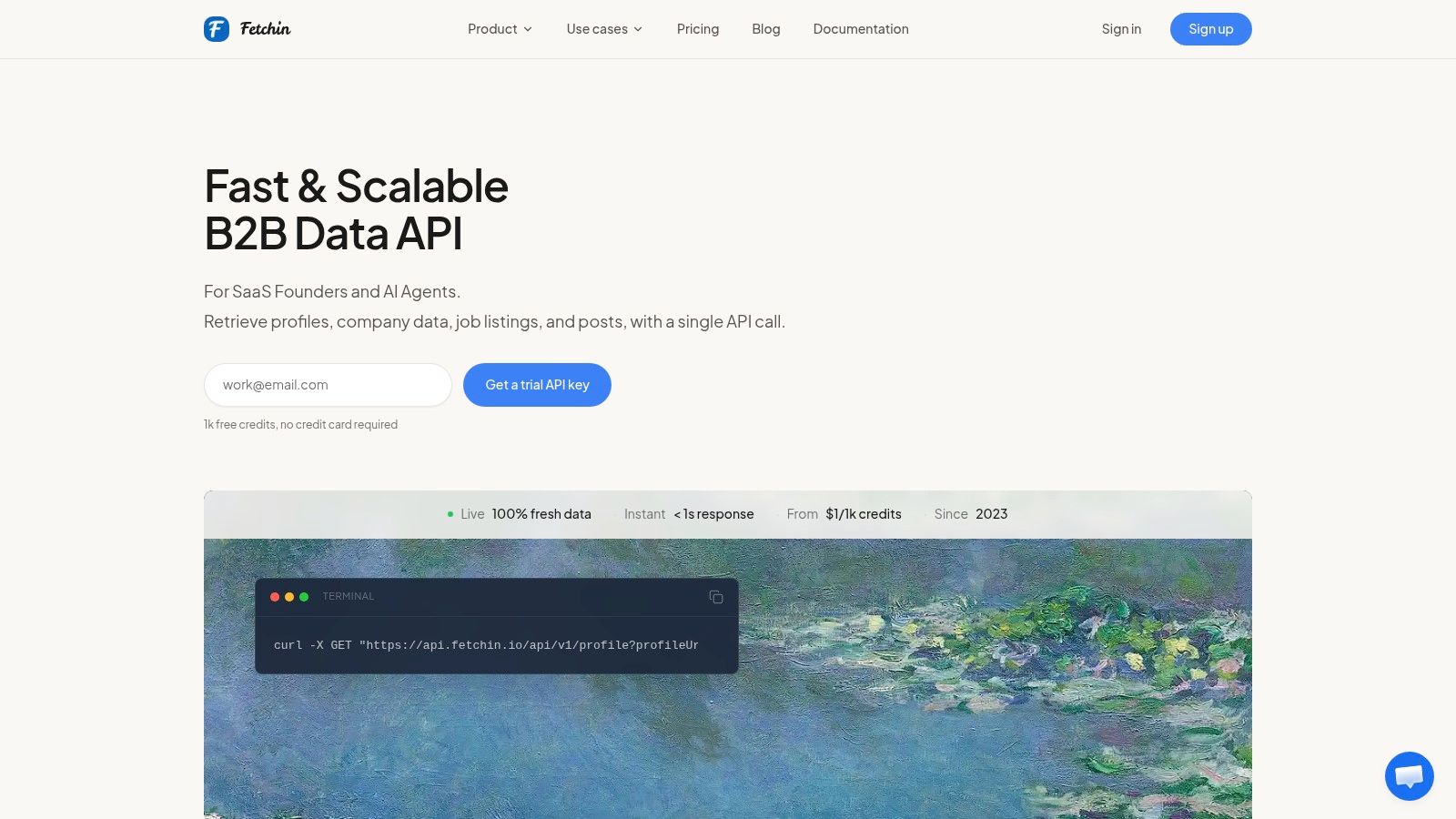
The usual way to rank enrichment vendors by database size obscures what Fetchin is for. Its fit is narrower and more operational. It is designed for workflows that begin with a public profile URL or company URL and need structured output in the same flow, such as product enrichment, agent actions, recruiting workflows, and user-triggered automation.
That delivery model sets it apart from indexed databases and CRM append tools. Fetchin retrieves current public page data at request time and returns it as JSON, which matters when the record being checked may have changed since the last vendor refresh. For product teams, that difference affects implementation more than a long feature list does. A stale employer, title, or company attribute can break routing logic, lead scoring, or in-app personalization even if the underlying vendor has broad coverage elsewhere.
Best workflow fit
Fetchin fits live enrichment jobs better than periodic CRM refreshes or broad prospect database use. If the input is a LinkedIn profile URL or company URL and the output needs to be consumed immediately by software, its model is aligned with the job. If the requirement is large-scale contact warehousing, non-public direct dials, or list building from an indexed universe, this is a weaker match.
The schema is also oriented toward application use rather than simple field append. Profile responses include detailed work history, education, skills, location data, and contact-related fields. Company responses cover common firmographic attributes such as industry, headcount, headquarters, founding year, and domain. Separate endpoints for posts, comments, and reactions make it more relevant for engagement-aware workflows than many standard enrichment APIs.
Implementation trade-offs
Live fetching improves freshness, but it changes how teams should evaluate throughput and reliability. A database lookup service can often process bulk requests more predictably because the data is already indexed. A live-fetch model introduces more dependency on the state and accessibility of the source page, so production teams should pay closer attention to latency distribution, fallback handling, and asynchronous options than they would for a simple append vendor.
That is why percentile latency matters more than headline speed claims. The benchmarking guidance cited earlier recommends measuring p50, p95, and p99 latency, plus throughput and error rates, because tail latency is what breaks user-facing product flows (API Status Check benchmarking guide).
Fetchin appears to account for that implementation reality with both synchronous responses and asynchronous handling for slower jobs. It also states that failed requests do not consume credits, which is more relevant in embedded product use than in overnight batch work. In batch environments, a few failed lookups are usually absorbed operationally. In customer-facing software, failed calls can become both a product problem and a cost-control problem.
Where it fits in the market
Compared with identity platforms such as FullContact or database-led vendors such as Clearbit, Fetchin is less about building a persistent customer graph and more about extracting current structured data from a known public entity. Compared with batch-oriented enrichment services, it is more useful when freshness and direct API consumption matter more than bulk file processing. Compared with sales intelligence platforms, it has less value for broad prospect discovery but more value for teams that already have a URL and need normalized output quickly.
Pricing and throughput should be read through that same workflow lens. Flexible credit models and self-serve access are useful for product teams testing enrichment inside applications. Throughput ceilings matter more for high-volume API pipelines, where even a capable live API may need dedicated capacity planning before it can support sustained ingestion at scale.
- Best for: Live URL-based enrichment inside products, agents, and workflow automation
- Stronger on: Fresh public-page retrieval, structured JSON output, and application-level API use
- Weaker on: Large private contact datasets, broad prospecting databases, and heavy batch-first enrichment programs
Use Fetchin if the workflow starts with a public profile or company URL and the result needs to be consumed immediately by software.
2. Clearbit (by HubSpot)
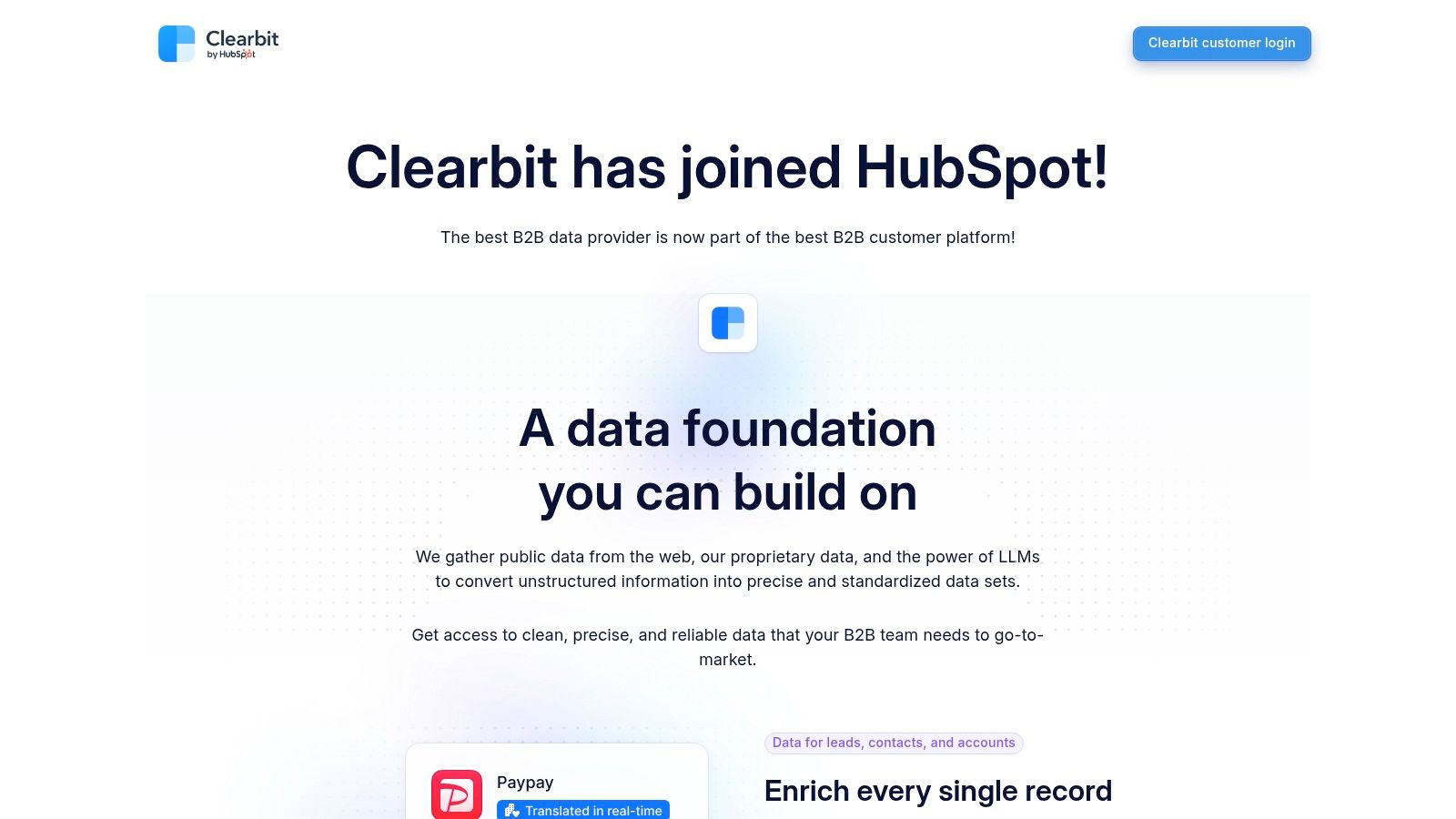
Clearbit is strongest when marketing and CRM teams want enrichment tied closely to inbound capture, website personalization, and account routing. It has long been a common choice for company and person enrichment, especially when the desired output is to update records in HubSpot or Salesforce rather than feed a custom product feature.
The important distinction is that Clearbit behaves more like a mature GTM data layer than a narrow API utility. It supports company and person enrichment, IP-to-company identification through Reveal, batch CSV workflows, and native integrations across common marketing and revenue systems.
Best workflow fit
Clearbit makes the most sense when the data job starts with firmographic context. If a team wants to identify visiting companies, enrich forms, route leads based on account characteristics, and keep CRM records fuller over time, it fits naturally. If the main requirement is live URL-based profile extraction into structured JSON, this isn't the cleanest match.
Freshness is the central trade-off. With database-driven enrichment, update quality depends on the vendor's collection and refresh cadence, not on what exists on the public page at the exact moment of request. That isn't necessarily bad. It's often preferable for standardized CRM operations. But it is a different architecture from tools built for live fetches.
For a deeper comparison between live API enrichment and classic database-led workflows, this lead enrichment API analysis is a useful companion.
- Best for: CRM enrichment, website personalization, inbound routing
- Strength: Mature integrations, repeatable batch workflows, broad operational fit for marketing teams
- Watch for: Pricing often moves into sales-led packaging, and freshness depends on internal update cadence
Use Clearbit when enrichment is part of your marketing system, not just your application layer.
3. ZoomInfo Enrich
ZoomInfo Enrich sits at the enterprise end of the market. It is designed for large CRM environments, major account coverage, and broad operational rollouts where person and company records need to be refreshed across multiple GTM systems and data stores.
What separates ZoomInfo from lighter enrichment tools is depth around account structure. Teams often choose it for org charts, buying committee mapping, intent signals, and connectors into the systems that already run enterprise sales motions. If you operate mostly in large-account outbound or ABM, that depth can matter more than low-friction API onboarding.
Where enterprise depth wins
ZoomInfo is usually not the cheapest or simplest option. That's often acceptable in environments where procurement, RevOps, SDR leadership, and marketing ops all need one vendor with broad internal reach. In that situation, the product isn't only selling enrichment. It's selling process standardization.
The main caution is architectural fit. If your use case is customer-facing product enrichment, contract-heavy enterprise packaging can be excessive. If your use case is CRM-wide record maintenance and account intelligence, the extra depth is the point.
Waterfall enrichment tends to outperform any single vendor on match rate, but the incremental gain drops quickly after the second source, which makes multi-provider orchestration more sensible for high-value records than for broad low-ROI pipelines (DataMagnet enrichment benchmark).
- Best for: Enterprise CRM refresh, account intelligence, buying committee mapping
- Strength: Deep organizational data and mature connectors
- Watch for: Opaque pricing, feature gating, and heavier implementation overhead
Use ZoomInfo Enrich when account depth matters more than self-serve flexibility.
4. Apollo.io (Enrichment API)
Apollo.io is attractive because it bundles prospect discovery, enrichment, and outbound execution in one stack. For many SMB and mid-market teams, that convenience changes the buying decision more than any single feature does.
Apollo's Enrichment API covers people and organizations, and the platform exposes usage and rate-limit details clearly enough for teams that want to monitor credit consumption. That transparency makes it easier to model workflows than with vendors that hide the operational details until late-stage sales calls.
Why teams pick Apollo
Apollo works well when the organization wants one vendor for list building, enrichment, and sequencing. That reduces tool sprawl. It also means API economics can get mixed with seat-based platform economics, which complicates pure infrastructure comparisons against API-only products.
Its practical limitation is consistency across segments. Coverage and field quality can vary by region, niche, and input quality. That's common across database-led vendors, but it matters more when a team assumes one platform can handle every market equally well.
If you're comparing single-platform workflows against API-first enrichment, this data enrichment API product overview helps frame the trade-offs.
- Best for: Teams that want enrichment and outbound in one environment
- Strength: Unified workflow, documented usage mechanics, strong SMB and mid-market appeal
- Watch for: Seat licensing can muddy API cost modeling
5. Lusha (API)
Lusha is a pragmatic choice for sales teams that care about contactability more than data warehousing elegance. Its API, extension, and web app share a unified credit balance, which sounds mundane but can simplify operational planning for teams that enrich records in several places.
The product is often chosen for outbound workflows, especially where direct-dial discovery and practical Salesforce integration matter more than a deep developer platform. That focus gives it a narrower, more sales-led shape than some API-first data providers.
Best used as a sales operations tool
Lusha's waterfall logic is relevant because real-world enrichment isn't a binary good-or-bad problem. Independent benchmark coverage for B2B email-finder tools reported returned-contact coverage ranging from 41.3% to 87.1%, with false-positive rates ranging from 0.9% to 6.5%, and waterfall-style enrichment delivered the highest coverage while tightly verified providers delivered the best precision (Cleanlist enrichment accuracy benchmark). That trade-off describes Lusha's lane well. Teams often accept broader retrieval logic when the goal is to give SDRs more reachable contacts.
The downside is geographic variability. Match quality and phone coverage can shift outside core markets, and advanced datasets often sit behind higher pricing tiers.
- Best for: SDR-heavy contact enrichment and sales operations
- Strength: Unified credits across product surfaces, practical outbound orientation
- Watch for: Less predictable coverage outside core geographies
Use Lusha when the main question is, "Can my reps reach this person?" rather than, "Can my product enrich this object in real time?"
6. Cognism (API and DaaS)
The biggest lead database is not always the safest choice. For teams enriching records across the UK and Europe, procurement often turns on lawful basis, regional phone coverage, and whether the vendor can support recurring CRM hygiene without forcing everything through a custom API build.
Cognism fits that operating model. It combines API access with batch enrichment, data-as-a-service delivery, and managed refresh programs, so it serves a different workflow from developer-first platforms such as PDL or live product-enrichment tools built around millisecond response times. If your enrichment job is quarterly CRM repair, territory-wide contact refresh, or policy-sensitive outbound data maintenance, that hybrid model matters more than a long feature checklist.
The trade-off is implementation style. A live API gives product and ops teams control inside their own systems, but indexed and batch-oriented services often make more sense when the job is to correct large volumes of stale CRM records, append mobile numbers, or standardize account data across regions. Cognism sits closer to that second camp, even though it also exposes APIs.
Compliance is part of the buying decision here, not post-purchase cleanup. California's CCPA and CPRA B2B exemption expired on January 1, 2023, and enriched professional data for California residents can fall within scope for businesses that meet the law's thresholds, as outlined in Explorium's GDPR and CCPA checklist for B2B enrichment APIs. That has pushed legal review closer to the center of vendor selection, especially for teams syncing external person data into CRM and sequencing tools.
One practical pricing detail stands out. Cognism does not charge again for re-enriching the same redeemed record, which can lower the cost of recurring refresh cycles. That matters less in one-off prospecting and more in environments where the same account and contact records are updated repeatedly over time.
A useful way to judge Cognism is by asking which data job you need done:
- CRM refreshes and managed batch operations: Strong fit
- EMEA contact enrichment with policy review: Strong fit
- High-throughput, engineering-owned API pipelines: Usable, but not the center of gravity
- Real-time product enrichment inside end-user flows: Usually less natural than API-first vendors
- Identity resolution across fragmented consumer and professional identifiers: More limited than identity-focused platforms
Use Cognism when the main requirement is governed enrichment at regional scale, especially for EMEA sales data and recurring CRM maintenance, rather than a pure API building block.
7. People Data Labs (PDL)
PDL makes the most sense if enrichment is treated as a data pipeline problem, not a sales workflow purchase. Teams usually adopt it for internal products, scoring systems, and high-volume API jobs where request logic, match criteria, and throughput matter more than SDR-facing features.
That distinction matters because PDL sits closer to a raw data utility than to a rep workflow platform. Person, company, and IP endpoints give engineering teams several ways to resolve records, but the value depends on how well your identifiers are normalized before requests are sent. In practice, stronger inputs often matter as much as vendor coverage.
A useful test is the workflow itself. For real-time product enrichment inside a signup form or routing flow, live API responsiveness and predictable request behavior are the main concern. For warehouse backfills or CRM cleanup, batch economics and match tolerance start to matter more. PDL is generally stronger in the first two categories than in managed refresh programs or compliance-led contact acquisition.
Its credit model also changes the economics of experimentation. Charging on successful matches can be favorable in pipelines where query quality is already high, but less predictable if your source data is noisy and match rates swing by segment. The implementation trade-off is clear. PDL gives engineers control, but it also asks them to own queueing, retries, throttling, and monitoring.
If you're comparing developer-oriented profile APIs, this comparison of people data API options helps frame where PDL fits.
PDL is strongest for:
- Engineering-owned enrichment services
- High-volume API pipelines
- Custom scoring, routing, or internal data products
It is less natural for:
- Turnkey CRM refresh programs
- Identity resolution across many consumer and offline identifiers
- Compliance-first buying motions where legal review drives vendor choice
Use People Data Labs when the main job is programmatic enrichment at scale and your team is prepared to manage the surrounding pipeline architecture.
8. FullContact (Resolve + Enrich APIs)
A standard enrichment API assumes you already know who the person is. FullContact is more useful in the messier stage before that assumption holds, when the same individual appears as a hashed email in a CDP, a mobile ad ID in paid media data, and a partial CRM contact with no stable join key.
That workflow changes the evaluation criteria. Coverage of appended fields still matters, but implementation value comes earlier, in whether the platform can resolve fragmented identifiers to a persistent PersonID that downstream systems can reuse. For warehouse teams, identity platforms and indexed contact databases solve different jobs.
A concrete example makes the distinction clearer. Suppose a consumer business wants to suppress existing customers from acquisition campaigns, enrich known users for lifecycle marketing, and avoid duplicate records in the CRM. FullContact can sit in front of enrichment, linking the hashed email from the CDP, the device-level identifier from mobile acquisition, and the CRM record to one identity. The result is not just more fields. It is a cleaner key structure for routing, suppression, measurement, and later refreshes.
The trade-off is operational fit. If the immediate job is SDR prospecting, simple company append, or a fast lookup from a known work email, Resolve can add steps that a sales-led workflow does not need. If the job is identity resolution across channels, those extra steps are the product.
FullContact is strongest where identity quality determines enrichment quality:
- Cross-channel person unification before enrichment
- CRM and CDP reconciliation using persistent identity keys
- Consumer and hybrid B2C/B2B environments with many identifier types
Less natural use cases:
- Lightweight contact lookup from already-clean records
- High-volume company-only enrichment jobs
- Teams that want a straightforward indexed database or batch append service without an identity layer
Use FullContact when record linkage is the main problem, and enrichment is only reliable after that problem is solved.
9. Coresignal
Coresignal fits a narrower job than many lead enrichment buyers first assume. It is less suited to classic contact append, and more useful for teams building company or workforce data into a product, model, or internal pipeline.
That distinction matters because Coresignal sits closer to a live data service than to a packaged sales database. The practical appeal is operational, not cosmetic. Teams can evaluate it with trial access, inspect published pricing, and work within stated rate limits before a long vendor review. For engineering-led buying, that reduces implementation risk.
The strongest use cases cluster around public-source company and employee data. If the workflow is high-volume API enrichment for account scoring, territory design, labor market analysis, or product features that depend on employer context, Coresignal makes more sense than tools optimized for SDR workflows. Its CSV enrichment option also gives revops teams a batch path when a full API integration is unnecessary.
A useful way to evaluate Coresignal is by the data job:
For live product enrichment, the question is not only coverage but response behavior, schema clarity, and whether public-source signals are sufficient for the user experience you are building. For batch operations, the trade-off is simpler. Coresignal offers a lower-friction route into company and employee enrichment than platforms that require heavier commercial onboarding. For CRM refreshes, it is a less natural fit if the main requirement is verified direct contact data, email confidence, or sales-ready person records.
This also shapes the compliance and freshness trade-off. Public-source aggregation can be attractive for teams that want a clearer line of sight into data provenance. At the same time, public-web and profile-derived records do not solve every identity or contact-quality problem. If the workflow depends on direct dials, personal contact resolution, or broad person-level PII append, indexed contact vendors and verification-focused tools usually align better.
Coresignal is strongest in these situations:
- Product and analytics teams that need structured company or workforce data through APIs
- High-throughput enrichment pipelines where self-serve pricing and visible limits matter during testing
- Batch enrichment jobs built around employer, firmographic, or employee-history context
Less aligned use cases:
- Email-first enrichment and verification workflows
- CRM cleanup projects centered on contact-level sales data
- Identity resolution across many identifier types
Use Coresignal when the workflow depends on public-source company and employee intelligence, and when transparent API buying matters as much as raw dataset breadth.
10. Dropcontact
Dropcontact fits a narrower job than several vendors above, and that is the point. It is built for contact cleanup, email discovery, and CRM hygiene workflows where verified professional email outcomes matter more than broad person or company append.
That makes it easier to place in a stack. Teams choosing between live enrichment APIs, indexed contact databases, and identity platforms should treat Dropcontact as an operational data-quality layer. It is closer to an email-centric refresh tool than to a product enrichment API or a large-scale account intelligence source.
The trade-off shows up in workflow design. For CRM refreshes, spreadsheet-based list maintenance, and deduplication, the narrower scope can reduce noise and procurement risk, especially for EU-based teams that scrutinize sourcing and compliance posture. For product-led enrichment, account scoring, or high-volume pipelines that need dense firmographic and employment attributes on every request, the limited breadth becomes a constraint.
A useful way to evaluate Dropcontact is by what it does not try to do. It is not competing head-on with broad indexed databases on company depth, buying-committee coverage, or identity graph resolution across many identifiers. It serves the email verification and contact normalization part of the process, where clean records can matter more than maximal field count.
The implementation model also differs from API-first enrichment vendors. Dropcontact is well suited to operators working inside CRMs and spreadsheets, and less suited to engineering teams building low-latency enrichment into user-facing products. Freshness matters here in a different way. The relevant question is not whether a profile contains dozens of updated attributes, but whether an email can be found, standardized, and kept usable in the systems where reps work.
Use Dropcontact for email-focused enrichment, deduplication, and compliance-sensitive CRM maintenance. Look elsewhere if the primary job is company intelligence, identity resolution across many data types, or large-scale API enrichment beyond contact hygiene.
Top 10 Lead Enrichment Tools, Side-by-Side Comparison
| Provider | Core features | Freshness & Performance (★) | Pricing & Value (💰) | Target audience (👥) | Unique selling points (✨) |
|---|---|---|---|---|---|
| 🏆 Fetchin | Real-time per-call fetch; Profile (100+ attrs), Company firmographics, Posts/Comments; sync/async JSON | ★★★★☆ · Live fetch every call · ~1s median / ~1.5s P95 · failed requests not billed | 💰 Free 1k credits; ~$1/1k starter; PAYG & enterprise/dedicated tiers | 👥 SaaS products, AI agents, recruiting, sales/GT M tooling | ✨ Live page-state fetching; consistent schemas; fail-safe billing; fast dedicated capacity |
| Clearbit (by HubSpot) | Company & Person enrichment, Reveal (IP->company), batch CSV, HubSpot/SFDC integrations | ★★★☆☆ · Database-driven updates (cadence-dependent) | 💰 Tiered; higher tiers often require sales contact | 👥 Marketing automation, website personalization, CRM teams | ✨ Mature ecosystem & native GTM integrations |
| ZoomInfo Enrich | Enrich packages, org charts, intent, connectors to GTM systems & warehouses | ★★★★☆ · Deep US enterprise coverage; enterprise-grade freshness | 💰 Contracted enterprise pricing (often expensive) | 👥 Enterprise GTM, ABM, sales ops | ✨ Buying-committee mapping & intent signals |
| Apollo.io (Enrichment API) | Person/Org enrichment, credits model, discovery + outbound bundled | ★★★★☆ · Strong SMB/mid-market coverage; metered API limits | 💰 Credit-based; bundled platform licensing can complicate API cost | 👥 SMB/mid-market sales & SDR teams | ✨ All-in-one prospecting + enrichment + outbound stack |
| Lusha (API) | Contact & company enrichment; unified credit balance across UI & API | ★★★☆☆ · Good direct-dial coverage in core geos; variable elsewhere | 💰 Simple credit model spanning extension/web/API; tiered features | 👥 Outbound SDRs and sales teams | ✨ Unified credit pool & direct-dial focus |
| Cognism (API & DaaS) | Enrich/Redeem APIs, bulk DaaS, CRM refresh programs | ★★★★☆ · GDPR-forward with verified mobile numbers; strong EMEA freshness | 💰 Sales-engaged pricing; enterprise packages | 👥 EMEA compliance-sensitive teams & enterprises | ✨ GDPR-first policies; no double-charge for redeemed records |
| People Data Labs (PDL) | Person, Company, IP enrichment APIs; very large profile graph | ★★★★☆ · Built for high-volume programmatic enrichment | 💰 Self-serve tiers (Free/Pro/Enterprise); credits-based | 👥 Developer teams needing scale & flexible delivery | ✨ Massive underlying graph; developer-centric APIs |
| FullContact | Resolve + Enrich APIs; persistent PersonID; Snowflake integrations | ★★★★☆ · Strong identity resolution & in-warehouse workflows | 💰 Enterprise-focused pricing; sales contracts common | 👥 CDPs, identity teams, enterprises unifying identifiers | ✨ Identity graph & PersonID for multi-channel unification |
| Coresignal | Company & employee APIs, multi-source data, no-code CSV enrichment | ★★★★☆ · Emphasis on freshness & high RPS support | 💰 Transparent, published rates; trial credits available | 👥 Product teams needing structured JSON & high throughput | ✨ Published pricing & source transparency |
| Dropcontact | Contact enrichment with pay-on-success for verified emails; Sheets/CRM add-on | ★★★☆☆ · Compliance-first (CNIL/GDPR) with pay-for-result email logic | 💰 Pay-on-success model reduces spend on nulls; tiered plans | 👥 EU ops teams, CRM users prioritizing compliance | ✨ Algorithmic email generation & CNIL-audited posture |
Choose by Data Job, Not Vendor Size
The easiest mistake in this market is to buy the vendor with the loudest coverage claims and then force every workflow through the same tool. That usually creates a messy stack. Product teams need synchronous lookups, stable schemas, and retry-safe billing. RevOps teams need CRM refreshes, batch jobs, and connectors. Marketing ops teams need firmographic append and routing. Data teams may need identity resolution or warehouse-friendly delivery.
Start with the input identifier. If your workflow begins with a professional profile URL or company URL, shortlist tools that can turn that exact identifier into structured output without extra manual matching. If your workflow starts with domain names, IP signals, email addresses, or partially complete CRM rows, your shortlist changes immediately. Good enrichment architecture starts with the record you have, not the record you wish you had.
Then separate live lookups from database enrichment. That's a harder line than many buyers draw. Live fetching is better for product features, current-state matching, and use cases where stale titles break logic. Database enrichment is better for broad CRM maintenance, large account coverage, and outbound prospecting motions where operational depth matters more than exact page-state freshness at request time.
After that, test match quality and field quality on your own records. Don't test on a handpicked sample of clean enterprise domains. Use the messy identifiers your pipeline really generates. Compare null behavior, company resolution, title freshness, and whether failed requests still burn credits. Cost per successful result is more useful than list price, especially when some vendors charge on attempt and others charge on success or matched return.
Throughput and retry behavior come next. Check published rate-limit mechanics, queue tolerance, latency at the tail, and whether the API can support synchronous product requests or should be isolated to asynchronous jobs. Integration maintenance also deserves more attention than most buyers give it. One broad but inconsistent provider can create more downstream cleanup than two narrower, more predictable sources.
Regional and legal requirements should be confirmed before rollout, not after contract signature. That is especially true if your workflow involves California resident data, EU operations, or a product experience that surfaces enriched fields directly to users.
The practical takeaway is simple. Fetchin is the strongest option here for live URL-based product enrichment, where current page-state data, structured JSON, and synchronous delivery matter. Clearbit and ZoomInfo are better aligned with CRM and GTM system enrichment. Apollo is attractive when you want enrichment and outbound in one stack. Lusha is useful when sales teams prioritize contactability. Cognism stands out for compliance-sensitive and EMEA-heavy motions. People Data Labs and Coresignal suit API-led data teams. FullContact solves identity resolution. Dropcontact is the specialist for compliance-led email workflows.
Pick the data job first. Then pick the vendor.
If your team needs live people or company enrichment from a professional profile URL or company URL, Fetchin is built for that exact workflow. It returns structured JSON, supports synchronous and asynchronous delivery, and is designed for products and automations that can't rely on stale snapshots. See how it works at Fetchin.