
A 30 60 90 day sales plan shouldn't promise full productivity by day 90. The sales-onboarding overview summarizes ramp periods across 114 organizations ranging from 3 to 24 months, with an average of 6 months. Treat the first 90 days as a way to test whether a rep is building the knowledge, habits, and pipeline that can lead to quota attainment, not as a guarantee that complex deals will close on schedule.
Table of Contents
- 30 60 90 Day Plan Milestones at a Glance
- Set Up the Plan Before Day One
- Set Role and Cycle Specific Ramp Targets
- How to Build the Days 1 to 30 Certification Plan
- Tracking Supervised Execution from Day 31 to Day 60
- Day 90 Checkpoints and Manager Triggers
30 60 90 Day Plan Milestones at a Glance
| Phase | Focus | Milestone to check | Evidence to review |
|---|---|---|---|
| Days 1-30 | Product, ICP, CRM and messaging certification | Three scored discovery role-plays completed by day 14 | Role-play scorecards on one shared rubric |
| Days 1-30 | Account list and first prospecting | First outreach activity logged by end of week two | CRM activity log |
| Days 31-60 | Supervised prospecting and discovery calls | Qualified meetings and opportunities created | Pipeline report with stage entry dates |
| Days 61-90 | Independent ownership of opportunities | Pipeline coverage of 3x ramp quota | Forecast split into commit, best case and upside |
| Days 61-90 | Forecast discipline and early bookings | First qualified opportunity and early wins by role | Deal review notes and forecast variance |
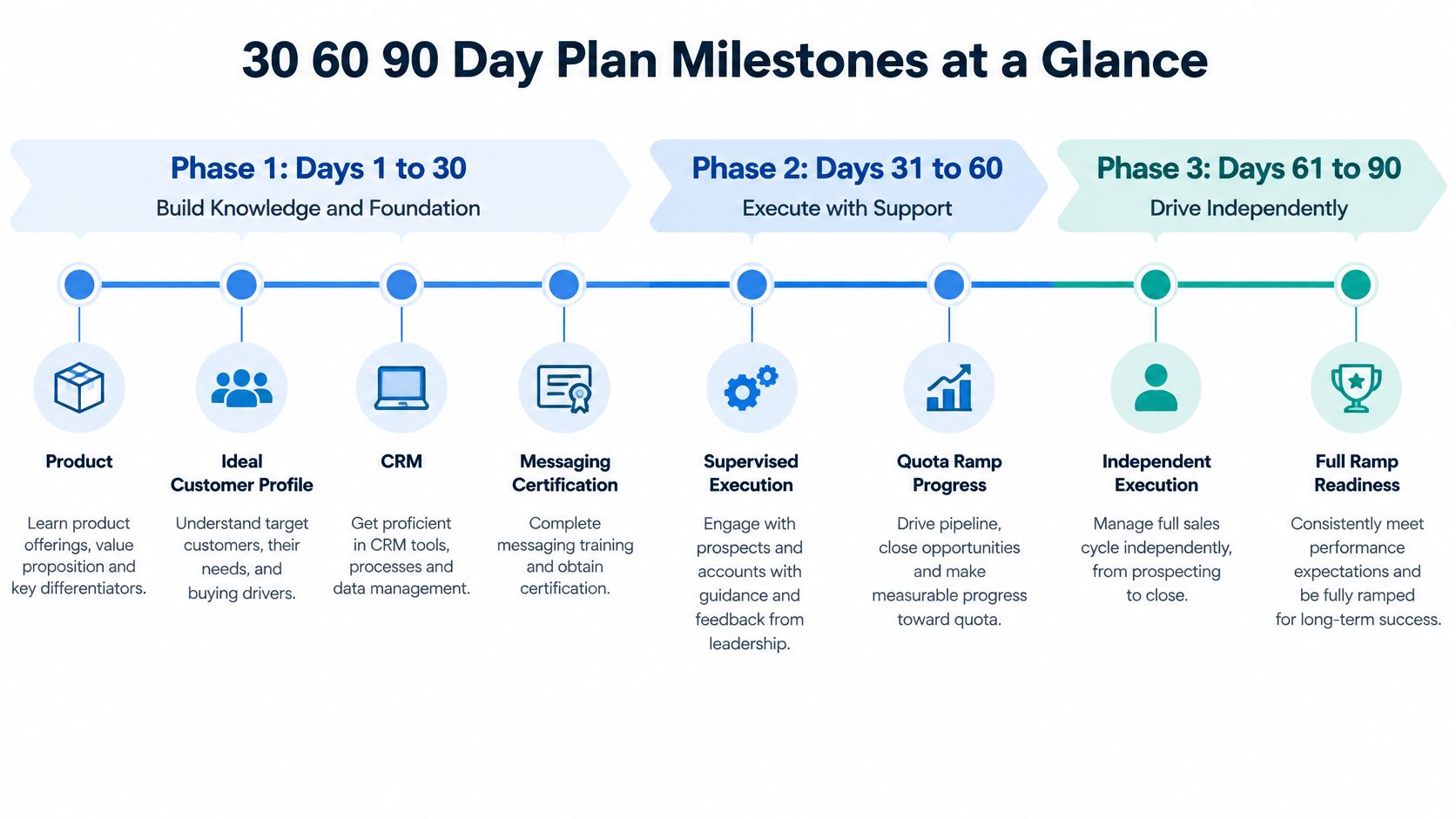
A usable plan ties every checkpoint to evidence. For the role-plays, use the same scorecard to assess discovery structure, listening, qualification, and next-step agreement. In the CRM, check that the first outreach is logged with a date and outcome, not merely marked complete.
At day 60, review the pipeline report for qualified meetings, opportunities, stage-entry dates, and documented next steps. At day 90, compare pipeline coverage with the rep's ramp quota, then review whether the forecast distinguishes commit, best case, and upside.
The first three months should primarily measure leading indicators. Quota attainment may arrive later, particularly when a rep sells into a long or complex buying process.
Milestone test: Every row needs a number, a date, and a named piece of evidence, such as a scorecard, CRM report, or deal-review note. If you can't identify the evidence source, rewrite the milestone before sharing the plan.
Set Up the Plan Before Day One
Start with the conditions that make a target fair. Before the rep arrives, write down the role, average sales-cycle length in days, and whether the rep inherits active pipeline. These facts affect what the manager can reasonably expect at every checkpoint.
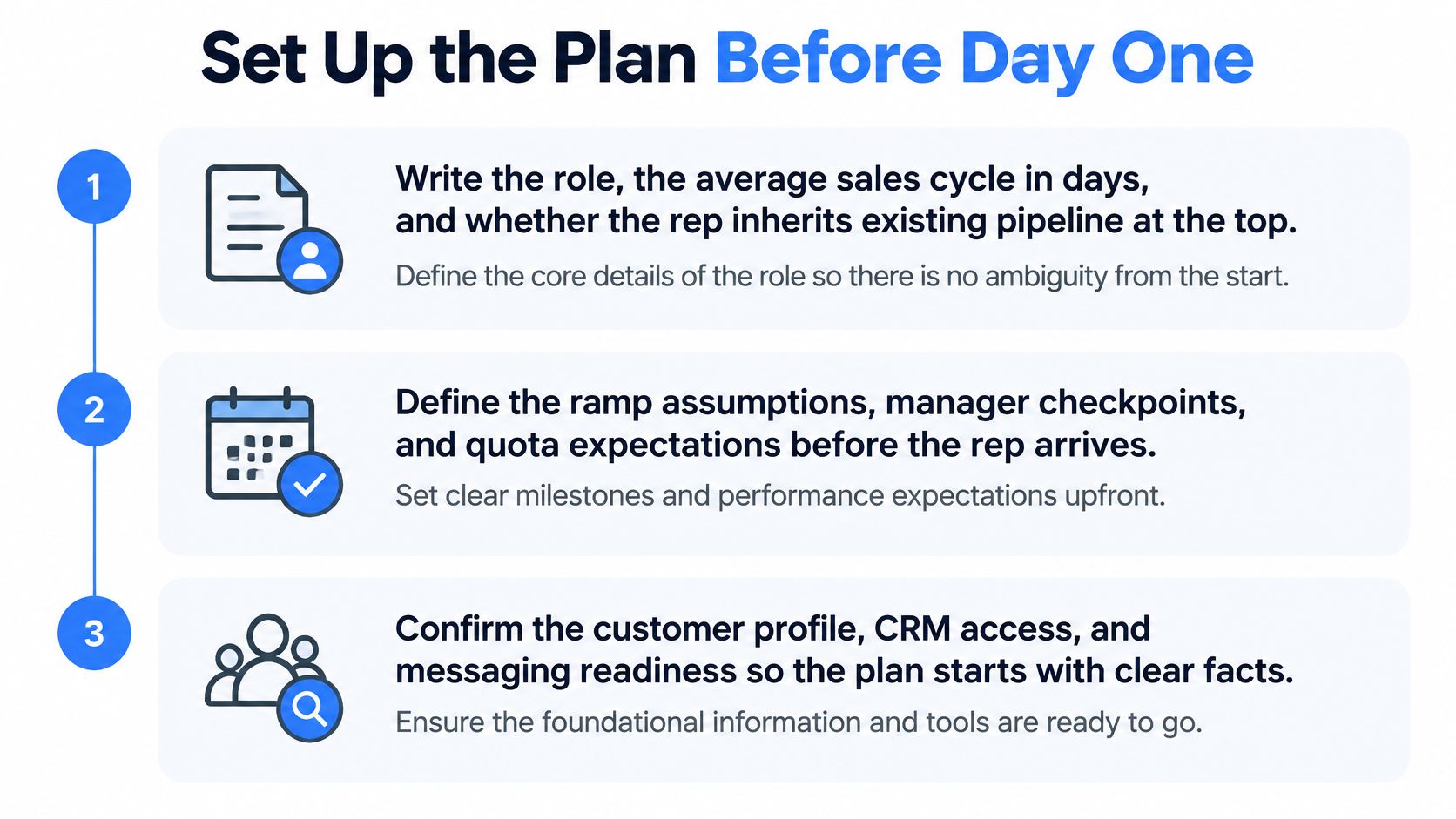
Define the starting conditions. Record the role, sales cycle, territory, and inherited pipeline status at the top of the plan. Without that context, a first-win target can reward inherited deals while penalizing a greenfield hire.
Score the target accounts. Build a first 50-account universe using fit factors such as company size, industry, and segment. Record the reason for each score so the rep and manager can challenge the assumptions rather than treating the ranking as fact.
Refresh the contact records. A professional data API can enrich records that contain only a name and email with role, seniority, and employer. If your CRM is stale, scheduled data hygiene can re-enrich records and catch job changes before outreach goes to someone who has moved on.
Set a job-change check. Agree on a recurring review of contact freshness. This is useful when titles and employers change faster than a territory plan does.
Agree on the checkpoints in writing. Set the day-30, day-60, and day-90 milestones with the rep, and name the evidence for each. For a broader view of connecting onboarding paperwork and payroll data, align sales onboarding records with the processes that support a new hire's arrival.
CRM and territory work also need a clear owner. Managers who want a consistent operating rhythm can review software sales management practices alongside onboarding responsibilities, so account approval and checkpoint reviews don't fall between teams.
The common mistake is scoring accounts after outreach has begun. That sends early activity toward a list the rep didn't have a fair chance to prioritize. Sign off on the plan and the target list before day one, then set targets against the agreed starting conditions.
Set Role and Cycle Specific Ramp Targets
Ramp time varies by role: the ranges below are directional, not pass-or-fail deadlines. The sales-rep ramp benchmark guide gives typical timeframes. Use them to set expectations, then judge progress against leading indicators the rep can influence.
| Role | First meeting | First qualified opportunity | First win | Full productivity |
|---|---|---|---|---|
| Inside or small-business account executive | 7 to 14 days | 15 to 30 days | 30 to 60 days | 3 to 4 months |
| Mid-market representative | 14 to 30 days | 30 to 60 days | 60 to 120 days | 6 to 9 months |
| Enterprise or field representative | 30 to 60 days | 60 to 120 days | 6 to 9 or more months | 9 to 12 or more months |
One close target cannot fit every role. Inside and small-business sellers may reach a first win sooner; enterprise representatives may still be qualifying opportunities after day 90. Sales development representatives need a different scorecard, weighted toward outreach quality, conversations, and qualified meetings rather than closed revenue. For role context, see this guide to types of sales.
Match the target to the sales cycle
Set day-90 success measures around the typical sales cycle. If deals often close within the onboarding window, include a closing target. For a 90-to-180-day cycle, assess stage progression, conversion, and forecast accuracy, then schedule a quarterly review. For longer cycles, retain early learning and supervised-execution gates, but assess opportunity progression quarterly rather than requiring a day-90 win.
The Bridge Group's 2024 SaaS sales benchmark reported an average account-executive ramp time of 5.7 months, a 32% increase from 2020, as summarized in this SaaS onboarding benchmark. A day-90 close in that context may say more about the opportunity's buying stage than the rep's ability to sell. To assess skill application, define observable behaviors and measure on-the-job learning outcomes.
Separate inherited pipeline from new pipeline
Inherited active deals can support a faster first-win target, but they do not show whether the rep can create pipeline. Set a separate target for newly sourced opportunities. For a greenfield hire, prioritize account selection, qualified opportunity creation, and progression.
Write the cycle rule and inherited-pipeline treatment on the first page of the plan. Before day one, both rep and manager should know whether success means a close, a qualified opportunity, or credible progression.
How to Build the Days 1 to 30 Certification Plan
The first month should end with proof that the rep can explain the offer, identify a fit account, and record activity correctly. A structured model calls for three scored discovery role-plays by day 14 and four shadowed live calls with written debriefs, as outlined in this sales onboarding ramp-time report.
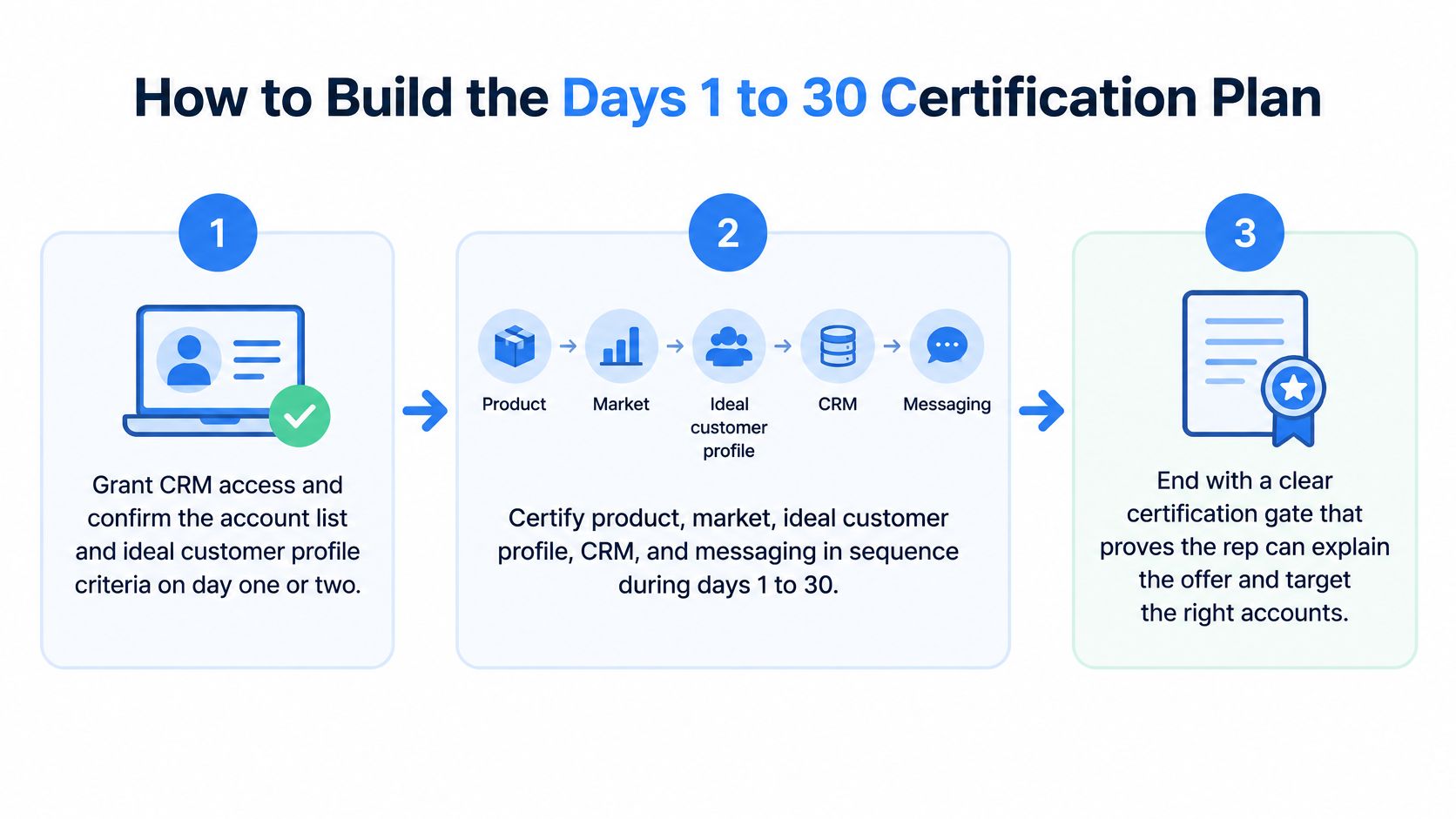
Grant access and confirm the account list. Give the rep CRM access on day one or two, then review the approved account list and ICP criteria together. The common slip is leaving account ownership or access unresolved, which turns early onboarding time into administrative delay.
Certify the core knowledge. Work through product, market, ICP, CRM, and messaging in sequence, with a short written check for each area. A rep who can repeat feature names but can't connect them to a customer problem hasn't passed the practical test.
Score discovery practice. Run three role-plays by day 14 using one shared rubric. Score the same behaviors each time, including question quality, listening, qualification, and agreed next steps. Without a consistent rubric, scores won't show whether the rep is improving.
Shadow calls and debrief. Have the rep observe four live calls and write a structured debrief for each, noting the buyer's problem, objections, and what the seller did next. Shadowing without a written debrief can teach the script but leave the rep unprepared for real objections.
Log first prospecting activity. Start outreach by the end of week two and set a daily activity target that tracks both outreach volume and reply rate. Counting sends alone can hide a message that isn't earning responses.
Establish a day-30 baseline. Record time to first activity, CRM completeness for each record, and the count of opportunities with a stage and next step. The baseline helps the manager distinguish missing knowledge from a process gap.
Day-30 gate: Certification passed, CRM records clean, and first activity logged. Don't make closed revenue the test of whether a new rep has learned the fundamentals.
Tracking Supervised Execution from Day 31 to Day 60
A documented ramp model sets month one at 25% of full quota, month two at 50%, and month three at 75%, adjusted for role complexity and sales-cycle length, according to this progressive sales-ramp model. Treat these figures as one model, not a universal forecast. Track leading indicators alongside quota attainment so managers can see whether a rep is building the pipeline needed for later results.
| Checkpoint | Documented ramp model (share of full quota) |
|---|---|
| Day 30 | 25% |
| Day 60 | 50% |
| Day 90 | 75% |
Set targets against the rep's role, deal cycle, territory quality, and inherited pipeline. Consistent sales analytics help managers compare activity and conversion measures with quota progress, rather than treating a single attainment figure as proof of readiness.

Inspect the funnel, not just the activity count
In weekly reviews, check contacts reached, positive reply rate, meetings held, qualified opportunities created, stage aging, and whether each open deal has a complete next step. High outreach volume with few meetings points to a targeting or messaging problem, not necessarily a need for more activity.
For example, 100 contacts at a 10% positive reply rate produce 10 conversations. If 3 of those conversations become meetings, review the contact-to-reply conversion before increasing volume. Check targeting and message quality first; increase activity if the response rate is healthy but opportunity creation remains low.
Review two recorded calls per week against the discovery rubric. Tie feedback to a specific moment, such as a missed follow-up question or an unclear next-step agreement. Have the rep practice that behavior before the next review.
At day 60, assess whether the rep can run discovery calls without manager intervention, create qualified opportunities at the planned rate, and record a next step for every open deal. If a measure falls short, identify whether the gap is targeting, messaging, qualification, or follow-through before changing the quota target.
Day 90 Checkpoints and Manager Triggers
A strong pipeline number alone doesn't prove readiness. At day 90, look for independent discovery and demos, a credible forecast divided into commit, best case, and upside, and opportunities that are progressing rather than accumulating without evidence.
Measure coverage against ramp quota, not full quota. One sales-onboarding framework identifies 3x ramp-quota pipeline coverage by day 90 as a sign that a representative is on track for the assigned number. It also recommends tracking time to first qualified opportunity and ramp attrition, meaning the share of new representatives who fail to reach full productivity.
Trigger reviews on repeated evidence
Don't turn one weak week into a performance verdict. Start a manager review when milestone conversion or data quality falls below baseline for two consecutive reviews. That pattern gives the manager a reason to investigate a persistent gap and decide whether the rep needs coaching, a better target list, or a process correction.
Consider two cases. A rep with 2x coverage, strong discovery scores, and clean CRM records needs a targeted coverage plan and a short extension, not an automatic conclusion that they can't sell. A rep with 3x coverage but missing next steps needs a data-hygiene plan first, because the pipeline figure can't be trusted until the records support it.
Review the same evidence together: qualified opportunity timing, opportunity quality and progression, CRM completeness, and the forecast's credibility. A large pipeline may be poorly qualified; a smaller one may show disciplined discovery and real buyer commitment. Ask at the day-90 review: which of the three signals is weakest, and what one change would move it?
Fetchin's B2B data API turns professional profile and company URLs into structured JSON, helping sales tools enrich records with current public professional and company data. If you're building workflows that need fresher account and contact information to support sales onboarding, visit Fetchin to explore the API.