You've built a product people will pay for, and now you're staring at a hiring plan that doesn't add up. Do you hire field reps, build a self-serve checkout, add an outbound team, or do all three at once? Most founders pick based on what a competitor did, then discover months later that the motion doesn't match how their buyers buy.
Table of Contents
- Why Sales Types Matter More Than Ever
- The Core Dimensions of Sales Classification
- B2B Versus B2C and Inside Versus Field Sales
- Inbound Versus Outbound and High-Ticket Versus Transactional
- Channel Sales and Hybrid Models
- What Each Sales Type Means for Your Tools and Data
- How to Choose the Right Sales Model for Your Business
- Bringing It All Together
Why Sales Types Matter More Than Ever
A SaaS founder we will call Maya launched with a free trial and a pricing page. Small teams signed up, paid by card, and rarely spoke to anyone. Then a larger company asked for a security review, a custom contract, and training for several departments. Her self-serve funnel couldn't answer those questions, and the deal stalled for weeks.
Maya hadn't chosen the wrong product. She had chosen one sales type for two very different purchases. The small teams needed speed and clarity. The larger company needed validation, coordination, and proof that implementation wouldn't create risk for other teams.
That's why understanding types of sales isn't an academic exercise. Your choice shapes who you hire, how you pay them, what your product must explain without a rep present, and what data your systems need to collect. A field team needs account research and travel time. A self-serve funnel needs pricing transparency, onboarding, and in-product guidance. An outbound team needs accurate account and contact data before the first message.
The Mistake of Picking One Label
Many leaders ask which single model is best. The better question is where human help adds value inside an otherwise digital journey. Buyers now research on their own, compare options, and often contact a vendor late. That doesn't mean reps are obsolete. It means reps earn their place at moments of ambiguity, risk, or internal disagreement.
- Hiring follows the model: Transactional motions need volume and process discipline, while complex motions need discovery and stakeholder management.
- Product follows the model: Self-service requires documentation, trials, and clear limits, not just a demo request form.
- Data follows the model: Outbound and account-based motions fail quickly when company and role data are stale.
If you get the combination right, your team stops forcing every buyer through the same path. Low-risk purchases move fast. High-risk purchases get the attention they need. Your costs stay aligned with the value and complexity of each deal, which is the practical point of classifying sales types in the first place.
The Core Dimensions of Sales Classification
A single label rarely describes a real sales motion. Calling a company B2B tells you who pays, but it doesn't tell you whether a rep is involved, whether a partner resells the product, or whether the buyer completes the purchase alone. You need three dimensions working together.
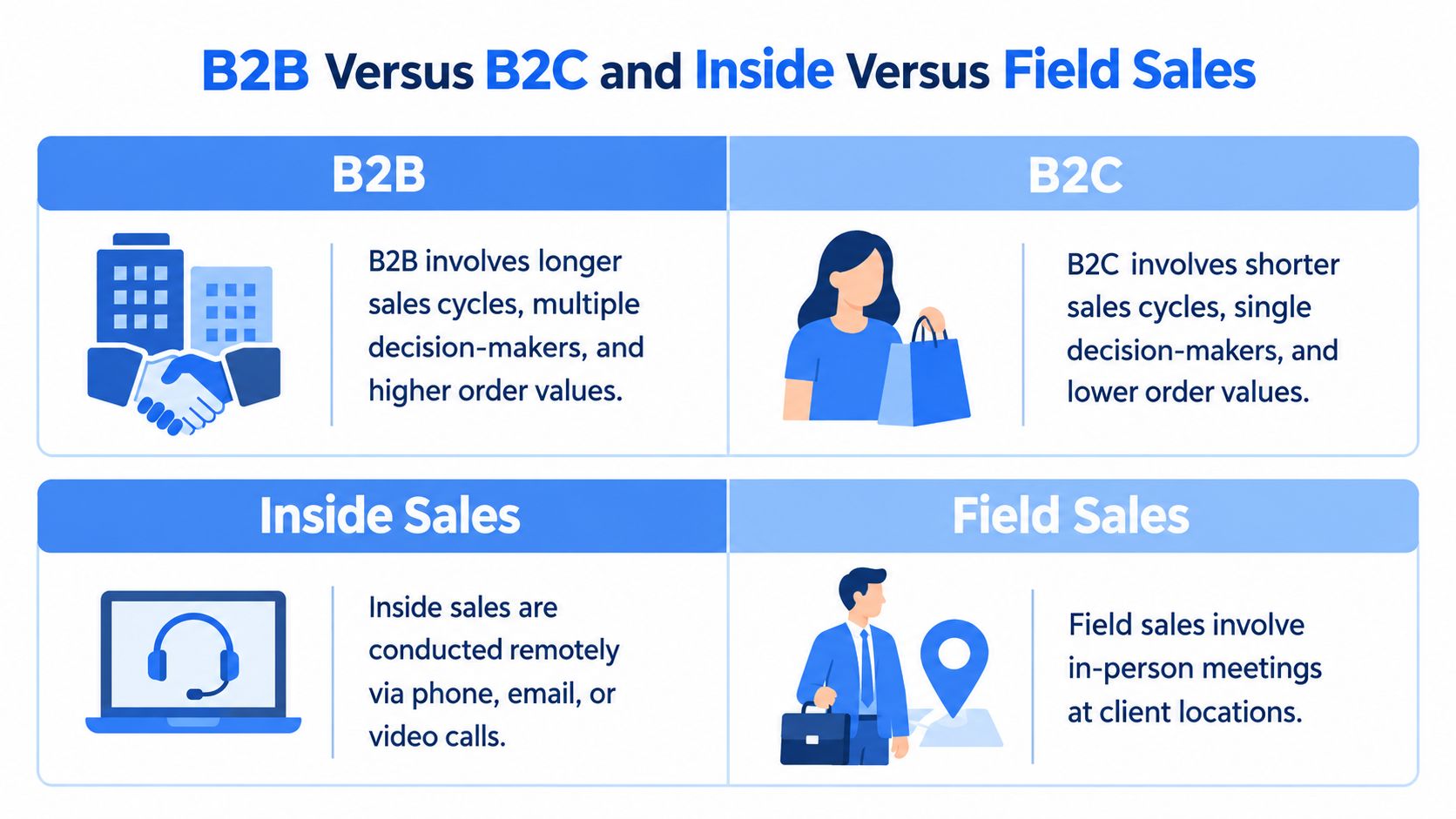
The visual below maps two of the most common comparisons founders encounter first.
Three Dimensions That Combine
- Buyer type: Business-to-business sales go to organizations, while business-to-consumer sales go to individuals buying for themselves. The buyer type influences approval, budget logic, and support expectations.
- Route to market: Direct selling means you sell through your own team, store, or website. Indirect selling uses distributors, retailers, marketplaces, agents, or other partners.
- Interaction mode: Buyers may meet in person, work with a rep remotely, or use digital self-service with no rep at all.
A software company can occupy several boxes at once. It might sell directly to businesses through its website, use inside reps for mid-size accounts, send field reps to enterprise customers, and list an integration on a marketplace. None of those choices cancels the others.
E-commerce history shows why overlap is normal, not messy. Online retail represented 0.6% of total U.S. retail sales in the fourth quarter of 1999, reached 16.1% in the second quarter of 2020, and accounted for 16.4% in the third quarter of 2025, with seasonally adjusted sales of approximately $310.3 billion, according to U.S. Census Bureau reporting on the growth of online retail share. Digital buying grew substantially, but it didn't replace physical retail outright.
The short video below is useful if you want another walkthrough of how these categories sit side by side in practice.
Practical rule: Describe your motion in a full sentence, not a single word. For example, direct, remote, B2B sales with self-serve renewal tells a hiring manager far more than B2B alone.
That sentence becomes your operating blueprint. It tells product what to build, marketing what to explain, and sales leadership what kind of rep to recruit. It also prevents a common confusion: treating channel, buyer, and interaction as if they're competing categories when they're separate choices.
B2B Versus B2C and Inside Versus Field Sales
B2B and B2C differ first in who bears the consequences of a bad purchase. A consumer who buys the wrong headphones returns them. A business that buys the wrong data platform may disrupt reporting, hiring, or customer outreach across several teams. That difference drives longer evaluation, more documentation, and more people in the room.
The comparison below also previews two other pairs that shape how a motion feels day to day.
In enterprise B2B, the buying group is the deal. Gartner reports an average of five to 11 stakeholders spanning about five business functions, while Demandbase reports that 72% of B2B purchases involve complex multi-stakeholder buying groups, as summarized in Gartner research on B2B buying groups and digital tools. A single enthusiastic champion can't carry legal, finance, security, and operations across the line alone.
That's why B2B selling rewards mapping each person's success criterion. Engineering cares about reliability, finance cares about predictable cost, and end users care about whether the tool saves time. If you want a fuller grounding in the buyer side, start with an explanation of how B2B purchasing works before you design territories or quotas.
Inside Sales Versus Field Sales
Inside sales happen remotely by phone, email, and video. This model suits repeatable deals, wider territories, and products a buyer can evaluate through a demo, trial, or documentation. Reps can handle more accounts, and managers can coach from call recordings and activity data.
Field sales happen in person at the customer's location. The extra cost makes sense when presence changes the outcome: a plant walkthrough, a multi-department workshop, or an executive session where trust and local context matter. Field reps usually carry fewer accounts because travel and preparation consume the week.
Many teams now blend the two. Inside reps qualify, run discovery, and keep momentum between meetings. Field reps join for high-value moments that justify travel. Leaders planning that blend can use a roadmap for AI in sales teams to decide which research, routing, and follow-up tasks software should handle so human time goes to conversations buyers value.
Your decision test is simple. If a video call can surface the same information as a visit, stay inside. If being on site reveals workflow, politics, or constraints you can't see remotely, send someone. Don't pay field costs out of habit, and don't force complex consensus building into a short remote call.
Inbound Versus Outbound and High-Ticket Versus Transactional
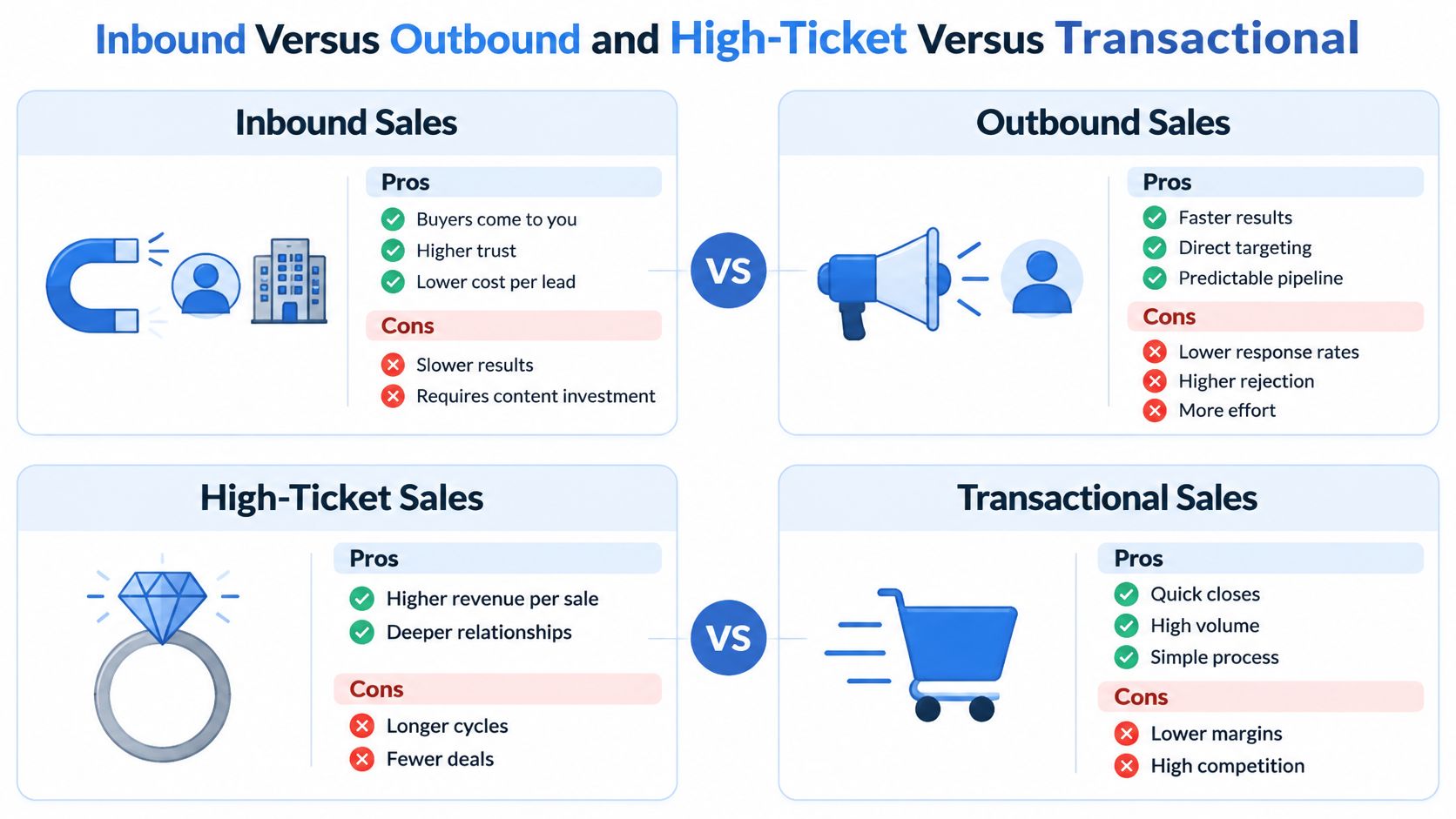
Inbound sales start when a buyer comes to you through search, content, referrals, a trial, or a marketplace listing. The buyer has already named a problem, so your job is to respond quickly and help them confirm fit. The weakness is control. You can't choose exactly who arrives or when.
Outbound sales start when your team selects accounts and initiates contact. You gain targeting control, which matters when your best customers share clear firmographic traits. You also carry the burden of relevance. A generic message to the wrong role wastes budget and damages trust.
The diagram below places these choices beside direct, channel, and hybrid routes so you can see they're separate levers, not substitutes.
If you're weighing where to invest first, a B2B lead generation strategy comparison can help you compare the cost, timing, and content demands of pull versus push motions before you commit headcount.
Transactional Versus High-Ticket
Transactional and consultative, or high-ticket, sales differ in cycle, stakeholders, and value. Transactional sales typically run 1 to 14 days with one decision-maker and average contract value of approximately €500 to €5,000, while consultative sales generally run 30 to 90 days with 2 to 4 decision-makers and approximately €5,000 to €50,000 in value, according to Zeliq's comparison of transactional and consultative sales cycles.
- Transactional fit: The buyer knows the category, the offer is standardized, and price or speed decides the purchase.
- High-ticket fit: The buyer needs diagnosis, customization, or internal justification before committing budget.
Those mechanics should drive your process. A transactional buyer doesn't want a multi-week discovery sequence. A high-ticket buyer won't trust a checkout page to answer implementation risk. Teams building the higher-value motion can study how to structure a high-ticket sales approach to align discovery, proof, and follow-up.
Don't confuse price with complexity. A moderately priced product can still need consultative selling if it changes workflow, touches compliance, or requires several teams to adopt it.
Inbound and outbound describe how the conversation starts. Transactional and high-ticket describe how much help the decision needs. A company can generate inbound trials for small teams and run outbound, consultative pursuits for larger accounts at the same time. Problems start when leaders use one playbook, one quota model, and one follow-up cadence for both.
Channel Sales and Hybrid Models
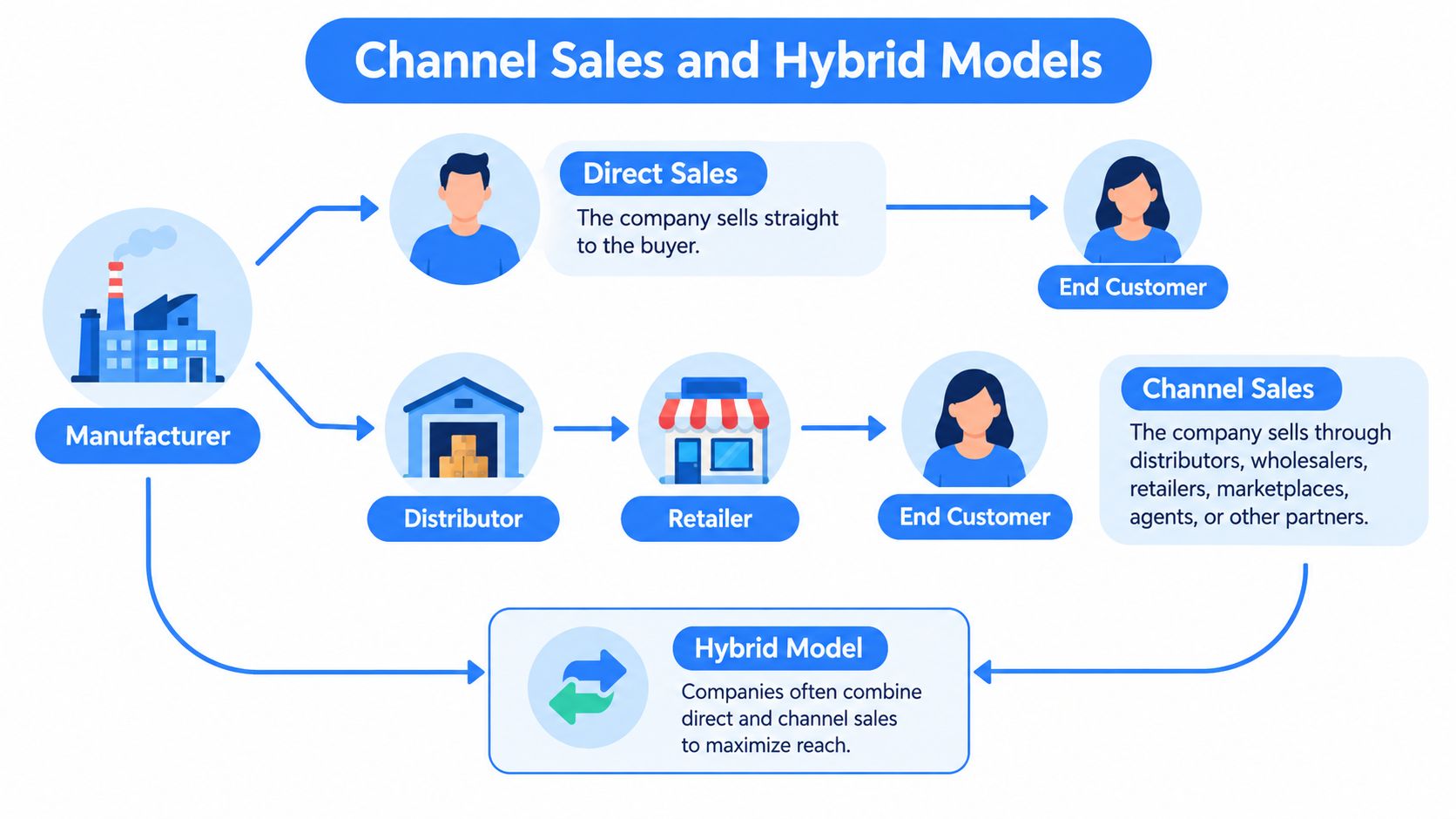
Channel sales use another organization to reach the customer. That partner might be a distributor, wholesaler, retailer, marketplace, agent, or implementation firm. You give up some margin and direct control. In return, you gain reach, local relationships, bundled offerings, or credibility you haven't built yet.
Direct sales keep the relationship and the data with you. Your team hears objections firsthand, controls pricing conversations, and learns why deals stall. The trade-off is cost. Every new region, segment, or vertical may require more reps, managers, and support coverage.
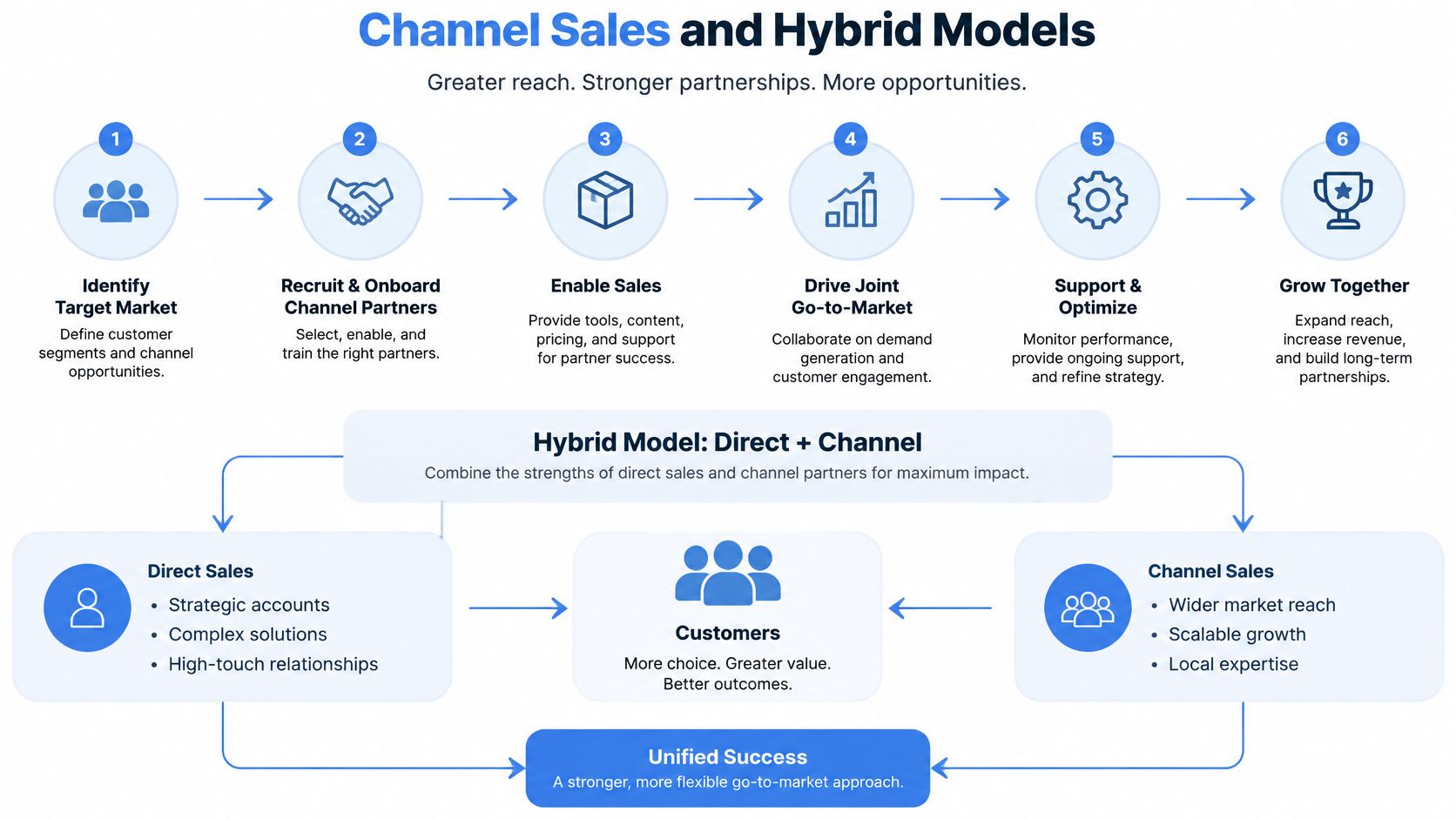
The process view below shows how a partner route adds steps between maker and buyer, and how a hybrid design keeps both paths available.
Retail measurement illustrates why these routes blur. The U.S. Census Bureau estimates retail e-commerce using the same sample as its Monthly Retail Trade Survey, measuring sales by retail businesses rather than treating online commerce as a separate sector, so a transaction can be digitally ordered but still belong to a retailer's broader multichannel operation, as explained in Census Bureau documentation on how retail e-commerce is measured. The order channel and the selling organization aren't the same thing.
When Hybrid Stops Being Optional
A hybrid model combines motions on purpose. Self-service handles discovery, trials, and repeat orders. Inside reps help buyers who stall. Field or specialist reps join when implementation, compliance, or organizational change raises the stakes. Partners cover segments where they already own trust.
Hybrid works when you define the handoffs. Decide which signals move an account from self-service to a rep, which deals partners can register, and how you'll prevent direct and channel teams from chasing the same buyer with different prices. Without those rules, hybrid becomes duplicated effort.
Choose channel when partners shorten your path to a market you can't serve economically alone. Choose direct when product learning, data quality, and customer control matter more than speed of coverage. Most growing companies end up with both, but the order matters. Prove the offer and the message directly first, then teach partners what already works.
What Each Sales Type Means for Your Tools and Data
Your sales model should dictate your stack, not the other way round. Teams often buy a complex CRM, then force a simple transactional motion through fields nobody needs. Or they run enterprise deals from spreadsheets and lose track of stakeholders. Start with the work, then buy the tool that removes friction from that work.
Match Tools to the Motion
- Transactional sales: You need fast lead routing, templates, payment links, and lightweight automation. Speed matters more than deep account history.
- Consultative sales: You need shared notes, mutual plans, content tracking, and clear next steps across a longer cycle.
- Enterprise sales: You need stakeholder mapping, security documentation, approval tracking, and forecasting that reflects evidence, not optimism.
Qualification discipline becomes a tooling requirement at the complex end. MEDDIC structures that evidence around Metrics, Economic Buyer, Decision Criteria, Decision Process, Identify Pain, and Champion, as detailed in Avoma's guide to the MEDDIC qualification framework. If your CRM can't store those answers clearly, reps will keep them in private notes and managers will forecast from memory.
For leaders redesigning the stack rather than adding another dashboard, Andy explains AI CRM for sales in terms of how automated capture and prioritization can reduce manual updating, which is often where adoption breaks down.
Match Data to the Buyer
B2C teams usually need behavioral and demographic signals: what someone viewed, abandoned, or bought before. B2B teams need firmographic and professional data: company size, industry, role, seniority, and whether the person still works there. Outbound motions are especially exposed to stale records because the first touch depends entirely on targeting accuracy.
That's where a B2B data API or professional data API fits. Instead of relying on a static list, your product or CRM can fetch current public professional data from a professional profile URL or company URL, then use that structured output for enrichment, matching, and routing. The data extraction happens at the moment of need, so a rep isn't working from a record captured months earlier.
If you're auditing vendors, compare them against current B2B sales intelligence tools and their data coverage, then test freshness on accounts you know well. Ask three questions. Is the record current? Can you identify the right stakeholder role? Does the system flag change, such as a new job or a funding event, soon enough to act? A tool that can't answer those questions adds activity without adding judgment.
How to Choose the Right Sales Model for Your Business
Start with the purchase, not your org chart. Interview recent buyers and lost prospects. Ask who else was involved, what almost stopped the deal, what proof they needed, and where they wanted a person instead of a page. Their answers will classify your sale more accurately than internal preference will.
Then pressure test four variables: decision risk, number of stakeholders, implementation effort, and contract value. Low risk with one buyer points toward self-service or inside transactional sales. High risk with several functions points toward consultative or enterprise selling with specialist support.
Scale changes the staffing math quickly. Enterprise deals typically last 6 to 18 months, involve approximately 6 to 15 decision-makers, and range from €100,000 to several million euros, while B2B buying groups can include 5 to 16 people across as many as four organizational functions, according to a published comparison of enterprise buying committees. You can't run that motion with a rep who also carries hundreds of small accounts.
Sales Model Decision Matrix
| Sales Type | Cycle Length | Decision-Makers | Contract Value |
|---|---|---|---|
| Transactional | Short, days | One | Lower, standardized |
| Consultative | Weeks to months | Small group | Mid-range |
| Enterprise | Many months | Large, cross-functional group | Highest |
Use the matrix as a first filter, then check product reality. Does the buyer need a trial, a pilot, or a full implementation plan? Can pricing be published, or does scope change the number? Does legal or security review apply to every deal or only above a threshold? Each yes adds human involvement, documentation, and time.
Run a small test before reorganizing. Pick one segment, define the handoff from digital research to rep help, and measure cycle length, win rate, and cost to close against your current path. Keep the test narrow enough that you can attribute the result. If buyers move faster with earlier specialist help, expand that trigger. If they ignore rep outreach until after a trial, stop interrupting them and improve the trial instead.
Avoid copying a company at a different stage. A mature vendor can support field teams, partners, and self-service because it has brand demand and operational depth. An early team usually needs one primary motion, one supporting motion, and clear rules for exceptions. Simplicity now gives you cleaner data for the hybrid model you'll likely need later.
Bringing It All Together
The useful way to think about types of sales is as dimensions you combine, not boxes you must choose between. Buyer type tells you who decides. Route to market tells you who sells. Interaction mode tells you how the conversation happens. Cycle length and stakeholder count tell you how much coordination the purchase requires.
Put those answers together and your operating choices get easier. You'll know whether to invest in self-serve onboarding or account planning, whether partners expand your reach or dilute your learning, and whether your reps need volume automation or stakeholder mapping. You'll also know what data must stay current for targeting and follow-up to work.
Start with an audit this week.
- Name your current motions: Write each one as buyer type, route, and interaction mode.
- Find the friction: Mark where buyers stall, ask for help, or bring in new stakeholders.
- Fix one handoff: Improve the move from research to rep, trial to pilot, or direct to partner.
Final check: If your sales process asks every buyer for the same meetings, proof, and approvals, it is designed for your convenience, not their decision.
Revisit the audit as your product, price point, and customer mix change. A motion that fits your first segment may strain when larger accounts arrive or partners enter the picture. Treat the model as a hypothesis you keep testing against buyer behavior, and you'll make staffing and tooling decisions with evidence instead of labels.
If your chosen sales model depends on current account and stakeholder information, Fetchin provides a real-time B2B data API that fetches structured professional and company data on demand for enrichment, matching, and routing. That live data helps outbound, consultative, and hybrid teams act on current roles and company context instead of stale lists. Visit Fetchin to explore the API and test it against accounts your team already knows.