You've got a serious prospect, a product that can solve a costly problem, and a calendar full of calls that still don't turn into predictable revenue. The issue may not be your pitch. High-ticket sales stall when buyers can't verify the offer, the right stakeholders appear too late, and nobody owns the next step.
The fix is to treat sales as a system-design problem. Build a buyer-led evidence layer first, map a small, intentional buying group, then use live data and clear operating rules to make each opportunity measurable. That's how to start high ticket sales without turning every deal into an exhausting series of improvised calls.
Table of Contents
- What High Ticket Sales Means in B2B
- Defining Your ICP, Offer, and Value Proposition
- Building a Buyer-Led Evidence System
- The Seven-Stage High Ticket Sales Playbook
- Mapping the Hidden Buying Group Without Stalling the Deal
- Pricing, Negotiation, and the Role of Live Data APIs
- KPIs, Forecasting, and a 90-Day Launch Checklist
What High Ticket Sales Means in B2B
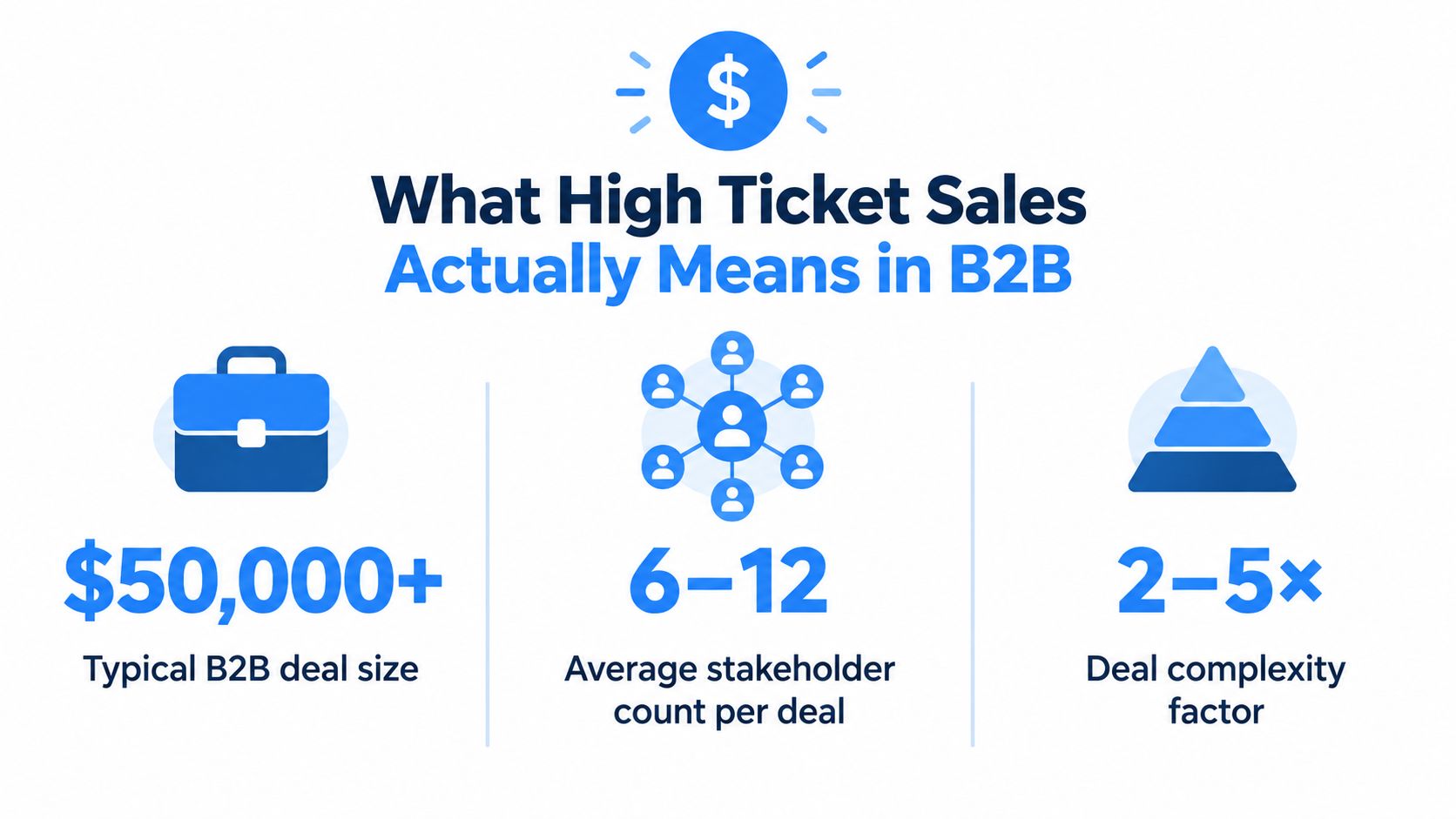
A $40,000 contract sits unsigned for six months. The product works, the champion is enthusiastic, and the deal still dies because legal never received the security documentation, the budget owner joined in month four, and nobody could verify the ROI claim. That is the reality of high-ticket B2B sales: a purchase that forces the buyer to justify real cost, evaluate risk, and coordinate people with competing priorities. A practical threshold is around $10,000 per deal, though some teams use $5,000 and enterprise contracts can begin at $50,000 (B2B high-ticket deal ranges). Complex deals may extend to $150,000 or more, with sales cycles often lasting 3–9 months (high-ticket B2B sales overview).
The operating conditions differ sharply from transactional selling. Industry syntheses put the touchpoint count for complex B2B purchases far above what sellers managed in earlier environments, and buying groups routinely span users, budget owners, executives, procurement, legal, and security reviewers. A seller who relies on one enthusiastic contact and a polished closing script is building on a fragile foundation.
The work breaks into seven interlocking pieces: a defined market, an outcome-based offer, buyer-facing evidence, qualification, discovery and validation, commercial approval, and onboarding. Each piece removes a different source of uncertainty. Together, they make the purchase easier to evaluate and the pipeline easier to forecast.
Design for the buying environment
Published benchmarks sort deals into tiers. Contracts between $10,000 and $50,000 typically involve three to five stakeholders and take about 75 days. Deals from $50,000 to $100,000 pull in five to eight stakeholders and stretch toward 120 days, and larger contracts demand more of both. Treat these figures as planning references. No benchmark predicts how a single deal will behave.
That complexity is why the motion has to be designed deliberately. Define who qualifies, what proof buyers need, how technical fit gets tested, and who moves the decision forward. Closing pressure does not fix a weak system. Your job is to reduce uncertainty at each step until the buyer can make a sound decision.
Defining Your ICP, Offer, and Value Proposition
Start with the buyer, not a broad list of companies that might conceivably need your product. A useful ideal customer profile (ICP) identifies a specific kind of organization, the costly problem it faces, and the conditions that make a purchase timely. For a B2B data API, that could mean SaaS teams struggling with stale external records, recruiting platforms scaling candidate enrichment, or sales-intelligence vendors trying to consolidate data integrations.
The best segmentation is narrow enough to guide action. A B2B market segmentation framework can help structure account criteria around company type, workflow, and problem severity. Add buying conditions that matter in practice: existing vendor or engineering costs, a deadline tied to a launch or migration, and access to someone who can sponsor evaluation.
Sell the result, not the feature list
A feature list says what a product does. A value proposition explains why the buyer should care. “Structured JSON and live retrieval” describes capabilities. “Reduce the engineering effort spent maintaining data workflows and deliver fresher records to your product” connects those capabilities to a business outcome.
Make the claim specific enough to test. During discovery, ask how the buyer handles data today, where records go stale, how much engineering work the workflow requires, and what failure or delay costs the team. Don't invent an ROI number for them. Use their actual volumes, costs, and operational assumptions to build the case.
Make the offer easy to understand
A high-ticket offer needs a clear scope, implementation path, commercial logic, and success criteria. State what the buyer receives, what the buyer must provide, how technical validation works, and what would justify expanding after a pilot. Pricing can be transparent without being one-size-fits-all: explain the variables that affect cost, such as request volume, rate limits, and service requirements.
Use this fill-in template: “We help [specific customer] solve [costly problem] by [approach], so they can achieve [measurable outcome]. The offer includes [scope], and we'll evaluate success using [agreed criteria].” If you can't complete it in plain language, the offer isn't ready for a complex purchase.
Building a Buyer-Led Evidence System
Don't make a first call carry the weight of your entire sales process. B2B buyers increasingly research and validate options independently. In a 2024 survey, 73% of respondents said they were willing to spend more than $50,000 per online order, up from 59% two years earlier (B2B online buying behavior report). That doesn't remove sales from the decision. It raises the bar for what a buyer should be able to verify before agreeing to talk.
Publish the evidence that helps a prospect judge fit without waiting for a representative. The essentials are an outcome-based offer, transparent commercial assumptions, security and compliance information, technical specifications, implementation timelines, and proof matched to the reader's role. A technical evaluator needs integration details. An executive needs a credible business case. Procurement needs clear scope and terms.
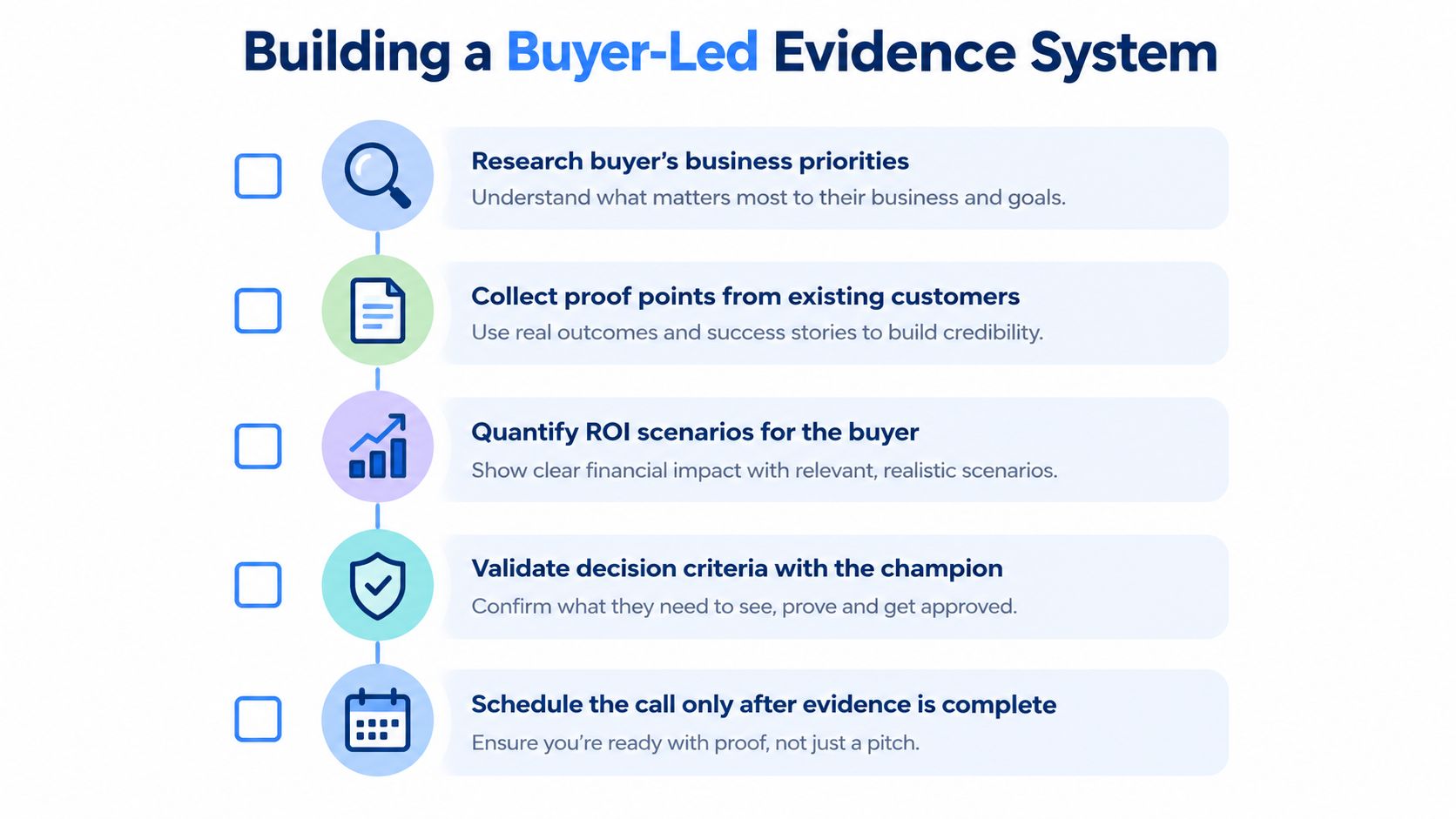
Audit the self-serve path
Walk through your website and documentation as if you've never heard of the product. Can a buyer understand the problem it solves, how implementation works, what information it uses, what a pilot involves, and how commercial assumptions are formed? If a prospect has to book a call to answer basic questions, your sales team is doing documentation's job.
For products that depend on timing or account context, make relevant buying signals easier to assess. A guide to using buying signals in account evaluation can help teams think about what information should inform qualification and what still requires a human conversation.
Practical rule: Book the call when you can diagnose the buyer's situation, not merely explain your product.
The call should add judgment: clarify priorities, surface tradeoffs, align stakeholders, or shape a business case. Keep routine education in pages, technical guides, and reusable proof. That gives buyers control over early research and lets sellers spend time where experience changes the decision.
The Seven-Stage High Ticket Sales Playbook
A high-ticket opportunity needs a documented sequence, clear exit criteria, and an owner for the next action. The stages below form the operating spine. Record the artifact each stage produces, the person responsible, and the specific action agreed with the buyer.
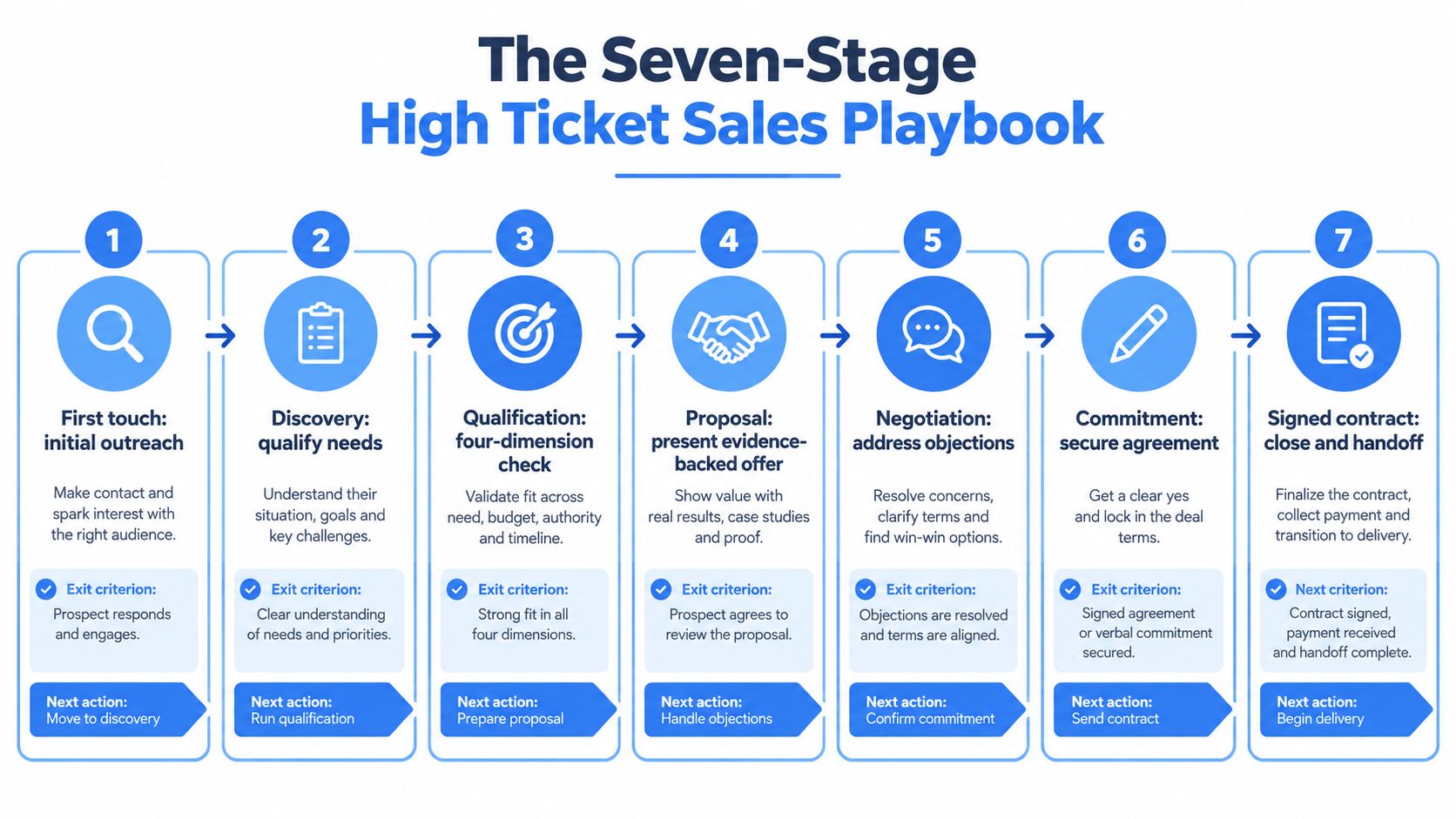
Run the stages with explicit exits
Qualification. Score the account on technical fit, economic fit, urgency, and buying authority. The artifact is a qualification record; the account owner moves it forward only when there's a credible problem and a route to a decision.
Discovery. Document the current workflow, request volume, acceptable latency, failure tolerance, required fields, and security requirements. The artifact is a discovery brief. The seller owns the next step: confirm the problem and its business cost with the buyer.
Technical validation. Run a constrained proof of concept using representative inputs and fixed acceptance criteria. For a data API, those might include response-time targets, schema completeness, and predictable credit consumption. The technical lead owns the test report and must agree with the buyer on what counts as a pass.
ROI justification. Compare current cost, pilot cost, and scaled cost using the buyer's assumptions. The artifact is a business case, owned jointly by the seller and champion. The next step is to validate the assumptions with the economic buyer.
Proposal. Specify architecture, scope, implementation milestones, commercial assumptions, acceptance tests, and an expansion trigger. Include a mutually agreed decision date. The account owner records the proposal and schedules the review rather than sending a document into a void.
Procurement and approval. Identify contract, security, privacy, and purchasing requirements before they become last-minute blockers. The buyer's procurement or legal contact owns internal review; your deal owner tracks open items and dates.
Onboarding handoff. Transfer goals, agreed scope, technical requirements, success criteria, and stakeholder responsibilities to delivery. The artifact is a handoff plan, owned by the account lead and implementation lead together.
Keep the playbook usable
A sales playbook overview is useful context for why teams document repeatable actions. Don't confuse a playbook with a script, though. The playbook should make sound judgment easier by showing what evidence to collect, what questions to resolve, and when an opportunity is ready to advance.
This sequence is the linear spine. The account owner should update the stage and next action after every meaningful interaction, even when a buyer pauses. That discipline prevents a technical trial from being mistaken for a buying decision.
Mapping the Hidden Buying Group Without Stalling the Deal
Single-threading is convenient until the only contact goes quiet or reveals that security, finance, or procurement has concerns nobody discussed. A champion matters, but a champion can't approve every risk alone. Gartner reports that 74% of B2B buying teams experience unhealthy conflict, while teams that reach consensus are 2.5 times more likely to report a high-quality deal (Gartner research on buying-team conflict).
Don't solve this by inviting every possible stakeholder to every meeting. Keep the active group focused, then equip your champion to circulate role-specific evidence. Separate research cited by MarketingProfs reports that hidden buyers have nearly equal influence to target buyers, at 49% versus 51%. It also reports that completion rates fall from 53% to 31% when decision teams exceed five members (hidden-buyer and decision-team findings). Treat those findings as a reason to map influence deliberately, not to enlarge meetings indiscriminately.
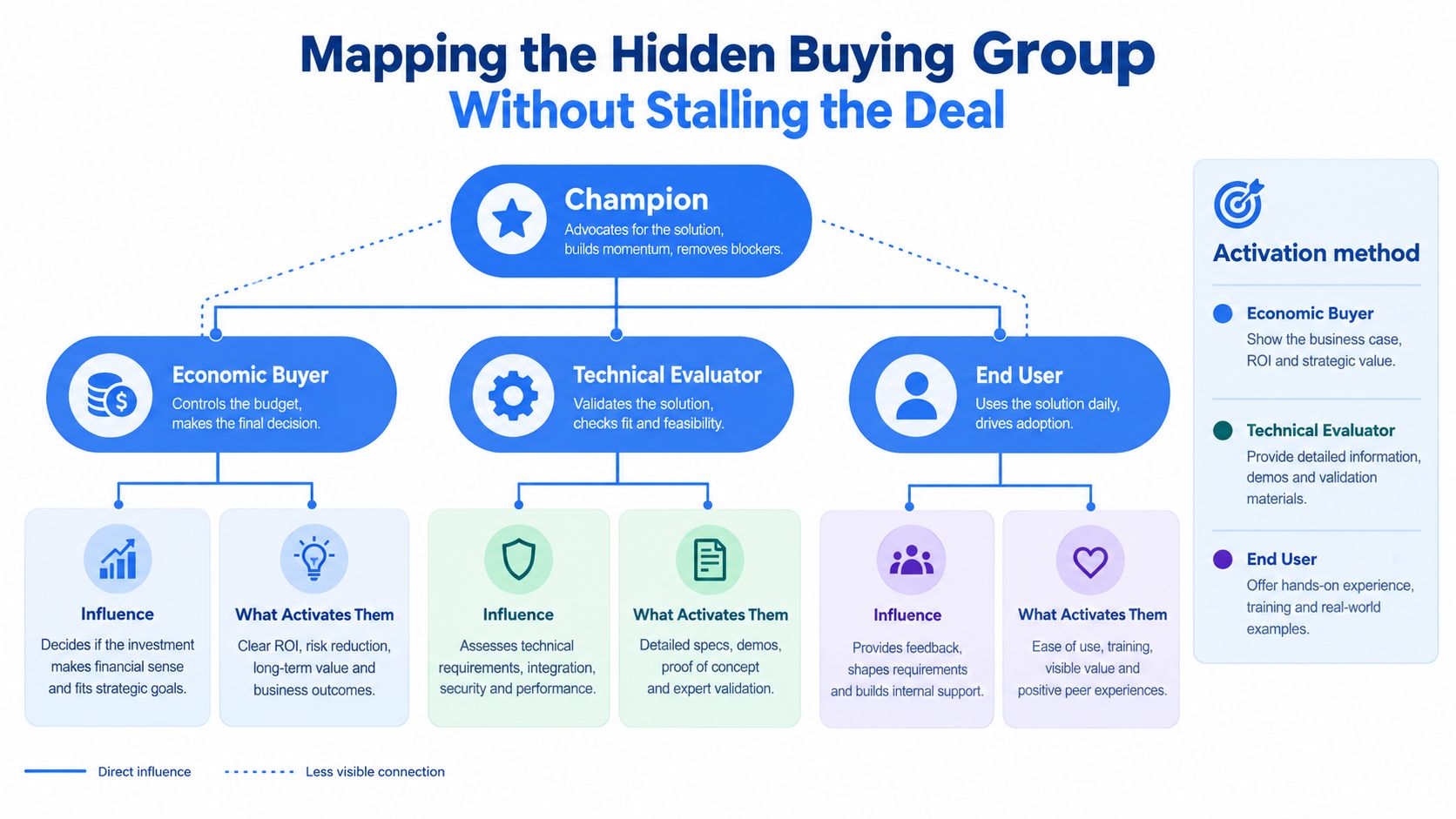
Match proof to the stakeholder
| Stakeholder | What they need to establish | When to involve them |
|---|---|---|
| Champion | The problem matters and the internal case is defensible | Early, to map priorities and decision process |
| Economic buyer | The investment and expected outcome make sense | When the business case has credible assumptions |
| Technical evaluator | The solution fits architecture and performance needs | Before or during technical validation |
| Security and legal reviewer | Data handling and contract terms meet requirements | Before proposal approval becomes imminent |
| End user | The workflow solves a practical operating need | During requirements and pilot design |
| Procurement contact | Scope, pricing, and purchasing steps are clear | Once the commercial path is taking shape |
| Likely blocker | Their specific risk or objection has an answer | When the concern becomes visible, not by default |
Ask the champion who can stop the purchase, what each person must believe, and how those questions are usually answered internally. Give the champion concise material to share asynchronously, then bring a stakeholder into a meeting when their judgment or approval is needed. If you need a repeatable way to organize prospect conversations before the formal evaluation, this guide to booking demos with useful context offers a related operational perspective.
Pricing, Negotiation, and the Role of Live Data APIs
Price pressure is usually a symptom of weak proof. Before you negotiate, show how the offer compares with the buyer's current workflow and what changes at pilot and production scale. Build three scenarios: current cost, pilot cost, and scaled cost. Ground them in the prospect's request volume, required rate limit, engineering effort, integration count, and acceptable latency. Skip any savings assumption you cannot defend.
| Deal Size | Stakeholders | Typical Cycle | Qualification Depth |
|---|---|---|---|
| $10,000–$50,000 | 3–5 | About 75 days | Confirm business problem, champion, and technical fit |
| $50,000–$100,000 | 5–8 | About 120 days | Validate economic case and map approval roles |
| $100,000–$250,000 | 8–10 | About 170 days | Document technical, commercial, and risk approval |
| Above $500,000 | 10–15 or more | About 270 days | Build a coordinated business case and procurement plan |
These deal and cycle figures come from the B2B sales benchmark compilation cited earlier. Use them to decide how much qualification a deal needs, not as a forecast for a specific buyer.
Connect technical performance to buyer economics
Treat API performance as a negotiation input, not a demo detail. Fetchin's B2B data API returns live professional and company records on demand, and the mechanics covered in this guide to live data APIs report median response times near one second and roughly 1.5-second P95, with failed requests not consuming credits. That matters when a prospect is weighing data freshness, maintenance effort, or unpredictable error costs, and it gives you a concrete alternative to periodic snapshots.
For low throughput, self-serve capacity may be appropriate. Sustained demand can justify dedicated capacity up to 100 requests per second, with provisioning planned 2–5 business days ahead. Put those requirements next to integration effort, sample output, rate-limit assumptions, and failure handling so the technical evaluator and the economic buyer are reading the same model. A buyer comparing research-related spend can also review pricing for account research as part of the cost assessment.
Negotiate from the model
Anchor on the agreed business case, not a discount. If procurement challenges price, revisit the scope, volume assumptions, service needs, or rollout plan. A lower price without a lower scope gives the buyer no reason to trust your original proposal.
Negotiation gets easier when the evidence layer did its job. If the champion has already defended the numbers internally, procurement is arguing about terms rather than existence. Before sending the final version, confirm who approves it, what remains unresolved, and the decision date.
One more discipline applies to the prospecting side of the motion. When you use public professional data, document the source and purpose, provide required privacy information, and honor objections and suppression requests. UK guidance holds that identifiable business contacts remain subject to data-protection rules and have an absolute right to stop their data being used for direct marketing, and EU direct-marketing email must comply with ePrivacy rules (European Commission guidance on business data and GDPR).
KPIs, Forecasting, and a 90-Day Launch Checklist
A pipeline review should tell you where the system is leaking, not merely how many calls the team held. Track pipeline coverage by stage, opportunity-to-close conversion, average sales cycle, multi-stakeholder coverage, proof-of-concept pass rate, and proposal outcomes. Review each metric with a clear owner and a next action. If opportunities keep stalling after technical validation, for example, inspect whether the business case and approval path are documented before changing the product demo.
Follow-up needs the same discipline. One sales benchmark summary says roughly 80% of sales require five or more follow-ups (proposal and follow-up benchmark summary). That's a reason to schedule useful touches, not to send repetitive nudges. A technical recap, a response to an implementation concern, and role-specific proof each give the buyer a new reason to continue.
Launch in focused blocks
- Week one: Define the ICP, the costly problem, the offer, and the qualification criteria. Make sure the team can explain what a qualified account looks like and what evidence it needs.
- Weeks two through four: Publish the evidence layer: commercial assumptions, technical specifications, security information, implementation steps, and role-relevant proof. Fix gaps that force buyers to book a call for basic facts.
- Weeks five through six: Document the sales stages, exit criteria, artifacts, ownership, and handoff. Make the next action visible in the pipeline for every active opportunity.
- Weeks seven through ten: Run the first three constrained proofs of concept with representative inputs and buyer-approved success criteria. Record what passed, what failed, and what blocked a commercial decision.
- Weeks eleven through thirteen: Establish a recurring pipeline review. Inspect stage conversion, time in stage, stakeholder coverage, and follow-up quality. Change one process bottleneck at a time so you can see whether the adjustment helped.
The numbers are useful only when they change behavior. If you can't point from a KPI to a specific decision, simplify the dashboard. If a deal has no buyer-owned next action, don't call it forecastable.
Fetchin provides a B2B data API that turns professional profile and company URLs into structured data for products and sales workflows. Visit Fetchin to evaluate whether live data retrieval fits the qualification and evidence system you're building.