Your forecast call starts soon, and you're still reconciling the CRM with a spreadsheet someone updated yesterday. A rep says a deal is committed, finance questions the close date, and your highest-activity seller doesn't have enough qualified pipeline. The problem isn't a shortage of dashboards. It's that nobody agrees on the evidence behind the numbers.
Table of Contents
- Why Software Sales Management Matters Now
- How Subscription Economics Reshaped Sales Management
- Quota Attainment and Compensation Benchmarks
- Building a Data-Driven Sales Operation
- Forecasting Accuracy Starts with Data Governance
- Managing Sales in the Age of AI Research
- Real-World Applications for SaaS Sales Teams
- Key Takeaways and Next Steps
Why Software Sales Management Matters Now
Software sales management is the operating system for turning selling capacity into dependable revenue. It connects territory design, hiring, coaching, compensation, pipeline decisions, and customer handoffs. The CRM records those decisions, but it can't make them coherent.
Consider a manager preparing for a revenue review. Marketing counts accepted leads, sales counts opportunities, and finance counts signed contracts. Each team can report accurately within its own definitions while disagreeing about whether the business is on track.
The manager's job is to resolve those differences before they become arguments about performance. That means defining what qualifies an opportunity, who owns the next action, and what evidence justifies moving a deal forward.
Manage the system before judging the seller
A missed target can reflect poor execution. It can also reflect an exhausted territory, an unrealistic ramp assumption, or leads assigned using outdated company information. Treating every miss as a motivation problem makes coaching less useful and capacity planning less credible.
Start by separating the questions managers need to answer:
- Capacity: Does the team have enough productive selling time and addressable demand?
- Execution: Are sellers qualifying, advancing, and closing the right opportunities?
- Evidence: Can leadership trace each forecast judgment back to current information?
- Buyer understanding: Does the team know what prospects believed before they contacted sales?
Practical rule: Don't ask a dashboard to settle a disagreement that your operating definitions haven't resolved.
For founders, this distinction matters when deciding whether to hire. For sales leaders, it shapes where coaching time goes. For revenue operations, it determines which workflows deserve automation.
A workable management system doesn't eliminate judgment. It makes judgment explicit, testable, and easier to improve without rebuilding the entire sales process whenever the team misses a target.
How Subscription Economics Reshaped Sales Management
A license sale gives a manager a relatively clear transaction to inspect. Subscription selling requires a broader commercial view: what the customer bought, whether they can adopt it, and whether the relationship can support renewal and expansion.
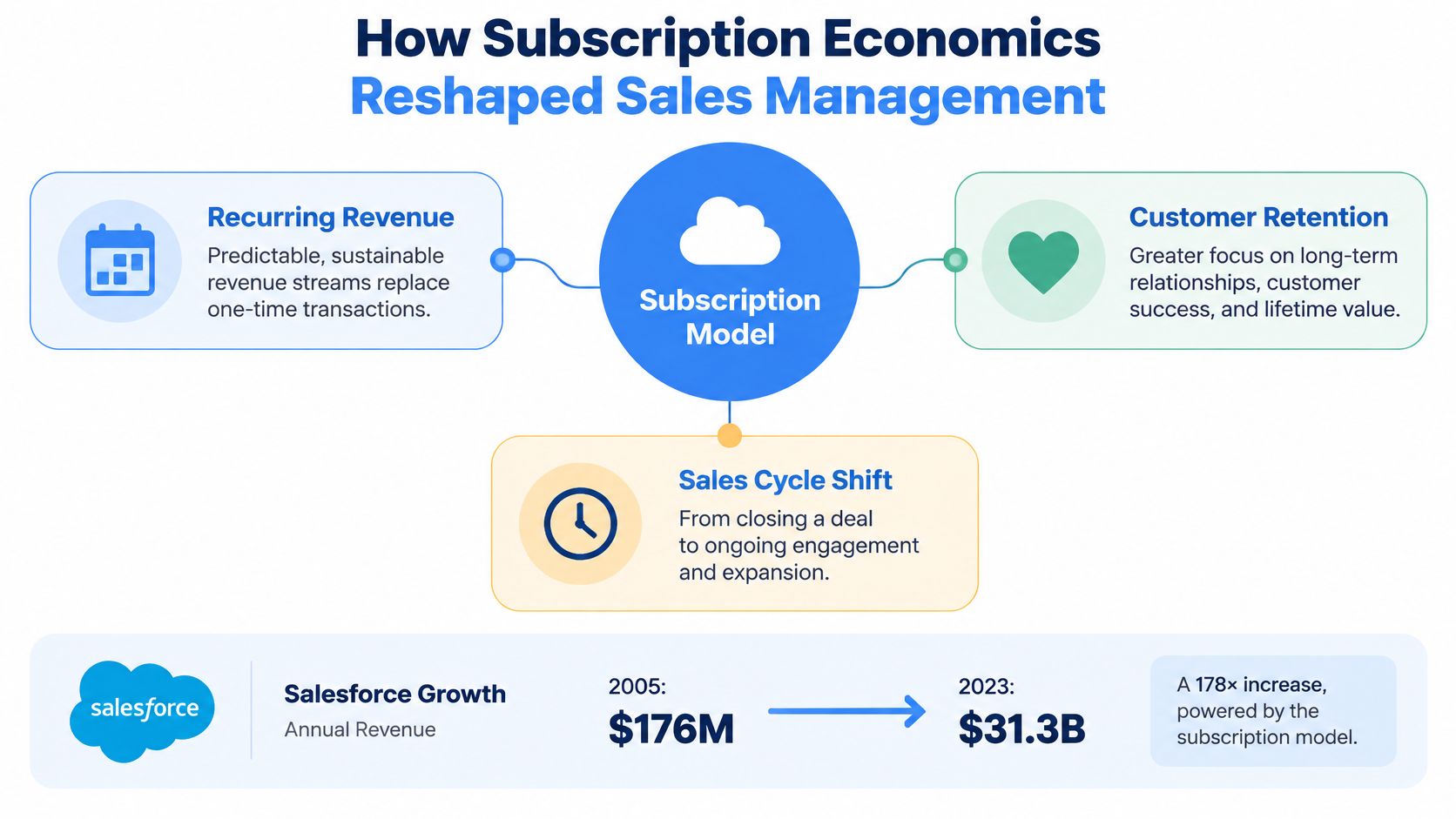
Salesforce illustrates the shift at scale. Its revenue increased from approximately $176 million in 2005 to $31.3 billion in 2023, a compound annual growth rate of about 29.7%; in 2023, subscription and support contributed roughly $29 billion, or 93%, while professional services contributed approximately $2.3 billion, according to this Salesforce revenue breakdown.
The management implication isn't that every SaaS company should copy Salesforce. It's that a signed contract is the beginning of a continuing commercial obligation, not proof that the full customer opportunity has been realized.
The relationship between those responsibilities is easier to see as a connected model.
Design ownership beyond the initial signature
A practical operating model distinguishes new annual contract value, renewal performance, expansion revenue, and customer lifetime value. Combining them into a single bookings total can hide important differences in the health of the business.
A seller might close an attractive contract by promising an implementation the delivery team can't support. The booking looks good, but the manager has accepted a commercial risk that won't be visible in the seller's activity report.
Use explicit handoff requirements instead:
- Customer outcomes: Record the problem the buyer expects the product to solve and how they'll recognize success.
- Delivery commitments: Document scope, dependencies, and promises made during negotiation.
- Commercial ownership: Assign responsibility for renewal conversations, expansion qualification, and account changes.
Territory design needs the same discipline. A territory with substantial expansion potential isn't equivalent to one that requires acquiring unfamiliar customers, even if both contain similar-looking account lists.
Compensation should reflect these responsibilities without creating competing claims over the same customer. Define whether an account executive retains expansion ownership, transfers it, or shares credit under documented conditions.
The trade-off is specialization versus continuity. Specialized teams can focus on distinct work, but every transfer creates a handoff to manage. Keeping ownership with the original seller preserves context, but it can also distract that seller from acquisition. Choose deliberately rather than letting account ownership emerge through negotiation between employees.
Quota Attainment and Compensation Benchmarks
Quota calibration should begin with what a territory and an experienced seller can reasonably produce, not with the company target divided by headcount. Otherwise, leadership mistakes an allocation exercise for a capacity model.
A historical warning is useful: a 2013 SaaS benchmark found that 79% of quota-carrying reps missed quota, average attainment was 58%, and 14% failed to reach even 10%, according to Xactly's SaaS quota analysis. Those findings aren't a current market baseline, but they show why attainment deserves more scrutiny than a team average.
SaaS Sales Compensation Benchmarks
| Metric | Benchmark Value |
|---|---|
| Quota relative to on-target earnings and team attainment | Approximately 4 to 6 times OTE for mid-market account executives, 5 to 8 times for enterprise roles, with roughly 60% to 70% team attainment as a planning target, per Glacier Lake Partners' compensation guidance. |
| Annual quota and earnings reference | Median annual contract-value quota of $740,000 and median OTE of $167,000, comprising $90,000 base salary and $77,000 commission opportunity, with approximately 66% attaining quota, in Jiminny's SaaS benchmark summary. |
| Pay mix, commissions, and accelerators | A commonly cited 60% base and 40% variable mix, new-customer commissions around 8% to 12% of annual contract value, expansion commissions around 10% to 12%, and example accelerators adding 2% to 4% after exceeding quota by 20% or more, in Everstage's compensation guidance. |
These are calibration references, not interchangeable prescriptions. Different samples, selling motions, and definitions can produce different compensation structures. Don't combine every attractive benchmark into a plan and assume the economics will work.
Test the plan against actual selling capacity
Build the quota model around territory potential, average contract value, sales-cycle length, ramp time, and pipeline availability. Separate experienced sellers from ramping hires before interpreting attainment.
Then stress-test the compensation mechanics. Specify how discounts, multi-year agreements, cancellations, and shared deals affect credit. Model accelerator expense against margin before launch, not after an exceptional quarter creates an unexpected payout.
A compensation plan should make the desired behavior easier to understand, not require a manager to explain exceptions after every deal.
For the broader goal-setting discussion, LiveDocument's take on sales goals is a useful companion resource to a quota-planning workshop. Keep the workshop grounded in your own evidence: if the target requires more qualified opportunities than the territory can support, changing the commission rate won't solve the underlying capacity gap.
Building a Data-Driven Sales Operation
A useful analytics system changes what sellers do next. A reporting system that merely describes last month's results may help leadership explain performance, but it doesn't necessarily help a rep choose an account or prepare for a meeting.
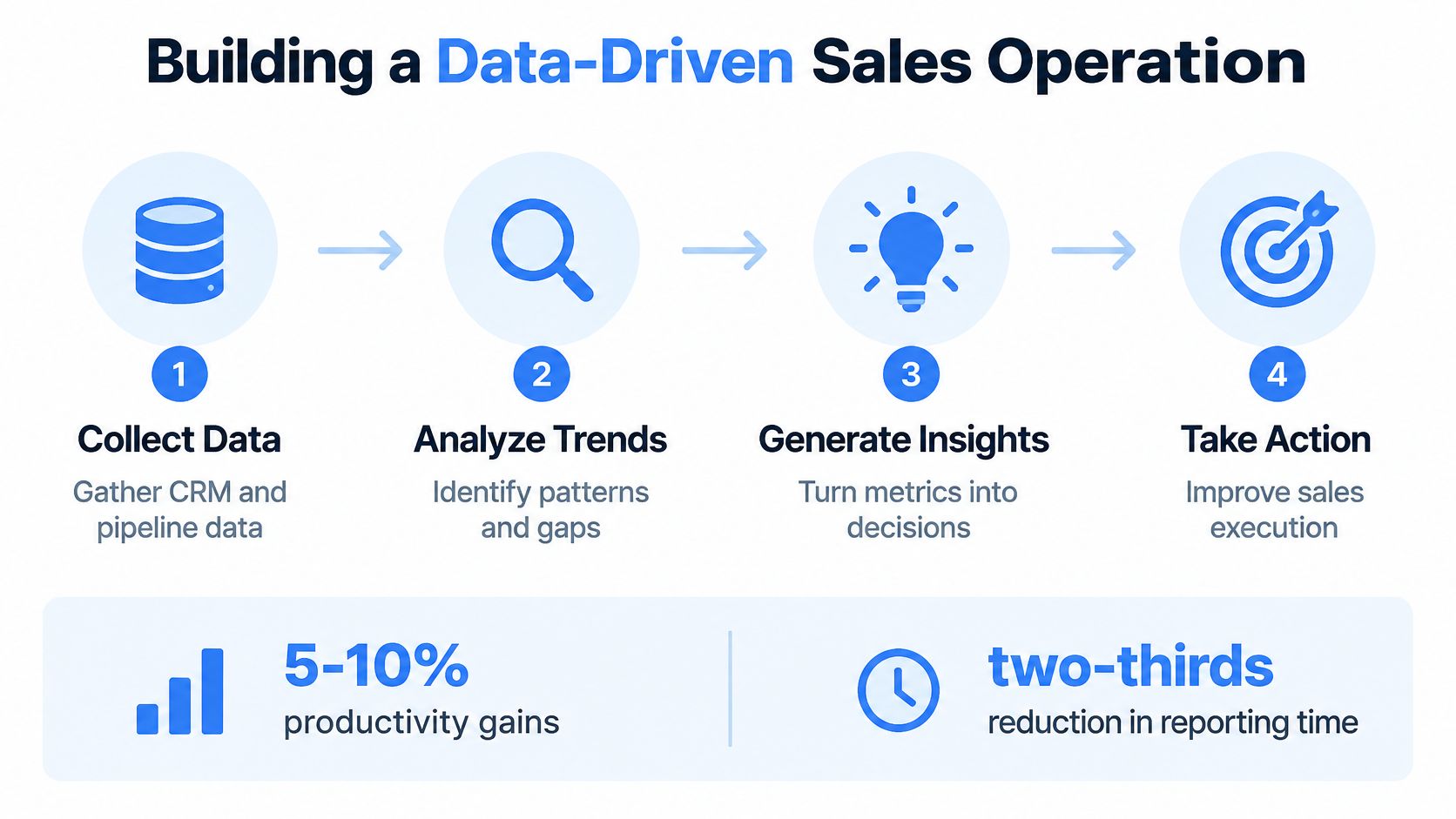
McKinsey reports 5% to 10% higher sales productivity and approximately two-thirds less sales-planning time among organizations applying advanced sales analytics; a separate pipeline-management example combined a 6% reduction in cost of sales with a 2% revenue increase, as described in its analysis of data-driven sales. Those are reported examples, not promised results for an enrichment implementation.
The operating sequence is straightforward, but each transition needs an owner.
Connect attributes to decisions
Start with the decision you want to improve. If inbound routing depends on industry and company size, fetching unrelated profile fields creates maintenance work without improving that decision.
A practical architecture accepts a professional profile URL or company URL, resolves the relevant entity, retrieves structured attributes, and passes validated values into a rules engine. Fetchin is a B2B data API option that turns those URLs into structured JSON using live public professional data; teams can also use CRM-native enrichment or maintain selected fields manually.
Keep retrieval separate from business logic:
- Identity resolution: Confirm that the person and company match the intended CRM records before updating them.
- Decision rules: Map industry, headcount, role seniority, or relevant engagement to a documented action.
- Workflow execution: Assign ownership, create a review task, or prioritize an account only after validation.
That separation lets operations change territory rules without rewriting the data integration. It also lets engineers replace a provider without rebuilding the sales policy.
Measure decisions rather than populated fields
Track lead-to-opportunity conversion, opportunity aging, seller hours saved, and cost per qualified meeting. Compare assisted and unassisted cohorts within comparable segments so a change in account mix doesn't masquerade as an improvement.
The practical use of analytics in sales starts with this connection between information and action. Field completion is an implementation metric; better prioritization is the operational objective.
There's a real trade-off between speed and completeness. A live routing workflow may need only enough verified information to choose an owner, while a bulk account review can wait for richer asynchronous processing. Don't make a seller wait for information that won't change the next action.
Forecasting Accuracy Starts with Data Governance
A forecasting model can't reliably compensate for opportunities whose amounts, dates, and buying evidence haven't been maintained. Salesforce's reported research found that 39% of reps said poor data quality hindered forecast accuracy, while the global survey reported 49% overall forecast accuracy, as summarized on its sales forecasting software page.
Treat the forecast as a controlled operational process, not a collection of optimistic seller notes. Every meaningful change should have a reason, a timestamp, and an accountable owner.
Require evidence at stage transitions
Stage entry rules should describe observable buyer progress. A completed demo isn't equivalent to a confirmed buying process, and a proposal sent isn't evidence that a buyer has approved funding.
- Validate transitions: Require the fields and buyer evidence relevant to the next stage, rather than making every field mandatory from creation.
- Preserve changes: Record movements in close date, amount, ownership, and forecast category.
- Separate judgments: Distinguish committed pipeline from best-case opportunities and retain the reason for each classification.
Use historical outcomes to estimate probability, segmented where the data supports it. A static stage label is an administrative category, not a substitute for observed conversion behavior.
Inspect calibration and overrides
For each probability band, compare predicted outcomes with realized wins. Also inspect systematic overstatement or understatement, stage-conversion variance, coverage, and the age of the inputs.
CRM data enrichment can support checks on company identity, firmographics, and professional roles before scoring. It can't establish that a budget is approved or a buying committee agrees, so preserve the distinction between externally verified attributes and seller-validated commercial evidence.
Forecast discipline: Allow managerial overrides, but retain the original estimate and require a reason. Otherwise, you can't learn whether judgment improved the forecast.
When reviewing vendors or implementation examples, use verified case studies for operations leaders from Applied as material for due diligence, not as a forecast of your own results. Ask what changed in the underlying workflow and whether the same inputs exist in your organization.
The objective isn't eliminating discussion from forecast calls. It's spending that discussion on genuine uncertainty instead of reconstructing missing information.
Managing Sales in the Age of AI Research
Increasing SDR activity won't fix a vendor-discovery problem. If prospects arrive with a shortlist already formed, managers need to understand how that shortlist was created before prescribing more outbound effort.
The buyer may be doing substantial evaluation before the sales team sees an opportunity.

G2's 2025 buyer research found that 79% of software buyers said AI search changed how they research vendors; approximately 30% said they begin research with AI search more often than Google, and generative-AI chatbots were the leading source influencing vendor shortlists at 17.1%, according to the G2 buyer behavior report.
Measure influence before the form fill
A prospect may encounter an AI-generated comparison and later visit through branded search or a direct session. Conventional attribution can record that later visit without capturing the earlier influence.
Don't solve this by assigning every unexplained visit to AI. Add a discovery question about where the buyer first compared vendors, and preserve their answer separately from tracked acquisition data.
Sales and marketing can then review:
- Discoverability: Whether relevant research questions surface the product at all.
- Citation accuracy: Whether referenced product facts match current documentation.
- Shortlist inclusion: Whether the product appears for the buyer problems it serves.
- Positioning gaps: Whether generated descriptions misstate capabilities, limitations, or intended customers.
Keep the queries and review method consistent enough to compare observations over time. Treat these checks as directional evidence, not a complete attribution system.
The following video provides an additional viewing resource alongside those checks.
Correct claims without inflating them
Maintain source-linked product facts, clear limitations, and approved comparisons. When a buyer repeats an inaccurate AI-generated claim, the seller should correct it with evidence rather than improvise a more flattering version.
This changes sales coaching too. Ask what the prospect already believes, which alternatives they've considered, and what remains uncertain. The seller can then address an actual decision instead of repeating introductory material the buyer has already encountered.
Real-World Applications for SaaS Sales Teams
The following scenarios are implementation patterns, not customer results. Each shows where a manager needs to make a decision that software alone shouldn't make.
An inbound lead with incomplete company information
A SaaS team receives a demo request containing a professional profile URL, but the company field is ambiguous. The enrichment workflow retrieves a current employer and firmographics, then checks the match against existing accounts.
If identity is sufficiently clear, the routing engine can apply the team's documented ownership rules. If the retrieved company conflicts with the submitted information, the workflow should preserve both values and create a review task rather than replacing the buyer's answer without disclosure.
A missing headcount field shouldn't automatically make the lead a poor fit. Unknown is a data state, not a qualification verdict. Keep fit scoring separate from confidence so sellers can distinguish an unattractive account from an incompletely evaluated one.
For a concrete workflow starting point, use the lead-scoring and routing application to frame the inputs and actions your own rules require.
A manager deciding where to coach
Salesforce's quota-progress interface displays 0% in grey, 1% through 33% in red, 34% through 66% in orange, and 67% or higher in green, according to its quota progress documentation.
Those bands can help prioritize inspection, but they're not diagnoses. A red indicator might prompt a territory review or pipeline-creation session; an orange indicator might warrant deal inspection. Green doesn't establish that the remaining target is secure.
The manager should compare progress with elapsed selling time, rep tenure, and the evidence behind expected closes. Coaching should address the constraint, not the dashboard color.
A refresh workflow with uncertain records
An account review is a useful point to revalidate data that will affect ownership or prioritization. Define acceptable freshness by decision risk instead of applying a universal refresh schedule.
- Failed retrievals: Preserve the previous value, mark the failed attempt, and retry or escalate according to policy.
- Conflicting sources: Retain provenance and route material disagreements to an accountable reviewer.
- Missing fields: Avoid converting an absent value into a negative assertion.
- Automation costs: Track misrouted leads, irrelevant personalization, correction work, and seller time spent recovering from errors.
Decide which source wins for each field and which records automation may overwrite. Public availability doesn't remove the need for access controls, retention decisions, or a review of permitted use.
A safe workflow can pause. The expensive alternative is an apparently successful update that nobody discovers was wrong until a seller acts on it.
Key Takeaways and Next Steps
Effective software sales management depends on the quality of the decisions managers repeat. More dashboards, richer records, and more automated actions are useful only when leaders can explain what those additions change.
Start with a bounded operating review
Choose a troublesome workflow rather than attempting a complete revenue-system redesign. An inbound assignment process, a forecast category, or a compensation crediting rule is narrow enough to inspect and consequential enough to improve.
- Check capacity assumptions: Reconcile quotas with territory opportunity, ramp expectations, and available pipeline.
- Assign data ownership: Identify who maintains critical fields and who resolves exceptions.
- Connect analytics to action: Name the decision each score or report should support.
- Inspect buyer understanding: Capture how prospects researched alternatives and correct unsupported product claims.
- Set automation boundaries: Specify what the system may change, what requires review, and how errors are reversed.
As teams consider agentic workflows, preserve those controls rather than treating autonomy as permission to bypass them. An automated action still needs an owner, a defensible input, and a recoverable failure path.
The immediate next step is practical: take a recent missed forecast or misrouted lead, reconstruct the decisions behind it, and fix the earliest controllable failure.
Fetchin offers a real-time B2B data API that converts professional profile and company URLs into structured JSON for enrichment workflows. Visit Fetchin to evaluate how live data could support your sales-routing or account-review process, then test it against your existing workflow before expanding automation.