Reference-based pricing (RBP) is a healthcare payment method in which an insurer, employer, or public health plan sets a fixed maximum amount it will pay for a service, tied to an external benchmark such as Medicare, commonly between 100% and 150% of the Medicare rate. That single ceiling figure decides your final bill: pick a provider who accepts the benchmark and you'll typically owe nothing extra, or pick one charging more and you could face a bill for the gap.
You're probably facing that exact puzzle right now. Maybe your employer handed out a new benefits packet with no familiar preferred-provider directory, or you're scheduling an outpatient MRI and noticed two clinics five miles apart charging wildly different prices for the exact same scan. Under a traditional insurance card, you'd check whether a clinic is "in-network" and pay a flat copay. Under an RBP plan, the clinic's price tag relative to your plan's ceiling does the heavy lifting.
If you're trying to figure out what is reference based pricing and how it changes who pays when a hospital charges more than expected, working outward from that single payment ceiling clears up the confusion fast.
Table of Contents
- What Reference Based Pricing Means
- How the Reference Amount Is Calculated
- Reference Pricing Compared With Other Payment Models
- Why Prices Vary and Why Benchmarks Help
- Real Examples From Employer Plans and Drug Programs
- Limits, Misconceptions and What to Check First
- Decide Whether Reference Pricing Fits Your Plan
What Reference Based Pricing Means
In practice, reference-based pricing replaces a provider's negotiated rate with a preset payment cap anchored to an outside standard. According to the Tennessee Advisory Commission on Intergovernmental Relations report on reference-based pricing, a payer such as an employer, insurer, or public health plan establishes a maximum reimbursement amount linked to a benchmark like Medicare, a regional market price, or the cost of a lower-priced local provider. Instead of paying whatever each hospital negotiated behind closed doors, the plan draws one firm line.
That single line is the number that decides your share of the bill. The easiest way to picture it is a fixed shipping allowance for a return parcel. The store agrees to reimburse up to one set dollar amount no matter which courier you pick. Drop the box at a standard courier priced at or below that cap, and you pay zero out of pocket. Choose an overnight express carrier charging twice as much, and the store still pays only its fixed allowance while you cover the remainder. Reference pricing applies the exact same logic to a knee replacement or an outpatient scan.
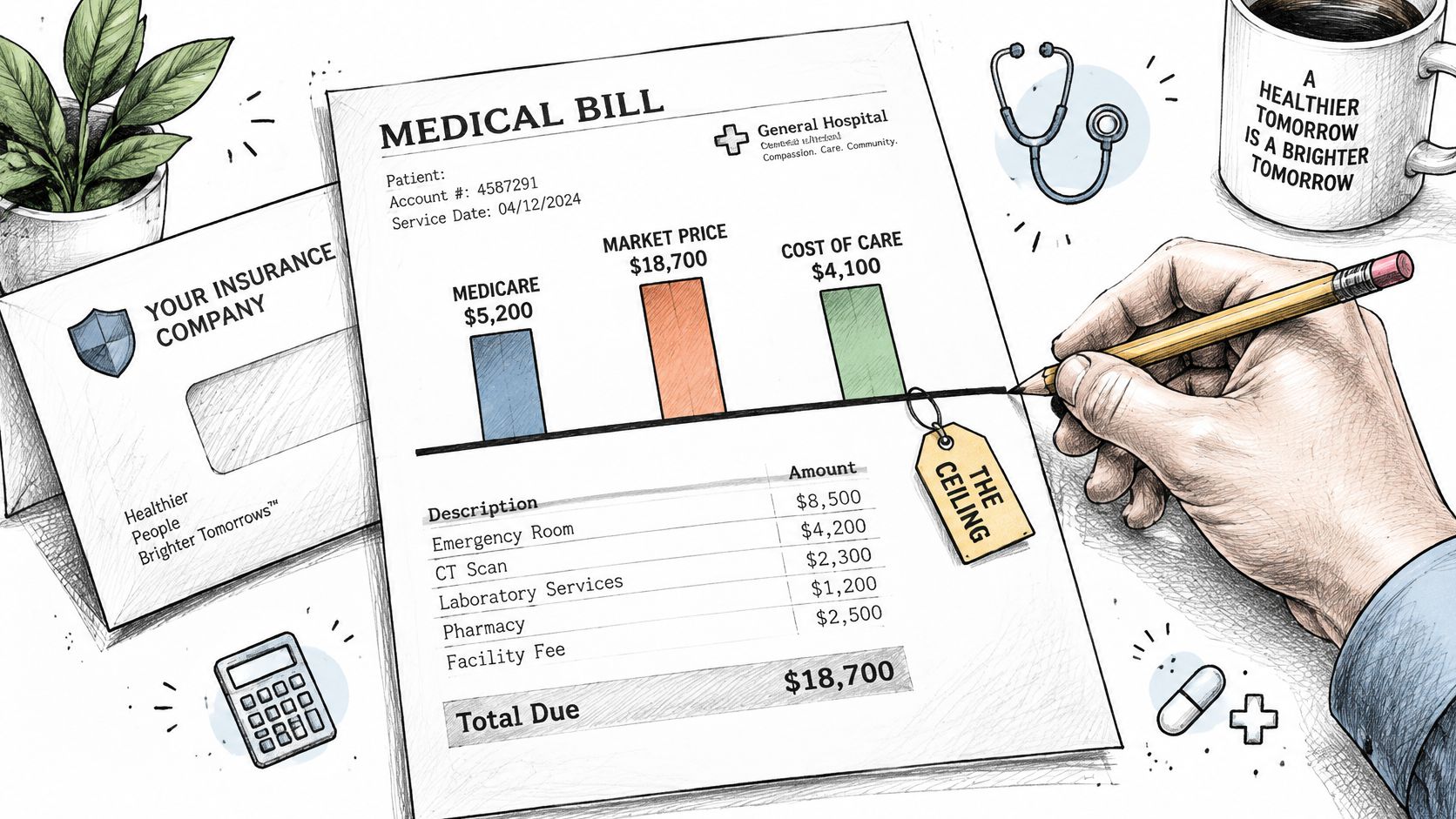
The visual below shows where that line falls on an actual medical bill when hospital charges sit above the plan's reimbursement cap.
From European Drug Caps to US Hospital Bills
The model didn't start in American hospitals. As the Tennessee commission report explains, European health systems pioneered the concept in pharmaceutical markets by grouping therapeutically similar drugs together and reimbursing up to a single reference amount. Drugmakers remained free to charge more, while patients who wanted a pricier brand typically paid the difference. That last detail matters, because it is the same tradeoff you face under a modern plan: the payer's ceiling stays fixed, and the provider you choose determines whether you owe anything beyond it.
American employers later borrowed that mechanic for shoppable medical care, expanding it into laboratory testing, diagnostic imaging, outpatient surgery, and joint replacements. Large public plans, including California's CalPERS program for state employees, applied the approach to targeted procedures to steer members toward lower-priced facilities.
Practical check: Open your summary plan description and look for two things: a named external benchmark (such as Medicare) and a stated maximum payment limit. If both appear in the reimbursement rules, your plan uses reference-based pricing.
This structure is what separates RBP from an ordinary copayment, and it is the point where readers most often get confused. A standard copayment depends only on the service category, such as a flat fee for any specialist visit no matter which one you see. Under reference pricing, your exposure shifts with the provider's price relative to the ceiling. Identical service, different facility, different outcome: $0 in extra charges at one, or a surprise balance bill at another. The plan's payment never changes. Only your choice of provider does, and that choice is what the benchmark puts a price on.
How the Reference Amount Is Calculated
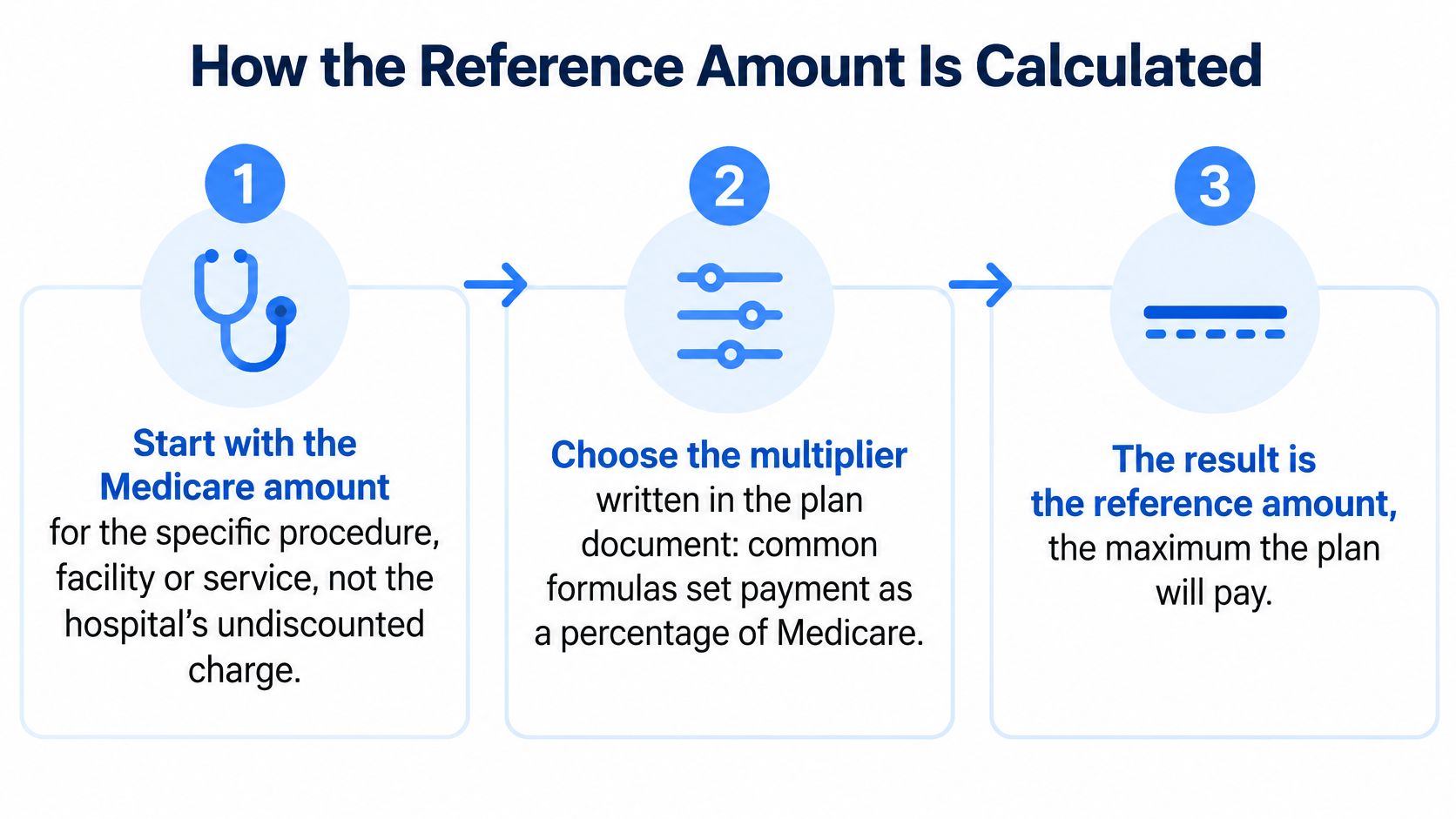
Knowing that a ceiling exists is only half the equation; you also need to see how plans turn a public fee schedule into an exact dollar limit. Plans don't start from a hospital's inflated sticker price, often called the chargemaster rate. Instead, they anchor the math to the applicable Medicare payment for that exact procedure, facility type, or service.
As outlined in the Allstate Benefits guide to reference-based pricing, a common formula reimburses between 100% and 150% of the Medicare rate for a covered service, while broader industry guidance describes typical levels spanning 120% to 300% of Medicare depending on local provider markets and clinical services.
This three-step breakdown illustrates how a plan moves from a base Medicare rate to a concrete payment cap.
Walking Through the Math on a Real Bill
Take a straightforward outpatient service with a $1,000 Medicare rate. If your employer's plan sets the multiplier at 150% of Medicare, you multiply $1,000 by 1.50 to reach a $1,500 reference ceiling. That same $1,500 limit can apply regardless of whether you visit a standalone clinic or a major hospital system.
Now look at how the patient's bill plays out in a hypothetical scenario. Say a hospital charges $1,800 for that procedure against your plan's $1,500 ceiling. The plan pays up to $1,500 (minus your normal deductible or coinsurance), leaving a $300 gap. Unless the hospital agrees to accept the benchmark, your plan's advocacy team negotiates the bill down, or applicable patient-protection rules prohibit balance billing, you may owe that $300 difference.
The table below shows how the same $1,000 Medicare base produces drastically different ceilings depending on the multiplier written into the plan document.
| Multiplier of Medicare | Ceiling for a $1,000 Medicare rate | Where it appears |
|---|---|---|
| 100% of Medicare | $1,000 | Lowest common ceiling, needs a wide network of accepting providers |
| 120% of Medicare | $1,200 | Low end of typical industry guidance |
| 150% of Medicare | $1,500 | Common formula in employer plans |
| 300% of Medicare | $3,000 | Upper end of guidance, used where local markets are costly |
Why One Percentage Never Tells the Whole Story
Hearing someone say their plan pays "150% of Medicare" can mislead you into thinking every medical claim follows a single flat formula. In practice, plan documents must spell out four separate details:
- The exact multiplier by category: A plan might reimburse physician visits at one percentage of Medicare and inpatient hospital stays at a higher multiple to reflect local market costs.
- Covered-service boundaries: Some employers apply reference ceilings only to selected shoppable procedures while leaving routine office visits under conventional rules.
- Built-in exceptions: Emergency care, rural sole-community hospitals, or specialized tertiary care often follow distinct payment rules so patients aren't penalized when they have no real choice.
- Advocacy and cost-sharing treatment: Plans must specify whether a balance-billing dispute triggers vendor negotiation support and whether any extra amount paid counts toward your annual out-of-pocket maximum.
For a quick visual walkthrough of how Medicare multipliers interact with provider billing and member support, watch the short overview below.
Before scheduling any non-emergency procedure, pull up your plan document, confirm the exact multiplier for that specific service category, and verify which exceptions or negotiation protections apply if a facility refuses the benchmark.
Reference Pricing Compared With Other Payment Models
Confusion usually peaks when people try to map reference-based pricing onto familiar insurance terms like preferred-provider networks or tiered copays. The dividing line is simple: most traditional plans hide the actual price inside private contracts between insurers and hospitals, while reference pricing puts an externally calculated payment ceiling in plain sight.
According to the NAIC working draft materials on reference-based pricing, the "reference" isn't just a passive comparison metric. It directly calculates the plan's payment obligation, which means an RBP design can operate without a conventional preferred-provider network at all. Rather than paying a negotiated percentage discount off a provider's billed charges, the payer sets a fixed dollar ceiling that applies across providers.
Similarly, the American Hospital Association fact sheet on reference-based pricing highlights how RBP differs from ordinary tiered network cost sharing. In a tiered plan, the insurer keeps a contracted network and nudges you toward preferred clinics by charging higher copays or coinsurance elsewhere, without capping the underlying payment at an external figure. In an RBP plan, the externally calculated ceiling is the central cost control, whether built from Medicare rates, regional commercial prices, hospital cost data, service setting, and clinical severity plus a margin factor.
| Payment model | How the payment is set | Who pays when the provider charges more | Typical example |
|---|---|---|---|
| Negotiated discount | Percentage off billed charges in a contract | In-network providers absorb amounts above the contracted rate | Hospital discount agreed with a network |
| Tiered network cost sharing | Fixed copay or coinsurance by provider tier | Patient pays a higher share at non-preferred providers | Preferred versus non-preferred specialist |
| Reference based pricing | Fixed ceiling tied to an external benchmark | Patient may owe the amount above the ceiling | Imaging paid up to 150% of Medicare |
| Capitation | Fixed payment per member to a provider group | Provider group absorbs the cost risk | Primary care group paid per enrolled member |
What Changes for the Patient Day to Day
Looking across those four rows reveals how sharply financial risk moves between parties. Under capitation, a clinic receives a set monthly fee per enrolled member regardless of how many visits occur, shifting cost risk onto the medical group. Under a negotiated discount, your insurer signs separate contracts with every hospital, so an MRI might cost wildly different amounts across town without you ever seeing the contract terms.
Running a plan without a traditional network shifts administrative responsibility onto transparency. Plans using RBP must give members clear disclosures of the benchmark, precise covered-service rules, accurate geographic and clinical risk adjustments, a pool of willing providers, and a formal appeals process for exceptional clinical cases or providers who reject the payment.
Ask one quick question when comparing health plans: does your out-of-pocket exposure follow a published external number you can check beforehand, or a private carrier contract you aren't allowed to see?
Why Prices Vary and Why Benchmarks Help
Employers don't adopt benchmark pricing just to experiment with benefit design. They turn to it because commercial hospital prices in the United States swing dramatically for identical medical care, even inside the same city.
Researchers at the RAND Corporation analyzed claims from self-insured employers, state all-payer claims databases, and participating health plans and found that private health plans paid hospitals an average of 247% of what Medicare would have paid in 2018 for the same procedures at the same facilities. Because that comparison holds both the procedure and the facility constant, it measures raw price markup rather than differences in health plan generosity.
Two Forces a Payment Ceiling Triggers
When commercial rates routinely sit more than double the Medicare baseline, switching from percentage-off-charges discounts to a defined Medicare multiple changes behavior on both sides of the exam table. RAND specifically pointed to percentage-of-Medicare contracting and reference-based pricing as potential alternatives to discounted-charge hospital agreements because they create two distinct pressures:
- Patients steer toward lower-priced facilities: Once members see that Facility A accepts the benchmark with no extra balance while Facility B charges hundreds more above the cap, people scheduling non-emergency scans or surgeries naturally move toward Facility A.
- Providers face pressure to trim markups: Hospitals and imaging centers priced far above the ceiling risk losing steady patient volume. To keep referrals flowing, higher-priced facilities gain a direct financial reason to lower their rates toward the reference line.
Where the Economics Break Down
Wide average markups don't guarantee automatic savings in every zip code. Both mechanisms depend on real local alternatives, willing providers, and genuine competition.
In a rural county served by one regional hospital system, patients can't easily drive across town to a lower-priced competitor. If the sole local hospital refuses the benchmark and holds enough market power to ignore volume threats, a rigid ceiling won't pull prices down. It'll only create billing friction for employees. Where price variation is narrow or alternative facilities barely exist, a reference benchmark has very little influence.
Real Examples From Employer Plans and Drug Programs
Theory sounds tidy on paper, so it helps to look at what happened when major employers and national health systems turned reference pricing on.
Inside the Safeway Employer Rollout
Safeway gives one of the clearest before-and-after snapshots of employer medical care. Looking at soaring price variation for routine diagnostics, the grocery chain introduced reference pricing for its employee health plan and gave workers clear incentives to pick facilities priced at or below the cap.
According to the Society for Human Resource Management (SHRM) report on reference-based pricing, three years after Safeway introduced the model, average payments dropped 13% for imaging services such as CT scans and MRIs and fell 27% for laboratory tests. Routine blood work and diagnostic scans worked especially well because patients schedule them in advance, quality doesn't swing wildly between accredited labs, and standalone centers frequently price services well below hospital outpatient departments.
How Pharmaceutical Reference Pricing Compares
Drug benefit programs run on a slightly different track, grouping therapeutically equivalent or substitutable medications under one reimbursement cap so patients pay the incremental cost if they choose a pricier brand. A systematic review published in the American Journal of Managed Care examined 16 studies covering nine policies across six countries and found consistent reductions in targeted drug prices alongside lower payer and patient spending.
In the same analysis, a Cochrane review reported a median 18% reduction in cumulative drug expenditures one year after transitioning to reference drugs plus cost-sharing products, though reviewers rated the underlying evidence quality as low. Financial savings also came with clinical nuances. While utilization shifted toward reference medications as intended, some studies observed reduced overall drug usage or short-term increases in physician visits as patients and doctors handled switches. That means drug programs can't track unit prices in isolation; they must monitor medication adherence, switching rates, prescription abandonment, clinical outcomes, and patient equity.
Why Adoption Remains Surprisingly Low
If targeted savings can reach double digits, why haven't most employers swapped out their traditional PPO networks overnight? The operational lift is steep. Running RBP well requires clear price-comparison tools, airtight emergency protections, active dispute resolution when providers push back, and firm safeguards against member balance-billing headaches.
That complexity explains why the SHRM analysis noted a 2019 survey of more than 1,300 employers in which only 2% were already using reference-based pricing and another 10% were actively considering it. Real-world results prove that RBP works best as a targeted strategy for shoppable services with wide price spreads, not as a one-size-fits-all forecast for every health plan.
Limits, Misconceptions and What to Check First
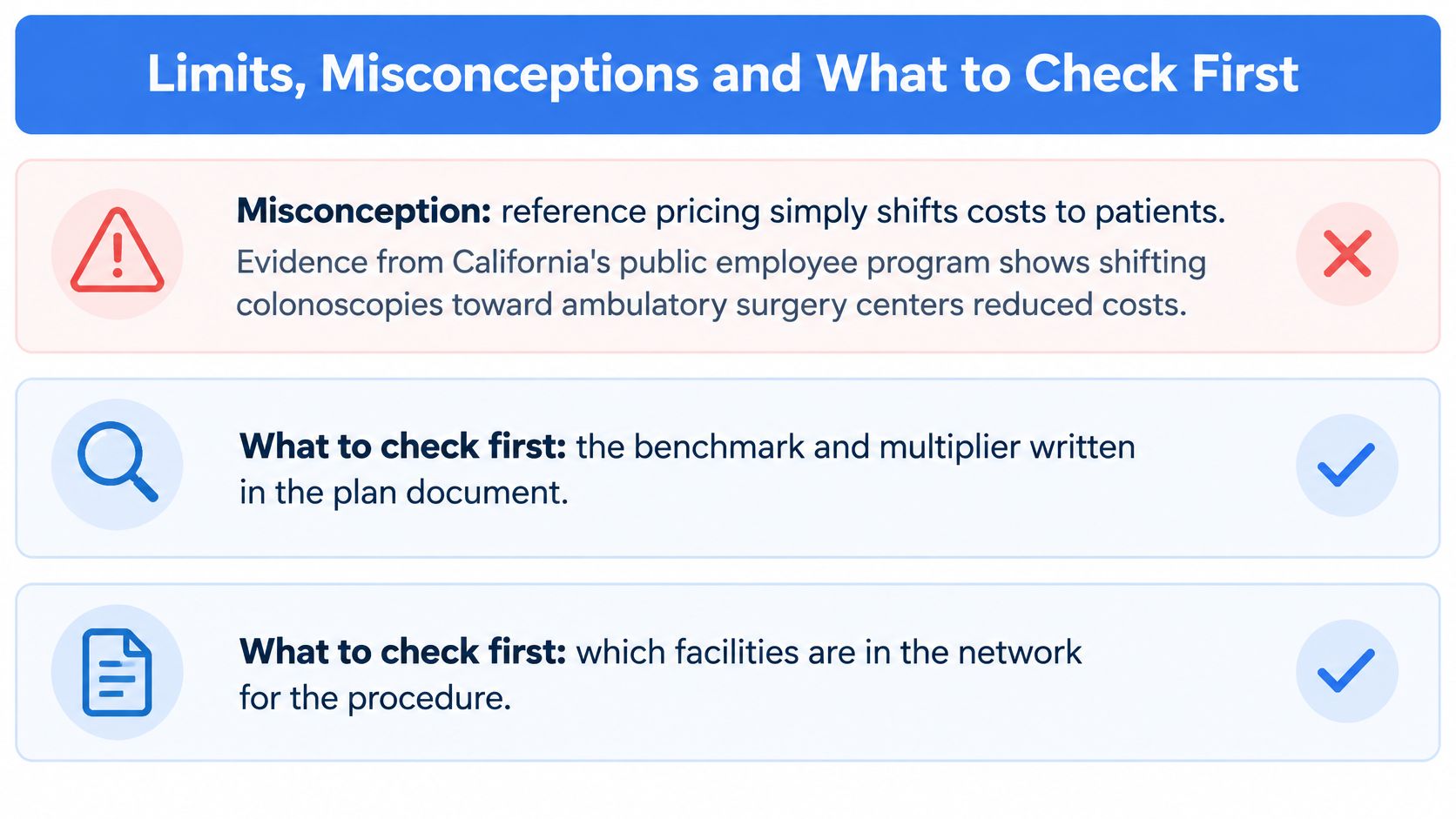
The sharpest criticism leveled against reference-based pricing is that it doesn't lower healthcare prices at all, it just dumps unpaid hospital bills onto workers' kitchen tables. That assumption sounds plausible if you imagine a plan dropping a low ceiling on employees with zero guidance. Real claims data tells a more nuanced story.
An economic evaluation published in JAMA Network Open examined 3.3 million prescription claims and found that reference pricing prompted physicians to prescribe more lower-priced medications, cutting both employer spending and employee cost sharing, though prescribing habits shifted with a noticeable time lag.
Notice what happened there. The reference amount did the steering, not the patient. Doctors moved toward cheaper equivalents because the ceiling changed what the plan would pay, and employees benefited rather than absorbing a penalty. This is the distinction most critics miss: a benchmark only becomes a bill dumped on a kitchen table when a member picks a provider above the ceiling without knowing it. The same knee MRI can cost a patient nothing at an in-network imaging center or leave a large gap at a hospital outpatient department, and the reference figure is the single number that decides which of those two outcomes happens. Well-built programs make that number visible before the appointment, so the choice belongs to the patient instead of surprising them afterward.
The infographic below contrasts that common misconception with the concrete plan details you should verify first.
Two Other Myths Worth Clearing Up
- Savings look identical across every service: They don't. Shifting an uncomplicated colonoscopy to an outpatient surgery center behaves very differently from pricing complex inpatient surgery or specialty medications. A straightforward procedure has clear equivalents and easy substitution, while a complex case may have only one realistic provider in the region. Outcomes rely heavily on clinically appropriate alternatives, transparent quality metrics, and reasonable geographic access.
- One universal percentage governs every claim: Even within a single employer plan, multipliers, covered categories, and balance-billing protections vary service by service. Treating RBP as one monolithic rate hides the design choices that decide whether members get protected or stranded, which is why reading the actual plan document matters more than reading any headline about the model.
When evaluating any benchmark program, ask one blunt question: do the savings come from genuine price competition among providers, or from patients delaying needed care and absorbing extra financial risk?
Your Pre-Adoption Safeguard Checklist
Whether you're enrolling in an RBP benefit or designing one for a workforce, check that seven safeguards exist in writing before the first claim arrives:
- Plain-language benchmark and multiplier: The plan document clearly names the external standard and exact percentage for each covered service category, so a member can calculate the ceiling for a specific procedure before booking it.
- Explicit covered-service list: Members can see immediately which procedures carry a reference cap and which follow standard cost sharing, with no guesswork at the billing desk.
- Air-tight emergency protections: Urgent and emergency visits are shielded so patients never face benchmark penalties when they can't shop around.
- Provider dispute and advocacy process: A named support team steps in immediately if a facility refuses the benchmark payment or sends a balance bill, rather than leaving the member to negotiate alone.
- Appeals route for unrealistic benchmarks: Patients with complex clinical needs or limited local access have a clear pathway to request an exception before the gap bill arrives.
- Clinical and access monitoring: Plan administrators track care abandonment, provider switching, and health outcomes rather than celebrating lower unit prices alone.
- Upfront balance-billing disclosure: Enrollment materials spell out in everyday language when a member could owe a gap and how to prevent it beforehand.
Every strong counterpoint to aggressive rollout boils down to the same takeaway: reference pricing is neither harmful by design nor magically effective. Its results are strictly service-specific and implementation-dependent, and the gap between those two outcomes is written in the seven items above.
Decide Whether Reference Pricing Fits Your Plan
Putting every piece together yields a simple decision rule: if price variation is wide, quality alternatives exist locally, and patients have time to compare options before booking, reference-based pricing is worth piloting. If any of those three conditions is missing, stick with standard cost sharing.
Where RBP Fits Well vs Where It Fails
Services like diagnostic imaging, routine laboratory panels, outpatient procedures, and scheduled joint replacements sit squarely in the sweet spot. Prices for identical procedures vary dramatically between hospital outpatient departments and independent facilities, and patients have days or weeks to check quotes.
By contrast, emergency trauma care, rare subspecialty interventions, and markets dominated by a single hospital system are poor fits. When a patient has no realistic alternative or no time to compare prices, a strict ceiling generates stress without creating competition.
Next Steps Based on Your Role
If you're an individual covered by an RBP plan, take three actions before your next scheduled appointment. First, look up the exact benchmark and multiplier in your benefit summary. Second, request a written price estimate from your chosen facility and compare it against your plan's ceiling. Third, ask the billing desk directly whether the provider accepts your plan's reference reimbursement as payment in full, and call your plan's member advocacy line if they hesitate.
If you're an employer or benefits designer, resist the urge to flip your entire health plan overnight. Pick two or three high-variation, shoppable service categories first, calibrate your Medicare multiplier against actual local market rates, and verify every safeguard on your pre-adoption checklist before open enrollment opens. Start today by opening your current plan document, confirming whether a benchmark and multiplier are named in plain language, and selecting one high-cost service category to audit first.
Evaluating healthcare pricing models, benefits vendors, or prospective employer accounts takes current market context, not months-old directories. Fetchin is a real-time B2B data API that fetches live, publicly available professional profile and company data into structured JSON in about a second, with a free tier of 1,000 credits and zero charges on failed API calls. Explore live endpoints and transparent credit pricing at Fetchin.