Most SaaS advice starts with the wrong conclusion: first-party data is good, third-party data is bad. That sounds responsible, but it creates poor operating decisions. Your own data may be accurate while still being too narrow to identify new accounts, update stale records, or understand a market you haven't reached.
The useful question is simpler: what does your product already know, where are the gaps costing revenue, and what external data should fill those gaps at the moment it matters? First-party data should usually be your core truth set. A professional data API should extend that truth selectively, not replace it with a giant external database you can't validate.
Table of Contents
- Why the First-Party vs Third-Party Question Is the Wrong Starting Point
- What First-Party and Third-Party Data Actually Mean
- Side-by-Side Comparison of Key Trade-Offs
- Privacy and Compliance Under CCPA and GDPR
- Integration Patterns for SaaS Products
- Real-World SaaS Use Cases and Scenarios
- How to Build a Data Strategy That Actually Works
Why the First-Party vs Third-Party Question Is the Wrong Starting Point
Founders often treat data ownership as a quality ranking. They assume data collected directly is automatically cheaper, cleaner, and easier to use compliantly. That assumption fails as soon as the business needs to find people or companies that have never visited its website, signed up for the product, or spoken with sales.
First-party data tells you a lot about known users. It can show which features an account uses, what plan it has, which pages a prospect visited, and what support issues it raised. It can't, by itself, reveal every company that fits your ideal customer profile. It also won't automatically tell you whether a contact changed roles, whether a company expanded into a new market, or whether a dormant CRM record is still valid.
The open web shows why this distinction matters. The 2024 Web Almanac cookie analysis reported that 61% of cookies were set in a third-party context and 39% in a first-party context. On the top 1,000 most popular desktop sites, the third-party share reached 77%. The data ecosystem is changing, but external reach persists because owned signals are strategically important.
Founder's rule: Treat first-party data as your source of truth, not as your only source of discovery.
The operational framework is straightforward:
- Inventory owned signals: List the fields your product collects through signups, authentication, billing, product events, support, and sales activity.
- Find revenue gaps: Identify where missing or stale data hurts lead routing, account expansion, hiring workflows, enrichment, or market discovery.
- Use external data selectively: Call a professional data API when a triggering event creates a real business need, rather than buying broad records in advance.
- Prevent duplication: Match on stable identifiers, preserve source and timestamp fields, and never overwrite a trusted customer value with an unverified inference.
This isn't a morality play about which data type deserves approval. It's a system design decision. First-party data gives you context and intent. Third-party data gives you additional coverage. The strongest SaaS products combine both while keeping consent, cost, and data freshness visible.
What First-Party and Third-Party Data Actually Mean
The labels describe the relationship between the collector and the person or company represented in the data. They don't describe whether a field is automatically accurate, ethical, or useful.
First-party data is collected directly by your company through channels you operate. A signup form captures an email address and selected plan. Your application records feature usage. Billing stores subscription status. Support records capture a customer's questions. A CRM record created by your sales team is first-party when the information came from your own interaction with that account.
The definition is about collection, not storage. If your analytics provider stores events on your behalf, the underlying customer interaction can still be first-party data because your company collected the signal directly.
Second-party data is another organization's first-party data shared with you under a relationship or contract. A partner might provide a list of companies attending a joint event, or share account information for a co-marketing program. The partner collected the data directly, but it becomes second-party data from your perspective. The agreement, permitted use, consent language, and deletion process matter more than the label.
Third-party data comes from an outside organization with no direct relationship to the end user in your product. A provider may aggregate company details, public professional data, or other records from multiple sources and license the result to customers. A purchased firmographic file containing company size and industry is a practical example.
The first-party customer data explanation from Salesforce makes the defining distinction clear: first-party data comes directly from your own audience, while third-party data is collected by an outside entity and commonly aggregated across sources. A plain-language explanation of the three-party model adds the useful shorthand, first means you collected it, second means a trusted partner provided it, and third means you received or purchased it from an aggregator.
Cookies add another layer of confusion. A cookie can be set in a first-party context while still supporting tracking or data sharing. Teams evaluating cookie practices should separate the technical setting from the business relationship and permitted use.
For SaaS teams, the distinction becomes actionable when each field has a clear source:
| Data category | Practical SaaS example | Best use |
|---|---|---|
| First-party | Signup email, billing plan, product events | Personalization, lifecycle messaging, customer health |
| Second-party | Partner-shared event audience | Joint campaigns, approved account discovery |
| Third-party | Purchased company attributes or external professional records | Net-new coverage, enrichment, market expansion |
A useful overview of profile data can help product teams think in terms of structured fields rather than vague audience segments. The key is to record provenance. A field without a source, timestamp, consent status, and confidence level shouldn't become a decision-making fact on its own.
Side-by-Side Comparison of Key Trade-Offs
The right choice depends on the job. First-party data wins when you need to understand an existing relationship. Third-party data wins when you need coverage beyond the relationships your company has already created.
| Dimension | First-Party | Third-Party |
|---|---|---|
| Accuracy | Strong for known users and observed actions, weaker for inferred attributes | Useful for external coverage, but quality varies by source and update process |
| Reach | Limited to people and companies that touched owned channels | Broader coverage for net-new accounts and contacts |
| Freshness | Can be near real time when your event pipeline is well designed | Depends on provider update cadence and delivery method |
| Cost | Requires investment in collection, storage, consent, and governance | Usually scales with records, calls, seats, or usage |
| Consent posture | Your team controls collection context, but still needs a valid basis for use | Requires vendor due diligence, permitted-use review, and careful handling of transferred data |
Accuracy depends on the field
First-party data is usually strongest for observed behavior. If a customer used a feature, opened a support ticket, or selected a plan, your own systems have direct evidence. Accuracy drops when your team infers information that the customer never supplied, such as role, buying authority, company size, or future intent.
Third-party data can supply those missing fields, but don't treat the output as unquestionable truth. Store the provider, retrieval time, field-level confidence when available, and the original input used for matching. A current external lookup can be more useful than an old internal record, but only if your system can tell the difference.
Reach and freshness pull in opposite directions
Owned data is naturally relevant because it comes from your audience. It also stops at the edge of your audience. This is the core reason a first-party-only strategy struggles with cold outbound, total addressable market discovery, and expansion into markets where your product has little existing traffic.
Third-party coverage expands the search area, but a static bulk file can age quickly. The verified industry angle on first-party and third-party B2B data captures the practical tension: owned data is accurate but narrow, while external data broadens reach and introduces quality and decay risks.
Cost is a workflow question
First-party collection isn't free. You pay with engineering time, instrumentation, warehouse capacity, governance, and product friction around consent. Third-party data isn't automatically wasteful either. A targeted lookup at signup or deal qualification can be cheaper than maintaining a large cache of records that nobody uses.
The best composition is not replacement. Keep owned signals central, then buy external coverage only where it improves a defined workflow.
Privacy and Compliance Under CCPA and GDPR
First-party doesn't mean exempt, and third-party doesn't mean unusable. Both require a documented reason for processing, clear product behavior, and controls that match the data involved.
Under GDPR, personal data covers information relating to an identified or identifiable natural person. Identifiability can be direct or indirect, so an email address isn't the only concern. Cookie identifiers and device identifiers can also qualify when they can be linked to a person. Under the CCPA, personal information includes data that identifies, relates to, describes, or could reasonably be linked to a particular consumer or household.
That means a company URL can be low risk in one workflow while a professional profile URL, role history, contact field, or device identifier may require much more careful treatment. Your team should classify the field and intended use, not label an entire vendor feed as “public.”
The practical difference between owned and external data
With first-party data, you control the collection interface and can explain the purpose directly to the user. You still need an appropriate legal basis, transparent notices, retention limits, access controls, and a process for rights requests.
With third-party data, you inherit additional diligence. You need to understand the source, the provider's role, permitted purposes, retention terms, deletion process, and cross-border transfer arrangements. If a vendor processes personal data for you, your contracts should define those responsibilities. For EU-related processing, teams commonly assess a data processing agreement and an approved transfer mechanism where data leaves the relevant jurisdiction.
CCPA obligations also require attention to sale and sharing opt-outs, sensitive personal information limits, and Global Privacy Control signals. A vendor that returns data doesn't remove your responsibility for deciding whether your use is permitted.
For a broader operating perspective, Menza's guide to data governance for e-commerce teams is useful because governance should cover ownership, access, retention, and auditability rather than just a privacy policy.
| Obligation | First-Party Data | Third-Party Data |
|---|---|---|
| Lawful basis or permitted use | Define it at collection and keep it tied to the stated purpose | Verify the provider's collection basis and your intended use |
| Transparency | Explain collection through your notice and product experience | Explain external enrichment where it affects the person or decision |
| Consent signals | Store consent, withdrawal, and preference changes | Obtain vendor assurances and preserve applicable opt-out status |
| Retention | Set deletion rules in your systems | Contract for retention, deletion, and return obligations |
| Vendor controls | Manage processors that host or analyze your data | Review contracts, security, transfers, and sub-processors |
| Individual rights | Search and update your own records | Make vendor-assisted lookup and deletion operational |
For product teams building a people data API, the compliance checkpoint belongs before enrichment is merged into a durable customer profile. Match only what the workflow needs, log why the lookup happened, and make it possible to remove the result.
Integration Patterns for SaaS Products
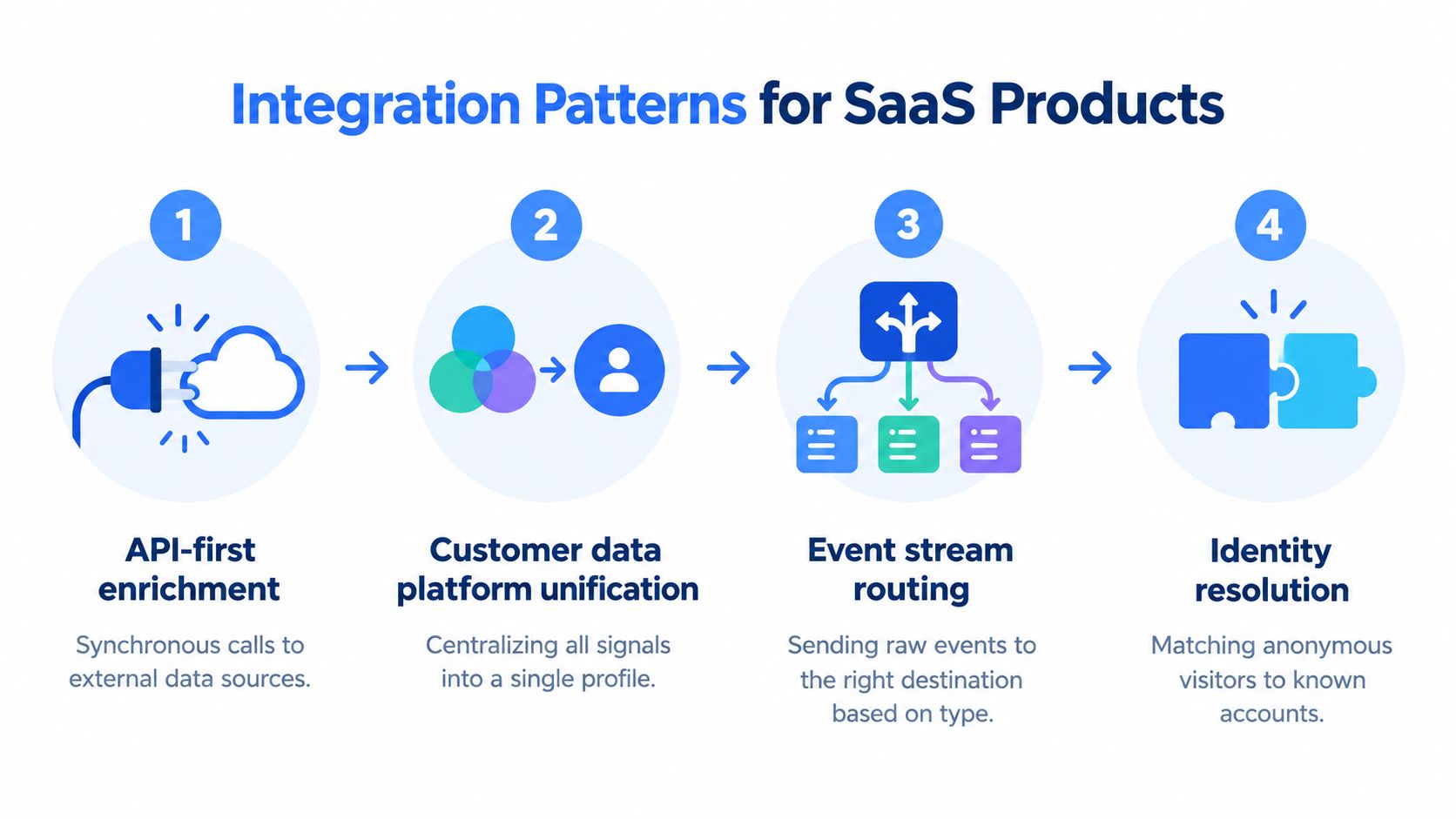
The safest architecture keeps first-party records authoritative and treats external data as an on-demand supplement. Four patterns cover most SaaS implementations.
API-first enrichment
Trigger a synchronous lookup when a signup arrives, a lead reaches a qualification stage, or a customer asks for an account review. Send a professional profile URL, company URL, or approved matching key. Write the structured response into a staging object first, then map selected fields into the CRM or product database.
This pattern fits user-facing workflows that need a result during the request. Its cost scales with triggering events, not with every possible account in a market. Design around rate limits, timeouts, partial responses, and vendor downtime. The product should still complete the primary action if enrichment fails.
Batch refresh
Use a scheduled job or webhook-driven queue to refresh records across a known account base. This works for stale titles, company attributes, and CRM hygiene where the user doesn't need the result immediately.
Batch processing reduces pressure on the main application path, but it creates a freshness trade-off. Failed jobs need retry rules, stale identifiers need quarantine, and every update should retain the previous value and source. A JSON data API guide is helpful for teams deciding how to map external structured responses into their own schema.
Server-side identity matching
Keep sensitive identifiers inside your warehouse or application perimeter whenever possible. Your server can generate a permitted match token from an approved email or use firmographic keys, send only the required token for resolution, and store the result behind your own access controls.
This pattern is valuable when matching accuracy matters more than instant response time. Its failure modes include inconsistent normalization, stale emails, duplicate companies, and false matches. Never merge solely because two records share a similar name.
Event-driven reverse ETL
Let first-party events trigger downstream actions. A product usage event can update an account score, while a thin coverage signal can initiate an external lookup only for that account. This keeps your external calls tied to an actual business event.
Choose the pattern by two questions: does the user need the result now, and how many records will trigger calls? Immediate, low-volume decisions favor API-first enrichment. High-volume maintenance favors batch jobs. Sensitive matching favors server-side resolution. Conditional lifecycle actions favor event routing.
Real-World SaaS Use Cases and Scenarios
The distinction becomes clear when a product has to make a decision, not when a marketer compares definitions.
B2B lead enrichment
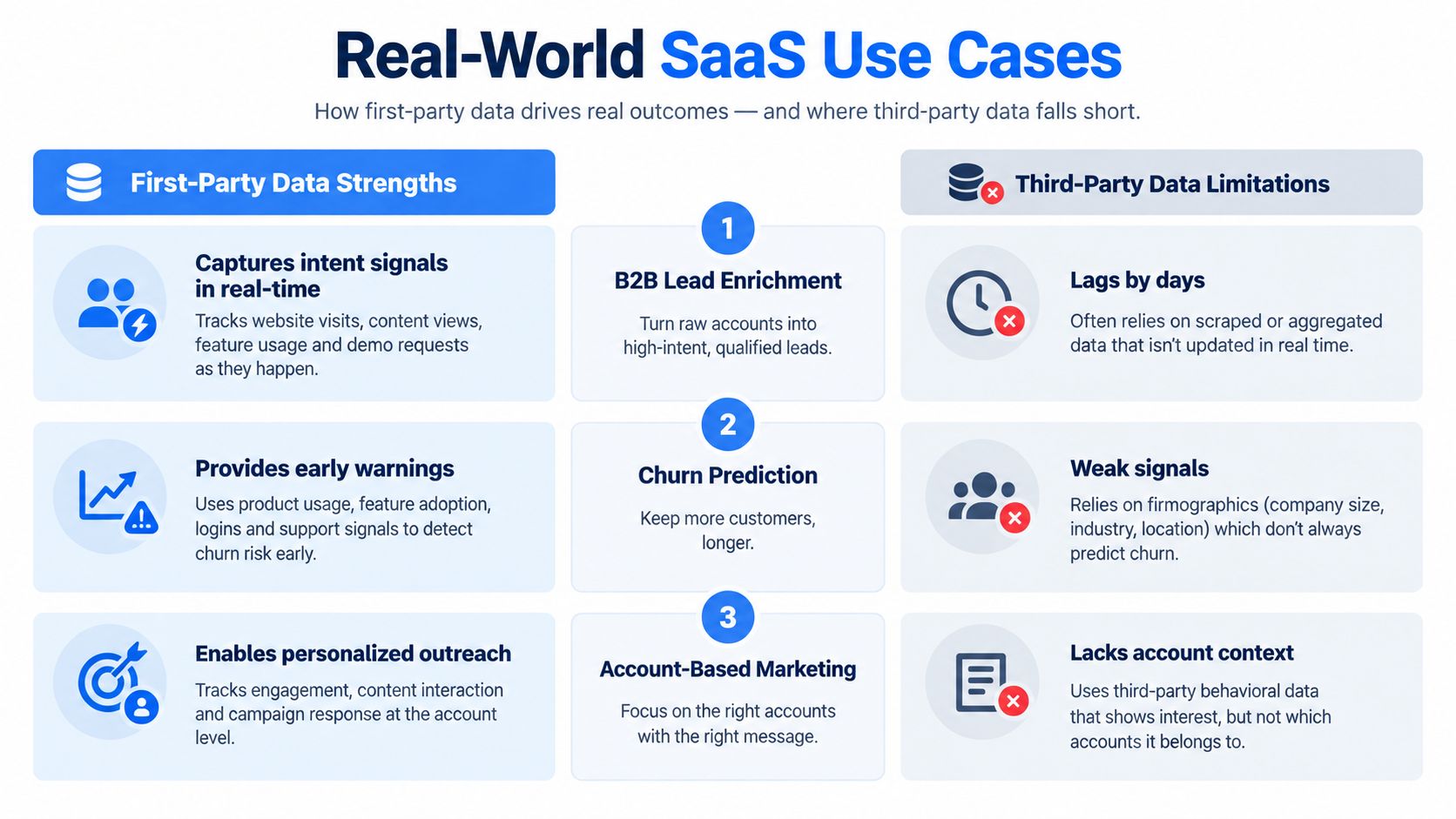
A signup form might collect the email address, company name, selected plan, and stated use case. Those are direct signals about the person's interaction with the product. An external professional data API can add company industry, headcount, headquarters, verified domain, or current role information when the routing workflow needs it.
The privacy checkpoint is consent and purpose. Do not use a free trial form to build unrelated marketing profiles. Match the company carefully, preserve the source of every appended field, and give sales a clear indication of what the customer supplied versus what the system inferred.
The gain is operational: better routing, more relevant qualification, and less manual research. A team overpays when it buys fields already captured accurately in its own signup and billing systems.
Technical recruiting
A recruiting platform can collect candidate-submitted profiles, work history, skills, locations, and preferences through its own experience. External public professional data can help verify a current title, identify a company change, or surface relevant project signals for people who haven't entered the platform.
The checkpoint is especially important because employment history and contact details can affect an individual. Define a legitimate recruiting purpose, respect deletion and objection requests, restrict access, and avoid treating inferred information as confirmed fact.
The operational value is broader candidate discovery and faster research. The platform wastes money when it purchases a complete record for every candidate even though the candidate already supplied most of the information directly.
Account-based sales intelligence
A sales product can combine first-party product telemetry, website interactions, trial activity, support history, and known account relationships. External data can add buying-committee roles, current company information, professional changes, and selected market signals for target accounts that have little or no owned activity.
The privacy checkpoint is identity and account matching. A shared company name isn't enough. Use verified domains or other controlled keys, keep person-level and account-level data separate, and document why the enrichment supports the sales workflow.
The gain is better account prioritization and wider pipeline coverage. The wrong approach is to purchase broad behavioral records and treat them as intent. External signals should prompt investigation, not manufacture certainty.
Across all three scenarios, first-party data supplies context and timing, while external data supplies coverage. Use each for the job it can perform.
How to Build a Data Strategy That Actually Works
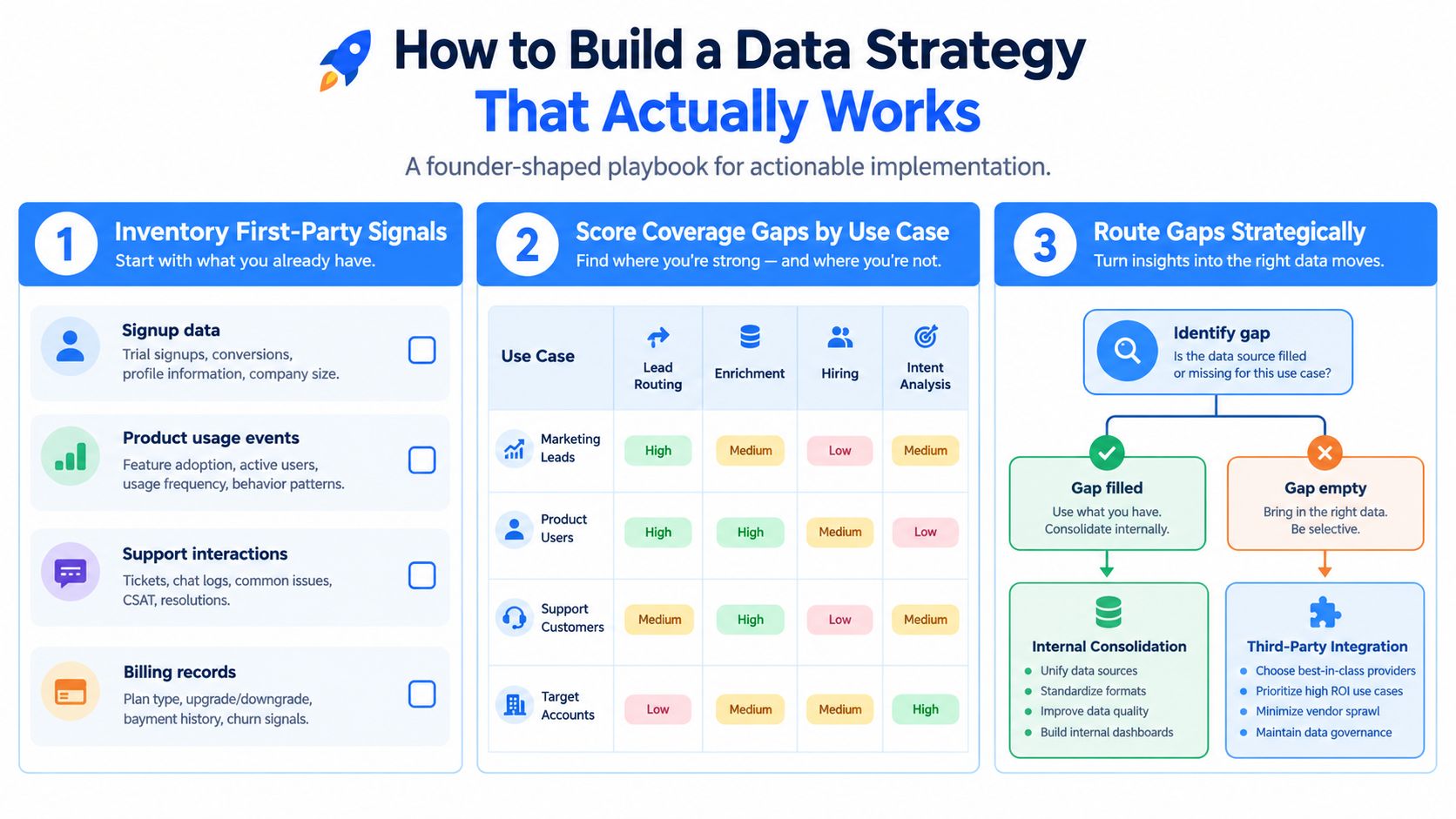
Start with an inventory, not a vendor shortlist. List every first-party signal your SaaS already collects, who owns it, how often it updates, what consent status travels with it, and whether the field is observed or inferred.
A practical inventory usually includes:
- Signup data: Email, company, selected plan, use case, and declared role.
- Product activity: Feature events, account activity, workspace membership, and lifecycle status.
- Support interactions: Tickets, issue categories, satisfaction feedback, and resolution history.
- Commercial records: Billing status, contract details, renewal stage, and sales notes.
Next, score coverage by use case. Don't ask whether your company has “enough data” in general. Ask whether the data supports the specific decision. Lead routing may have strong company identification but weak firmographics. Hiring may have rich candidate submissions but poor recency. Intent analysis may have strong product activity for customers and almost nothing for target accounts outside your funnel.
Put external lookups at the point of action
Use a professional data API where a missing field blocks a meaningful decision. Trigger the call when a lead needs routing, an account reaches a sales threshold, a candidate needs verification, or a customer record requires a current company match.
Avoid building a huge external cache before you know which fields change outcomes. Bulk data can create duplicate records, inflate storage and review work, and leave your team paying for records that never enter a workflow.
Your operating controls should include:
- Stable deduplication keys: Prefer verified domains, controlled account IDs, and carefully normalized identifiers.
- Consent flags: Carry collection source, permitted purpose, opt-out status, and deletion state with the record.
- Audit trails: Log the triggering event, request time, provider, response fields, and merge decision.
- Vendor terms: Review permitted use, retention, security, subprocessors, transfer mechanisms, and deletion support.
- Coverage testing: Compare enrichment results against a defined holdout sample regularly, then remove fields that don't support a real decision.
The decision rule is blunt. If owned data is sufficient, stay closed. If you need to find accounts you've never seen or refresh a critical field, pay for an external lookup at the point of action. That composition gives founders the control of first-party data without accepting its coverage limits.
A SaaS team should start by mapping its owned signals and identifying the workflows where missing professional or company data blocks action. Fetchin provides a real-time B2B data API that turns professional profile and company URLs into structured JSON for targeted enrichment and matching. Visit Fetchin to evaluate an API-based approach that adds external coverage without replacing your first-party foundation.