Around 2010, talent intelligence platforms emerged as AI-driven systems that aggregate workforce data, predict hiring needs, and map employee skills. By 2026, IDC projects that over 90% of companies will be affected by global skills shortages, making fresh talent intelligence a strategic requirement rather than a recruiting add-on.
What happens when your ATS contains a complete record of yesterday's hiring activity, but your team needs to understand who is available in the market today? That question exposes the gap in conventional thinking. Talent intelligence platforms are more than better databases. They combine internal records, external professional data, skills relationships, and market signals to support decisions that static HR systems can't make reliably.
Table of Contents
- Defining the Talent Intelligence Platform
- How Talent Intelligence Differs From an ATS
- The Role of Skills Graphs and External Data
- Use Cases Across Product and Recruiting Teams
- Evaluating Data Sources and Privacy Compliance
- Assessing Technical Performance and Integration
Defining the Talent Intelligence Platform
A recruiter opens a requisition for a specialist role. The ATS returns candidates who applied previously, employees with similar job titles, and profiles that contain the right keywords. The process looks organized, but it answers a narrow historical question: who has already appeared in the system?
A talent intelligence platform asks a broader one. Which people have the capabilities associated with this role, even if they describe their experience differently? Which employees could move into the position? Where does relevant talent exist externally, and how does the supply compare with the organization's future needs?
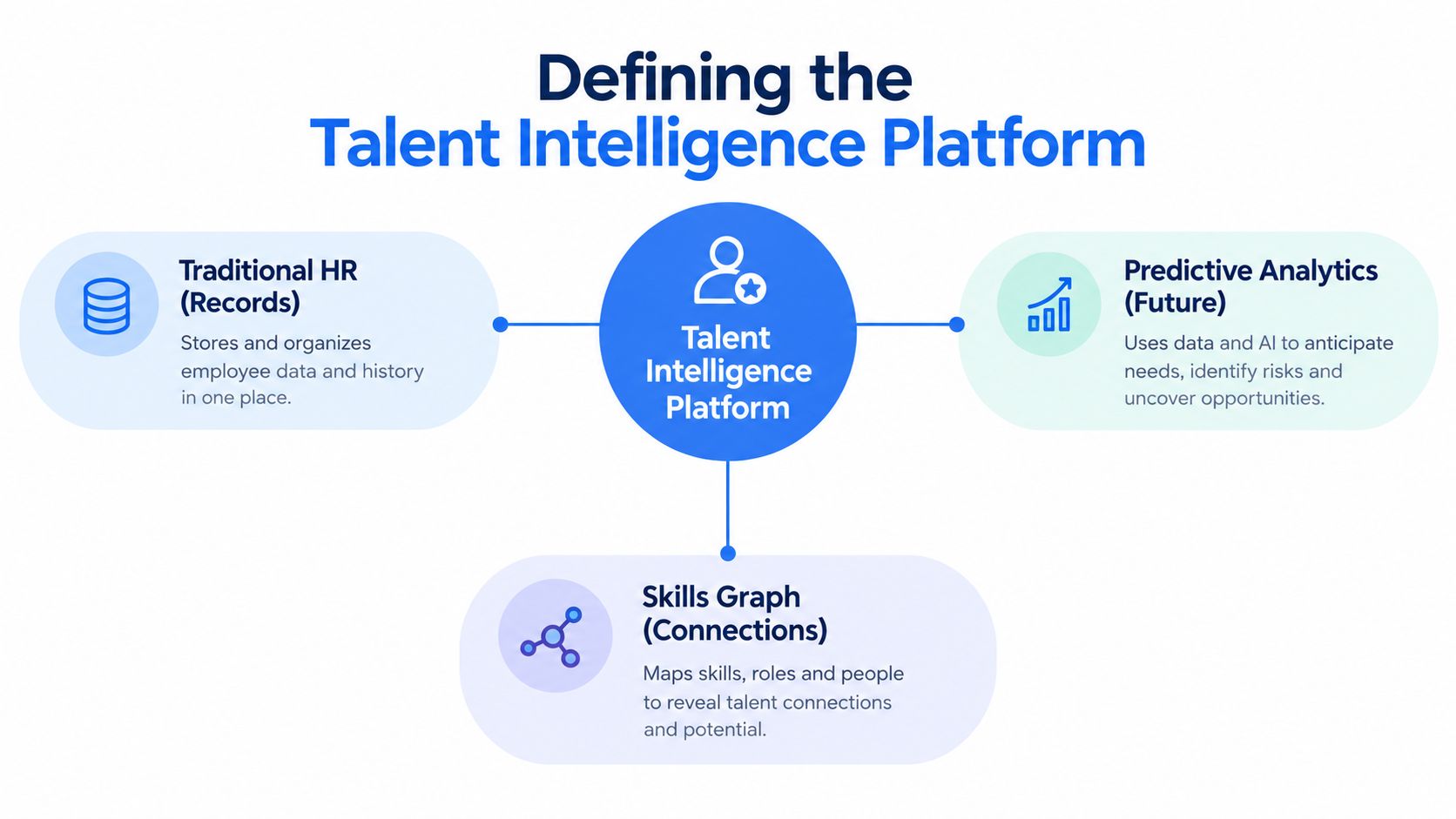
The distinction comes from the system's purpose. Traditional HR software records events, workflows, applications, employee changes, and hiring outcomes. Modern talent intelligence platforms analyze those records alongside external signals, then use AI to identify skills, career paths, organizational fit, and potential workforce gaps. The category's historical shift began with HR software consolidation through acquisitions such as Oracle buying Taleo and SAP buying SuccessFactors, followed around 2010 by systems from companies such as Eightfold AI, Degreed, Beamery, and Gloat that centered analysis on people and teams rather than job-centric workflows, as described in this overview of the talent intelligence platform market.
From records to continuous analysis
A useful mental model is a continuous research assistant rather than a digital filing cabinet. The platform ingests internal HRIS and ATS information, normalizes inconsistent job and skill language, and connects that information to external labor-market evidence. It can then surface adjacent skills, possible role transitions, and talent availability.
That architecture changes the decision sequence:
- Define the business need: Translate a requisition or workforce plan into capabilities, outcomes, and adjacent experience.
- Connect the data: Combine employee records, candidate history, public professional data, company records, and labor-market signals.
- Infer relationships: Use AI and graph-based models to identify people, skills, roles, and organizations that are related even when the wording differs.
- Route an action: Send a recommendation into recruiting, internal mobility, workforce planning, or a product workflow.
Practical rule: If a platform only tells you what is already stored, it provides reporting. If it continuously adds context and recommends the next decision, it provides intelligence.
The infrastructure matters because prediction is only as reliable as the data beneath it. A stale profile can misrepresent a person's current role. An unnormalized skill label can hide a qualified candidate. An internal employee record can show a job title without revealing capabilities developed through projects, education, or previous work.
A mature platform therefore combines historical evidence with current signals. It doesn't replace the ATS or HRIS. It sits above them, turning operational records into a decision layer that supports hiring, internal movement, and workforce planning.
How Talent Intelligence Differs From an ATS
An ATS is a workflow system. It manages requisitions, applications, interview stages, evaluations, approvals, and hiring outcomes. Its strongest guarantee is operational consistency: candidates move through a defined process, and the organization retains a record of what happened.
A talent intelligence platform is a data interpretation system. It can use ATS history, but its value begins before a candidate enters the pipeline. It enriches profiles, identifies relationships between skills and roles, and helps teams discover people who aren't represented in the existing database.
| Capability | ATS | Talent intelligence platform |
|---|---|---|
| Primary job | Manage hiring workflow | Interpret talent and market data |
| Main data orientation | Candidates already in the process | Internal and external talent signals |
| Matching method | Often role and keyword centered | Skills, attributes, relationships, and inferred fit |
| Output | Pipeline status and hiring records | Recommendations, talent pools, and workforce insights |
| Freshness requirement | Records update through workflow activity | External signals need continuous enrichment |
The architectural difference is easy to miss because vendors often place both products under the same recruiting technology budget. A team comparing options can use a practical guide to recruiting software for startups, but it should still separate workflow management from data acquisition during evaluation.
Why static candidate history fails
An ATS knows what a person submitted, when they applied, and how the process ended. It usually doesn't know whether that person changed roles, acquired a new capability, joined another company, or became relevant to a different requisition unless a new interaction updates the record.
This creates a subtle failure mode. The organization may own a large candidate database, but the database's apparent scale doesn't equal current market coverage. A stale record can produce false confidence, while a current professional profile can reveal evidence that never existed in the ATS.
A professional data API addresses the missing layer by fetching profile and company information at the moment a product needs it. One published API description says a single request can return professional profiles, company pages, and posts as structured JSON, including experience, education, skills, company firmographics, funding, headcount, specialties, and hiring insights, as described in this professional data API overview. The operational benefit isn't merely more fields. It's the ability to enrich a decision without waiting for a manual upload, batch refresh, or recruiter-maintained spreadsheet.
The right stack is complementary
Replacing an ATS with a talent intelligence platform is usually the wrong architecture. The ATS remains the system of record for process governance. The intelligence layer should improve discovery, ranking, enrichment, and planning, then return qualified records and decisions to the systems where teams already work.
An API-first enrichment layer fits between external data and the intelligence or recruiting application. It can return structured JSON for a candidate view, a matching service, a workforce model, or an AI agent. That separation also makes testing clearer. Product leaders can measure whether live enrichment improves coverage and decision quality, while engineering teams can monitor response behavior independently of workflow completion.
The result is a modern talent stack with distinct responsibilities: the ATS stores the journey, the intelligence platform interprets the talent, and the API supplies current external context.
The Role of Skills Graphs and External Data
Keyword matching treats talent as a collection of labels. Skills graphs treat talent as a network of relationships.
A graph-style labor-market model can connect occupations, skills, job postings, people, and evidence. Published descriptions of skill graphs identify techniques such as link prediction, node similarity, shortest-path analysis, and TF-IDF-style distinctiveness scoring, which allow systems to infer adjacent capabilities and role transitions instead of relying only on exact terms, as explained in this skill-graph technical summary.
Suppose a product team needs someone who can operate across data engineering and machine learning infrastructure. A keyword filter may exclude a candidate whose profile emphasizes platform engineering, distributed systems, and model deployment without using the exact target phrase. A graph can recognize those skills as connected through roles, projects, and labor-market evidence.

Why the graph needs external evidence
Internal HRIS data is valuable but incomplete. It captures the organization's employees, titles, reporting structures, and selected history. It rarely captures the full external supply of skills, the movement of people between companies, or the signals that indicate how an organization's hiring context is changing.
Public professional profiles, company records, market signals, and job-posting evidence fill those gaps. A published guide for evaluating talent intelligence vendors recommends examining external data breadth and freshness, privacy posture under GDPR or CCPA, and integrations with ATS and HRIS systems, as discussed in this guide to choosing a talent intelligence platform.
The important trade-off is not internal versus external data. It is internal context plus external recency. Internal records explain what the organization needs and what it already has. External signals reveal who and what exists beyond the organization's current systems.
Cyndra's AI guide for candidate profiles is useful context for product teams designing candidate representations, because profile quality depends on more than a résumé field list. A platform needs a model that preserves evidence, relationships, dates, and confidence rather than collapsing every person into a single matching score.
Designing the data layer
A reliable implementation should separate three layers:
- Evidence layer: Store the originating profile, company, role, skill, or market observation with timestamps and provenance.
- Normalization layer: Map different spellings, titles, and taxonomies into consistent entities without deleting the original wording.
- Inference layer: Calculate adjacency, similarity, transitions, and fit while preserving the evidence behind each result.
That structure helps product leaders answer a question that dashboards often obscure: why did the system recommend this person or skill? Explainability isn't a decorative feature in talent intelligence. Recruiters and hiring managers need to distinguish observed experience from inferred capability, especially when recommendations affect access to employment.
Teams building a product around these principles can use this people data API resource to think through profile retrieval, structured attributes, and integration boundaries. The broader lesson is that a skills graph becomes useful only when the underlying evidence remains fresh, traceable, and connected to an action.
Use Cases Across Product and Recruiting Teams
Talent intelligence becomes concrete when it enters an operating workflow. The same external signal can support a recruiting search, a product feature, or a workforce planning decision, but each team needs a different interface and success measure.
A SaaS product enriches account and contact records
A SaaS company can accept a professional profile URL or company URL, request structured enrichment, and return current attributes inside its application. A sales intelligence feature might connect a person's experience to company firmographics, hiring activity, or relevant organizational changes.
The product team doesn't need to build a second research console. It needs consistent JSON, clear schemas, error handling, and a way to show users which fields were observed and when. That architecture turns external research into a product capability rather than a manual operations task.
A company enrichment API described by one provider returns more than 250 fields across firmographics, funding, headcount time series, web traffic, reviews, and hiring signals from more than 15 sources, with real-time refresh, according to this company enrichment API description. Those fields are useful only when the application maps them to a decision, such as account qualification, territory planning, or workforce-risk analysis.
An AI agent builds a recruiting shortlist
An AI recruiting agent needs more than a search endpoint. It needs current profile evidence, normalized skills, company context, and a controlled path from discovery to outreach. If the agent relies on an indexed snapshot, it can recommend people whose role or employer has changed. If it relies on keyword matching alone, it can miss adjacent experience.
A better flow is explicit:
- Translate the requisition into required and adjacent capabilities.
- Retrieve current public professional data.
- Rank candidates using observed evidence and graph relationships.
- Ask for human review before outreach.
- Write the final candidate record to the ATS.
The recruiting and sourcing use case illustrates where live profile data fits into that workflow. The API isn't the recruiter, and it shouldn't make unreviewed employment decisions. Its role is to supply structured evidence that a recruiting application can evaluate and present.
A workforce team plans beyond open requisitions
Workforce planning teams need to understand capability supply, not only fill current vacancies. They may compare internal skills with external labor-market availability, identify roles that can be redesigned, or determine whether a capability should be developed, acquired, or sourced through hiring.
This is where the category's strategic value exceeds recruiting automation. IDC's 2025 MarketScape describes talent intelligence platforms as enabling movement from role-centric to skills-based planning and projects that over 90% of companies will be affected by global skills shortages by 2026, as reported in the SAP-hosted MarketScape document.
Onboarding is another point where workforce data becomes operational. Teams designing a broader employee lifecycle can consult this onboarding automation guide for 2026, then connect role requirements, skills, and employee information to the systems that guide a new hire's first activities.
The common design principle is simple: use live data to improve a decision, not to create another dashboard.
Evaluating Data Sources and Privacy Compliance
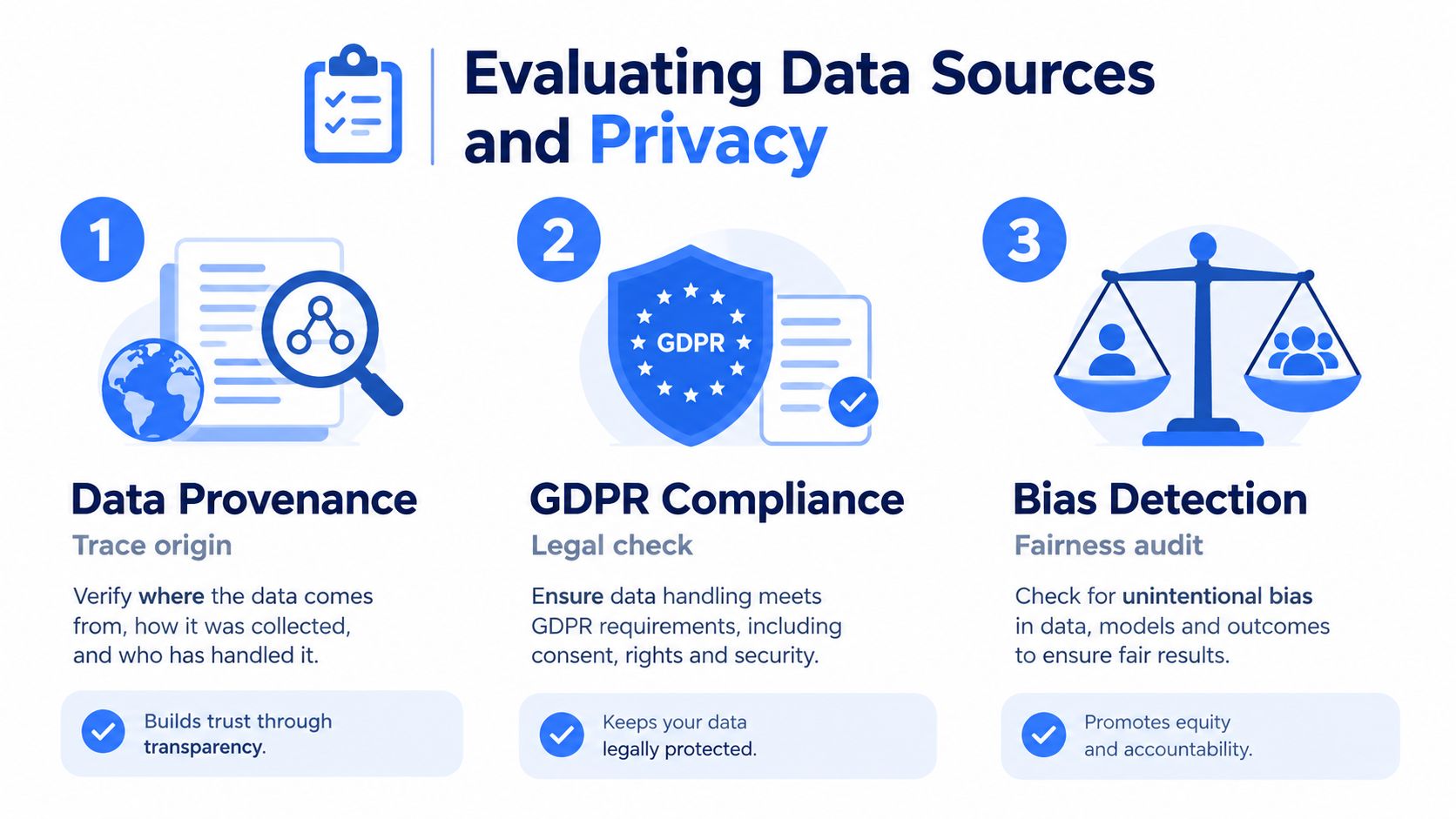
Data-source evaluation should begin with provenance, not volume. A large database can still be unsuitable if the records are stale, the collection basis is unclear, or the platform cannot explain how a field was obtained.
Three approaches commonly appear in talent data architectures:
| Approach | Strength | Risk |
|---|---|---|
| Periodic database snapshots | Predictable batch processing and familiar storage patterns | Records age between refreshes |
| Uncontrolled page collection | Broad apparent coverage | Inconsistent reliability, governance, and provenance |
| Live API fetching | Current data at the point of need and structured delivery | Requires provider diligence, rate planning, and privacy controls |
The second approach is particularly difficult to govern when the source, timing, and permitted use of data aren't documented. A buyer should ask for source categories, update behavior, retention rules, deletion handling, access controls, and evidence that the provider respects applicable terms and laws.
Provenance and lawful processing
Public availability doesn't automatically remove privacy obligations. The published vendor-evaluation guidance notes that many providers rely on legitimate interests as the lawful basis for processing publicly available profile data, but that GDPR requires a documented balancing test. Buyers should therefore treat compliance as a pipeline property, not a checkbox on a contract.
A useful data provenance framework should answer four questions:
- Where did the field originate? Record the source category and retrieval context.
- When was it observed? Store timestamps so users can distinguish current from historical evidence.
- Why is it processed? Tie collection and use to a defined product or business purpose.
- How can it be corrected or removed? Provide a documented process for rights requests and data lifecycle controls.
A major skills intelligence vendor states that its platform uses public data and contractual sources, including professional profiles, career data, company and executive insights, financial and regulatory data, news, market signals, and vetted industry sources. It also states that its platform supports GDPR, CCPA, and other global privacy laws, as described in its data and compliance overview. Buyers should still validate the exact contractual commitments and operating controls rather than treating a vendor statement as a substitute for internal review.
Bias and decision boundaries
Freshness doesn't guarantee fairness. A graph can reproduce historical labor-market patterns, and an inferred skill can be wrong even when the source is current. Product teams should test recommendations across roles, geographies, career paths, and demographic contexts, then expose evidence and uncertainty to human reviewers.
Governance principle: Use talent intelligence to expand and explain a search, not to hide a hiring decision inside an opaque score.
The strongest architecture keeps people accountable for consequential decisions, records why a recommendation appeared, and separates data enrichment from automated rejection. That design protects candidates while giving engineering teams a clear audit trail.
Assessing Technical Performance and Integration
A platform can have an impressive data model and still fail in production. Product leaders should test the path from request to usable record, not just inspect a polished demo.
Start with a production-shaped test. Send profile and company requests using representative inputs, measure response latency, inspect field completeness, and record how often the returned structure can be written directly into your application without manual transformation.
A practical technical checklist
- Latency: Measure median and tail response time, not only the fastest successful request.
- Freshness: Confirm whether each call fetches current information or returns a periodically indexed snapshot.
- Schema stability: Test field types, missing values, pagination, and versioning before building downstream logic.
- Failure handling: Verify retries, timeouts, idempotency, and whether failed requests consume credits.
- Throughput: Run concurrent requests at expected production volume and test both synchronous and asynchronous delivery.
- Integration: Confirm that ATS, HRIS, CRM, queue, and observability systems can consume the output.
- Compliance posture: Review data provenance, retention, deletion workflows, access controls, and contractual privacy terms.
A real-time B2B data API can return profile and company enrichment as structured JSON, but the integration still needs caching rules, consent or lawful-basis logic, and a clear distinction between retrieved evidence and model inference. Don't let a fast endpoint become an ungoverned shadow database.
The second test should use realistic load rather than a single request:
Teams should also calculate the cost of incomplete work. If a failed request consumes credits, transient infrastructure problems can distort unit economics. If a provider offers synchronous responses for interactive screens and asynchronous delivery for slower workflows, the product can reserve the right mode for each user experience.
The integration outcome is measurable even without inventing a universal benchmark. Track enrichment completion, usable-field coverage, stale-record frequency, request failure rate, time from discovery to ATS write-back, and reviewer correction rate. Those metrics reveal whether the data layer improves the product or merely adds another dependency.
For teams building talent intelligence, recruiting, or sales products, Fetchin offers a professional data API that turns professional profile and company URLs into structured JSON through on-demand data retrieval. Visit Fetchin to evaluate live enrichment, schema integration, and the API workflow against your own production use case.