A product manager opens the dashboard on a Tuesday morning and sees the number every growth team wants. Sign-ups are climbing. Then the CRM tells a different story. Demo calls book, then stall halfway through, and the deals that close are smaller than the pipeline promised.
Volume isn't the problem. The team is creating demand at the wrong moment, for the wrong accounts, with records that were accurate eight months ago. A free-tier user hits a rate limit and leaves because nobody showed them what the next plan costs. An outbound sequence lands two weeks after the prospect changed jobs. An intent surge sends a rep toward an account that replaced its entire data team last quarter.
Every strategy below is framed around the same question. What does a buyer meet in the first few minutes of contact, and what has to be true about your data at that moment for the next step to make sense? Freshness is the part that gets skipped. A well-written sequence sent to a stale record is a wasted quarter.
The ten demand generation strategies here run roughly from self-serve to sales-assisted. Three of them will fit your company this quarter. Running all ten at half strength is worse than running three properly.
Table of Contents
- 1. Product-Led Growth with a Free Tier
- 2. Developer-Led Content and API Documentation
- 3. Account-Based Marketing
- 4. Intent Data Targeting
- 5. Signal-Based Outbound Sales
- 6. Progressive Profiling and Enrichment at Sign-Up
- 7. Free Tools and Interactive Lead Magnets
- 8. Inbound SEO Content and Topic Clusters
- 9. Integration Marketplace and Partner Co-Marketing
- 10. Conversational Marketing and Website Engagement
- How the 10 demand generation strategies compare on cost, speed, and fit
- Building a Demand Engine That Compounds Over Time
1. Product-Led Growth with a Free Tier

The first encounter with a product-led company rarely happens on a landing page. It happens in a terminal window, when an engineer pastes a curl command and waits to see what comes back.
Product-led growth creates demand by letting people experience the product before any sales conversation. They run real workloads, expand usage on their own schedule, and the product handles much of the qualification. For a data API, a free credit allowance lets engineers test profile and company endpoints against URLs they already care about, which makes the first successful integration the sales motion. Slack grew this way in collaboration software, with teams adopting it bottom-up before anyone signed a paid contract. Twilio built a developer-first API business where free trial credits pushed a large share of developers into production accounts.
Our free tier runs at 1,000 credits, which is enough for a working proof of concept on real data.
- Size the allowance for a complete proof of concept: a pilot should hit a production-like wall, not a demo wall. Let people finish the integration, then require a paid plan to keep it running.
- Instrument activation, not signups: track the first successful profile fetch and trigger onboarding when a user stalls before it.
- Put pricing next to usage: show credits consumed and the cost of the next tier inside the dashboard, and link through to API pricing models so nobody has to guess what scale costs.
- Prompt at the limit: surface the upgrade when a user approaches rate limits or runs out of credits, not on day two.
The trade-off is real. Free tiers attract hobbyists who never convert, and support load scales with them. Cap the allowance and the support surface together.
2. Developer-Led Content and API Documentation
Engineers don't read your product tour. They search for the error message that's blocking them at 11pm and land on whichever documentation page answers it.
Developer-led content targets the people who choose and implement data infrastructure, not the executives who sign. Publish quickstarts, code samples, SDKs, and end-to-end tutorials that solve a concrete integration problem. Search engines and developer communities surface the pages, and the engineer who shipped with your API becomes the internal advocate who brings the tool into the team. Stripe is the standard example, with documentation so good that developers recommend it to peers without being asked. Twilio built a large developer community on tutorials and sample apps for messaging and voice use cases.
For a B2B data API, the pages that do the work cover the profile endpoint, the company endpoint, and the posts, comments, and reactions endpoints. Those three are what SaaS founders, AI agent builders, and product teams evaluate.
The assets that carry the demand
- One end-to-end tutorial per use case: lead enrichment, candidate sourcing, AI agent context retrieval. One per job, not one per feature.
- Benchmark notes with real numbers: publish median response time and P95 latency so engineers can size their architecture before they commit.
- A copy-paste example that returns live JSON: the reader should see a structured response within the first minute, not after a sales call.
- A changelog that flags schema changes: integrations break without warning, and the changelog is how you keep the customers you won.
The test that matters: a developer should get from a search result to a real JSON response without opening a support ticket.
3. Account-Based Marketing
Broad reach is cheap. Sustained attention from twelve named accounts is not, and that's the whole argument for account-based marketing.
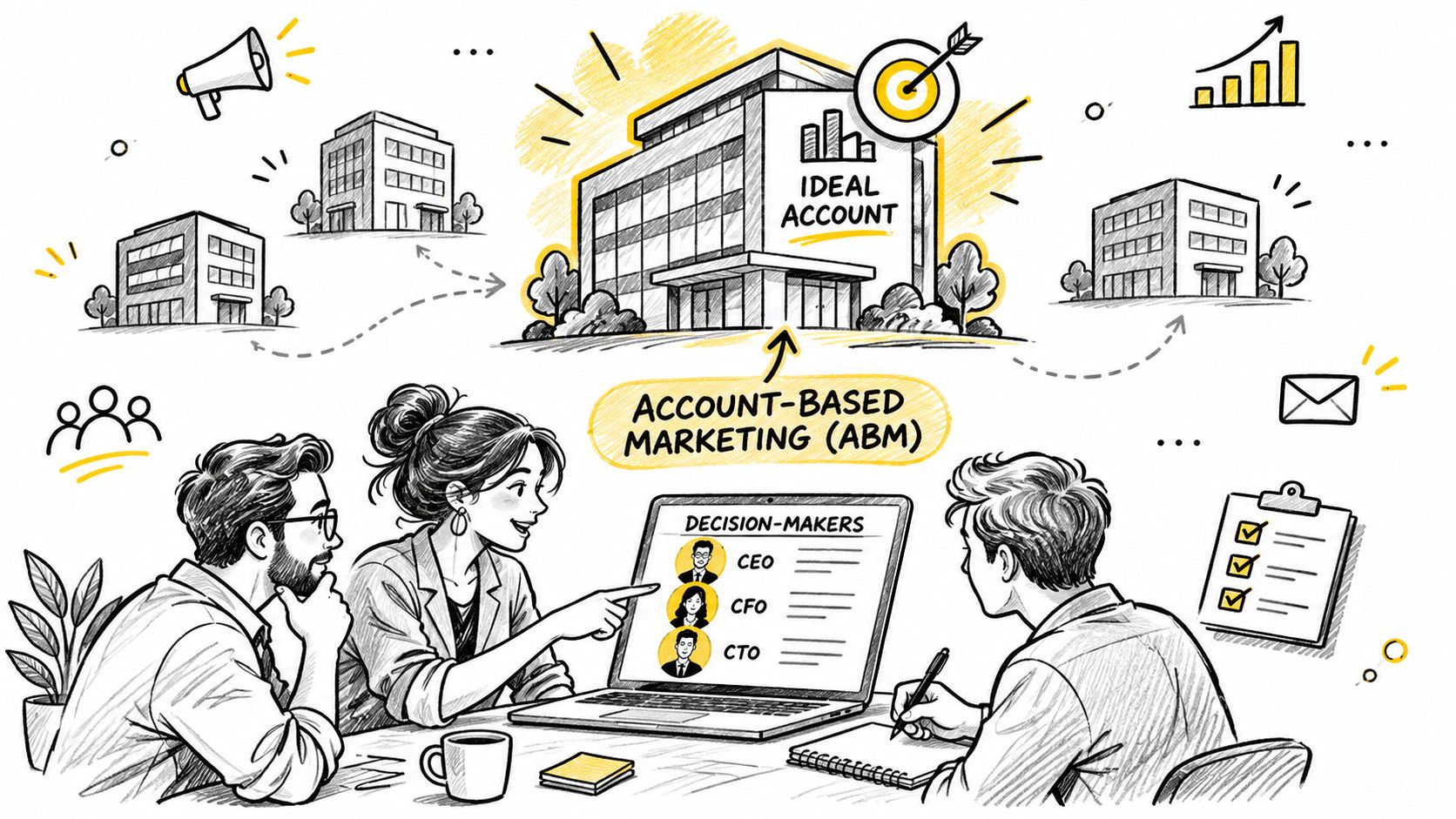
ABM concentrates marketing and sales resources on a defined list of high-value targets instead of chasing lead volume. The team researches each account, maps the buying committee, and coordinates ads, email, events, and rep touches around the same message. Terminus and Demandbase built platforms around orchestrating those ads, website personalization, and account reporting. Enterprise vendors commonly run tiered programs, with executive outreach reserved for the top tier and lighter coverage below it.
For a company selling a B2B data API, ABM pays off with sales intelligence vendors, recruiting platforms, and SaaS companies whose contract values justify a personalized program. It also pairs naturally with fresh firmographics pulled from company URLs, because headcount, industry, and headquarters decide whether an account belongs on the list at all.
AI has made personalization at volume easy, and the returns are mixed. Benchmark reporting on AI-driven demand generation puts adoption at roughly 87% to 95% depending on the survey, while only about 41% of marketers can demonstrate measurable return on that investment, and trust in AI-written content fell from 72% in 2023 to 58% in 2025, according to lead-spot's 2026 AI benchmark report. Personalized outreach built on stale or inferred attributes lands in the same bucket.
- Build lists from firmographic fields: industry, headcount, founding year. Refresh the list before every campaign wave rather than once a year.
- Verify the company domain before spend: one wrong domain burns ad budget and sends a rep into the wrong lobby.
- Map two or three contacts per account: pull current titles and roles instead of working from a static contact list that was accurate at import.
- Report account-level engagement: stakeholders reached, roles covered, meetings held. Lead counts hide whether a committee is moving.
4. Intent Data Targeting
Intent data tells you which companies are already researching the category. It's useful right up until a rep dials a contact whose situation changed since the signal fired.
These signals come from content consumption, search behavior, and third-party publisher activity. Bombora supplies company-level intent that many B2B teams use for prioritization. 6sense layers intent on predictive scoring to recommend accounts and estimate buying stage. Used alone, either one produces a ranked list with no context about who to call.
The catch is that a large share of buying research now happens where tracking can't see it. A 2026 state of B2B growth marketing report notes that 67% of B2B buyers prefer a rep-free buying experience, and that AI assistants, private communities, podcasts, and peer recommendations leave little attributable web activity. Intent data is one input into that blind spot, not a substitute for asking buyers how they found you.
Pair intent with website visitor tracking software for first-party engagement, then confirm fit against live company and profile records before a rep makes contact.
- Set thresholds from your own conversion history: vendor defaults are somebody else's funnel.
- Re-verify the account before outreach: current headcount and industry, not the fields that were true when the signal fired.
- Match each surge to one asset: a use-case guide or integration tutorial, not a generic demo request.
- Audit quarterly: retire any signal type that hasn't produced a meeting in two quarters.
5. Signal-Based Outbound Sales
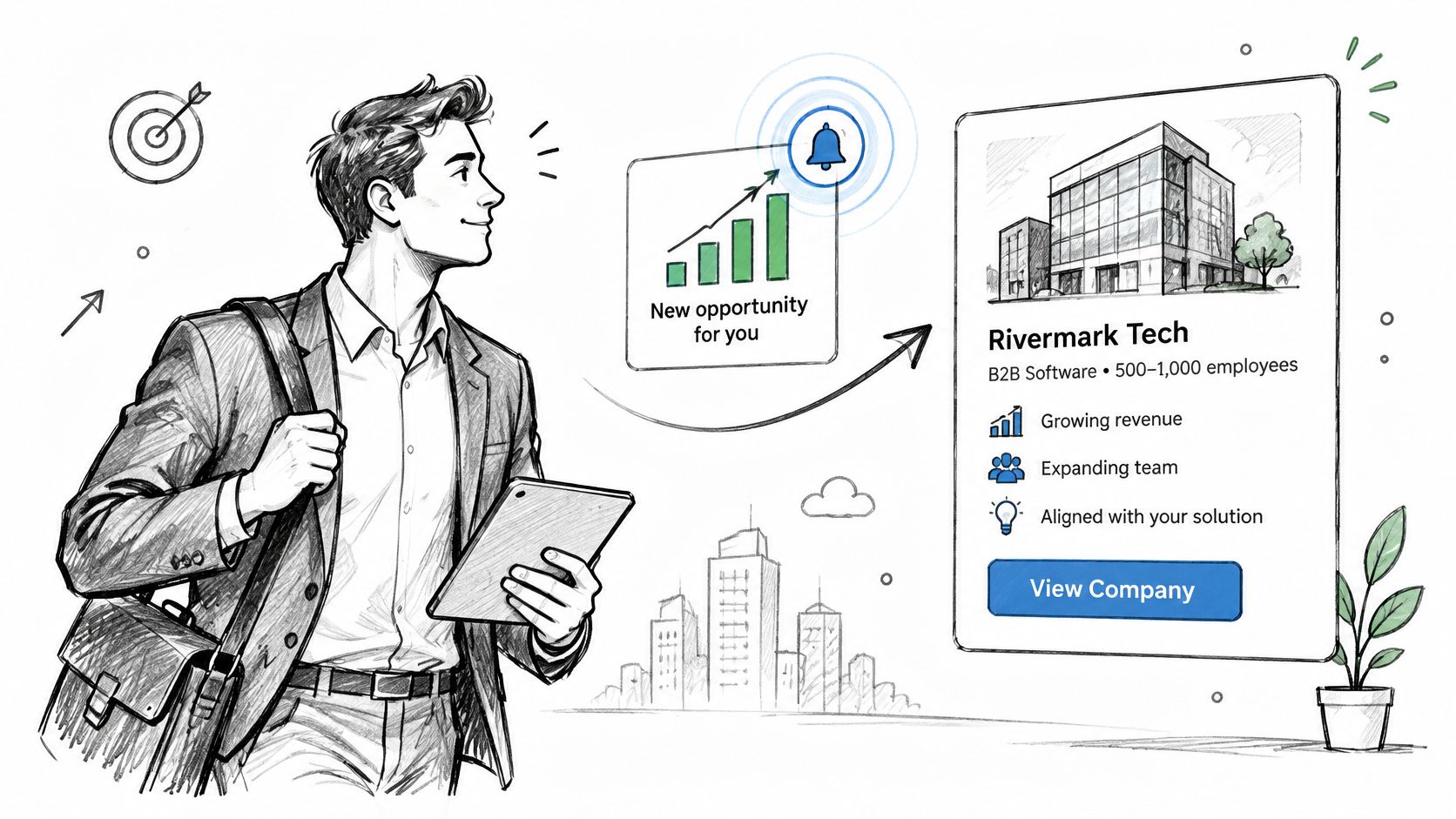
A trigger without a fresh record is just a cold email with a story attached.
Signal-based outbound fires when something specific changes: a new hire in a relevant role, a funding round, a headcount jump, a product launch, a leadership swap. Instead of running a static list through a sequence, reps reach out when the timing explains why now. For data API vendors, signals drawn from public professional data and company information can trigger sequences for recruiting teams, sales tooling vendors, and SaaS products that live or die on current records. The buying signals use case turns what accounts publish, and who reacts to it, into timed outreach.
Because live fetching returns current page state on every call, a rep can confirm the account and the person at the moment of sending rather than trusting a list built last month.
The human layer still matters. Gartner's B2B buying research found that buyers using digital self-service are 1.65 times more likely to regret a purchase than buyers on rep-led paths, while buyers are 1.8 times more likely to complete a high-quality deal when digital tools are used together with a sales representative, as detailed in the Gartner B2B buying report. Timing the human touch is the strategy. Automating the whole path is not.
Compliance is part of the build, not a review step. Under the CAN-SPAM Act, which applies to B2B commercial email in the United States, each separate violating email can carry a civil penalty of up to $53,088, opt-outs must stay functional for at least 30 days after sending, and requests must be honored within 10 business days, per the FTC's compliance guide.
- Refresh immediately before send: one lookup per contact beats a quarterly list cleanse.
- One trigger, one message: reference the specific event, then stop.
- Document the lawful basis: keep evidence for GDPR and CCPA and include an opt-out in every message.
- Measure reply rate by trigger type: delete the triggers that don't earn replies.
6. Progressive Profiling and Enrichment at Sign-Up
The longest form on your site is the one asking for headcount, industry, and headquarters when all three sit behind the work email the visitor already typed.
Progressive profiling asks for almost nothing at sign-up, then collects detail across later sessions. Enrichment covers the gap between the two. A prospect submits a work email and company name, a lookup resolves firmographics from the domain, and routing and personalization run before anyone reviews the record. Clearbit, now part of HubSpot, popularized this pattern by populating company fields from an email domain, and short sign-up forms backed by enrichment have since become standard practice across B2B products.
The supporting evidence is dated, though it points the same way. In a 2012 survey of 373 B2B marketers, 61% reported generating more leads after integrating marketing automation and 60% reported passing better-quality leads to sales, according to Chief Marketer's coverage of the survey. Volume and qualification only rise together when the record is fresh at the moment it enters the flow. Scoring each signup against your ICP through a people enrichment API uses the person's current title and company size, rather than whatever a visitor typed into a form months earlier.
- Ask for two fields: work email and company name. Enrich the rest, including title and seniority.
- Verify the domain before populating: a mistyped domain produces confident nonsense in every downstream field.
- Let users correct enriched data: show what you filled in and give them an edit path, because the record decays the moment someone changes roles.
- Publish the lawful basis at collection: UK guidance from the ICO on direct marketing and data protection identifies six lawful bases for processing personal data and requires the chosen basis to match the purpose. Pick consent or legitimate interests before the form goes live, and keep the evidence with the record.
7. Free Tools and Interactive Lead Magnets
A free tool is the shortest demo you can give, and it works because it answers one narrow question in seconds.
Calculators, lookup tools, and report generators attract search traffic and capture contact details in exchange for a result the visitor wants. For a B2B data API, a free company lookup or profile enrichment checker demonstrates the structured JSON output and the speed of live fetching in the same session. HubSpot's Website Grader has run for years as a lead asset for exactly this reason. Ahrefs publishes free backlink and keyword tools that pull traffic and graduate users into paid subscriptions.
Lead generation remains close to the top of the agenda for B2B teams. In 2024 it ranked as the second-highest marketing objective with an average priority score of 7.6 out of 10, according to Grant Marketing's 2024 B2B marketing benchmark report.
The plumbing is where these tools fail. A tool page that carries FAQ or review markup for content the visitor can't see breaks search guidelines. Google's structured data policies require markup to describe content visible to page readers, and Google may withhold rich results when time-sensitive content is no longer relevant. If your tool page says pricing changed last month, the markup and the page have to agree.
- One output per tool: a headcount and industry snapshot beats a dashboard nobody asked for.
- Rate limit the public endpoint: protect capacity and route heavy users to the free tier.
- Link results to documentation: every output should end with the endpoint that produced it.
- Track tool-to-signup conversion: retire any tool that draws traffic without producing accounts.
8. Inbound SEO Content and Topic Clusters
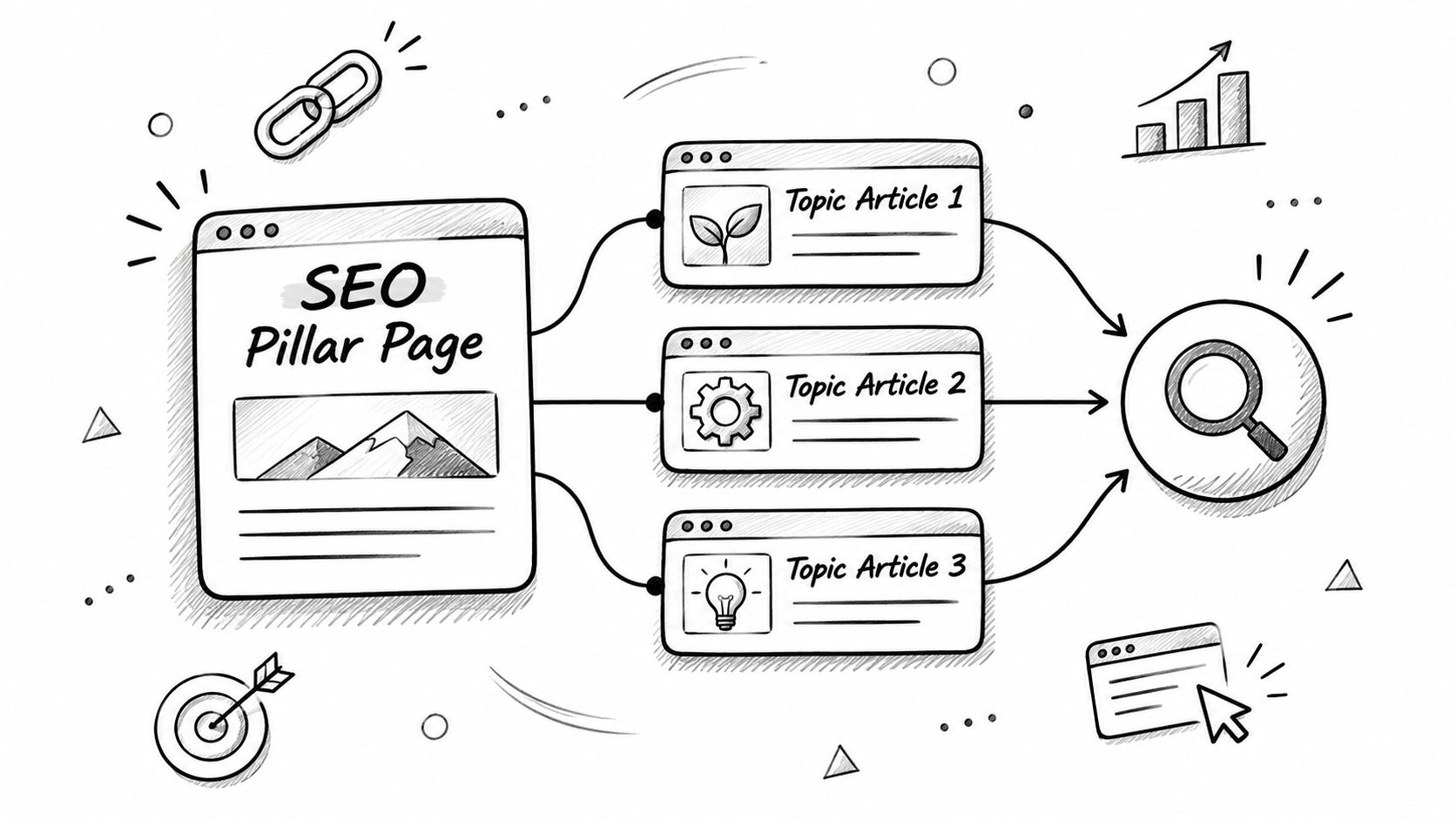
Most of your market isn't shopping this quarter. The content you publish now is how you end up on the shortlist when they start.
Topic clusters organize a pillar page around supporting articles that link back to it, which gives search engines a clear picture of what the site covers and gives readers a path through the subject. For a data API company, those clusters map to profile enrichment, company firmographics, engagement analytics, and CCPA and GDPR obligations. Each article ends at a relevant endpoint or tutorial, so organic traffic turns into signups instead of bounce.
Content still carries the widest reported funnel effect. In the Content Marketing Institute's 2025 B2B benchmark, 87% of surveyed B2B marketers said content marketing helped create brand awareness over the previous 12 months, and 74% reported an impact on demand or lead generation, according to the CMI 2025 B2B content marketing research.
Scale is where teams get hurt. Google's spam policies define scaled content abuse as producing many pages primarily to manipulate rankings rather than help users, and treat automated transformations that add little value as an example. Swapping city names or job titles across near-identical landing pages is a search-quality risk, not a demand strategy.
- One pillar per use case: lead enrichment, recruiting intelligence, AI agent data retrieval. Three pillars beat thirty orphans.
- Include a real JSON response: technical readers trust the output, not the description of it.
- Link every article to a quickstart: the next step should be one click away.
- Refresh latency and pricing figures yearly: stale numbers on a technical page cost credibility fast.
9. Integration Marketplace and Partner Co-Marketing
A buyer's first encounter with a data API is often an install button inside the CRM they already pay for, not a landing page. That placement is why marketplace listings outperform a lot of paid acquisition: the product shows up where the work happens.
CRM platforms, automation tools, recruiting systems, and no-code builders all run directories where integrations install in a few clicks. Co-marketing then pushes those listings through joint webinars, case studies, and partner newsletters. Zapier's app directory connects thousands of services into workflows and creates real discovery for smaller API products. Salesforce AppExchange and the Shopify App Store do the same for their ecosystems.
The channel math has changed. McKinsey's B2B Pulse research found buyers use approximately 10 channels during the purchasing journey, compared with about five in 2016, and that high performers mix in-person, remote, and self-service digital interactions, per McKinsey's B2B Pulse analysis. A listing only pays off when the signup behind it is handled like any other inbound lead. Score partner-sourced signups against your ICP when they arrive, using current title and company size, and route each one before it reaches a human. Re-enrich those records on a schedule as well, since partner leads go stale to job changes like any other list.
- Pick marketplaces where your audience already automates: enrichment and outbound workflows first, general app stores second.
- Ship a template workflow: enriching a CRM contact from a professional profile URL is the demo that sells itself.
- Give partner users a reason to activate: a credit bonus or a dedicated onboarding guide.
- Track partner-sourced pipeline separately: otherwise the channel looks free when it isn't.
When scoping which connectors to build first, a directory of supported outbound tool integrations shows which sequencers and CRMs outbound teams already run, which is where a data API plugs in.
10. Conversational Marketing and Website Engagement
A pricing page with no way to ask a question is a dead end for anyone evaluating a technical product.
Conversational marketing replaces the static form with real-time dialogue through chat, bots, or instant meeting booking. The goal is to engage while interest is high, answer the objection immediately, and route the visitor to the right owner. Drift popularized the category by routing website visitors to reps in real time. Developer tools use the same mechanic differently, pointing visitors to documentation or to a sales team depending on what they ask.
Answer the questions that stall deals
For a technical product, most chat questions are factual. What are the rate limits? How does pricing scale? Which endpoints are covered? Self-serve plans run at 5 requests per second, while dedicated capacity scales up to 100 requests per second, so the answer is specific rather than "contact us."
- Route by question type: developers to the free tier and docs, enterprise evaluators to a meeting.
- Script the top five objections: rate limits, pricing, coverage, compliance, and latency.
- Disclose identification: say in the privacy notice if visitors are identified, and offer an opt-out.
- Read transcripts monthly: they're the cheapest source of objection data you'll ever get.
Keep chat out of the critical path. If the bot can't answer in two exchanges, hand it to a person or a documentation link, never a loop.
How the 10 demand generation strategies compare on cost, speed, and fit
| Item | Best For | Time to Results | Main Cost Driver | Key Trade-off |
|---|---|---|---|---|
| Product-Led Growth with a Free Tier | Letting developers test and adopt a product themselves | Fast initial trials; paid conversion may take longer | Free-tier support and onboarding | Scales self-serve acquisition but requires strong guidance to convert users |
| Developer-Led Content and API Documentation | Reaching engineers seeking implementation solutions | Slow; compounds over months | Creating and maintaining technical content | Builds trust and reusable assets but needs ongoing updates |
| Account-Based Marketing (ABM) | Pursuing a defined list of high-value accounts | Slow; long sales cycles | Personalized campaigns and account data | Focuses resources on valuable accounts but requires coordination and current data |
| Intent Data Targeting | Prioritizing accounts showing potential buying interest | Timely when signals appear; results depend on validation | Intent data subscriptions | Improves prioritization but signals can be noisy and costly |
| Signal-Based Outbound Sales | Contacting prospects after relevant business events | Potentially fast after a signal | Signal data and outreach automation | Makes outreach timely but stale signals or over-automation can undermine relevance |
| Progressive Profiling and Enrichment at Sign-Up | Improving lead data while keeping forms short | Fast for form completion and routing | Enrichment data and implementation | Reduces form friction but can produce mismatches and raise privacy concerns |
| Free Tools and Interactive Lead Magnets | Demonstrating product value and attracting problem-focused visitors | Variable; depends on traffic and tool adoption | Tool development and maintenance | Can attract qualified users but many may not convert |
| Inbound SEO Content and Topic Clusters | Building sustained organic discovery for relevant searches | Slow; usually takes months to compound | Content creation, updates, and link building | Lowers long-term acquisition costs but requires sustained investment |
| Integration Marketplace and Partner Co-Marketing | Reaching buyers through tools and ecosystems they already use | Variable; listings and approvals may take time | Connector development, certification, and partner promotion | Adds trusted distribution but partners may limit visibility or margins |
| Conversational Marketing and Website Engagement | Engaging and routing high-intent website visitors | Fast for visitor response and qualification | Chat tooling, staffing, and setup | Reduces response friction but poor automation can frustrate visitors |
Building a Demand Engine That Compounds Over Time
No single strategy fills the pipeline. The teams that compound results pick the play that matches how their buyers start, then wire fresh data underneath it so every touchpoint reflects current reality.
Start where your first contact happens. If engineers evaluate the product before anyone talks to sales, the free tier and documentation are your demand engine, and everything else feeds them. If twelve accounts carry the quarter, ABM and signal-based outbound deserve the budget. Most companies need one self-serve play plus one sales-assisted play running in parallel, measured on the same account-level scorecard.
Budget is moving, but not dramatically. In 2025, 35% of surveyed organizations said their demand-generation budgets increased slightly, according to Demand Gen Report's 2025 benchmark survey. That's not a mandate to add channels. It's room to fix the data underneath the channels you already run.
Measurement is where the pressure sits. In 2024, 73% of B2B marketers said they were increasing their emphasis on measurement and attribution, per The Mx Group's 2024 measurement and attribution survey. Attribution alone won't get you there when discovery happens in assistant answers and private communities. Pair it with self-reported attribution, branded search trends, and account-level engagement, and treat the first identifiable CRM event as the middle of the journey rather than the start.
Two operating habits matter more than any single tactic. First, refresh before you activate. Every strategy above fails the same way, when a rep or a workflow acts on a record that no longer describes the account. Second, define the qualification step in advance. Whether that's a credit threshold, a stakeholder count, or a verified domain, write the rule down and let the data enforce it.
Fetchin is a B2B data API that returns live professional profile and company data on each call, and it has been serving production traffic since 2023. Every self-serve credit volume runs at 5 requests per second, dedicated capacity is provisioned in 2 to 5 business days, and only successful or not-found calls consume credits. If you're rebuilding the data layer under a demand program, that last detail matters more than it sounds. For a wider view of how demand work extends past lead capture, this piece on demand generation beyond lead harvesting is worth your time.
You can open a free account with your name, work email, company name, and billing details, then test the enrichment steps above against accounts you already know well.
Fetchin turns a professional profile URL or a company URL into structured JSON, with median response times around one second, so lead routing, ICP scoring, and personalization happen inside the moment of engagement instead of in an overnight batch. Open a free account with 1,000 credits and run a lookup against five accounts on your target list, then compare the response quality with the records already sitting in your CRM. Start at Fetchin and see what your pipeline looks like when the data is current.