You have a name, a company, or a professional profile URL, but not enough confidence to know whether you've found the right person. A manual search may produce a plausible result, yet product teams need more than plausibility. They need structured data, current page state, measurable confidence, predictable API behavior, and a clear boundary between legitimate professional research and invasive personal-data collection.
To look for someone reliably, treat the task as an identity-resolution pipeline. Start with a useful identifier, fetch public professional data, compare independent signals, validate the match, and record why the system accepted or rejected it. That approach works better than treating a directory result as proof.
Table of Contents
- The Reality of Modern Identity Resolution
- Fetching Structured Data from Professional URLs
- Triangulating Signals to Verify the Right Person
- Managing API Latency and Throughput at Scale
- Navigating Privacy and Compliance Requirements
- Building Reliable Lookup Features for Production
The Reality of Modern Identity Resolution
People-finding has never depended on one perfect identifier. Archival research guidance points researchers toward local birth, death, and marriage records, census records, alternate spellings, approximate dates, and places of birth because names alone create ambiguity. Civil registration, census enumeration, and municipal vital records became important foundations for locating people, but those records remained fragmented across jurisdictions and institutions, as illustrated by historical people-search guidance.
Modern systems face the same problem in a more dynamic environment. A person may have a common name, a changed surname, several employers, multiple locations, and professional profiles with different levels of completeness. A company database may retain an old title while a public profile shows a newer role. An email address may identify an account but not establish that the account belongs to the person your application intended to find.
Demand makes the engineering problem impossible to dismiss. One public people-search service reported 35,583,311 searches in a single year in its published service information. Users often begin with only a first and last name, or a name combined with a city or state. That low-input behavior creates a high risk of false matches, particularly when an application automatically promotes the first plausible record to a confirmed identity.
Practical rule: A lookup result is evidence, not identity. Your system should preserve the signals that support the match.
Why directory-style lookup fails
Traditional directories usually optimize for recall and convenience. They aggregate records, normalize names, and return a profile that appears complete. That model can work for an exploratory consumer search, but it becomes fragile inside enrichment, recruiting, sales intelligence, and AI-agent workflows.
The core weaknesses are familiar:
- Stale attributes: Job titles, employers, cities, and contact fields change, while an indexed record may remain unchanged.
- Ambiguous names: Common surnames can produce multiple candidates with similar occupations or locations.
- Unclear provenance: A result may not show which public source supports each field.
- Weak auditability: Teams may know what the system returned but not why it selected that person.
- Privacy spillover: A user trying to identify a professional can receive unrelated personal information about relatives, neighbors, or associates.
A professional lookup feature should therefore separate candidate discovery from identity confirmation. The first step can collect possible matches. The second must compare independent markers and apply a confidence policy before writing data into a customer record.
For implementation patterns around endpoints, schemas, and people-data workflows, the people data API guide offers useful product context. Teams that need human review for a sensitive contact workflow can also consult this resource on human verified LinkedIn email extraction, while keeping the actual system design focused on consent, public professional data, and verification rather than indiscriminate collection.
Fetching Structured Data from Professional URLs
For a B2B workflow, a professional profile URL is often a stronger starting key than a name. A URL can point to a specific public profile, while a name can refer to many people. It still isn't proof of identity, but it gives the extraction service a narrower target and lets your application preserve the exact input used during resolution.
A professional data API can fetch publicly available profile information and return structured JSON rather than forcing engineers to parse page layouts inside the product. Public profile APIs may expose a stable profile URL and structured fields such as identity, biography, follower counts, verification status, and account type, as documented in this professional profile API reference. Access isn't universal, however. Public-facing APIs commonly distinguish between public data and fields available only through private permissions or restricted developer programs, as shown in this public profile API documentation.
A practical extraction sequence
- Accept the narrowest legitimate identifier. Prefer a professional profile URL supplied by the user, a URL already associated with a business workflow, or a combination of name, employer, and location. Don't begin by collecting unrelated personal attributes.
- Validate the input format. Normalize the URL, remove tracking parameters, preserve the canonical path, and reject unsupported domains before making an API call.
- Fetch the current public profile state. Request the profile endpoint and retain the response timestamp, input URL, returned canonical URL, and provider status.
- Map the response into your internal schema. Store fields such as current and previous positions, education, skills, locations, biography, profile identifiers, and contact fields separately. Don't flatten every attribute into one untraceable text field.
- Record field-level provenance. A downstream reviewer should be able to see which response supplied a title, company, location, or biography fragment.
The distinction between live fetching and a cached snapshot matters most when your product makes decisions from current employment or company context. A periodic index may be efficient for broad discovery, but it can preserve old roles or obsolete locations. Fetching on demand gives the application a current response for the request, although it also introduces latency, availability, permission, and cost considerations.
A useful design is hybrid rather than ideological. Use stored identifiers and prior matches to avoid unnecessary calls, then fetch again when the user opens a record, a confidence score drops, or a workflow depends on current role information. The data API explainer provides additional context on structured retrieval and application integration.
Triangulating Signals to Verify the Right Person
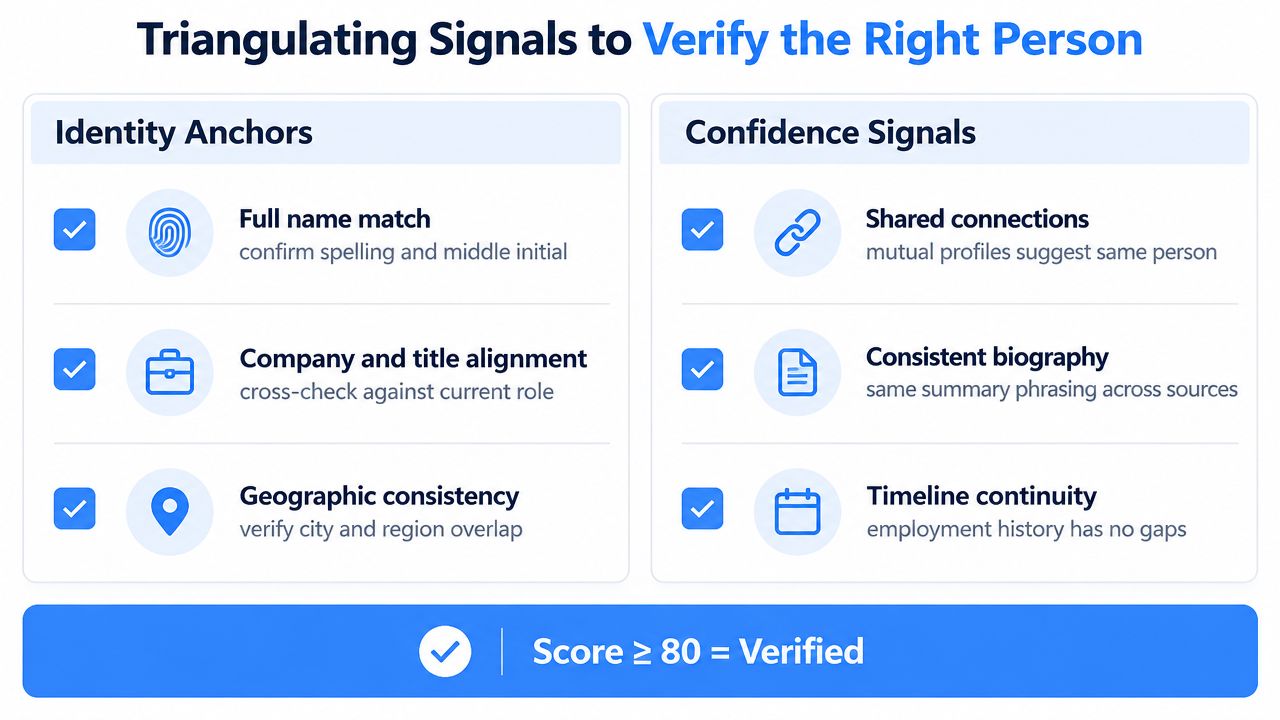
Finding a profile is only half the job. The dangerous failure occurs when an automated system assigns that profile to the wrong individual and downstream tools treat the assignment as fact. A precise matcher should compare at least three independent signals, such as full name, approximate age, a known prior address, and a relative connection, following the identity-matching guidance. In a professional system, replace or supplement sensitive personal markers with current company, title, location, career timeline, and stable profile identifiers.
A practical matcher doesn't ask whether one field matches. It asks whether the combined pattern makes sense and whether the signals are sufficiently independent. A full name and a copied biography may come from the same underlying source, so they shouldn't count as two independent confirmations. A company endpoint, a profile endpoint, and a user-supplied URL provide a stronger combination because each contributes a different type of evidence.
Build a confidence decision
Use a policy that is explicit enough to test. For example, the application can classify a candidate as unverified, review required, or accepted, with each state tied to observable conditions rather than an opaque model score.
Useful checks include:
- Name integrity: Confirm spelling, middle initials, suffixes, and known former names where lawful and relevant.
- Company alignment: Compare the profile's employer and title with the company endpoint's firmographic data, including industry, headquarters, verified domain, and other business context.
- Geographic consistency: Check whether the public professional location is compatible with the known region or employment history.
- Timeline continuity: Look for plausible transitions between roles and education. A sudden contradiction should lower confidence.
- Engagement context: Posts, comments, and reactions can help establish that activity belongs to the same professional identity, but engagement is supporting evidence, not a unique identifier.
- Profile continuity: Compare canonical URLs, stable IDs, biography language, and other persistent public fields.
The system should also retain negative evidence. If the candidate works in a different industry, has an incompatible location, or has a timeline that conflicts with the user's known information, record the reason for rejection. This makes human review faster and prevents the matcher from repeatedly resurfacing the same wrong candidate.
A high-confidence match needs converging signals and an explanation. A high similarity score without provenance is not verification.
Don't use identity resolution to infer sensitive traits or to turn weak public clues into a private dossier. The safest production design limits fields to the purpose of the workflow, gives users a way to correct records, and routes uncertain matches to review instead of forcing a binary answer.
Managing API Latency and Throughput at Scale
A user submitting a professional profile URL expects a prompt result. A background enrichment job has different requirements: it must absorb slow upstream responses, process many records, and retry without holding open a web request. Choose synchronous delivery for interactive lookups and asynchronous delivery for queues, batch enrichment, and recurring refreshes.
| Delivery Method | Best Use Case | Latency Profile |
|---|---|---|
| Synchronous response | Interactive lookup, profile preview, confidence review | Immediate response required, bounded by upstream availability |
| Asynchronous delivery | Batch enrichment, recurring refreshes, large workflow queues | Variable completion time, better separation from user-facing requests |
Model the integration as a request lifecycle rather than a single HTTP response. Normalize the input, generate an idempotency key from the input and workflow purpose, persist request state, and make retries safe. Classify failures before retrying. A temporary upstream error can receive backoff, while an invalid URL, denied access, or unsupported profile should become a terminal failure.
Rate limits are part of the API contract, and this guide to API rate limits explains pacing strategies in detail. Some professional-tier APIs cap usage at 100 requests per minute, while raw-data APIs may allow 10 requests per second, as documented in this rate-limit reference as documented in this rate-limit reference. These limits belong to particular service tiers, not to the industry as a whole. Read response headers when available, then enforce a client-side token bucket or leaky-bucket scheduler.
Protect throughput and budget
- Queue work by priority: Keep interactive requests ahead of bulk refreshes.
- Deduplicate inputs: Canonicalize URLs before enqueueing so repeated lookups do not consume capacity.
- Retry selectively: Apply exponential backoff to transient failures and stop on permanent validation errors.
- Track credit outcomes: Store requested, succeeded, failed, and retried counts separately.
- Measure tail performance: Median latency can appear healthy while slow calls hurt the product, so monitor high-percentile latency and end-to-end completion time.
- Expose operational state: Show whether a profile is fresh, pending, unavailable, or awaiting review.
A production client also needs overload protection. Cap concurrent work per provider, reserve capacity for interactive traffic, and add jitter to retry delays so workers do not reconnect simultaneously. Monitor queue age, provider errors, rate-limit responses, and freshness separately. Those signals distinguish an upstream outage from an overloaded scheduler or stale data.
Treat throughput as a scheduling problem. Smooth demand, protect user-facing calls, and prevent failed requests from creating a retry storm.
Navigating Privacy and Compliance Requirements
A common assumption is that public information is automatically safe to collect and reuse. That assumption is too broad. Public professional data can still be personal data, and the intended purpose, legal basis, retention period, access controls, and user expectations all matter.
The FTC warns that opting out of one people-search service may not eliminate exposure. Information can persist in reports about relatives, neighbors, or associates, and it can reappear when public records change, according to its guidance on people-search sites and information removal. That persistence makes static directory thinking especially risky. A removal request isn't a universal deletion from every source, and a product shouldn't imply that it is.
Put boundaries into the pipeline
Start with data minimization. Collect only the public professional fields required for the feature, such as current role, company, professional location, biography, or business contact context. Avoid pulling unrelated household, family, or sensitive personal details only because an upstream source exposes them.
Then make governance operational:
- Define purpose: Document whether the workflow supports lead enrichment, account research, recruiting operations, or another legitimate business use.
- Separate public from restricted data: Public access rules don't imply permission to access fields gated behind private permissions or restricted developer programs.
- Support correction and opt-out: Provide a process for people to challenge inaccurate records, request deletion where applicable, and understand what your product stores.
- Limit retention: Keep raw responses only as long as the use case requires, and retain a concise audit record when a match decision needs explanation.
- Control access: Apply role-based permissions, encryption, logging, and deletion workflows to the returned data.
- Review high-risk uses: Don't use a lookup feature as a substitute for official verification, nor repurpose it for fraud investigations, stalking, or consequential screening.
Privacy-focused enrichment guidance emphasizes collecting publicly available professional data and supporting opt-out or deletion requests in ways aligned with GDPR and CCPA expectations, as described in this contact enrichment API privacy guidance. Teams assessing a vendor should also view the Privacy page to understand how a provider describes its data handling practices.
Real-time extraction can support better privacy than indefinite aggregation when the workflow fetches only what the user needs, uses it for a declared purpose, and avoids building a permanent personal-data warehouse. Freshness alone doesn't make a system compliant. The combination of narrow scope, clear provenance, controlled retention, and user rights does.
Building Reliable Lookup Features for Production
A production lookup feature starts with a narrow job. A sales application may need to confirm that a professional profile belongs to a contact at a target company. A recruiting product may need current role and employment context. An AI agent may need a source-linked profile summary before it drafts an outreach message. Each case should define its accepted fields, freshness expectation, confidence threshold, and review path before engineering chooses an endpoint.
The implementation can follow a compact operating model:
- Capture the input and purpose. Store the normalized professional profile URL or other permitted identifier with the workflow that generated it.
- Fetch structured public data. Use a B2B data API or professional data API that returns consistent JSON and makes access boundaries clear.
- Resolve the company context. Compare employer, domain, industry, headquarters, and title rather than relying on a name match.
- Score and explain. Combine independent signals, preserve contradictions, and route uncertain records to human review.
- Monitor freshness and quality. Track response timestamps, field completeness, rejected matches, corrections, and changes in canonical identifiers.
- Control operations. Apply queueing, rate-limit handling, idempotent retries, credit monitoring, and access logging.
For example, a product can accept a profile URL from a customer, fetch the current public profile, resolve the employer through a company endpoint, compare the returned firmographic context, and show a review card with the evidence behind the match. If the company or timeline conflicts, the system can hold the record instead of writing a false contact into the customer's CRM.
Fetchin is one option for this architecture. It provides a real-time B2B data API that turns professional profile and company URLs into structured JSON, with endpoints for profile attributes, company context, posts, comments, and reactions, plus synchronous and asynchronous delivery modes. The important design principle isn't the vendor name. It's the decision to make freshness, provenance, confidence, compliance, and operational behavior visible parts of the feature.
Fetchin can help product and engineering teams turn professional profile and company URLs into structured, current data for identity resolution and enrichment workflows. Visit Fetchin to evaluate the API capabilities and design a lookup flow that verifies the right person without treating weak matches as facts.