The most popular advice about choosing a SaaS lead generation company is also the least useful: pick the provider that promises the most leads. Lead volume doesn't tell you whether you need booked meetings, an outsourced SDR process, full-funnel pipeline measurement, paid acquisition and conversion support, or fresh structured data inside your product. Those are different revenue jobs, with different owners, costs, implementation burdens, and success metrics.
This ranking separates managed services from software and data infrastructure. It weighs service model, target customer, pricing transparency, scalability, data freshness, and the operational difference between creating demand and executing sales outreach. The list moves from specialized real-time infrastructure and managed outbound to broader demand-generation and paid-media options, so you can identify the category that matches your bottleneck and scale your B2B pipeline in 2026 without treating every vendor as interchangeable.
Table of Contents
- 1. Fetchin
- 2. Belkins
- 3. CIENCE
- 4. Martal Group
- 5. Powered by Search
- 6. Directive
- 7. Hey Digital
- Top 7 SaaS Lead Generation Companies Comparison
- Match the Provider to the Revenue Job
1. Fetchin
Best for product-integrated B2B data infrastructure
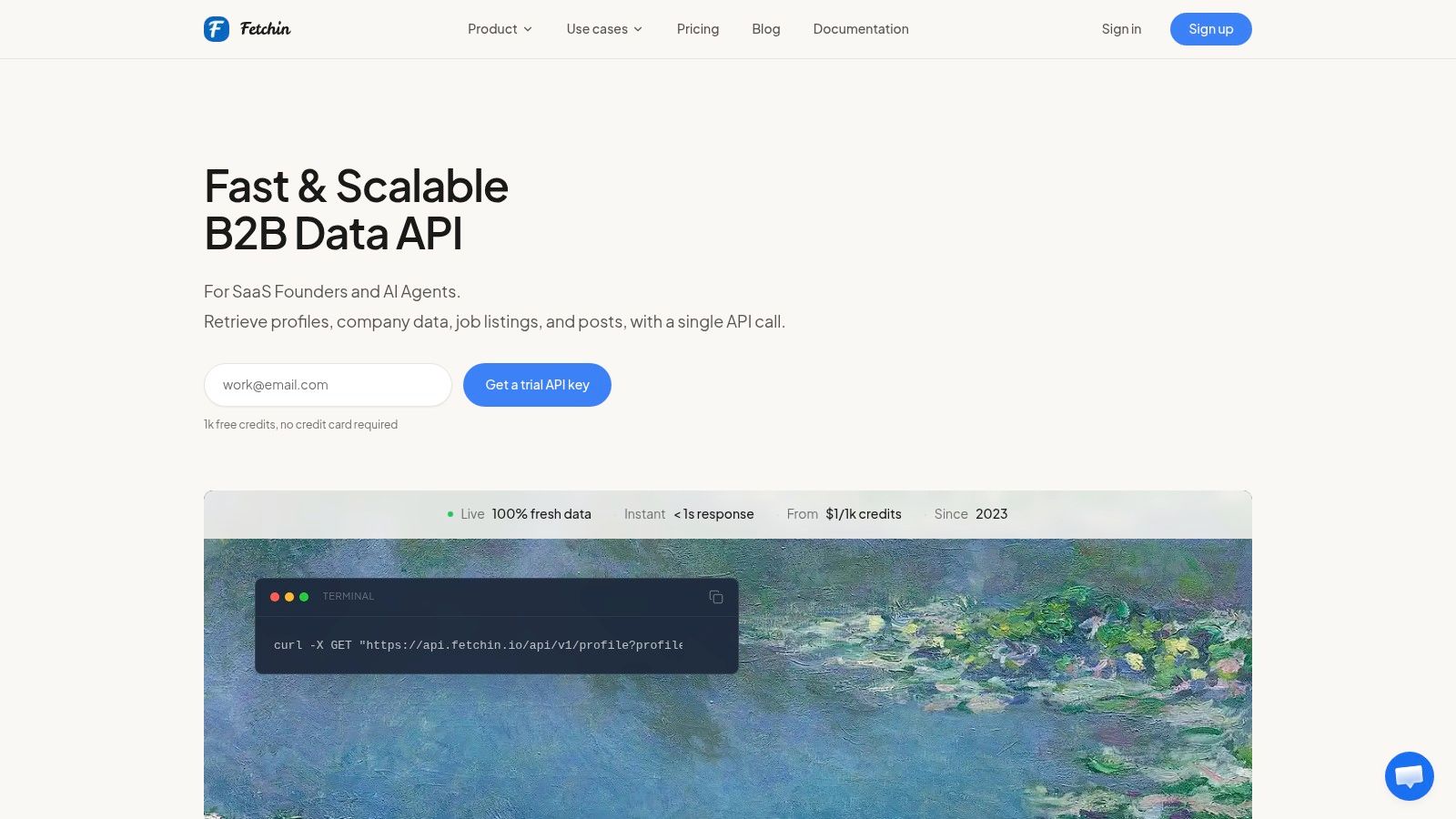
Fetchin is the outlier in this list because it isn't an outsourced sales team or a conventional marketing agency. It's a real-time B2B data API for SaaS founders, engineers, product teams, recruiting platforms, and sales intelligence vendors that need current people and company context inside their own workflows.
A professional profile URL or company URL can be turned into structured JSON, including 100+ profile attributes, positions, education, skills, locations, contact fields, and company firmographics. Additional endpoints cover posts, comments, and reactions, allowing a product team to build enrichment, lead scoring, routing, analytics, or AI-agent features without stitching together separate data services. Fetchin's documentation also describes extracting profile information and posts to build targeted lead lists, as well as enriching inbound leads with role, seniority, and firmographic data for qualification and routing.
Why the live-fetch model matters
Snapshot-based data can be useful for broad prospecting, but it introduces a freshness problem when a SaaS product needs the current state of a professional or company record. Fetchin fetches public data on demand, with median responses near one second and approximately 1.5 seconds at P95, according to the publisher's product information. That makes it better suited to synchronous enrichment, matching, and routing than a run-based workflow that waits for a batch to complete.
The API returns consistent schemas for direct integration. Synchronous delivery is the default, while optional asynchronous processing supports workflows where latency tolerance is higher. Self-serve rate controls reach 5 requests per second, and dedicated capacity can scale to 100 requests per second for higher-throughput applications. Dedicated capacity is provisioned in 2 to 5 business days, so larger implementations need capacity planning rather than a last-minute upgrade.
Practical rule: Choose Fetchin when data retrieval is part of your product experience, not when you simply want someone else to operate outbound campaigns.
Trade-offs and commercial fit
Fetchin offers 1,000 free credits without requiring a card, base pricing from approximately $1 per 1,000 credits, pay-as-you-go and subscription options, and dashboard controls for credits, rates, and live pricing. Failed requests don't consume credits, which improves cost predictability during error conditions. Higher-throughput capacity carries a larger commitment, with published examples beginning around $2,000 per month for 10 requests per second and extending to approximately $20,000 per month for 100 requests per second.
The limitation is equally clear: Fetchin provides public professional data, not private or proprietary records. Its public-only approach aligns with the CCPA and GDPR positioning described by the company, but teams still need their own legal review, consent logic, retention policy, and use-case controls.
Visit Fetchin when your lead-generation capability must be embedded in software rather than delivered as a managed campaign.
2. Belkins
Best for booked meetings through managed outbound
Belkins fits a SaaS company whose immediate constraint is sales capacity, not missing product data. It runs managed SDR-style programs covering research, messaging, outreach, reply handling, calendar management, and appointment setting. The engagement is designed to put qualified conversations on a sales team's calendar, while the client's sales process remains responsible for discovery, evaluation, and closing.
The model reduces operational overhead because the provider supplies the researchers, copy specialists, deliverability work, and scheduling process. Its multi-channel programs combine cold email, phone, and outreach through a professional network. That breadth can help when one channel alone isn't producing enough engagement, but it also makes campaign governance more important. The client should define which replies count as qualified, who owns follow-up, and how no-shows or poor-fit meetings are handled.
Belkins publishes outreach benchmarks and playbooks, which helps buyers assess the operating method before a sales call. Its pricing is presented as an average starter price, with exact costs determined through discovery. That gives the buyer some directional context, but it isn't the same as a fully transparent price sheet.
Where Belkins earns its place
Belkins is strongest when you already have a clear ICP, a credible offer, and account executives who can convert meetings into opportunities. It isn't the right first purchase if the core problem is weak positioning or unclear product-market fit. A managed team can execute a campaign efficiently, but it can't make an undifferentiated offer compelling to a difficult market.
Results also depend on domain health, offer competitiveness, list quality, and the time required to refine targeting and messaging. Ramp periods are normal, so a buyer shouldn't judge the program only by its earliest activity.
For teams comparing the underlying data layer as well as the service layer, this guide to B2B sales intelligence tools provides useful context. The distinction matters because Belkins operates the outbound motion, while a B2B data API supplies information to software and internal systems.
3. CIENCE
Best for a process-driven outsourced SDR engine
CIENCE is a stronger fit than a meeting-only provider when the client needs a defined outbound operating system. Its managed programs cover target-account selection, list building, data verification, multi-channel outreach, qualification, and sales-ready handoffs. It also offers Revenue System Setup to connect demand generation with CRM and revenue operations.
That combination makes CIENCE relevant to SaaS companies that don't just need more activity. They need a repeatable process for deciding whom to contact, how to qualify responses, and how to move accepted opportunities into the sales team's workflow. The quality-control layer is important because a large contact list can create administrative work without creating qualified pipeline.
Budget visibility and execution depth
CIENCE publishes a starting price from $5,600 per month, which gives teams a clearer budgeting reference than a purely quote-based engagement. The final commitment will still depend on scope, channels, target markets, research depth, and campaign complexity. A visible starting point helps with planning, but it shouldn't be mistaken for a forecast of total program cost.
Its strengths are process depth, list-building discipline, qualification standards, and a broad case-study footprint that includes SaaS and other industries. The trade-off is that scaled programs can require a larger monthly commitment than a boutique provider. The client also needs a well-defined ICP and offer, because a refined execution process can't compensate for vague qualification criteria.
The cheapest lead is often the one that never enters the CRM. A useful partner should make acceptance criteria explicit before outreach begins.
CIENCE is the practical choice when marketing and sales leaders want outsourced execution plus operational wiring. Teams researching adjacent lead enrichment tools should separate enrichment from human qualification. Enrichment improves the record. CIENCE's managed service adds research, outreach, conversations, and handoff responsibility.
4. Martal Group
Best for higher-touch, onshore SDR coverage
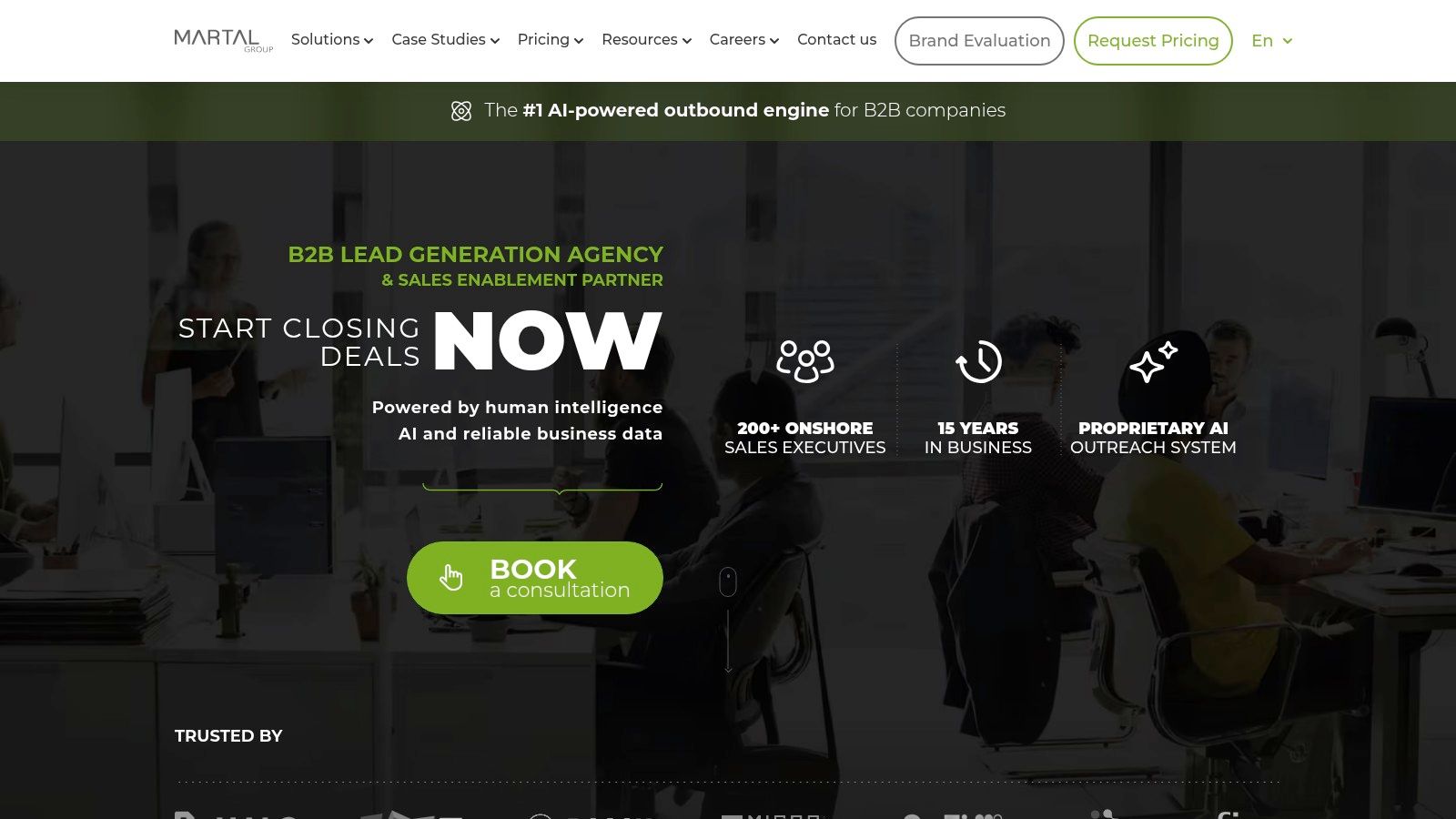
Martal Group serves SaaS and technology companies that value close collaboration, regional coverage, and experienced SDR execution. Its teams support North America, Europe, and Latin America, with an emphasis on onshore representatives, multi-channel outreach, inbound lead qualification, and outbound appointment setting.
That positioning matters for complex B2B sales. A campaign aimed at technical buyers, regulated industries, or multiple stakeholders often needs more than a templated sequence. Representatives must understand the offer, recognize buying context, and route conversations accurately. Onshore coverage can also reduce timezone and cultural friction during training, campaign reviews, and live handoffs.
A fit for complex sales motions
Martal is more appropriate for funded SaaS companies with a developed offer and a sales process that can absorb higher-touch meetings. It isn't a substitute for product marketing, and it won't solve weak CRM instrumentation. The provider can generate and qualify conversations, but the client still needs to define opportunity stages, follow-up ownership, and the evidence required for a meeting to become sales-accepted.
Pricing is quote-based and not published, so buyers should expect a consultation before they can compare total cost. That reduces upfront transparency, though it may allow the engagement to reflect geography, rep seniority, and campaign complexity. Return on investment can also take several sales cycles to evaluate when contract values are high or buying decisions involve many participants.
For teams building territory and account logic, a structured B2B company list can support planning, but a list alone isn't an SDR program. Martal's value comes from the people and process that turn targeting into conversations.
5. Powered by Search
Best for full-funnel demand generation tied to revenue
Powered by Search belongs in a different category from the three managed outbound providers above. Its work combines paid media, SEO, content, conversion systems, and demand-generation operations, with measurement designed to connect marketing activity to pipeline and revenue rather than stopping at MQL counts.
That distinction is important for SaaS companies with a demand problem. An SDR agency can create sales conversations through outbound execution, but it doesn't necessarily build the organic visibility, paid acquisition system, content library, landing-page experience, and attribution feedback loop that support demand over time. Powered by Search is designed around that broader system.
Why the measurement model changes the buying decision
The agency publishes SaaS-specific frameworks and case studies centered on pipeline and revenue outcomes. Those materials can help a buyer evaluate whether the provider understands long and complex sales cycles, where conversions may happen after multiple touches and across multiple stakeholders.
The main trade-off is engagement complexity. These programs are customized and typically aren't entry-level purchases. They also require cooperation from sales operations and CRM owners. If opportunity stages are inconsistent or revenue attribution is unreliable, the agency may produce useful channel work without being able to prove its commercial contribution.
Demand generation creates reasons for buyers to enter the market. SDR execution creates direct sales activity. A SaaS team should know which job it's paying to perform.
Powered by Search is the best match when leadership wants marketing channels managed as one revenue system. It isn't the fastest answer for a sales team that just needs more appointments next month, and it isn't a data API for product enrichment.
6. Directive
Best for integrated performance marketing and RevOps
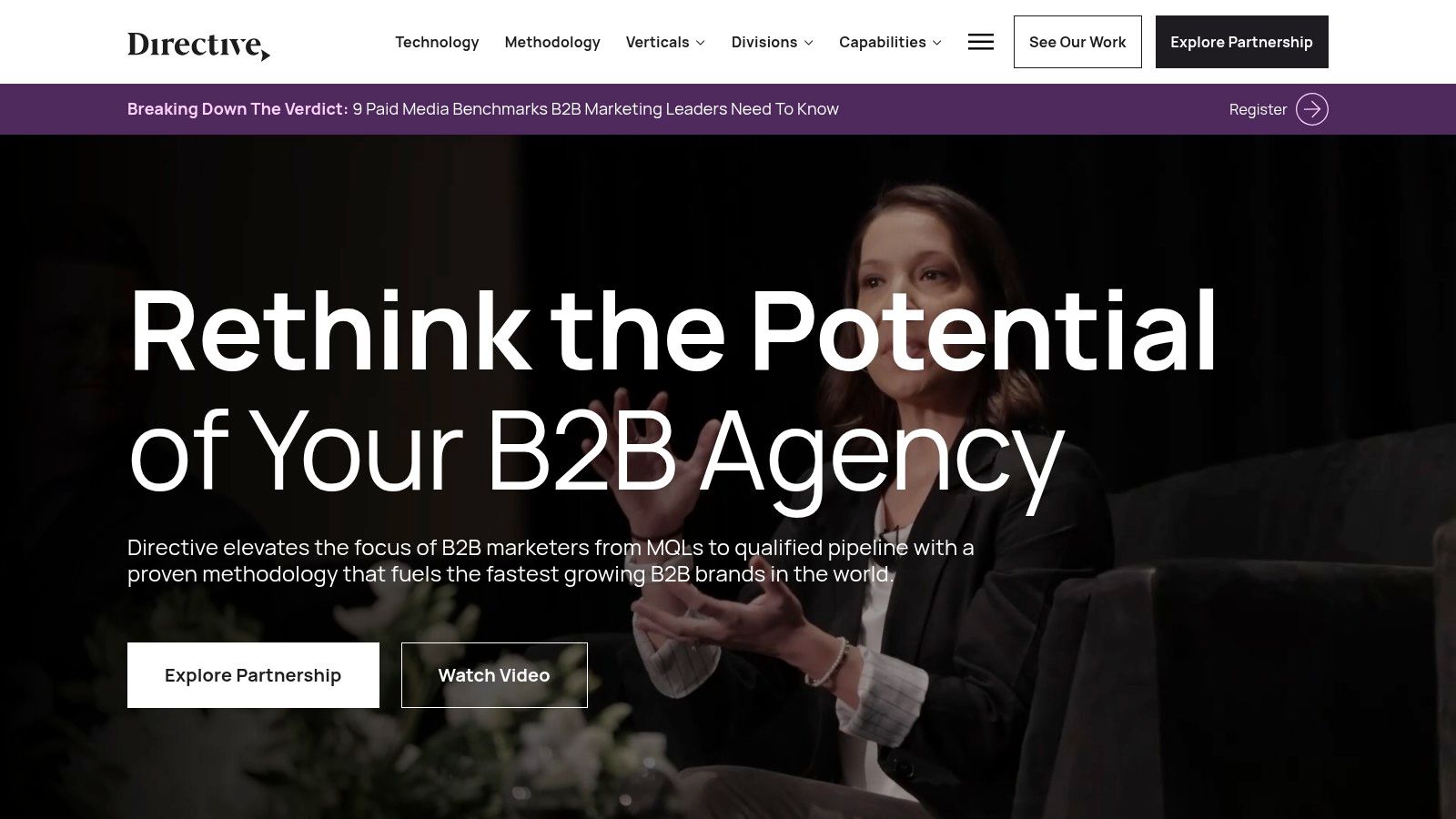
Directive combines paid media, content and SEO, conversion-rate optimization, and revenue operations for B2B SaaS. Its programs focus on demos, trials, and pipeline, while its internal AI platform, Stratos, supports campaign execution and insights.
This is a strong option for companies whose acquisition problem crosses organizational boundaries. Paid traffic may be reaching the right audience, but landing pages fail to convert. Trials may be growing, but sales can't distinguish product-qualified users from low-fit signups. CRM data may exist, but campaign decisions don't connect cleanly to opportunity value. Directive's model is intended to address those linked problems rather than optimize a single channel in isolation.
The cost of an integrated engagement
Directive has a long-standing B2B SaaS orientation and emphasizes revenue metrics over vanity metrics. It can integrate marketing, sales processes, CRM, and analytics from the start, which is valuable when the organization is ready to change how it measures acquisition.
The limitation is fit. Very early-stage or low-budget companies may not have enough traffic, data, internal ownership, or process maturity to benefit from a broad performance program. Stakeholder alignment is also essential. Marketing, sales, product, and operations teams need to agree on definitions for a qualified lead, a valuable trial, an accepted opportunity, and a successful handoff.
Directive should be considered when the bottleneck is conversion and measurement across the funnel, not when the only requirement is a fresh professional record or a managed appointment-setting team.
7. Hey Digital
Best for paid acquisition and landing-page conversion
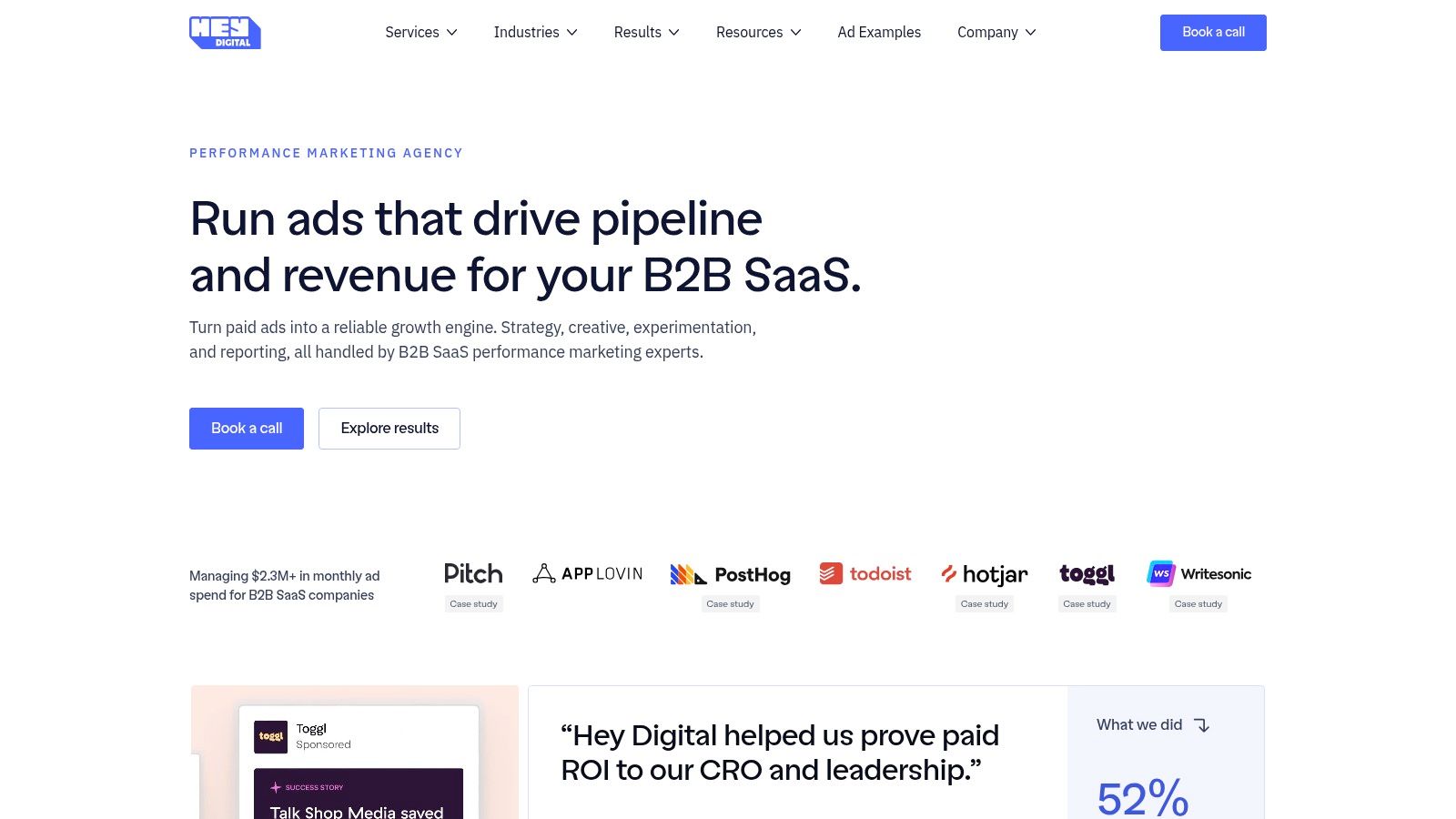
Hey Digital is the narrowest channel specialist among the demand-generation agencies in this ranking. It focuses on SaaS paid acquisition across PPC and paid social, supported by creative, messaging, landing pages, and conversion-rate optimization. Its reporting and optimization are positioned around pipeline and revenue outcomes.
That makes it a logical choice when the immediate gap is paid demand. A SaaS company may have a clear offer and a functioning sales process, but lack the campaign structure, ad testing, audience strategy, or landing-page experience needed to turn budget into qualified demos and trials. Hey Digital addresses those components without pretending to be an outsourced SDR department.
A complement, not a replacement for outbound
Hey Digital doesn't handle appointment-setting in the same way as Belkins, CIENCE, or Martal Group. Paid campaigns can create inbound interest and conversion opportunities, but the client still needs prompt lead handling, qualification, nurture, and sales follow-up. If those responsibilities are unclear, better ad performance may only produce more unworked demand.
The agency's SaaS-specific focus is an advantage for teams selling demos or trials through paid channels. Its public content on SaaS PPC also gives prospective clients a way to assess its strategic point of view before starting a conversation.
Pricing is quote-based and typically involves multi-month retainers plus ad spend. That structure means the buyer should evaluate total acquisition cost, creative requirements, landing-page ownership, CRM handoff, and the time required to reach a stable optimization loop. Hey Digital is a good fit for paid acquisition and conversion support, not for data infrastructure or a full outsourced sales motion.
Top 7 SaaS Lead Generation Companies Comparison
| Product | 🔄 Implementation complexity | ⚡ Resource requirements | 📊 Expected outcomes | 💡 Ideal use cases | ⭐ Key advantages |
|---|---|---|---|---|---|
| Fetchin | Low–Moderate: simple REST API, sync by default, optional async | Dev time + credits; 1k free credits, pay-as-you-go; dedicated capacity for high throughput (enterprise costs) | Real-time, production-ready enrichment; ~1s median responses; avoids stale data | CRM enrichment, lead scoring, recruiting workflows, AI agents needing current context | ⭐ Real-time rich profiles (100+ attributes), unified schema, compliance-first |
| Belkins | Low: managed service with onboarding and campaign setup | Managed program fees (quote-based); requires collaboration on ICP and messaging | Booked meetings at scale; outcomes vary by offer and domain | Outsourced outbound appointment setting to fill sales calendars | ⭐ Mature SDR playbooks, multi-channel outreach, reply/calendar handling |
| CIENCE | Moderate: outsourced SDR process + integrations into CRM | Clear starting price (~$5.6k+/mo); requires ICP definition and handoff processes | Qualified leads and handoffs; process-driven pipeline generation | Companies wanting structured, scalable outsourced SDR programs | ⭐ Strong list-building, QA and qualification standards; visible pricing |
| Martal Group | Moderate: managed SDR with onshore team and timezone coordination | Quote-based pricing; higher onshore labor costs; consultative setup | Higher-touch qualification and better collaboration with onshore reps | Funded SaaS or complex B2B needing onshore/local coverage | ⭐ Onshore experienced reps, strong social proof (G2/Clutch) |
| Powered by Search | High: custom full-funnel demand-gen and attribution work | Senior strategists and agency fees; requires aligned sales ops and measurement | Pipeline- and revenue-focused outcomes with tracked attribution | Full-funnel demand systems needing measurement tied to revenue | ⭐ SaaS-specific frameworks linking content/paid to pipeline/revenue |
| Directive | High: integrated performance marketing + RevOps and analytics | Significant budget and stakeholder alignment; longer engagements | Demo/trial growth and pipeline tied to spend; data-driven optimization | B2B SaaS scaling revenue with CRO, paid, SEO and RevOps integration | ⭐ Conversion-first approach, internal AI platform for insights |
| Hey Digital | Moderate: focused paid campaigns and landing/CRO work | Ad spend + agency retainer (quote-based); multi-month engagements | Improved paid capture and conversion to demos/trials | Companies needing immediate paid acquisition and CRO for demos | ⭐ Deep PPC/paid social focus with landing page conversion expertise |
Match the Provider to the Revenue Job
Start with the required outcome, not the provider category. If the outcome is a feature that enriches records, scores leads, routes inbound demand, or supplies current context to an AI workflow, choose Fetchin. It's a product-integrated B2B data API, not a managed campaign. The relevant questions are schema quality, freshness, latency, throughput, failure handling, compliance controls, and integration effort.
If the outcome is booked meetings from a managed outbound process, compare Belkins and CIENCE. Belkins is the more direct appointment-setting choice, while CIENCE adds stronger process and CRM-operations depth. If the sales motion needs higher-touch representatives and regional collaboration, Martal Group is the better fit.
For demand creation rather than direct sales execution, choose Powered by Search when you need a full-funnel system connecting paid media, SEO, content, conversion, and revenue measurement. Choose Directive when performance marketing must connect closely with CRO, product-led motions, CRM, and RevOps. Choose Hey Digital when paid acquisition and landing-page conversion are the immediate constraints.
Before signing, validate the operating details that lead volume can hide:
- ICP clarity: Confirm that the provider can work from specific account, role, geography, and qualification criteria.
- Handoff ownership: Define who handles replies, inbound leads, no-shows, opportunity creation, and follow-up.
- CRM instrumentation: Agree on required fields, lifecycle stages, source tracking, and feedback from sales to marketing.
- Ramp expectations: Establish when targeting, messaging, channel performance, or API capacity should be reviewed.
- Pricing structure: Compare retainers, media spend, credits, usage, dedicated capacity, setup work, and overage terms.
- Coverage and throughput: Check whether the provider supports the channels, regions, schemas, latency, and request volume your motion requires.
- Success metrics: Weight qualified pipeline, accepted opportunities, revenue contribution, or product outcomes above raw lead counts.
A practical next step is to create a short scorecard. Give the highest weight to qualified pipeline, then score implementation effort, budget fit, data or channel coverage, and the provider's ability to support your current sales motion. That process will usually narrow the field faster than comparing promises about lead volume.
Fetchin turns professional profile and company URLs into structured JSON with current, publicly available people, company, and engagement data for SaaS products. If your lead-generation workflow needs live enrichment, scoring, routing, or data-driven features, visit Fetchin to review the API and start with its developer-friendly access.