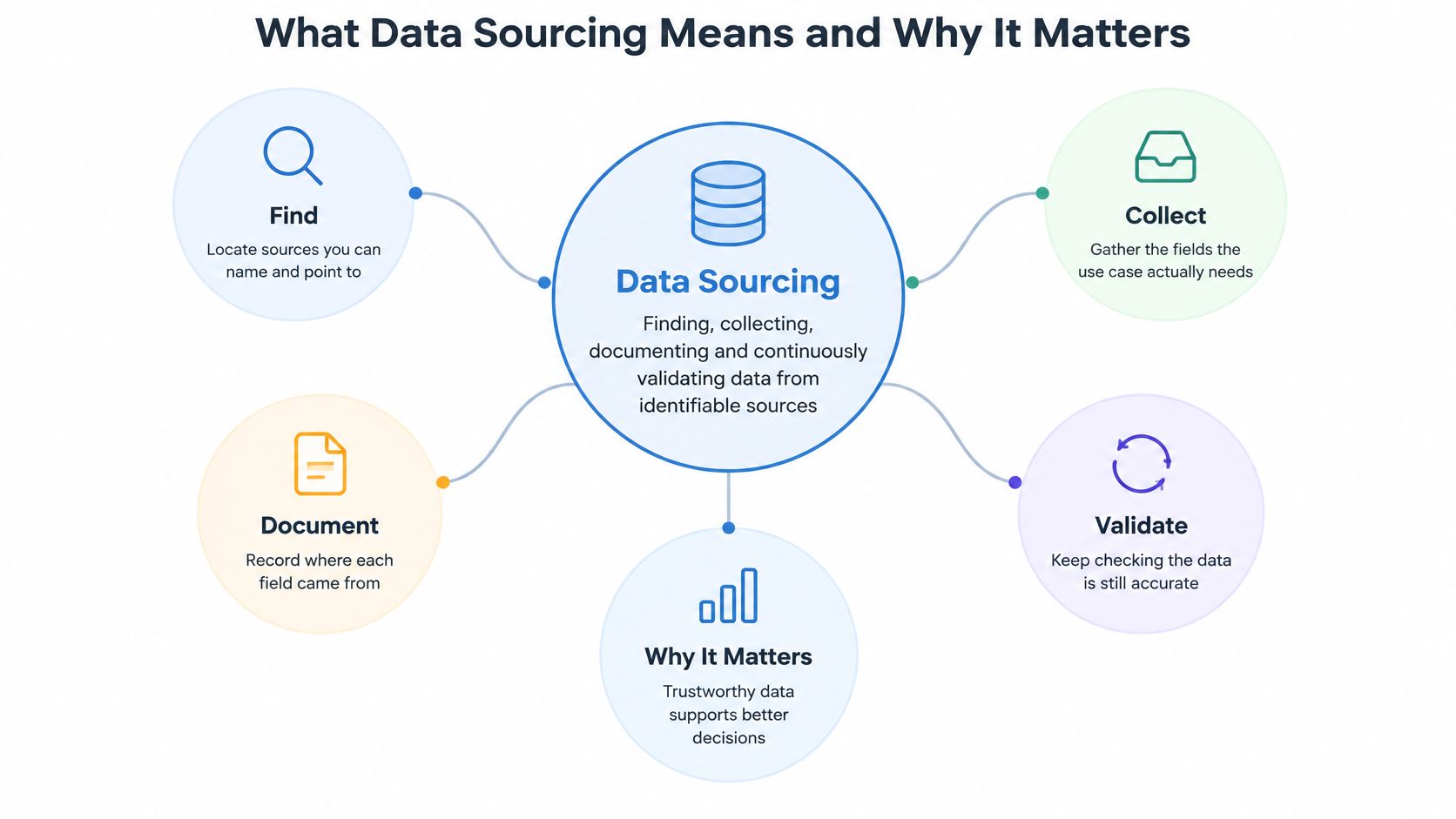
Data sourcing is the disciplined process of finding, collecting, documenting, and continuously validating data from identifiable sources so it can support business decisions, products, analytics, or AI systems. Without that discipline, a growing database quickly becomes an operational drag rather than a competitive asset.
Ask an engineering or revenue team where their newest prospect list came from, and notice how often the room falls silent. Most organizations still equate acquiring data with piling up rows, assuming that a larger spreadsheet automatically delivers sharper insights. Yet raw volume tells you nothing about whether a job title is two days old or two years stale, who published a company's headcount, or whether your team has a lawful basis to contact the person in a given row.
Understanding what is data sourcing in practice means shifting focus from volume to verifiable evidence. Freshness, provenance, and legal accountability matter far more than the sheer size of a file.
Table of Contents
- What Data Sourcing Means and Why It Matters
- Where Sourced Data Comes From and How It Is Collected
- How a Sourcing Workflow Runs, Step by Step
- Keeping Sourced Data Current, Traceable and Auditable
- Privacy, Lawful Basis and Controller Roles
- Choosing Live, Snapshot or Synthetic Data for Each Use
What Data Sourcing Means and Why It Matters
Picture a supermarket produce buyer evaluating a shipment of apples. Before a single crate reaches the shelf, the buyer checks which orchard grew the fruit, the harvest date, the cold-storage conditions, and whether the supplier followed food-safety rules. Apples without a paper trail don't go on sale, no matter how shiny they look in the box.
Business records follow the exact same logic. When a SaaS application enriches a new signup or an analyst builds a revenue forecast, every field on that screen carries a hidden history. A professional profile or company record only helps your workflow if the role, employer, industry, and location reflect current reality and come from an identifiable origin.
Separating Data Collection From True Sourcing
Teams often confuse data collection with data sourcing, even though they produce very different outcomes. Collection stops the moment records land in a CSV file, warehouse table, or JSON payload. Sourcing treats acquisition as the starting point of an operational control system.
A properly sourced record always travels with context: where the value originated, how it was retrieved, when it was captured, what normalization rules touched it, and how your organization is allowed to use it. That context turns fragile raw fields into inputs you can trust inside automated pipelines, matching engines, and AI workflows.
Skipping this groundwork gets expensive fast. According to IBM's overview of data quality, Gartner estimates that poor data quality costs organizations an average of USD 12.9 million per year. The same IBM guide notes that MIT Sloan Management Review linked bad data to roughly 15% to 25% of revenue for many companies, while knowledge workers can spend up to 50% of their time wrestling with routine data-quality errors.
Those losses rarely stem from a lack of records. They happen because teams feed undocumented, outdated, or duplicated values into CRMs, scoring models, and customer-facing features, then pay engineers and analysts to clean up the mess afterward.
Run the two-question audit today: Pick any ten rows in your primary customer or lead table. Can you name the exact source of each value and the date it was last verified? If you can't, that data has been collected, not sourced.
Where Sourced Data Comes From and How It Is Collected
No single pipeline fits every business problem. Some fields belong inside your own product database, while others require external registries, commercial contracts, or real-time API extraction. Comparing your options side by side makes it easier to match each requirement to the right supply channel.
| Source | How it is obtained | Typical example | Main risk |
|---|---|---|---|
| First-party records | Created by your own users and systems | CRM contacts, sign-up forms, product events | Consent and stated purpose must match what users were told |
| Licensed third-party datasets | Bought or licensed under contract | Firmographic files, industry lists | Collection history can be unclear, so ask for provenance and licence terms |
| Public web and open government records | Retrieved from public pages or open portals | Company registries, professional licence listings | Public visibility does not remove privacy duties |
| Live B2B data API | Fetched on each request from a profile or company URL | Structured JSON for enrichment and matching | Values change over time, so store the retrieval timestamp |
| Partner or user-submitted data | Shared under agreement or entered by users | Data-sharing agreements, survey responses | Accuracy depends on the contributor |
| Synthetic data | Generated by a model that mimics real records | Test sets, model training samples | Can carry source bias and leak patterns, so label it |
Trade-Offs From Most Controlled to Least Controlled
Working down the table shows a clear spectrum of control, freshness, and verification effort. First-party records sit at the top because your own systems generate them through sign-up forms in Salesforce or HubSpot, billing events, and in-app activity. You control the schema and capture time directly, yet you're strictly bound by the notice and purpose you presented when users handed over their details.
Licensed third-party datasets give teams broad market coverage quickly, such as firmographic files or curated buying lists. For a concrete look at how external commercial datasets structure company-level cues, see AdvertiserLeads prospecting signals explained. The catch with bought files is opacity: vendors sometimes bundle records from dozens of upstream feeds, so you need written provenance and clear licensing terms before ingesting a single row.
Public web and open government records are widely used across modern businesses. In 2024, 36% of UK businesses that handled digital data drew on public data sources, according to the UK Department for Science, Innovation and Technology. Portals like company registries and state licensing boards provide authoritative reference facts, though public availability never grants a free pass around privacy law.
When stale directories break product workflows, teams turn to a live B2B data API. Rather than pulling from a months-old archive, the API extracts public professional data on demand from a professional profile URL or company URL and returns structured JSON. Teams evaluating real-time pipelines alongside scheduled extraction can review common web data collection methods to weigh latency against freshness. Because live pages shift whenever someone changes roles, you must log the retrieval timestamp on every call.
Partner or user-submitted data fills niche gaps through co-marketing agreements, ecosystem exchanges, or customer surveys. External sharing remains selective: in 2024, 14% of UK businesses that handled digitised data shared data outside their organisation, as reported in the UK Business Data Survey 2024. Verification is the main hurdle here, since contributor quality varies widely across partners.
At the least directly observable end sits synthetic data, which algorithms generate to mirror the statistical shape of real records for software testing or early model training. While it avoids exposing live customer rows during QA, synthetic output requires clear labeling so engineers never mistake simulated profiles for real people.
A simple selection rule keeps teams out of trouble: pick the source that delivers the freshest value you can still document, and cross-check any field that drives an automated decision or customer-facing claim against a second source.
How a Sourcing Workflow Runs, Step by Step
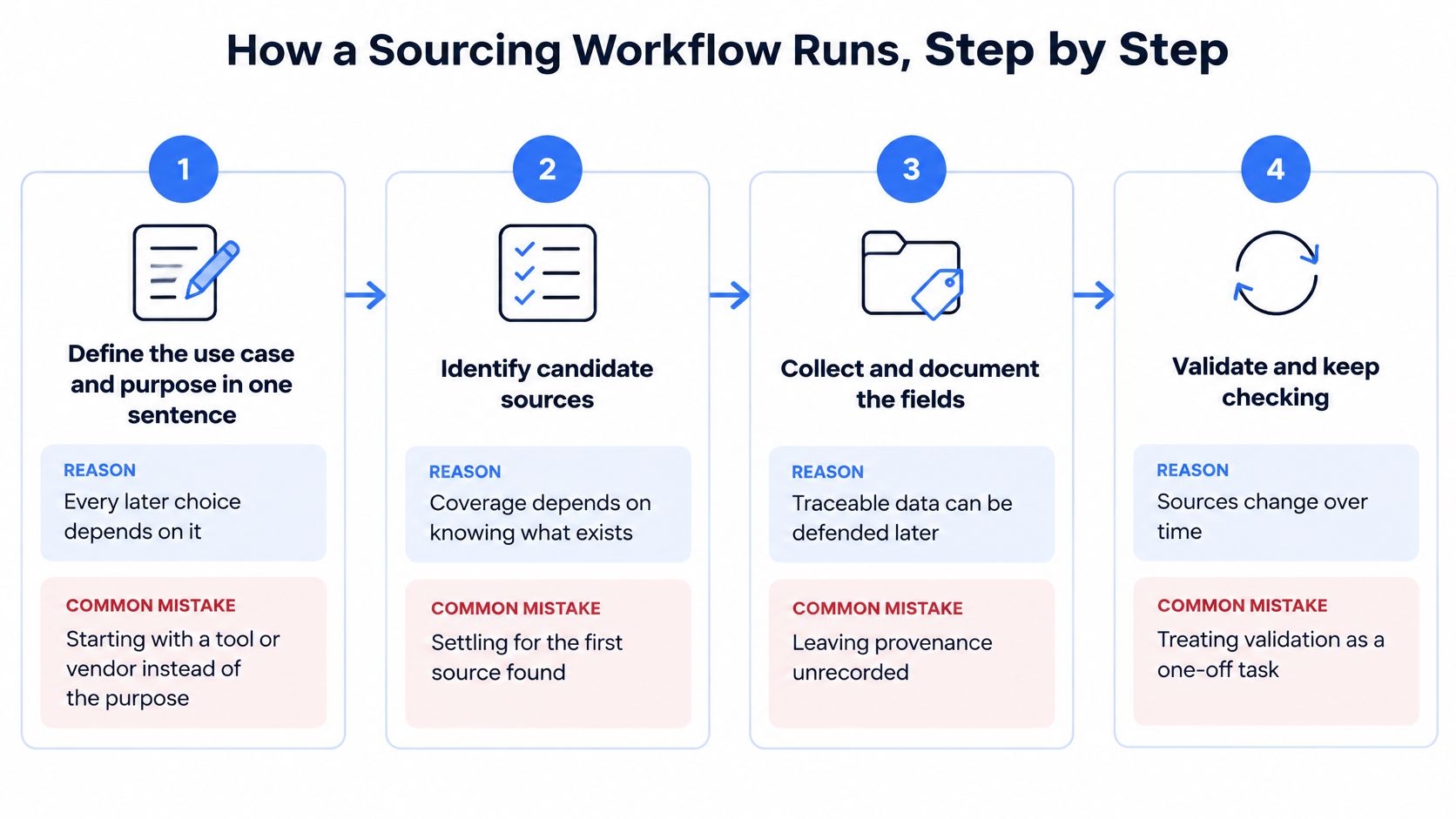
Knowing where records originate is only half the work. Turning raw feeds into reliable, production-ready inputs requires a repeatable sequence where documentation and validation happen inline, not as an afterthought six months later.
Planning and Acquisition Steps
- Define the use case and purpose in one sentence. Every downstream decision, from which attributes you fetch to how long you retain them, hangs on that sentence. Teams frequently jump straight to picking a vendor or writing an API script without stating the business purpose, which leads to bloated tables full of unused personal fields.
- Identify candidate sources and rank them by fit, freshness, and control. Mapping all realistic options prevents tunnel vision and exposes gaps in coverage early. Settling for the first directory or API you find often locks a product into slow refresh cycles or weak attribution.
- Confirm lawful access and permitted use before any collection begins. Checking terms of service, licensing clauses, and privacy obligations upfront costs hours, whereas unwinding an unlawful dataset costs months. The classic mistake is assuming that because a profile page loads in a browser without a password, your company can repurpose every field without restrictions.
- Extract or collect the data and capture retrieval metadata simultaneously. Recording the source reference and exact UTC timestamp at the moment of retrieval anchors the record's history. Trying to reconstruct collection dates from server logs weeks later leaves unverified gaps that break audits.
Cleaning, Documenting and Refreshing Records
- Normalize fields into one consistent schema. Map job titles, country codes, currency units, and ISO dates into uniform formats as records arrive. Leaving mixed formats like "US", "U.S.A.", and "United States" inside the same column breaks join keys, skews analytics, and causes territory-routing errors.
- Deduplicate and validate with automated checks. Run null checks, data-type validations, and sensible range rules before writing rows to production tables. Skipping deduplication inflates pipeline counts, distorts lead scoring, and triggers embarrassing duplicate outreach to the same buyer.
- Attach provenance metadata to every record or batch. Store the source identifier, transformation script version, and validation result right alongside the business attributes. Keeping provenance in a separate wiki page that nobody updates guarantees the documentation will drift out of sync with reality.
- Set a refresh schedule and event-based triggers. People switch employers, companies rebrand domains, and headcount shifts every quarter. Re-enriching a stale database on a fixed schedule or triggering a fresh check when a bounce or domain change appears keeps records accurate before they drive outreach or product logic.
Before any pipeline ships to production, run a final sign-off check: every record in the destination table should be traceable to its origin, stamped with a retrieval date, and tied to a documented purpose.
Keeping Sourced Data Current, Traceable and Auditable
Good sourcing architecture links engineering design directly to operational risk. The OECD Recommendation on Enhancing Access to and Sharing of Data defines data access as querying or retrieving data subject to technical, financial, legal, or organizational requirements, and stresses that open-data arrangements should preserve integrity, provenance, attribution, and openness. The same OECD framework emphasizes assigning clear ownership for data quality and risk management across the entire data value cycle.
When teams omit access controls, rate limits, schema checks, encryption, or retention rules, they lose the ability to prove whether a record was lawfully obtained or accurately transformed. To keep pipelines defensible, engineers should follow established W3C PROV data model principles, which treat provenance as structured metadata describing the entities, people, and processes involved in producing or delivering data. This aligns closely with how NIST frames provenance as a chronological record of origin, ownership, location, and changes.
Practically, every material record or batch in a production pipeline should carry six core metadata fields:
- Source identifier: The exact URL, registry name, or API endpoint that supplied the raw payload.
- Retrieval timestamp: The precise date and time the value was fetched, supporting automated freshness policies that flag or re-check stale records.
- Schema version: The structural definition active when the record was parsed, preventing silent breakage when upstream layouts evolve.
- Transformation version: The code release or mapping rule that normalized strings, split names, or standardized locations.
- Validation outcome: A pass, fail, or warning flag showing which null, type, and range checks the record cleared.
- Observation flag: A clear marker separating directly observed facts from inferred or model-predicted attributes.
Enterprise buyers increasingly inspect this metadata before signing off on external feeds. You can review the specific attributes procurement and engineering leads now ask for in data provenance standards for buyers, and explore a deeper breakdown of how data provenance works across automated B2B workflows.
Comparing Live Retrieval and Stored Snapshots
Once provenance fields are in place, teams face an architectural trade-off: fetch current values on demand, or read from a stored snapshot? Each pattern behaves differently under production pressure.
| Criterion | Live retrieval | Stored snapshot |
|---|---|---|
| Freshness | Values as of the request | Values as of the last capture |
| Latency | Response time set by the provider | Read from storage, usually fastest |
| Reproducibility | A repeated request may return different values later | The same snapshot returns the same values every time |
| Auditability | Needs timestamps and source references on every call | Easy to freeze and cite with a capture date |
| Change tracking | Requires a re-check schedule to detect job or company changes | Changes appear only when a new snapshot is taken |
Many engineers assume live retrieval is always superior because it eliminates cache decay. That assumption breaks down under scrutiny. As recent AI provenance and traceability research points out, provenance, transparency, traceability, bias, and privacy operate as connected concerns rather than isolated checklists. Without timestamps, source references, validation flags, and deterministic capture rules, real-time data is harder to audit than a dated snapshot.
The freshest value isn't automatically the best value. If you can't prove what a record said on the day an algorithm or analyst made a decision, speed has undermined accountability.
Stale-but-reproducible data is often the right engineering choice. During a regulatory audit, a legal dispute, or a machine-learning benchmark where two model versions must be evaluated on identical inputs, a frozen, dated snapshot beats a shifting live feed every time.
Privacy, Lawful Basis and Controller Roles
Public accessibility isn't a blanket license to extract and repurpose every attribute visible on a webpage. Both U.S. and European privacy frameworks draw sharp boundaries around public personal data, and responsible sourcing treats legal compliance as a design requirement from day one.
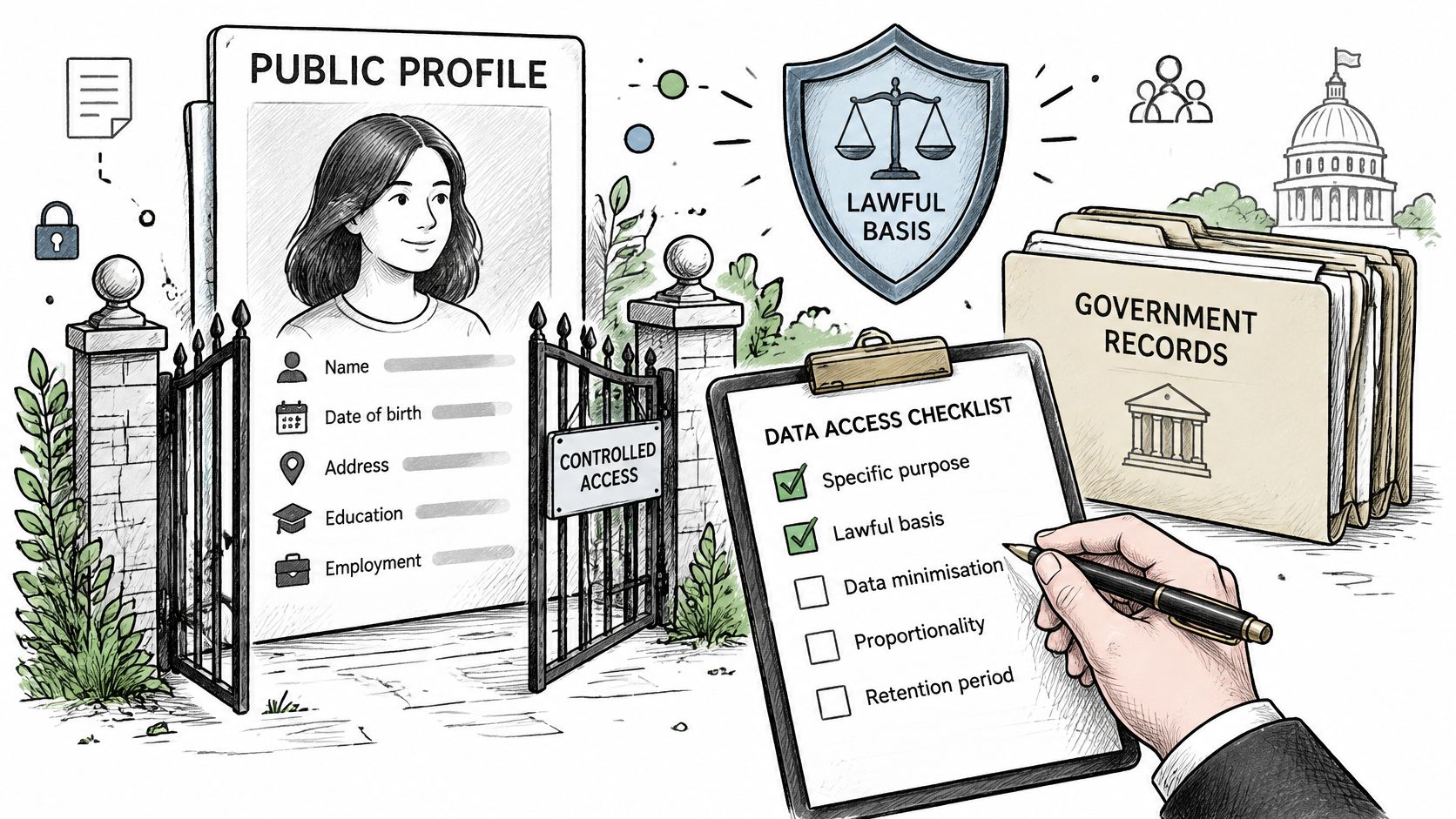
In California, the California Attorney General's CCPA guidance explains that publicly available information from federal, state, or local government records, such as professional licenses or public property records, generally falls outside the statute's definition of personal information. The exclusion also covers information a business reasonably believes was lawfully made available to the general public by the consumer or through widely distributed media. Even there, boundaries hold: biometric information collected without a consumer's knowledge remains regulated, proving that source context and collection method still matter.
Across Europe and the UK, obligations go further. As detailed in a European Commission GDPR and CCPA comparison guide, GDPR took effect on May 25, 2018, followed by California's CCPA on January 1, 2020. Under GDPR, gathering personal data from a publicly accessible website still binds the organization to transparency rules, requiring clear disclosure of processing purposes, data categories, recipients, and the exact sources collected from, alongside purpose limitation and retention limits.
UK regulators reinforce the same rule. Guidance from the UK Information Commissioner's Office states that organizations pulling personal data from publicly accessible sources like social media, the open electoral register, or Companies House may still need to supply privacy information to individuals unless a specific exemption applies, and must identify a valid lawful basis before using the records. For teams building enrichment workflows across jurisdictions, our guide to CCPA and GDPR compliance for public data maps these obligations to practical API design.
Understanding controller and processor roles clarifies who owns each duty. The customer deciding why and how to use sourced records is typically the data controller. At Fetchin, we act as a data processor on behalf of our clients for the data they submit through our APIs, and customers can request a Data Processing Agreement when we process personal data on their behalf under GDPR, CCPA, or similar laws.
Field minimization keeps your risk profile narrow. Pulling a company's headcount, founding year, or industry rarely triggers personal privacy friction, whereas extracting a personal contact detail demands a documented lawful basis and retention limit.
Mapping Sourcing Purposes to GDPR Article 6 Bases
Under the European Commission's legal grounds for processing data, GDPR Article 6 establishes six lawful bases. Every sourcing pipeline that touches personal data needs to map cleanly to one before extraction starts.
| Lawful basis | Fits sourcing when | Check before you collect |
|---|---|---|
| Consent | The person opts in to the specific collection | Records show the opt-in, its scope and how to withdraw |
| Performance of a contract | Data is needed to deliver a service the person requested | Each collected field is necessary for that service |
| Compliance with a legal obligation | A law requires the collection or retention | The specific legal duty is named and documented |
| Protection of vital interests | Data is needed to protect someone's life | Use is limited to that emergency and recorded |
| Public interest task | A public authority performs a defined task | The task and its legal mandate are documented |
| Legitimate interests | The organisation's interest outweighs the person's rights | A written balancing test confirms rights do not override, and people can object |
Most B2B enrichment workflows evaluate legitimate interests, which requires a formal balancing test verifying that the individual's fundamental rights and freedoms don't override the business need. The European Commission notes that whether a person has manifestly made the data public is a relevant factor in that assessment, though it never removes the need for proportionality or opt-out handling.
Cross-border transfers and acceptable-use boundaries round out responsible governance. When we transfer data outside the EEA, we use Standard Contractual Clauses approved by the European Commission. We only retrieve publicly available data, we do not sell personal data, and our terms strictly prohibit users from using extracted outputs for unsolicited bulk communications (spam), harassment, discrimination, or any unlawful purpose.
Choosing Live, Snapshot or Synthetic Data for Each Use
The sharpest data teams don't force every feature onto a single supply pattern. Instead, they pick the sourcing path that matches the operational stakes of each workflow.
Look at how those three paths divide across real B2B software before deciding where each belongs in your stack.
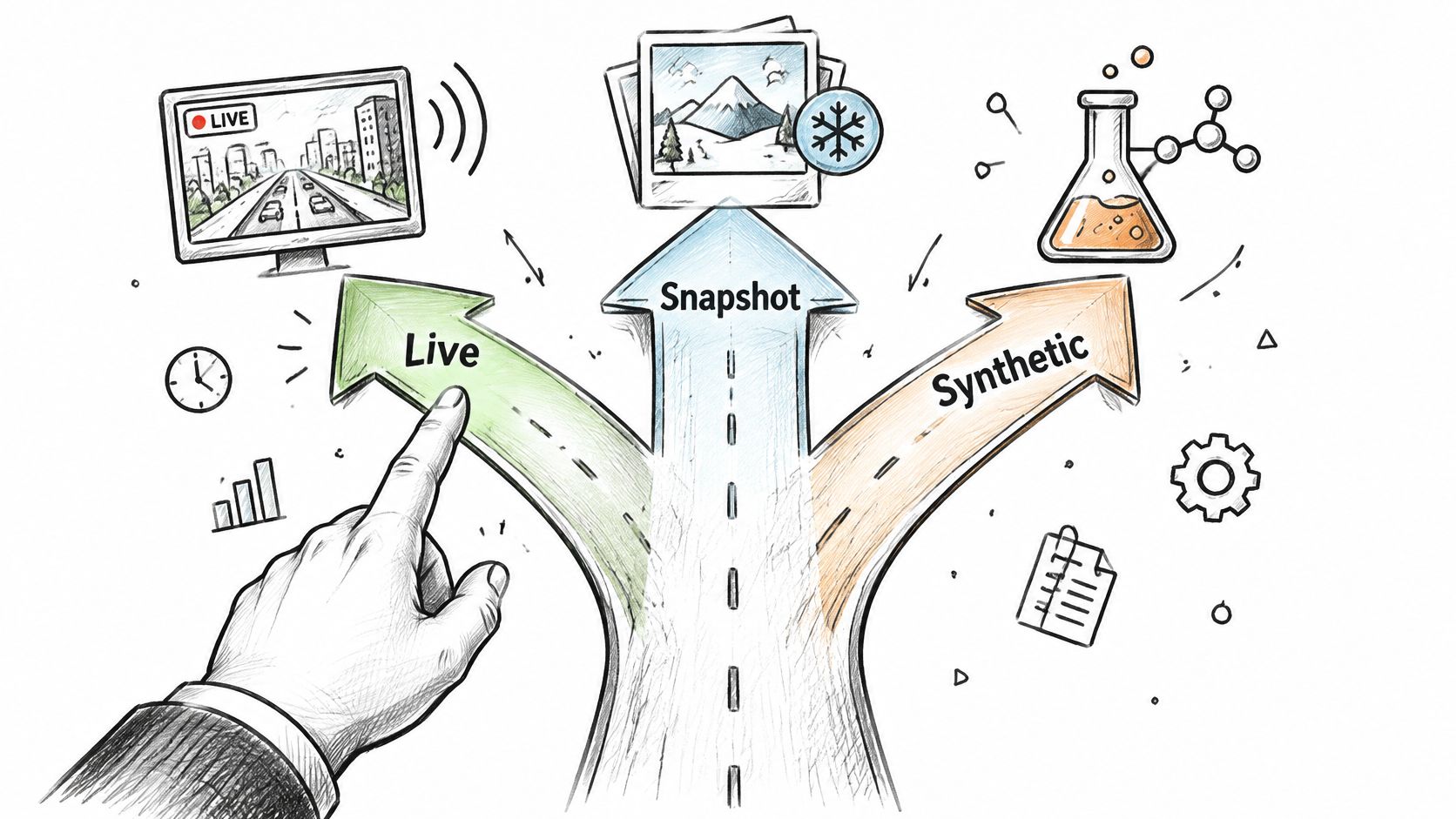
Live retrieval belongs wherever a stale fact causes immediate, visible mistakes. Think about lead scoring and routing, which qualifies and assigns a new signup before it ever reaches a sales rep. If a prospect left their previous company three weeks ago, cached firmographics route the lead to the wrong territory. Fetching the current record on demand, storing the retrieval timestamp, and pairing it with a re-check trigger keeps automated routing accurate.
Stored snapshots win whenever repeatability outranks real-time currency. Executive quarterly reporting, financial reconciliation, and offline model evaluation all break if underlying rows shift mid-analysis. Freezing a dated snapshot lets anyone re-run the exact query six months later and arrive at the same number.
Synthetic data serves QA environments, load testing, and early model prototyping where real personal records aren't necessary. Treat it with the same skepticism as external feeds, though. According to an OECD report on privacy-enhancing technologies for AI, synthetic data can reduce re-identification risk while introducing bias, accuracy loss, or privacy leakage through attacks such as membership inference and attribute disclosure. Always label synthetic tables clearly, audit them for source bias, and test for leakage before shipping them to downstream teams.
Recruiting illustrates how two paths work side by side inside one department. Recruiting and sourcing builds candidate records and re-checks them before outreach, so sourcers need live retrieval, a fresh timestamp, and a documented lawful basis before messaging a candidate. That same department's quarterly hiring-funnel report, however, should run on a frozen snapshot so leadership reviews consistent numbers across board meetings.
For a quick walkthrough of how modern teams structure these data sourcing choices in practice, watch the overview below.
Three Questions Before You Pull Any Record
When a product manager or engineer proposes a new data feed, test the plan against three fast filters:
- Would a stale value trigger a customer-facing error? If yes, budget for live retrieval or tight event-based refresh triggers.
- Will someone need to reproduce this exact output later? If yes, snapshot the dataset with immutable version IDs and capture dates.
- Do you need personal data to solve the problem? If you're testing UI layouts or training an early classifier, strip personal identifiers or use properly vetted synthetic records instead.
Before your team pulls a single record for its next feature, write a one-page sourcing record. Name the exact source, the retrieval timestamp format, the lawful basis, and the refresh rule in plain language. That single page turns raw data extraction into an auditable asset your product, legal, and engineering teams can stand behind.
If your product needs fresh, structured B2B records without managing fragile extraction pipelines, Fetchin turns professional profile and company URLs into clean JSON on demand. We retrieve publicly available data live on each API call, with synchronous or asynchronous delivery, so your enrichment, recruiting, and lead-routing workflows stay current and traceable. Visit our site to explore the documentation and test live endpoints with your own URLs.