Conversion rates were more than eight times higher when the first sales attempt happened within five minutes rather than between five minutes and 24 hours, according to the lead-response benchmark summary. The same summary describes a separate sample in which contacting leads within one hour made them nearly seven times more likely to qualify than contacting them later. These are associations, not promises, but they reframe the inbound / outbound debate: choosing a channel matters less if your operating model wastes the buyer's signal.
The practical question isn't which motion wins universally. It's whether your team can recognize interest, establish account and role fit, and start a useful conversation without ignoring an objection or mistaking casual research for purchase intent.
Table of Contents
- Inbound and Outbound Side by Side
- Benchmarks That Fit Each Motion
- Response Rules and Pipeline Design
- Handing Off From Self-Service to Human Outreach
- Consent and Opt-Out Rules Before Outbound Sends
- Choose Inbound, Outbound or Both by Situation
Inbound and Outbound Side by Side
Inbound and outbound sales compared
| Criterion | Inbound | Outbound |
|---|---|---|
| Starting event | Prospect shows interest through a form, demo request, download or trial signup | Seller picks an account before any interest appears |
| Who sets the timing | The prospect | The seller and the sequence cadence |
| Typical channels | Search, content, webinars, product trials | Email, phone, social outreach, events |
| Data needed at first contact | Context on the person and company at the moment of the event | Account selection, contact validity and personalization |
| Consent exposure | Lower when the prospect opted in and the purpose is clear | Higher, needs a lawful basis and channel rules before sending |
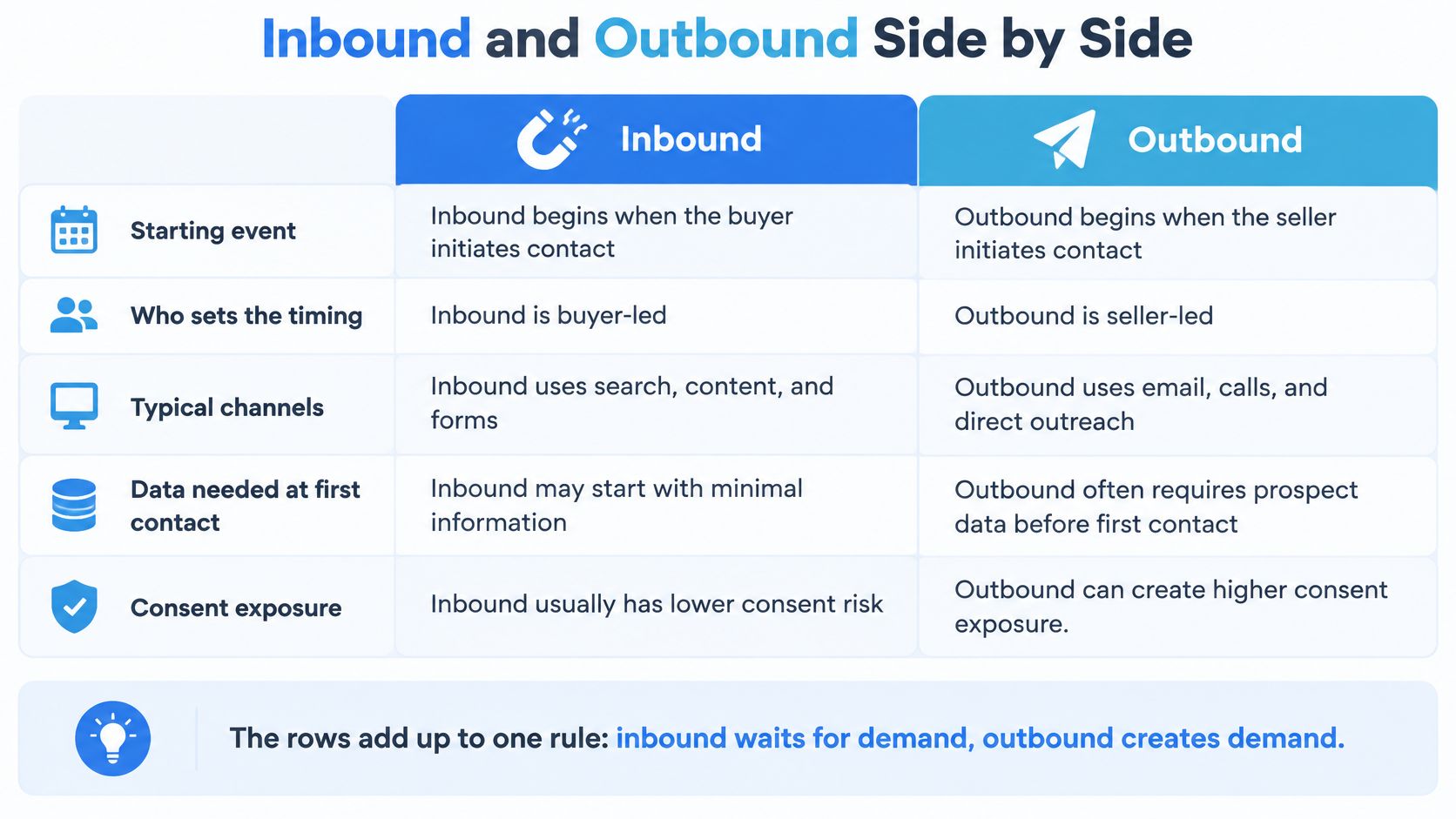
The operational distinction is who initiates contact. With inbound, respond to an expressed-interest event, enrich the record and qualify the request. With outbound, select the account, validate the contact and establish relevance before sending anything.
The comparison below makes those differences visible.
Follow the Starting Event
Say a pricing-page visitor requests a demo. Capture the request's context and resolve the person's role and company before assigning an owner. Search, content, webinars and trials bring buyers to that event; enrichment belongs at the form submission or trial signup.
Now consider a seller emailing an engineering leader at a hypothetical fifty-person SaaS company that has never engaged. The seller needs evidence that the company fits, the leader owns the relevant problem, and the chosen channel is permissible. Sequenced email, phone, professional-network touches and events require prepared contacts, not a queue of unverified names.
For teams separating broad demand generation from deliberate account selection, IronPeak Marketing's guide to prospecting differences provides useful terminology. Don't let channel labels obscure who initiated the conversation.
Choose the Constraint You Can Manage
Inbound converts existing demand, but your team can't schedule when buyers arrive. It also requires traffic and useful content that take time to build. Outbound lets sellers approach chosen accounts on a campaign schedule, but introduces reply fatigue, deliverability risk and greater consent exposure.
Fetchin is a B2B data API. Treat its role in this comparison as the data layer, not the decision-maker: your team must define which attributes make a record contact-ready.
A company can run both motions. Use the table to identify weak rows, then decide which motion starts the pipeline and which fields must exist before contact.
Benchmarks That Fit Each Motion
The 2022 benchmarking report conducted with Salesforce, LeanData, Atrium, Clearbit, Modern Sales Pros and RevOps Squared found a median win rate of 25% for inbound marketing leads, compared with 20% for outbound sales leads, a 5-percentage-point advantage for inbound. That's a useful reference, not evidence that changing a lead's source would change its probability of winning.
Inbound records enter after an interest event. Outbound measurement can begin with a much colder population of contacted accounts. A blended conversion rate therefore mixes buyer selection with seller execution.
Define the Denominator Before the Target
KPIs by motion
| KPI | Inbound use | Outbound use |
|---|---|---|
| Source-to-opportunity rate | Main check on content and form performance | Secondary, because the denominator is contacted accounts |
| Opportunity win rate | Compare with the inbound median reported above, after checking stage definitions | Compare with the outbound median reported above, after checking stage definitions |
| Response latency | p50 and p95 time from form submission to first action | Time from sequence step to reply |
| Enrichment completeness | Share of inbound records with title, company size and domain | Share of target accounts with validated contacts |
| Cost per qualified opportunity | Content and tooling cost divided by qualified opportunities | Data, tooling and rep time divided by qualified opportunities |
Before comparing win rates, verify what the benchmark and your CRM count as an opportunity. Don't interpret a reported lead win rate as closed-won opportunities divided by qualified opportunities. Keep both calculations if your team needs both, and label them explicitly.
For source-to-opportunity rate, preserve the original source event. A demo request and a content download shouldn't become interchangeable because both entered through a form. Similarly, distinguish an outbound account selected for research from one contacted.
Measurement rule: Compare equivalent stages within equivalent cohorts before comparing channels.
Separate Fit From Readiness
Build scoring with distinct fields for account fit, role fit and observed intent. Profile and company attributes can establish fit; posts, comments and reactions can add context. An engagement event shouldn't compensate automatically for a company outside your target market.
Record missing attributes as unknown rather than assigning them a negative fit score. Otherwise, you'll confuse incomplete enrichment with poor prospects and potentially misdiagnose a source.
Establish your own source-level baseline for at least one quarter before making a budget comparison. That's a recommended observation period, not a statistical guarantee. Channel mix, qualification rules, market segment and sales execution can all change the outcome, so treat the benchmark gap as directional rather than causal.
Response Rules and Pipeline Design
For inbound, make response speed an operating requirement. For outbound, make preparation quality the gate. The lead-response findings support prioritizing a submitted request over background list work, but they don't establish that every enrichment task must finish before a seller can act.
Run essential inbound enrichment synchronously inside the form or demo workflow. Prepare outbound lists in scheduled batches tied to campaign windows. Reserve slower engagement extraction for asynchronous processing when it would otherwise block acknowledgment or routing.
Build Around Four Operational Pillars
- Synchronous inbound enrichment. Resolve the identity and company fields required for routing while processing the event.
- Batch outbound preparation. Validate selected accounts and contacts before a campaign window, rather than assembling them during sending.
- Engagement extraction. Attach relevant posts, comments and reactions with their timestamps and provenance.
- Suppression before every enrichment write. Check whether marketing use is permitted before updating a marketing record.
Keep the synchronous path deliberately narrow. If company resolution fails, acknowledge the request and send it to a fallback owner instead of leaving the buyer waiting for a complete record. A missing field should trigger an exception workflow, not an invisible stalled lead.
For an implementation-oriented view of event capture, identity resolution and ownership, use the lead-generation systems guide alongside your CRM field map. We've been serving production traffic since 2023, but your team still needs to test its own end-to-end workflow rather than treating provider uptime as proof of successful routing.
Route the Event Without Losing Its Context
- Capture the event. Store its source, timestamp, requested action and available consent information. Preserve the original request text.
- Resolve the professional profile URL and company URL using the identifiers the person supplied. Keep uncertain matches out of automatic assignment.
- Score against the ideal customer profile using current title, company size and domain. Add relevant engagement context before routing when it's available without delaying the request.
- Route to a named owner, with a fallback queue for missing matches, conflicting territory rules or unavailable representatives.
- Log time to first action separately from enrichment completion and automated acknowledgment.
Don't count a confirmation email as a substantive sales response. Store separate timestamps for receipt, enrichment, assignment and the owner's first action. That lets revenue operations distinguish a slow API from a territory-rule failure or an unattended queue.
Make Suppression Survive Every Refresh
Under UK Information Commissioner's Office guidance, the right to object to direct marketing is absolute, including profiling for that purpose. A competing legitimate interest can't override a valid objection.
Implement exclusion as shared state across the CRM, enrichment workflow, audience exports and sequencing tools. Store the marketing purpose, objection status, timestamp and matching identifiers so a later import doesn't recreate an eligible contact.
Fresh information does not create fresh permission.
Refresh inbound records at the event and outbound lists before each send window. Re-check suppression immediately before every marketing enrichment write, including queued jobs that began before an objection arrived. At send time, check again rather than trusting an earlier export.
Use access controls and write rules to prevent enrichment jobs from clearing exclusion fields. Test the awkward case explicitly: a contact objects after a batch starts but before the sequencing platform receives it.
Finish the dashboard with time from lead creation to first action and qualification rate by response-time bucket. Segment those results by source and request type. Otherwise, a fast response to weak-interest downloads can conceal a slow response to demo requests.
Handing Off From Self-Service to Human Outreach
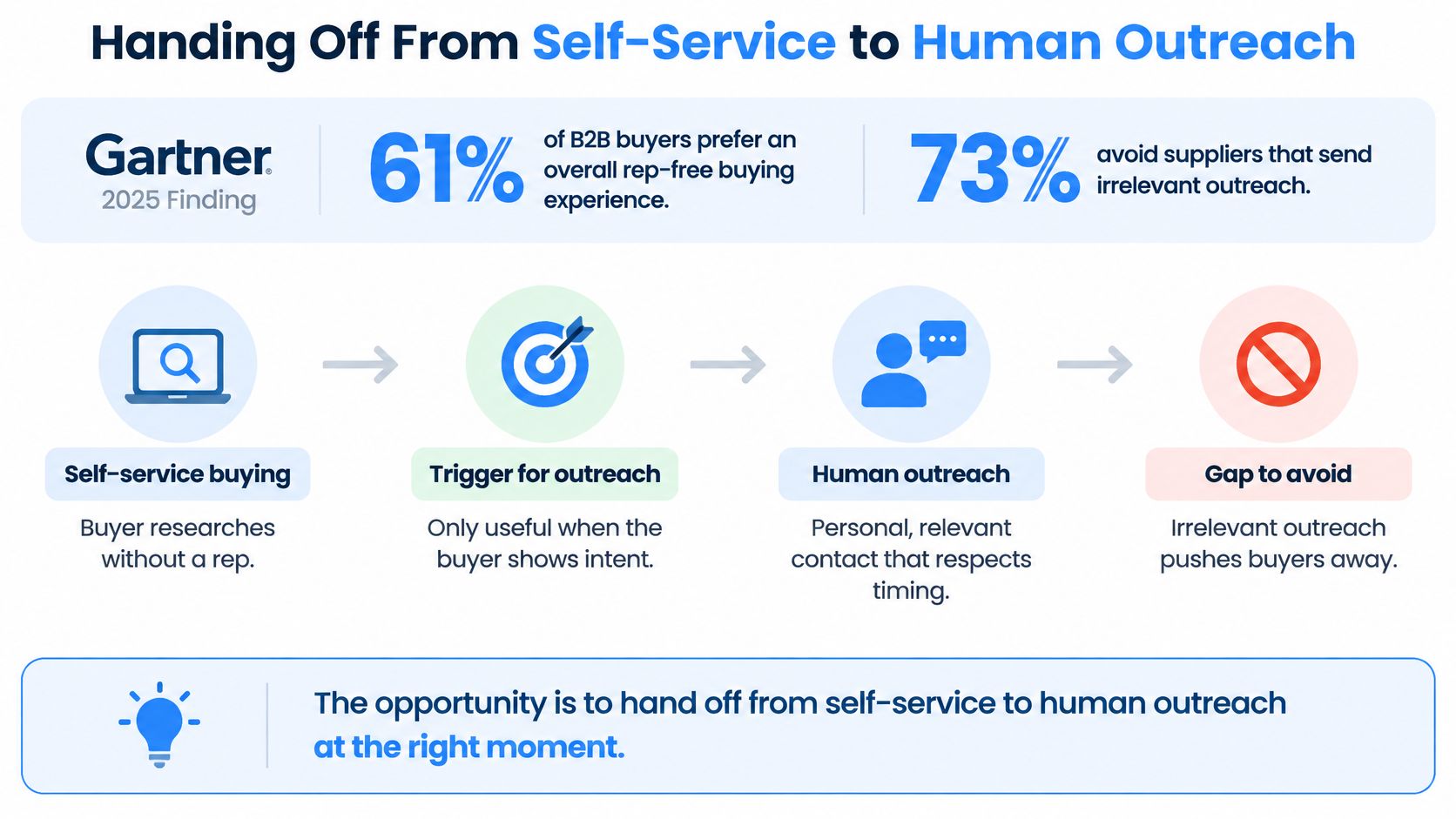
Gartner's 2025 sales survey found that 61% of B2B buyers prefer an overall rep-free buying experience, while 73% actively avoid suppliers that send irrelevant outreach. Buyers nevertheless prefer seller input for tasks requiring contextual intelligence, including deciding whether an offering fits their company.
The gap isn't just insufficient personalization. It's the absence of a reliable rule for moving from independent research to human assistance.
This handoff should preserve the buyer's control.
Apply an Account-and-Role Threshold
Use this transition sequence as an operating policy, not a validated prediction model:
- Anonymous research on content and pricing remains self-service.
- Match an identifiable account using a verified domain, then establish company size and a relevant person's title. Don't assign a named identity from an account match alone.
- Add engagement signals from posts, comments and reactions.
- Check the person's role against the buying committee.
- Apply an intent threshold to account fit, role fit and behavior together.
- Send a consultative message, or keep waiting.
Signals that justify outreach
| Signal | Justifies outreach | Reason |
|---|---|---|
| Repeat visits to pricing and architecture pages from an account with a relevant role | Yes, with a consultative message | Shows evaluation plus role fit |
| Demo request or trial activation by a buying committee member | Yes | Explicit intent with role match |
| One read post or a single comment on competitor content | No, keep waiting | Shows research only |
| Visits from an account with no matching title or company size | No | Wrong stakeholder or fit risk |
| Opt-out or objection on record | No, suppress | Marketing use is barred |
Apply the signal table at the engagement, role and intent checks. These are proposed action thresholds, not universal conversion findings, and every positive decision still requires permission for the chosen contact.
A technical evaluator researching architecture may need integration guidance, while procurement may need contractual detail. Verify the responsibility before contacting either person; don't send the same pitch to everyone associated with the domain.
The accompanying video offers another way to consider the transition.
Measure helpful intervention through a substantive reply that resolves a buyer question or an accepted meeting. Opens and clicks don't demonstrate that seller involvement helped.
The counterintuitive conclusion is that effective outbound depends on inbound-style evidence. A message earns its place when the seller can explain why this account, this stakeholder and this moment justify assistance with architecture, security, procurement or the business case.
Consent and Opt-Out Rules Before Outbound Sends
Check recipient, channel, jurisdiction and consent status before approving a campaign. The European Data Protection Board's legitimate-interest guidance explains that direct marketing may qualify as a legitimate interest under GDPR Recital 47, but national rules and the ePrivacy Directive can require prior consent for unsolicited email, SMS, MMS and similar communications.
That distinction matters: a lawful basis for processing personal data doesn't automatically authorize a particular message. Calling a campaign business-related or relevant doesn't replace the channel analysis.
Turn the Legal Assessment Into Send Gates
Record who will receive the message and whether you're using personal contact data. Identify the communication channel and applicable national requirements, then document whether the necessary consent or other permission exists. If the assessment is unresolved, hold the record out of the send queue.
According to the European Commission's explanation of legal grounds for processing, valid consent must be specific, informed, freely given and based on affirmative action, not silence, inactivity or a preselected option. Where legitimate interest applies, document the precise purpose, necessity and balancing assessment.
Operationally, retain consent evidence, separate purposes instead of bundling them, and provide an effective objection route in the first communication. Keep that evidence attached to the contact's permitted use rather than only to a campaign spreadsheet.
An IT decision-makers email-list workflow should therefore distinguish contact validity from permission to contact. A correct title and working address answer neither the jurisdiction question nor the consent question.
Assign Responsibilities Explicitly
We act as a data processor on behalf of clients for data they submit through our APIs. When we process personal data on your behalf and you act as data controller under GDPR, CCPA or similar laws, you can contact us to request a Data Processing Agreement.
That agreement defines processing responsibilities; it doesn't decide whether your campaign is lawful. Give campaign approval to a named owner who can review unresolved cases with qualified counsel.
Use this campaign-review checklist:
- Recipient identified. Contact type and intended purpose are recorded.
- Channel assessed. Applicable jurisdiction and communication rules are documented.
- Permission evidenced. Required consent or the applicable assessment is retained.
- Objection route tested. The recipient can decline further marketing effectively.
- Suppression checked. Excluded contacts can't enter the approved send population.
Choose Inbound, Outbound or Both by Situation
Which motion to lead with by situation
| Situation | Lead with | Why |
|---|---|---|
| Product-led SaaS with free trials | Inbound, with outbound for trial accounts that stall | Trial signals show intent, so outbound should wait for a relevant trigger |
| Enterprise deal with long procurement | Both, with outbound aimed at named buying committees | Buyers still want seller input for fit and business-case questions |
| Recruiting platform sourcing candidates | Outbound-style sourcing with inbound applicant handling | Candidate records need checks before any outreach |
| Sales intelligence vendor building target lists | Outbound | Account selection and contact validity drive results |
| Early-stage company with little content | Outbound until inbound demand exists | Inbound needs traffic and content before it converts |
| Small EU team with no consent records | Inbound and opted-in lists only | Use this conservative starting policy until channel permissions are established |
Lead with inbound when demand and response capacity already exist. Lead with outbound when account selection is the bottleneck and you can establish permission to contact. Run both when independent research leads to a buying committee that needs coordinated seller assistance.
The EU recommendation is a conservative operating choice, not a claim that every business email everywhere requires consent. Without records or a completed jurisdiction assessment, a small team shouldn't guess its way into sending.
Match the Motion to the Work
For a product-led company, assign sales assistance to unresolved evaluation tasks rather than every signup. For an enterprise account, appoint an owner who can coordinate technical, commercial and procurement conversations without triggering competing sequences.
Recruiting teams should distinguish applicant handling from proactive sourcing. Sales intelligence vendors should treat list readiness as an output with explicit acceptance criteria, not equate database size with pipeline.
Once a record qualifies for conversation, the warm-calling versus cold-calling guide can help define how much context the representative should bring. Keep the decision about who to approach separate from the script used to approach them.
Start with the motion whose required fields your team can populate reliably, not the motion with the most attractive headline benchmark.
Run a Thirty-Day Operational Pilot
- Choose a primary motion. Limit the pilot to a defined segment and assign an accountable owner.
- Set the KPI baseline using source-to-opportunity rate, win rate, latency, enrichment completeness and cost per qualified opportunity. Keep cohort definitions fixed.
- Verify consent requirements and synchronized suppression before any send. Test exclusion behavior with a deliberately suppressed test record.
- Track p50 and p95 latency and qualification rate by response-time bucket. Investigate slow-tail failures, not just the median.
- Decide whether to add the second motion only after at least one quarter of source-level baseline data. The initial pilot tests operational readiness; it doesn't settle acquisition economics.
Include data-resolution outcomes in the cost review. Under our credit policy, only a successful call (200) and a not-found response (404) consume credits. Track not-found outcomes separately so an unsuccessful identity match doesn't disappear inside an average enrichment cost.
Choose the motion you can execute cleanly today. Expand when ownership, measurement and permission controls work together, not merely when representatives have spare sending capacity.
Fetchin offers a B2B data API that turns professional profile and company URLs into structured data for qualification, routing and account preparation. Visit Fetchin to evaluate the identity and company fields your primary motion needs, then test them in a workflow that preserves source context and suppression status.