Calls addressing a prospect's specific challenge produced more than twice the engagement of generic outreach in a 2025 calling analysis discussed by HubSpot. That reframes warm calling vs cold calling: prior contact matters, but so does having a defensible reason to call. The useful comparison includes a middle category, context-enriched cold calls, and a stopping rule for prospects who never engage.
Table of Contents
- Warm Calling vs Cold Calling at a Glance
- Where a Warm Signal Starts and Stops
- How Much Warm Calls Outperform Cold Ones
- Measuring the Funnel Before Judging Warm Calls
- Use Cases and Attempt Limits by Situation
- Scripts and Openers for Each Call Type
- Compliance Rules Before the First Dial
- Confirm Your Next Call Type Before You Dial
Warm Calling vs Cold Calling at a Glance
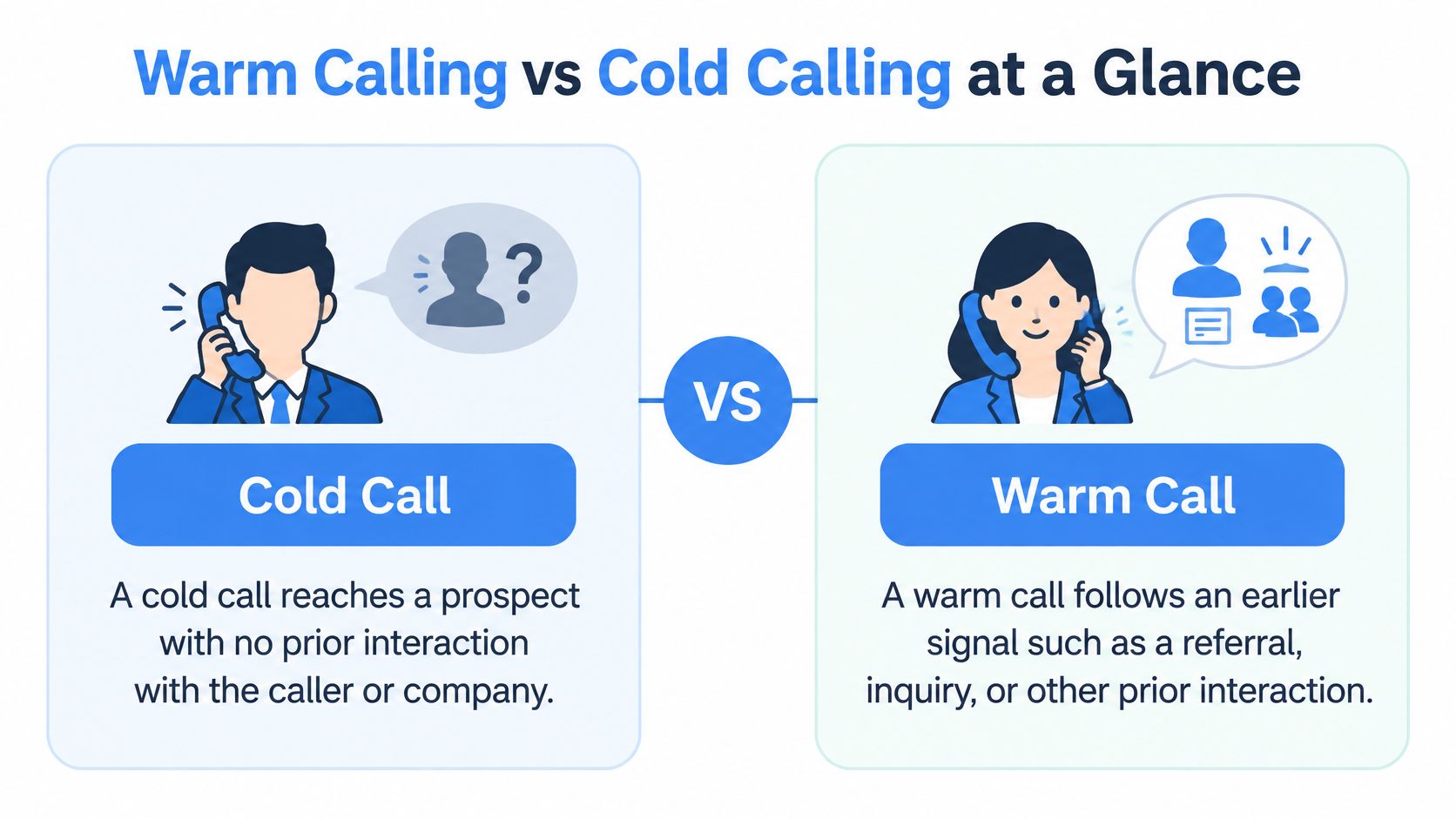
A cold call reaches a prospect with no prior interaction with the caller or company, consistent with Investopedia's definition. A warm call follows an earlier signal such as a referral, inquiry, content engagement or existing relationship.
Warm calling doesn't replace outbound prospecting. It adds context to the same practice, while a well-targeted cold list remains a way to reach suitable accounts that haven't interacted with you.
Warm and cold calling compared on core criteria
| Criterion | Warm calling | Cold calling |
|---|---|---|
| Prior awareness | An earlier signal exists, such as a referral, inquiry or content engagement | No prior interaction with the caller or company |
| Trigger for the call | A documented signal or relationship | Target profile match only |
| Typical opening | References the earlier action or the introducer | Introduces the company and one reason for the call |
| Data needed | Signal date, signal source and verified contact details | Verified contact details and current role |
| Main risk | A stale or mistaken signal treated as consent | Poor targeting and unwanted interruption |
| Best fit | Accounts with active interest or a trusted introducer | Large outbound lists with a clear ideal customer profile |
Start With the Trigger
Read the trigger row first. It determines what the caller can reference, which fields need checking and what assumptions could undermine the conversation.
Cold calls fail when the caller can't establish relevance at an acceptable moment. Warm calls fail when the rep overreads an action, references an outdated relationship or treats engagement as permission.
Channel choice is a separate decision. EmailScout's comparison of cold calls versus emails for sales is useful when deciding whether an unsolicited approach belongs on the phone or in writing.
For planning purposes, distinguish the evidence supporting the call from the channel carrying it. An accurate phone number makes someone reachable, not warm. A relevant account makes someone worth evaluating, not necessarily ready for a conversation.
Where a Warm Signal Starts and Stops
A company matching your ideal customer profile doesn't make its employees warm leads. A warm classification needs a documented connection, referral, engagement event or permission-based signal that supports personalization, as Scrap.io's warm-call guide explains.
For triage, review signals in this order, while allowing explicit requests to outrank passive actions:
- Direct referral: Confirm who introduced you and whether you can name them.
- Inbound inquiry or webinar registration: Establish what the person requested or registered for.
- Prior reply or meeting: Read the actual exchange, including any promised follow-up.
- Content interaction or website visit: Confirm attribution before treating account activity as an individual action.
- Product review or trial: Check whether it concerns your offering and whether the person's role is relevant.
This is an operating hierarchy, not a proven universal ranking. A detailed trial request can be stronger than a casual referral; a review of an unrelated product may supply context without establishing any relationship.
Separate Interaction From Public Context
Hiring activity, funding, leadership changes and product launches can justify investigation. They don't establish that someone knows your company.
Use these categories:
| Tier | Evidence required | Appropriate interpretation |
|---|---|---|
| Warm | Documented interaction or relationship | There's shared context to reference |
| Context-enriched cold | Fresh, specific, verifiable public signal | There's a timely hypothesis to test |
| Cold | Target fit without a relevant signal | Relevance must be established from the opening |
Set a freshness window measured in weeks for public events, then test whether that window suits your market. Don't present it as an established expiration date.
Say a sales director changed roles last month at an 80-person software company. That hypothetical record supports a context-enriched call about a plausible new-role priority, not a claim of prior familiarity.
Our buying-signals workflows turn what accounts publish, and who reacts, into timed outreach. Each API call fetches the record live rather than reading a stored copy, so the returned record reflects its state at the moment of the request.
A stored record may describe an earlier role. Check the current position and event date separately: a fresh retrieval doesn't make an old event recent.
Classification rule: The signal decides the call type, not the phone.
How Much Warm Calls Outperform Cold Ones
The strongest source-level comparison shows a stepped relationship: a B2B pipeline study covering 939 companies, cited by Martal, reported dial-to-meeting conversion of 1.5% to 2% for cold lists, 4% to 6% for marketing-qualified leads, and 15% to 25% for warm introductions and referrals. These are ranges from one cited study, not universal performance guarantees.
Dial-to-meeting ranges by lead source
| Lead source | Dial-to-meeting range | What the caller should do |
|---|---|---|
| Cold list | 1.5% to 2% | Lead with a context-enriched opener and a clear reason for the call |
| Marketing-qualified leads | 4% to 6% | Reference the content or event interaction in the first sentence |
| Warm introductions and referrals | 15% to 25% | Confirm the introducer's name and agree the reason before dialing |
For the cold-list row, context enrichment is preparation, not something the list automatically contains. If no defensible signal exists, use an honest cold opener rather than inventing a connection.
Interpret Each Source Separately
A cold-list result includes the work of establishing relevance from scratch. Before concluding that this channel is uneconomic, inspect whether the list contains suitable accounts, current decision-makers and usable contact details.
Marketing qualification narrows the audience through an earlier action. But the label alone says little. A registration, a substantive reply and a broad content download should remain separate fields, even if marketing places them in the same queue.
Referrals add a different ingredient: borrowed credibility. The caller can establish why a trusted person thought the conversation was worthwhile, rather than relying entirely on an unsolicited introduction.
That's a plausible explanation for the stronger referral range, not proof that trust alone caused the difference. Referred prospects may also have better fit, more immediate needs or a clearer reason to meet.
Improve the Source Before Increasing Volume
The practical workflow is to capture relevant marketing engagement, qualify the account or seek an appropriate introduction before dialing. Each change should alter the opening, not merely add a warmer label in the CRM.
Use a short preparation checklist:
- Identify the action: Record exactly what happened rather than a generic intent score.
- Verify the person: Separate individual engagement from account-level activity.
- Confirm the fit: Check whether the role can influence the problem you solve.
- Choose the next question: Ask about the underlying need rather than assuming purchase readiness.
For context-enriched cold calls, test whether fresh public signals improve results against comparable cold records without those signals. Don't assume they'll achieve the marketing-qualified range.
Keep account selection, rep mix and messaging as consistent as practical. Otherwise, a better list or stronger caller could receive credit that belongs to neither warmth nor enrichment.
Measure gains by lead source before crediting warmth as the cause.
Measuring the Funnel Before Judging Warm Calls
| Funnel stage | Benchmark and scope |
|---|---|
| Connection | A 1.9-million-call analysis reported 9.6% for completely cold first touches, 21.4% after professional-network invitation acceptance and 19.2% after an email reply or click, according to lemlist. |
| Interest after connection | In that analysis, 11.8% of answered warm calls became interested leads versus 3.9% of answered cold calls, approximately three times the post-connect qualification rate. |
| Answered calls | Cognism's 2025 analysis reported 13.3% for SDR cold calls using verified contact data versus 14.4% for AE calls to warm opportunities. |
| Booked meetings | Cognism's 2025 State of Cold Calling Report recorded 2.3% average cold-call success, defined as a booked meeting, as reported by Shopify. |
These rows don't form a single funnel. They come from different analyses, and the SDR-versus-AE comparison also involves different sellers and sales contexts.
The observational findings support prioritization experiments, not causal promises. Answer rate measures connection; dial-to-meeting performance also includes targeting, messaging, qualification and booking.
Instrument the Stages
Build sales analytics around separate events:
- Dials and answers: Record attempts, contact source and whether someone answered.
- Meaningful conversations: Define the qualifying exchange consistently.
- Meetings and opportunities: Distinguish bookings from later commercial progress.
Segment every stage by lead source and call tier. Hold scripts and rep allocation steady when testing signals, and record contact verification separately.
The stage where warm prospects pull ahead shows where the signal may have helped: getting answered, establishing relevance or securing the next step.
Use Cases and Attempt Limits by Situation
Use attempt budgets as operating policies, not scientifically established optimal cadences. Prioritize warm leads while their action remains relevant, and refresh context-enriched records before another attempt.
Choosing the call type and attempt limit by situation
| Situation | Call type | Attempt limit | Next step |
|---|---|---|---|
| Inbound inquiry or referral | Warm | Two attempts within one day | Call while the interest is fresh |
| Recent content, event or site engagement | Warm | Three attempts over two weeks | Reference the specific action |
| Fresh, verifiable company or role change | Context-enriched cold | Three attempts, refreshing the record each time | Name the signal and its date |
| Generic list with no signal | Cold | Up to five attempts | Stop at the fifth attempt without a new signal |
| Below ideal customer profile fit | None | Zero | Route to nurture |
A 2025 industry report summarized by Cognism found that three attempts accounted for 93% of conversations, with more than 98% occurring by the fifth attempt; the same page cites another 2025 dataset in which 52% of meetings came from follow-up calls, while only 21% of representatives consistently followed up.
Those findings aren't contradictory. Follow-up can matter while repeated, low-information dialing becomes difficult to justify. They support a bounded sequence, not abandoning every prospect after an unanswered first call.
Allocate a List by Evidence
Consider a hypothetical SaaS team with 2,000 trade-show contacts. Of these, 300 showed identifiable engagement, 800 have a fresh company event, and 900 have no signal.
Trade-show list inclusion alone doesn't establish a personal interaction. The team assigns records based on what it can document:
- Engaged contacts: Work the 300 warm leads over two weeks, referencing the specific action.
- Public-event contacts: Make three context-enriched attempts to the 800, refreshing the record each time.
- Unengaged contacts: Make up to five cold attempts to the 900, stopping at the fifth unless a new signal appears.
These are illustrative allocations, not benchmark outcomes. Any refusal or applicable restriction overrides the attempt budget.
Make Stopping Part of the System
Encode the budget in your lead-generation system, including a reason for pausing, switching channels or closing the sequence. Don't let a routine CRM update restart an exhausted cadence.
A new signal should be substantive: a fresh inquiry, relevant reply or material event, not merely another imported timestamp. If results are weak, check contact accuracy and signal freshness before rewriting the script.
Scripts and Openers for Each Call Type
Write the opener around what you can substantiate. The rep's job is to test a relevant hypothesis, not to make the prospect accept the CRM's classification.
The following are illustrative scripts, not quotations from research or claims of measured performance.
Warm Opener
“You downloaded our onboarding checklist last week, so I wanted to ask how your team handles handoffs between sales and onboarding.”
The structure is earlier action, reason for calling, diagnostic question. It gives the prospect a recognizable starting point without claiming that the download indicates a buying decision.
Listen for why the person wanted the material. If they were gathering general information, adjust the conversation instead of forcing a meeting request.
Context-Enriched Cold Opener
“Your company opened another office this quarter, which made me wonder whether reporting across locations is on your agenda. How are you handling that today?”
This names a public event and presents the business implication as a hypothesis. It doesn't claim that the prospect has a problem because the company expanded.
Choose an event connected to the person's responsibilities. An office announcement isn't automatically relevant to every executive at the company.
Pure Cold Opener
“I'm Maya from Northstar, and we help software sales teams manage handoffs into onboarding. Is that something you oversee, and may I explain why I called?”
The fictional caller identifies herself, names a role-relevant problem and makes a low-commitment ask. She doesn't pretend there was an earlier connection.
As a rehearsal constraint, keep the first fifteen seconds focused on the prospect's responsibilities rather than company history. That's a writing discipline, not a proven performance threshold.
Check the Evidence Before Reading the Line
Before dialing, verify:
- Current role: Does this person still own the function your question concerns?
- Signal date: Can you explain when the event happened without implying it was more recent?
- Problem hypothesis: What single issue are you asking the prospect to confirm or reject?
Don't recite activity like a surveillance report. Mention the minimum context needed to explain your relevance, especially when activity was inferred rather than explicitly shared.
A useful opener invites correction. It doesn't require the prospect to accept your interpretation.
After no answer, don't manufacture novelty by rewriting the same unsupported premise. If a new signal appears within the permitted sequence, use it; otherwise, retain the honest reason for calling or stop when the budget is exhausted.
Compliance Rules Before the First Dial
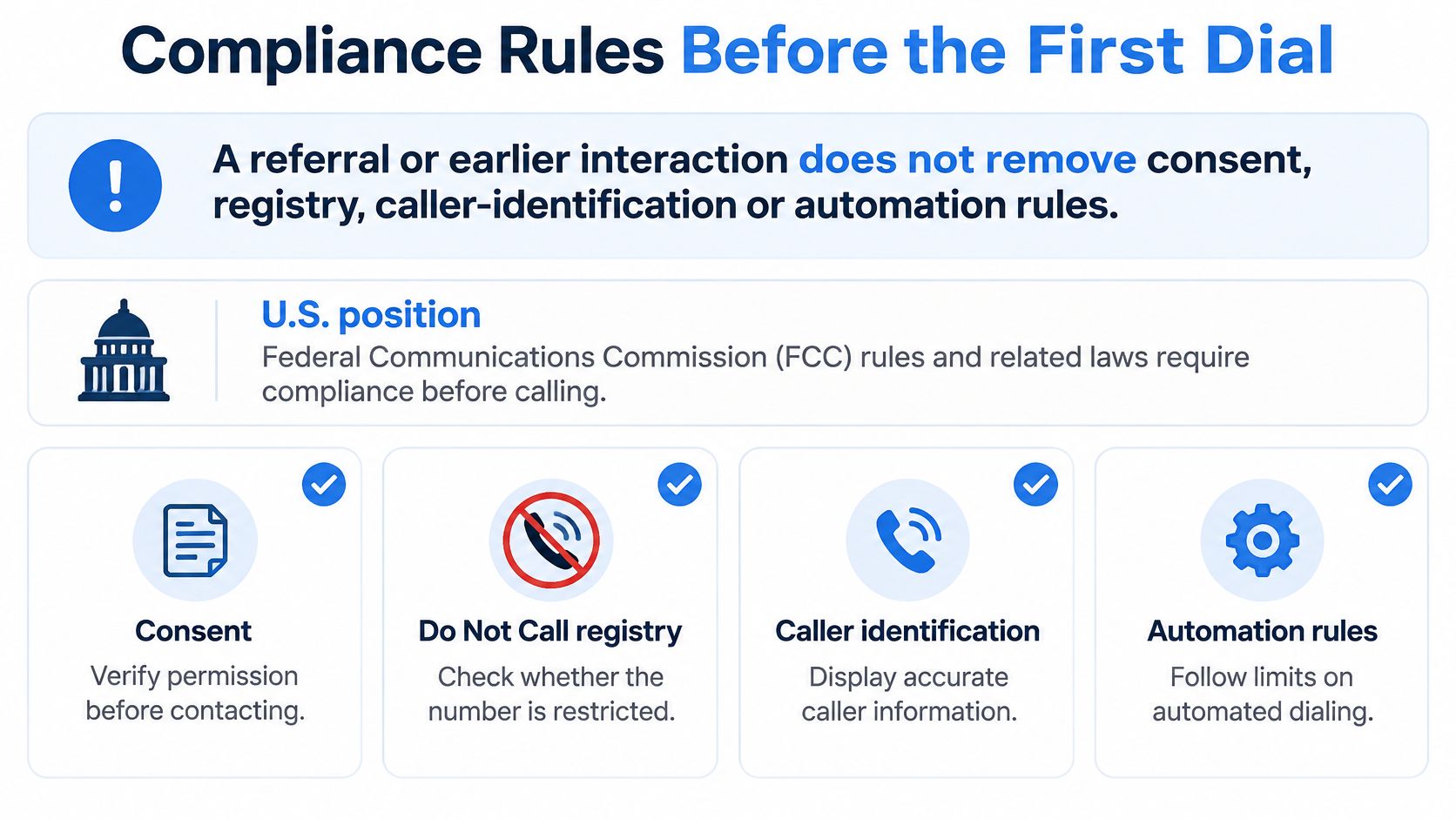
A warm lead isn't automatically a compliant call. A referral or earlier interaction doesn't remove consent, registry, caller-identification or automation requirements.
The Federal Communications Commission states that non-emergency autodialed or prerecorded calls to cell phones generally require prior express consent, and written consent is required when a prerecorded or autodialed call contains an advertisement. For numbers on the National Do-Not-Call Registry, advertising calls, including manually dialed live calls, are generally prohibited unless the recipient has an established business relationship with the caller or has provided prior express written consent.
Keep a Separate Compliance Record
Don't use a lead-temperature field as a substitute for permission documentation. Maintain a record the calling workflow can check:
- Lead source: Where the contact came from and how it was obtained.
- Phone type: Whether the number is wireless or another category relevant to applicable rules.
- Dialing method: Manual, automated or prerecorded.
- Consent status: What permission exists and what it covers.
- Do-not-call requests: Any refusal, restriction or suppression status.
- Signal date: When the interaction or public event occurred.
A public profile or company announcement is neither consent nor proof of buying intent. Keep relevance assessment and legal eligibility as separate decisions.
Specialized workflows may require additional review. For healthcare-related operations, SnapDial's discussion of HIPAA requirements for call center teams provides context for assessing how agents handle sensitive information; it doesn't replace a determination of which rules apply to your organization.
Rules differ by country and region, so confirm local requirements before dialing outside the U.S. Have counsel or the responsible compliance owner approve the combination of audience, number type, dialing technology and message.
Check campaign lists against suppression records before every campaign and after every data refresh. Updating a person's role must never erase their earlier request not to be contacted.
Confirm Your Next Call Type Before You Dial
The useful decision is not whether warm calling beats cold calling. It's whether the evidence supporting this particular call is strong enough to justify its opener, priority, and remaining attempt budget.
Run a Pre-Dial Check
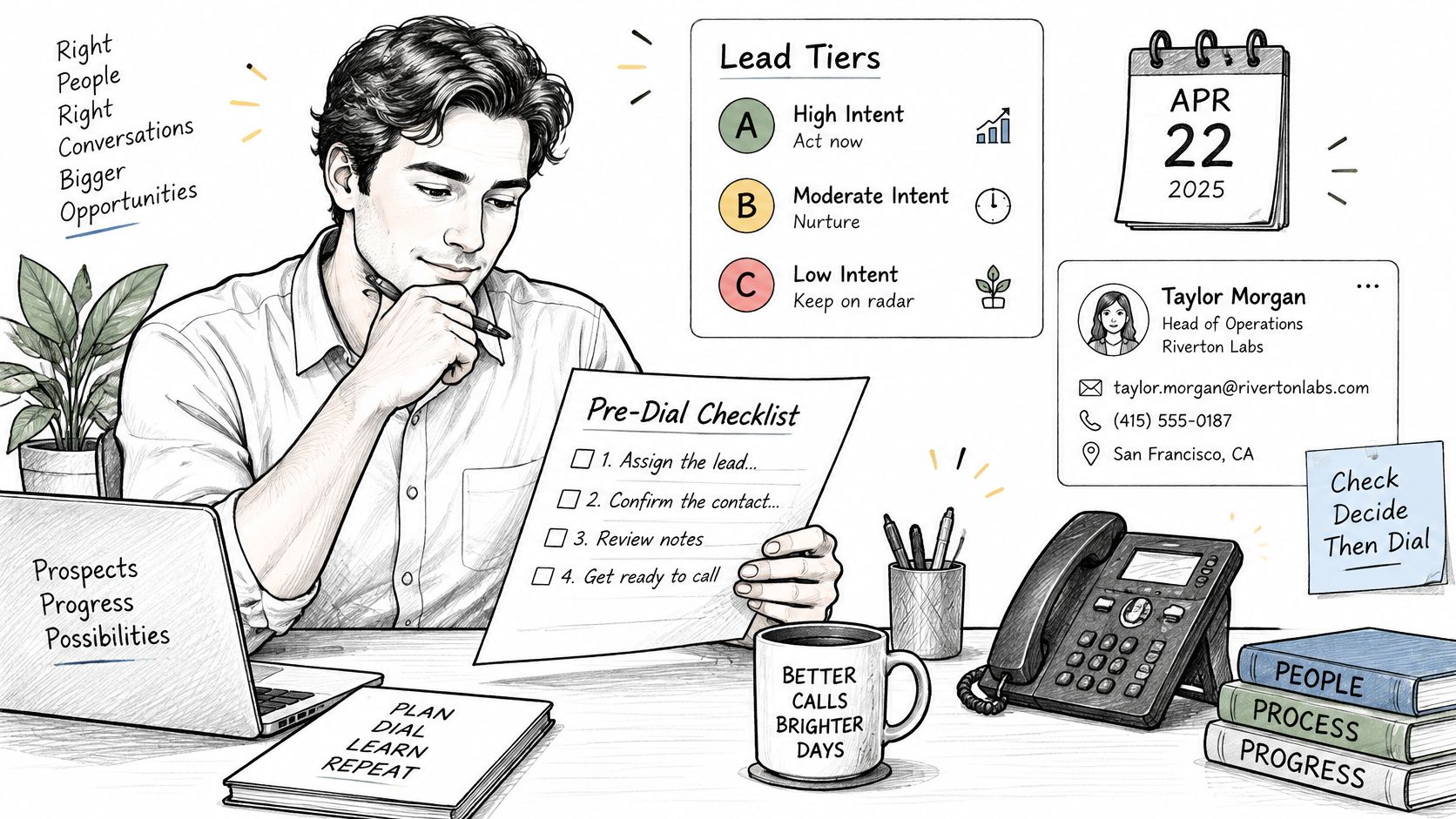
Assign the tier. Use the signal's source and date to classify the contact as warm, context-enriched cold or cold. Leave an audit trail explaining the choice.
Verify the current record. Use a B2B data API such as Fetchin when current professional profile and company data are needed at call time.
Check eligibility. Review the compliance record and suppression status before passing the contact to a dialer or representative.
Choose the opener and budget. Match the wording to the evidence, assign the permitted attempts and record what will stop the sequence.
Budget enrichment before a large run. A profile call with
fullProfile=trueand a post engagement call each cost two credits. Plan which records require each operation rather than enriching every field indiscriminately.
For inbound acquisition, our lead qualification scores signups against your ideal customer profile when they arrive, using current title and company size. Lead scoring and routing can qualify and assign a signup before it reaches a human.
Test a Segment Before Expanding
Pick one list segment, classify it into the three tiers and run a two-week test with fixed attempt limits and a written stop rule. Treat that duration as a practical pilot window, not a benchmark-backed optimum.
Measure results by lead source and funnel stage before expanding. Keep unanswered calls, conversations and meetings separate so you can tell whether the next improvement belongs in contact accuracy, prioritization or the conversation itself.
Fetchin offers a real-time B2B data API for current professional profile, company and engagement data. Visit Fetchin to build a workflow that verifies calling context, routes relevant signals and refreshes records before outreach.