A stealth startup is an early-stage company that deliberately limits public disclosure of its product, technology, brand or business model while it builds and validates the offering. If secrecy protects a good idea, why do so many quiet companies still launch a product nobody asked for?
That question exposes the usual mistake in how people explain the idea. Stealth isn't a binary choice between hiding everything and announcing everything. It's a controlled disclosure strategy you can design by audience and by stage, so you hide the few things that are hard to copy while you test the problem, the buyer and the price with real customers. When founders mix those two lists up, secrecy stops protecting the business and starts protecting it from feedback.
Table of Contents
- What a Stealth Startup Actually Means
- Pros and Cons of Stealth Mode
- Who Sees What During a Stealth Period
- What Stealth Changes for Product, Hiring and Fundraising
- Real Stealth Startups and How Common Stealth Is
- Deciding Whether Stealth Fits Your Startup
What a Stealth Startup Actually Means
A stealth startup is an early-stage company that deliberately limits public information about its product, technology, brand or business model while it develops and validates the offering. You'll usually see a minimal website, no press coverage and no public product demonstrations. Detailed information goes only to employees, selected customers and investors who need it to do their part.
Think of a restaurant kitchen testing recipes behind a closed door before the dining room opens. The menu isn't public yet, so passersby can't judge dishes that are still changing. Inside, though, the kitchen is fully operating, with staff, suppliers, costs and quality checks. A stealth company works the same way. The closed door changes who can watch, not whether real work is happening.
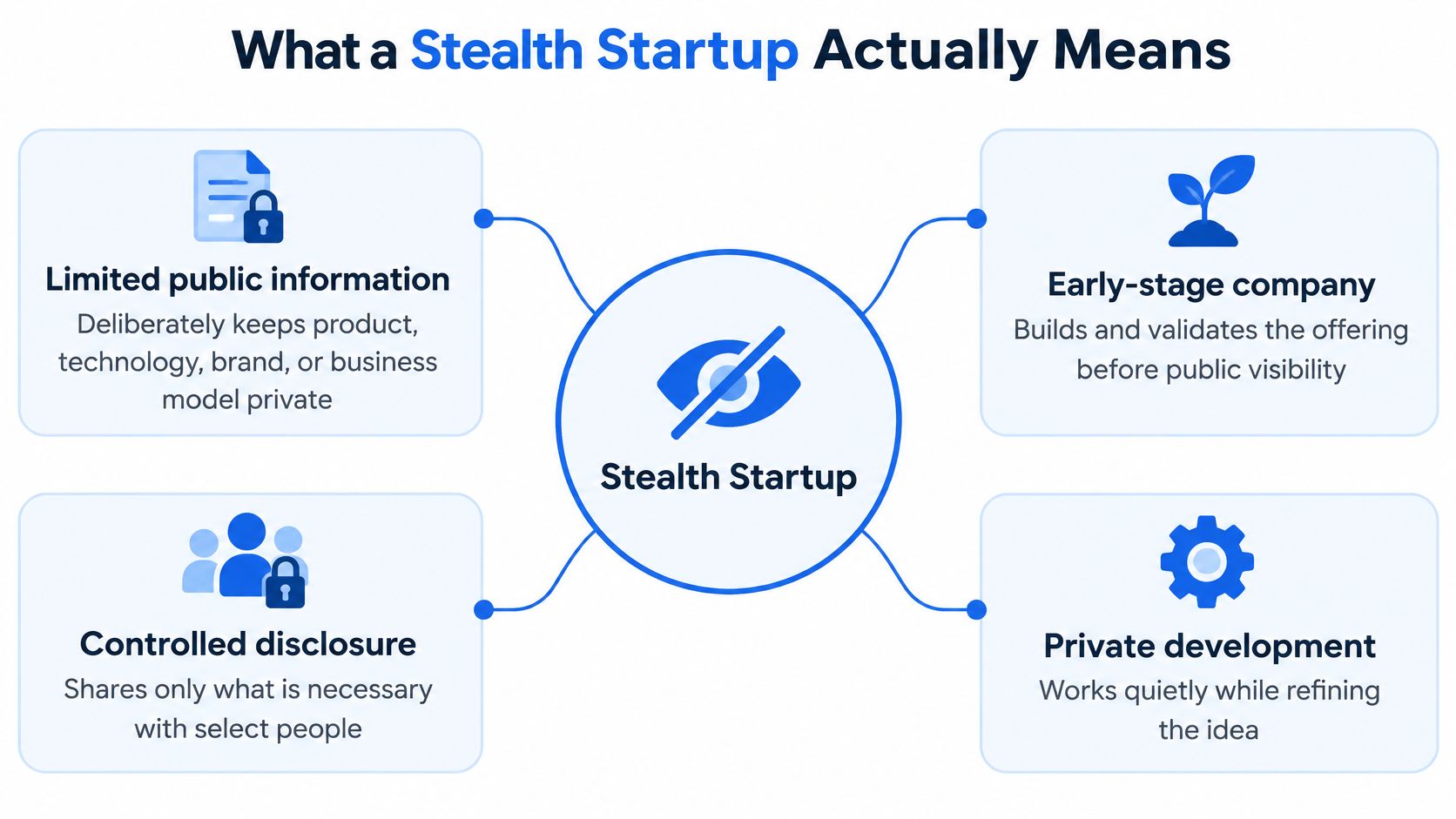
A Disclosure Strategy Not a Legal Category
Stealth is a temporary operating state, not a permanent model and not a company type. The Angel Investors Network guide to stealth startup investing risks makes the legal point clearly, noting that a stealth startup isn't a separate legal entity or incorporation category. It's a disclosure strategy that can cover product, team, progress, customers or financing while ordinary business continues.
That distinction matters in practice. A stealth company can still incorporate, hire staff, sign contracts, file patents, pay tax and meet its employment and intellectual property obligations. It may have no public product page and no confirmed public name, yet still be a normal, accountable business. Stealth describes visibility and information-sharing practices, not a government-recognized status.
Quiet Does Not Mean Inactive
Readers often assume stealth means unfunded, tiny or not yet started. That's a misreading. Many stealth companies raise money, hire engineers and run customer pilots while staying quiet in public. What Is a Stealth Startup, then, if money and work are already flowing? It's best understood as a decision about who learns what, and when.
Ask whether the company is hiding its details to protect something specific, or simply avoiding feedback because feedback feels risky. Only the first reason justifies the closed door.
That simple test sorts useful secrecy from habit. If a founder can't name what a competitor would do differently with the hidden information, the company probably isn't protecting an advantage. It's delaying the conversations that would tell it whether an advantage exists.
Pros and Cons of Stealth Mode
| Side | Benefit or cost | What it means in practice |
|---|---|---|
| Benefit | Protects intellectual property | Competitors learn less about architecture and research methods |
| Benefit | Limits information asymmetry | Rivals cannot easily copy the concept or bid up scarce engineers |
| Benefit | Controls narrative and timing | The team avoids positioning around a version that will change |
| Benefit | Hardens technology privately | Reliability is tested with design partners before public scrutiny |
| Benefit | Focuses resources | Early effort goes to building rather than publicity |
| Cost | Less external feedback | The team may build a product the market does not want |
| Cost | Weaker inbound interest | Growth depends on the founders' networks |
| Cost | Harder recruiting | Candidates get incomplete information until late interviews |
| Cost | Signaling risk | Investors or customers may read a quiet company as unvalidated |
| Cost | Delayed operational work | Legal entity, tax, banking and IP assignments slip and cost more to fix later |
Why Founders Choose the Closed Door
The starting benefit is intellectual property protection. The overview of stealth startups on dak.dev identifies protecting intellectual property and preserving a competitive advantage as the principal strategic rationale. A quiet period limits what competitors learn about your architecture, data sources, schema design or research methods. For a technically differentiated product, those details are often the difference between a head start and a fast copy.
That protection works through information asymmetry in your favor. If rivals don't know your concept, they can't easily copy it, pre-empt your distribution channels or bid up the scarce engineers you need. Say you're building a B2B data API and your edge sits in how you resolve sources and keep schemas stable. Publishing that method early invites competitors to rebuild it before you've signed enough customers to defend your position.
Stealth also gives you control of narrative and timing. Early products change weekly, and public positioning hardens around whatever you said first. If you announce a tool for one workflow and then learn buyers want a different workflow, you're now correcting a public story while rebuilding. Staying quiet lets the team choose the moment when the product, the name and the promise line up, rather than explaining a version that won't survive the next pilot.
There's a calmer engineering benefit too. A data infrastructure startup can measure p95 latency, request success rate and schema stability with a small group of pilot users, fix the weak points and publish benchmarks only once they hold under real load. Public scrutiny during that hardening phase doesn't make the system more reliable. It mainly turns ordinary early failures into a reputation you have to outgrow.
Finally, stealth focuses resources. A small team that isn't feeding a press cycle, a content calendar and a launch countdown can put its hours into research and product execution. That focus is real, but it's the weakest reason on this list on its own. You can also get focus by not doing publicity yet, without hiding information customers need.
What the Closed Door Costs You
The largest cost is less external feedback, and it's the one that kills companies unnoticed. When only insiders see the product, you lose the casual corrections that public users supply for free, such as confusing onboarding, a missing integration or a price that makes no sense for the job. The team can spend months polishing a product the market doesn't want, and secrecy ensures nobody interrupts that mistake early. Private pilots reduce this risk only if pilot users are free to tell you the product misses the point.
Visibility costs follow from the same choice. With little public presence, you get weaker inbound interest, so growth depends on the founders' personal networks, introductions and outbound effort. That's workable for a narrow enterprise product with a short list of buyers. It's painful for a product that needs volume, self-serve signups or a broad developer community, because you've switched off the channels that would have found those users for you.
Recruiting gets harder in a specific, predictable way. Candidates receive incomplete information until late-stage interviews, so they're asked to stay interested in a company they can't research, a product they can't try and a mission described in general terms. Strong candidates with other offers often decline rather than wait for the reveal. The founders then hire from their own networks, which narrows the talent pool and can reproduce the same blind spots across the team.
There's also signaling risk. Investors and customers can't easily distinguish a disciplined stealth company from an unvalidated idea with a vague website, and some will assume the worse option. A quiet company therefore needs credible substitutes for public proof, such as founder references, a secure demonstration, a clear customer problem statement or a technical milestone that a skeptical outsider can check. Without those substitutes, secrecy reads as absence of evidence.
The least glamorous cost is delayed operational work. Teams in hiding sometimes postpone the legal entity cleanup, tax registrations, banking setup and IP assignment paperwork because none of it feels like product progress. That debt gets more expensive later, when a financing or a large customer requires clean documents on a deadline and a missing assignment from an early contractor turns into a negotiation. Stealth doesn't cause that neglect, but a culture of deferring anything external makes it more likely.
Verification test: If you can't name three ways a candidate or investor can check your company without seeing the product, your secrecy is probably costing more than it protects.
That test keeps the comparison honest. Benefits are real only when what's hidden is valuable and hard to rebuild. Costs are real every week, in slower feedback, slower hiring and slower trust. Weigh the specific secret against those weekly costs, not against a general feeling that quiet is safer.
Who Sees What During a Stealth Period
Stealth rarely means complete isolation. The Recent Funding explanation of stealth startups describes the pattern as controlled disclosure rather than complete isolation, with information shared privately with selected investors, prospective employees, design partners and pilot customers. The public sees very little, while each insider group sees the slice it needs. That map, written down and followed consistently, is what makes stealth a strategy instead of improvisation.
Practical controls are unglamorous. Teams use generic or placeholder company names, private introductions through trusted networks and restricted product demonstrations instead of public demos. The public website shows only a problem statement or a basic holding page. When you're deciding which buyers to approach first under those limits, it helps to define your ideal customer profile before you start asking for introductions, because a short, well-chosen list keeps disclosure narrow.
Confidentiality agreements support that sharing, but they don't replace discipline about what each person receives. If you're building with distributed contributors, the guidance on confidentiality agreements for nearshore teams is a useful reminder that the agreement should match who gets access and for how long. An NDA is a legal control. It doesn't undo a leaked repository, a forwarded architecture diagram or an over-shared data room, any of which can reveal more than a careful verbal pitch ever would. Pair every agreement with least-privilege access, so people hold only the documents and systems their work requires.
| Audience | What They See | Typical Control |
|---|---|---|
| General public | Generic company name and a minimal website | No demos, press or detailed roadmap |
| Investors | Team, runway and selected product detail | Private introductions and investor updates |
| Employees and candidates | Role scope and engineering standards, product detail after vetting | NDA and staged interview disclosure |
| Design partners and pilot customers | Restricted product access and problem-specific details | Confidentiality agreement and controlled demos |
| Competitors | Almost nothing beyond the public holding page | No launch date, architecture or pricing published |
Read the table as a starting map, not a permanent one. What you can safely share with a pilot customer at seed stage may be too much just before launch, when launch timing itself becomes sensitive. Revisit the map at each stage and ask two questions for every row: does this audience still need this information, and does the control still match the risk if it leaks? If either answer is no, tighten the row before the next conversation.
What Stealth Changes for Product, Hiring and Fundraising
The diagram below sets out how the same disclosure discipline plays out across the three functions founders feel first.
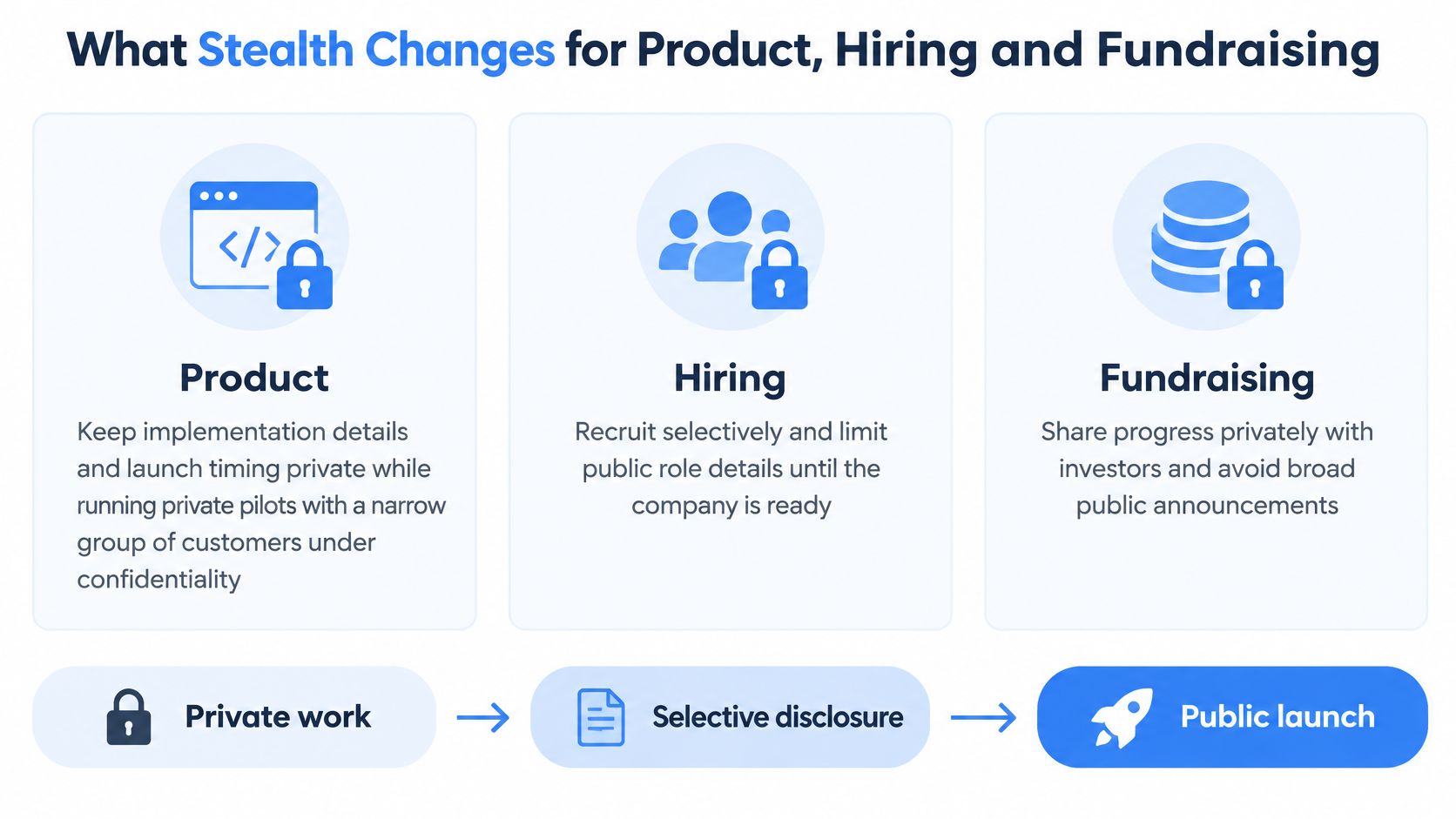
Product work splits cleanly into what stays private and what gets tested. Keep implementation details and launch timing private, then run private pilots with a narrow group of customers under confidentiality agreements. Track measurable outcomes such as latency, success rate and cost per successful response, so pilot conversations produce evidence rather than compliments. Before any pilot user connects, document your baseline controls. We protect data with encryption in transit (TLS), secure API key management, access controls and regular security assessments, and a stealth team should be able to describe its equivalent list without hesitation.
Hiring needs substitutes for the information you're withholding. Candidates can't evaluate an unseen product, so give them credible technical detail about the problem, founder references they can call, a defined role scope and clear equity terms. If you're writing senior roles under those constraints, this breakdown of a job description for a VP of sales shows how much role clarity you can publish without revealing the product. For a candidate's view of what makes a quiet opportunity feel legitimate, the stealth hiring insights from Underdog.io are worth reading before you open a role. Put explicit IP assignment agreements in place before work starts, since quiet companies often rely on contractors whose contributions must belong to the company unambiguously.
Fundraising runs on private introductions and a controlled data room rather than public momentum. With selected investors, you share the full picture: team, runway, milestones and whatever validated demand your pilots have produced. You're trading broad discoverability for deeper disclosure to fewer people, so the quality of that evidence matters more than the polish of the mystery.
The short video below walks through how these staged choices look in sequence, from private work to public launch.
A Three Stage Disclosure Path
- Publish the problem domain and engineering standards. This gives candidates and partners something real to evaluate without exposing the solution.
- Disclose architecture to vetted contributors. People who build or integrate get technical depth under agreement and least-privilege access.
- Reveal customer-facing capabilities once evidence is in place. Public claims wait until reliability and compliance evidence can support them.
Following that order limits the classic failure modes of total secrecy, especially slow hiring and discovering usability problems only after launch. Each stage releases the information that opens the door to the next kind of progress, and nothing more. The decision checklist at the end turns this sequence into a choice you can make for your own company.
Real Stealth Startups and How Common Stealth Is
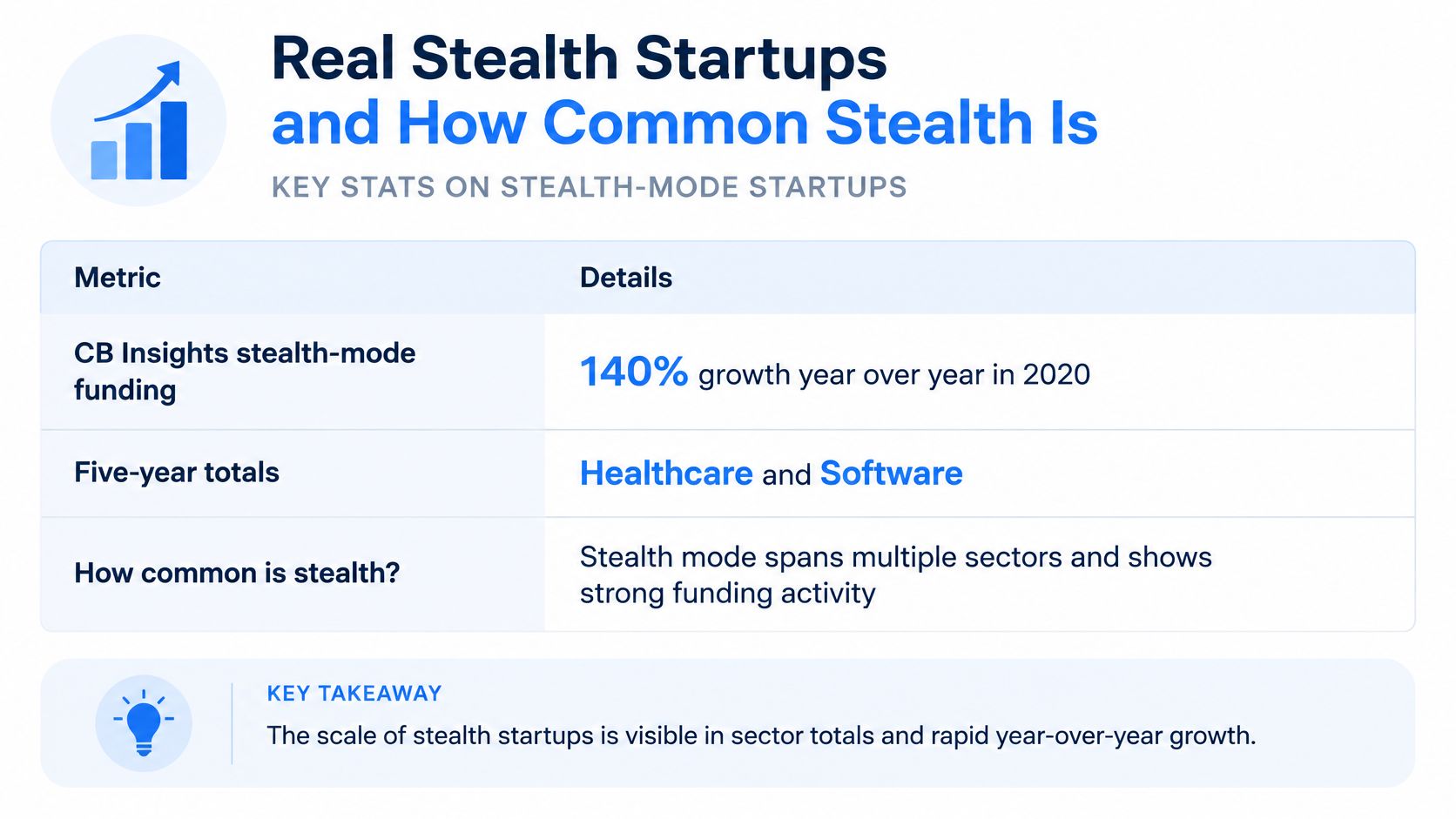
How common is stealth mode, really? The clearest public snapshot is CB Insights research on stealth-mode startups, which reported that funding for companies identified as operating in stealth mode rose 140% year over year in 2020.
| Measure | Figure |
|---|---|
| Funding growth for stealth-mode companies in 2020 | 140% year over year |
| Stealth healthcare companies, five-year analysis | More than $1.3 billion across 350 deals |
| Stealth software companies, five-year analysis | Nearly $1.7 billion across 511 deals |
| Share of stealth-mode deals in the United States | 88% |
| Stealth-mode deals in California | 282 |
| Stealth-mode deals in New York | 102 |
The same analysis places most activity in the United States and shows heavy concentration in software and healthcare, two fields where the edge often sits in implementation details, clinical evidence or proprietary methods. Read that pattern as controlled disclosure with a purpose. Teams keep the copyable mechanism private while still testing the buyer, the workflow and the price with selected customers.
A useful stealth exit works like a curtain rising after rehearsal. When the company goes public, the announcement usually carries proof such as financing, a customer signal or product readiness, so outside audiences get evidence instead of mystery. That is the practical lesson from real stealth companies: the quiet period ends when disclosure can open the next door, whether that door is capital, hiring or a first wave of customers.
Keep one caution in mind when you read totals like these. The table reports aggregate figures across hundreds of deals, so any single company's path, sector and timing will differ. Use the numbers to judge whether stealth is a normal, fundable choice in your sector, then decide which facts must stay private and which customer-facing claims need open testing before launch.
Deciding Whether Stealth Fits Your Startup
Stealth fits when your advantage lies in building something hard to copy and you can still get honest outside feedback while you build it. It fails when secrecy replaces customer validation, because then you're not protecting an edge, you're postponing the discovery that buyers don't care. Work through four steps on paper before you commit to either path.
Step one is to list what must stay secret. That list is usually short: implementation details, architecture, source logic and launch timing. These are the items a competitor could act on quickly once exposed, and they're the only items secrecy protects. If an item wouldn't change a rival's behavior, it doesn't belong on this list.
Step two is to list what must be tested with selected customers from the start. That list should include the problem, the buyer, pricing, the workflow you fit into and how urgent the pain feels. While you size that opportunity, this guide to how to calculate addressable market helps you test whether the buyers you can reach are numerous enough to matter. Stealth can hide the signal that a product isn't needed, so these questions can't wait for launch day.
Step three is to set exit criteria based on evidence rather than calendar time. Useful triggers include stable performance benchmarks, validated customer workflows and documented data governance controls. Add one communication trigger: a launch narrative that shows enough capability to create demand without exposing the defensible details underneath. When those boxes are ticked, staying quiet stops buying you anything.
Step four is to decide who receives which information and under what agreement, then record it in one place. A written disclosure plan keeps every founder, hire and advisor telling the same story at the same depth. Without it, disclosure drifts with whoever happens to take the meeting, and drift is how controlled sharing becomes an accidental leak.
Write down three things you'll keep secret, three things you'll test now, and the evidence that will trigger your public launch. If you can't fill in all three columns, you're not ready to choose stealth.
That short exercise is the whole decision in miniature. If the secret column holds something defensible and the test column stays active, a quiet period can buy you room to build. If the secret column is everything and the test column is empty, build in the open instead.
If you're building and need current professional data without maintaining your own data extraction pipeline, our real-time B2B data API at Fetchin turns professional profile URL and company URL inputs into structured JSON you can validate with design partners today. Start with a small pilot, measure the response quality against your own benchmarks, and keep your implementation details to yourself while the evidence builds.