An ICP (Ideal Customer Profile) is a company-level description of the organizations most likely to buy, successfully implement, get value from, renew and expand their use of a product. What is ICP worth if the accounts that sign fastest are the ones that churn first? That's the gap most definitions miss, and it's why a useful ICP has to predict realized value, not just a signed contract.
Table of Contents
- What an Ideal Customer Profile Means
- Why an ICP Changes Who Your Team Chases
- The Five Layers Every Strong ICP Combines
- Why Buying Groups Matter More Than One Contact
- How to Build an ICP From Your Closed-Won Data
- A Worked ICP Example for a SaaS Team
- Privacy Rules for Public Professional Data
- Check, Refresh and Act on Your ICP
What an Ideal Customer Profile Means
An ICP describes the account itself, not one person inside it. As Salesforce's guide to ideal customer profiles puts it, it's the organizations most likely to buy, successfully implement, receive substantial value from, renew, and expand their use of a product. A buyer persona, by contrast, describes an individual decision-maker or user.
That distinction matters because teams often mix three ideas together. If you're working out how to identify your best-fit customers in practice, separating the account, the person and the wider market is the first step.
| Concept | Describes | Unit | Question it answers | Example |
|---|---|---|---|---|
| Ideal customer profile (ICP) | Organizations most likely to buy, adopt, renew and expand | Company account | Which accounts should we prioritize? | B2B software companies with 50 to 500 employees and a growing sales team |
| Buyer persona | An individual decision-maker or daily user | Person | What does this role need from us? | VP of Sales who wants faster pipeline reporting |
| Target market | The broad group of organizations that could use the product | Market segment | How large is the opportunity? | All mid-market SaaS companies in North America |
A quick example and a test you can run today
For a SaaS business, an ICP might be B2B software companies with 50 to 500 employees, a growing sales organization, a particular technology stack, and a need for reliable real-time data. The point isn't the list. It's prioritization, so marketing, sales, product and customer success separate high-fit accounts from merely large or visible prospects and work from the same definition of value.
Practical rule: Write one sentence naming the company type, its size, its stack and the problem it solves, then check whether your three best recent customers fit it.
If they don't fit, your sentence describes who you wish you sold to, not who gets value. Rewrite it until it matches those three accounts, then use it to judge new prospects.
Why an ICP Changes Who Your Team Chases
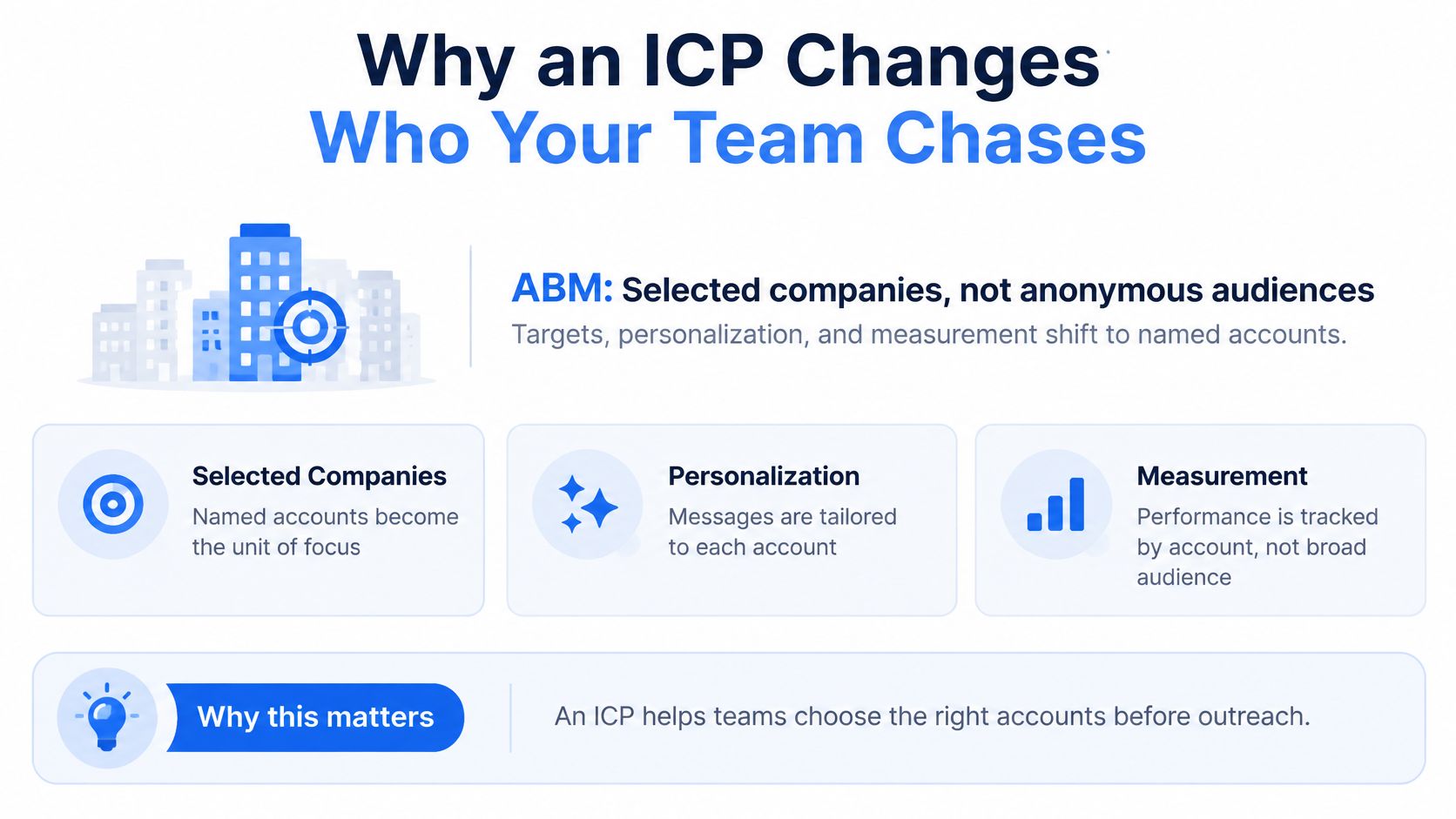
Account-based marketing (ABM) focuses on selected companies rather than anonymous audiences. That changes the work: teams choose which accounts to pursue, tailor outreach to those accounts, and track progress at the account level.
The SiriusDecisions/Forrester finding cited in this SaaS Hackers handbook reports that B2B companies with a clearly defined ICP achieve 68% higher account win rates than those without one. The source also associates sales and marketing alignment around a shared ICP with 36% higher customer retention, 38% higher sales win rates, and 208% growth in marketing-generated revenue.
These are reported industry research claims, not guaranteed causal results. The source does not provide methodology or sample details, so treat the figures as directional rather than as a forecast for your team.
What changes in practice
A team that chases large logos without checking fit may spend months on deals that stall during implementation. The buyer might lack the technology or staff needed to deploy the product. An ICP gives sales and marketing a shared basis for prioritizing accounts, such as a match between the company's technology and team size.
An ICP is a testable operating hypothesis, not a fixed list of company traits. Check it against closed-won accounts, then test whether those customers renew, expand, and make sound business sense. If the pattern changes, revise the hypothesis. A workshop can help draft it; customer outcomes show whether it holds up.
The Five Layers Every Strong ICP Combines
Think of an ICP as a building. Firmographics are the foundation, technographics are the wiring, behavioral signals are the timing, business needs are the reason to buy, and commercial fit is the business case. Miss a layer and the structure looks fine from outside but fails once someone moves in.
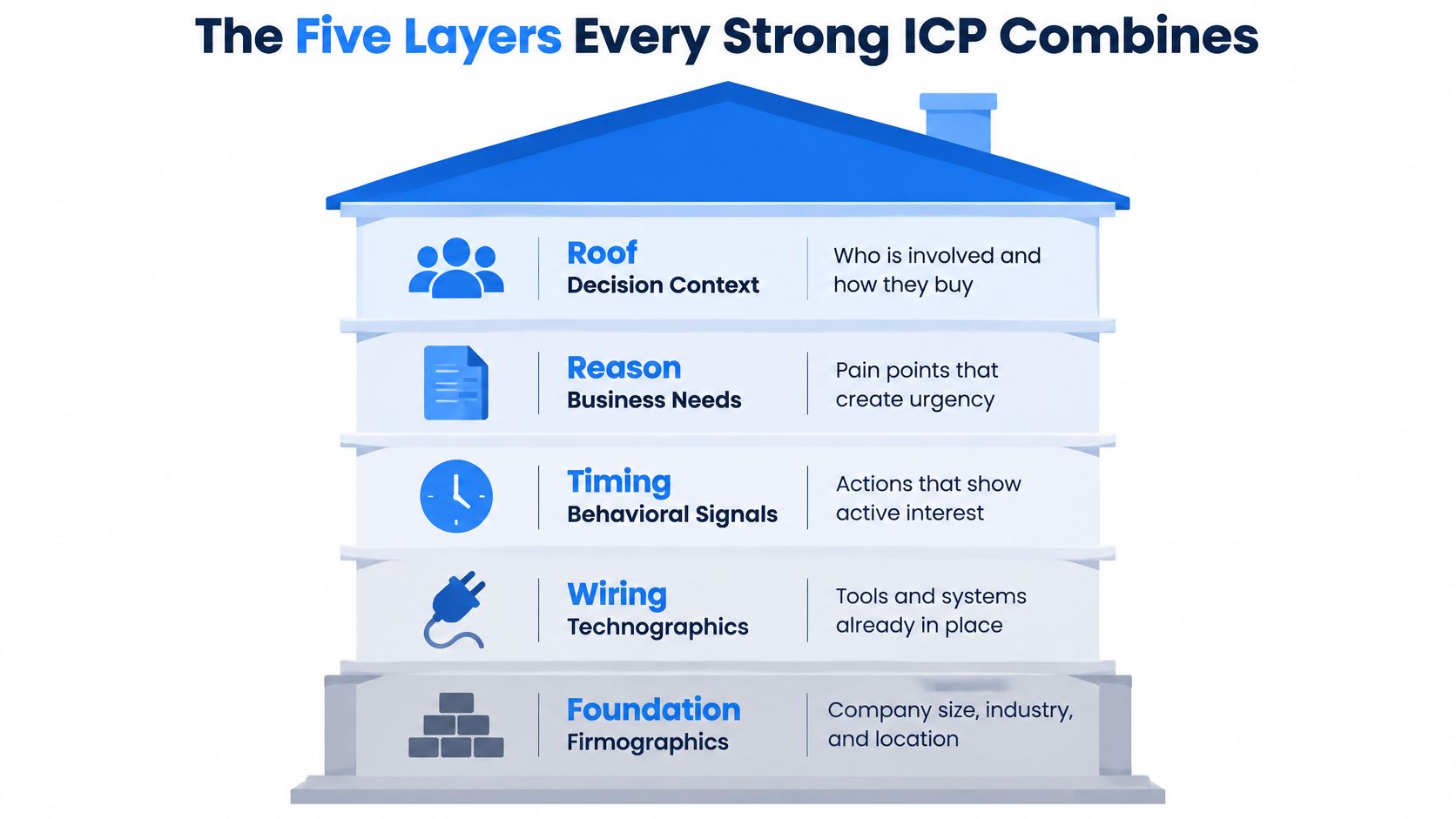
| Layer | What It Covers | Example Attributes | Question It Answers |
|---|---|---|---|
| Firmographics | Stable company facts | Industry, employee count, revenue, location, growth stage | Is this the right size and market? |
| Technographics | Software and infrastructure in use | CRM, cloud provider, data platform, integration requirements | Can it connect to our product? |
| Behavioral signals | Current activity that shows timing | Hiring for relevant roles, funding, pricing-page visits, product trials | Is it ready to act now? |
| Business needs | Pain points the product solves | Manual lead research, stale CRM records, slow enrichment | Does it have a problem we solve? |
| Commercial fit | Economics of the relationship | Budget, sales-cycle length, retention, expansion potential | Will it pay, stay and grow? |
Say your target account has 200 employees in B2B software, runs a cloud data warehouse and a CRM, and is hiring two data engineers. Its daily pain is manual lead research and stale CRM records, and it has budget for an annual contract it's likely to renew. Each layer adds a different kind of evidence, and understanding firmographic data helps you source the foundation layer correctly.
Filtering isn't ranking. Firmographics and technographics are relatively stable, so they remove ineligible accounts. Behavioral signals and business needs then rank the accounts that remain. Data usually comes from company records, job postings, web analytics, discovery-call notes, and closed-won and churn records.
Two traps undo this work. Teams load the ICP with fields nobody uses in scoring or reporting, or they leave out commercial fit and attract accounts that can't pay or stay. Choose three to five attributes that most clearly separate your best customers from the rest.
Why Buying Groups Matter More Than One Contact
An ICP that stops at company type can produce pipeline that stalls, because several people make the purchase together. The map below shows how those stakeholders sit inside one account.
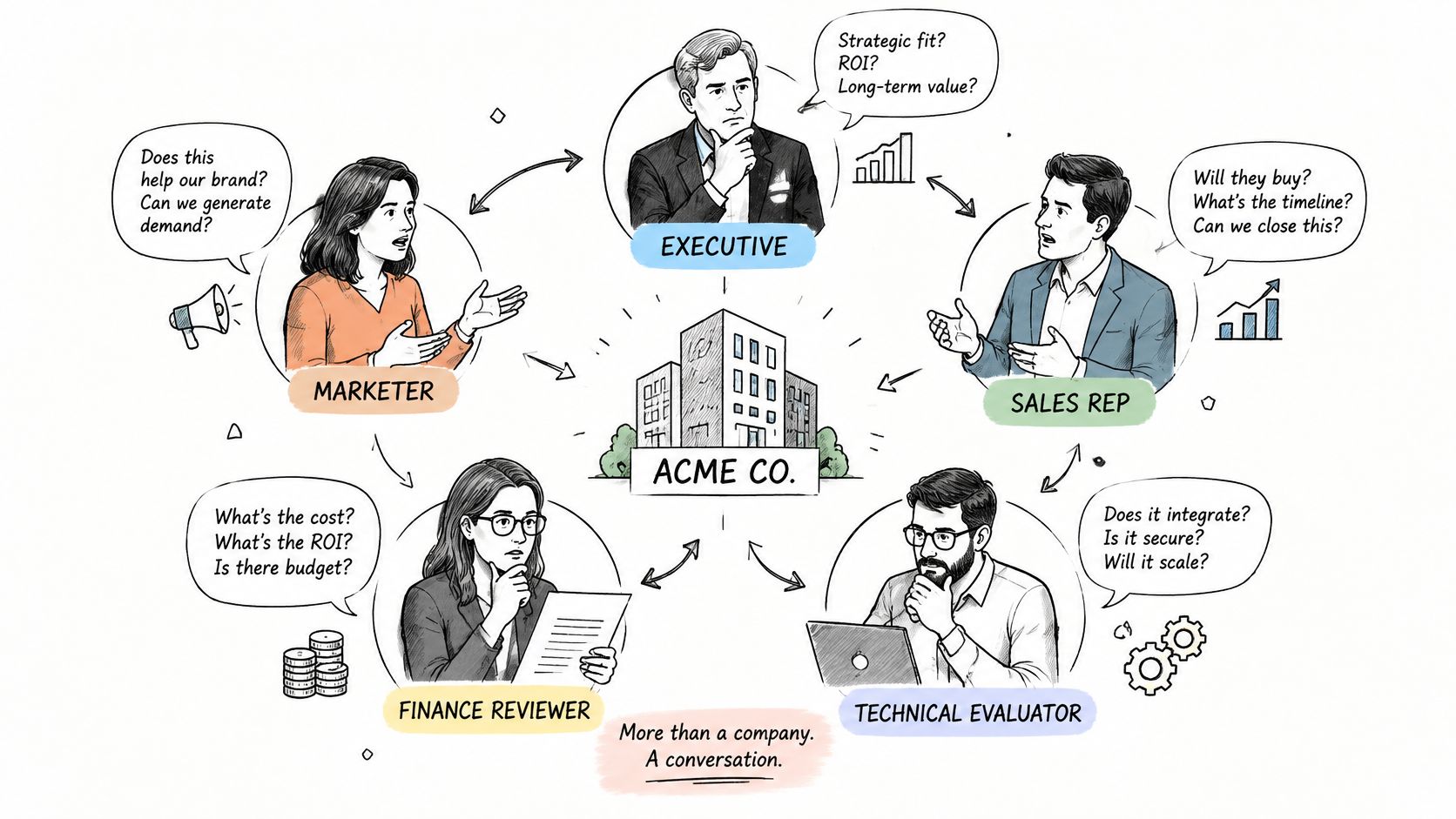
You'll usually meet five roles. The economic buyer weighs ROI and price, the champion advocates internally, the technical evaluator checks integration and security, procurement handles contract terms, and the end user lives with the product daily. The Demandbase State of the B2B Buyer Report found that 72% of B2B purchases involve complex, multi-stakeholder buying groups, and more than three-quarters of B2B buyers involve over three people in a decision.
So a strong ICP needs two connected layers. The account layer covers firmographics, technology environment, geography and maturity. The buying-group layer maps each role's influence, objections, information preferences and approval authority. This matters for paid campaigns too, since teams trying to turn SaaS ad spend into qualified pipeline need messages that reach the whole group, not one contact. The same principle applies if you're learning how to approach high-ticket sales conversations where approvals stack up.
Watch the short explainer below for how buying committees shape a deal before you ever get on a call.
A technical lead with no budget can still block your deal. That's the hidden influencer problem, and a company-only ICP won't surface it.
Map at least two roles for each target account before outreach begins. You'll know who can say yes, who can say no, and who needs different information.
How to Build an ICP From Your Closed-Won Data
Don't build your ICP in a workshop from memory. Build it from your own wins and losses, where the evidence already exists.
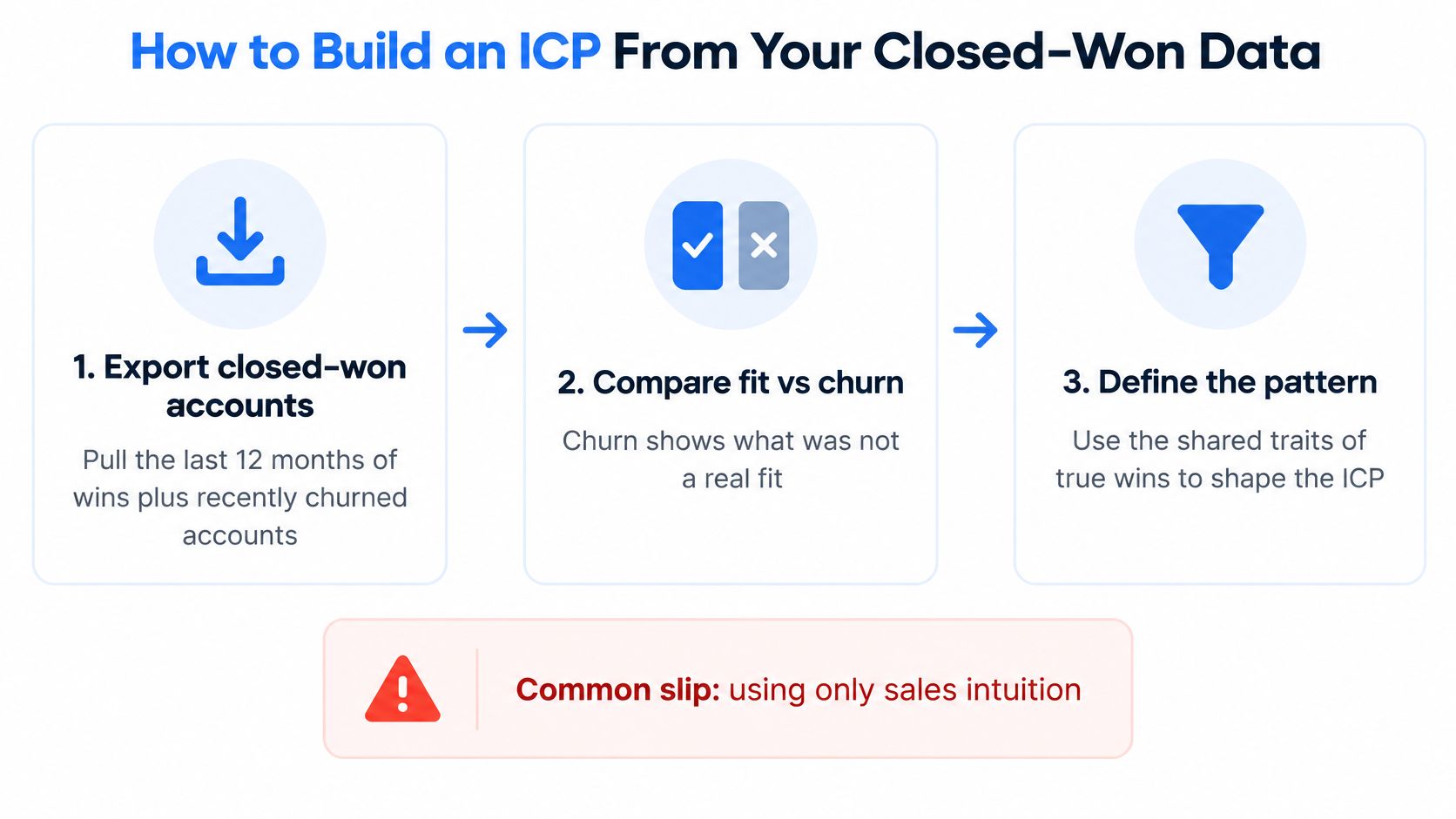
- Export your recent accounts: Pull closed-won accounts from the last 12 months plus recently churned accounts, because churn separates real fit from lucky wins. The common slip is using only the sales team's memory of good deals.
- Tag every account: Add firmographic, technographic, behavioral and commercial attributes, using enrichment where fields are missing. Resources on AI-powered CRM enrichment with Cyndra show how teams fill those gaps systematically. The common slip is tagging only company size and industry.
- Compare stayers with churners: Set accounts that renewed and expanded against accounts that churned, and look for attributes recurring among winners and absent among churners. The common slip is treating every shared trait as meaningful, so check whether churners share it too.
- Turn attributes into weights: Give positive weights to matches and negative weights to disqualifiers, such as unsupported deployment requirements or company sizes outside your market. This converts a description into a scoring model reps can apply consistently.
- Set and test a threshold: Pick a score such as 70 out of 100, then test it against the next 50 inbound leads before relying on it. The common slip is skipping the test and trusting the model because the spreadsheet looks tidy.
- Review quarterly: Retire any attribute that no longer predicts value, and add new ones your recent wins reveal. Your product and market shift, so your criteria should too.
What finished looks like
A finished ICP fits on one page. It lists the target criteria, the weights, the exclusions, the threshold and a named owner who updates it. If it runs longer, nobody will use it during a busy week. If it has no owner, it will go stale while everyone assumes someone else is maintaining it.
A Worked ICP Example for a SaaS Team
Say a fictional B2B SaaS company sells a reporting tool to sales teams. Its team sets five weighted criteria, two exclusions, and one threshold.
- Firmographics, 25 points: B2B software, 50 to 500 employees
- Technographics, 20 points: Cloud data warehouse and CRM in use
- Behavioral signals, 20 points: Hiring for data or revenue operations roles in the last 90 days
- Business need, 15 points: Manual lead research or stale CRM records
- Commercial fit, 20 points: Budget for an annual contract and renewal history in similar accounts
Exclusions come first: companies under 20 employees and companies with no CRM are out before scoring. The pass threshold is 70 out of 100. These weights are illustrative, not industry benchmarks, so derive your own from closed-won and churn data.
Scoring three accounts
Account A has 200 employees, a cloud warehouse and CRM, no recent hiring, a clear manual research problem and an unconfirmed budget. It scores 25 plus 20 plus 0 plus 15 plus 10, which equals 70, so it passes and goes to sales.
Account B has 45 employees. Wait, that clears the size floor, but it has no CRM, so the exclusion removes it before any points are counted. Exclusions protect reps from accounts that can't implement, however enthusiastic the first contact sounds.
Account C has 300 employees, a CRM but no cloud warehouse, recent data hiring, a moderate need and no budget signal. It scores 25 plus 0 plus 20 plus 10 plus 0, which equals 55, so it stays in nurture until its stack or budget changes.
Now test the threshold against your next 50 inbound leads. If too many weak accounts pass, raise it. If strong accounts fall short, check which weight is punishing them unfairly.
Privacy Rules for Public Professional Data
Public doesn't mean free to process. The Dutch data protection authority's guidance on personal data in public sources states that placing personal data in open sources, including public Internet pages, is still processing of personal data and therefore falls under the GDPR. That processing requires a lawful basis and a specific, legitimate purpose, and each new processing operation should be assessed to determine whether a data protection impact assessment is required.
People also keep rights over that data. The same guidance covers the European Commission position identifying a right to object when data is processed for direct marketing, legitimate interests, or certain public-interest purposes. In California, the CCPA similarly gives consumers control over personal information, so your workflow needs access, deletion and opt-out handling where those rights apply. Our own overview of CCPA and GDPR compliance for data workflows walks through how these regimes overlap.
What to document before you start
- Purpose: Why you're collecting and using this professional data
- Legal basis: The ground that permits the processing
- Retention period: How long records are kept before deletion
- Access controls: Who inside your team can see and export the data
- Objection process: How someone asks you to stop and how you respond
You can request a Data Processing Agreement by contacting us when we process personal data on your behalf as data controller under GDPR, CCPA, or similar laws. Review the full workflow with legal counsel before it touches customer records, because guessing here creates risk you can't undo later.
Check, Refresh and Act on Your ICP
Judge your ICP by realized value, not only by conversion. Track three separate scores: likelihood to buy, likelihood to achieve value, and expected account economics. A small company may convert quickly but churn because it lacks implementation capacity, while a large enterprise closes slowly but retains and expands. If you only measure the signature, you'll keep chasing the first group.
| Metric | What It Shows | Healthy Sign | Review Interval |
|---|---|---|---|
| Win rate by ICP score | Likelihood to buy | Top-scored accounts close above the average | Monthly |
| Time to first value | Likelihood to achieve value | Within the onboarding target set for the segment | Monthly |
| Logo retention by segment | Likelihood to stay | Stable or rising across cohorts | Quarterly |
| Net revenue expansion | Likelihood to grow | Upsell rate higher in ICP accounts | Quarterly |
| Tickets per account | Support burden | Below the company average | Quarterly |
| Contract value against cost to serve | Account economics | Positive margin after onboarding | Quarterly |
Accounts also drift. Hiring, leadership changes, funding and new tool adoption can change whether an account fits, so static records mislead over time. To run the check, pick one segment and compare its win rate, time to first value, retention and expansion with the baseline for all accounts. Then decide whether the criteria need changing.
Your actions this quarter
- Write the one-page ICP for one product segment, with criteria, weights, exclusions and an owner.
- Score 50 inbound signups and compare the top group with the rest on conversion and early value. Our lead qualification scores inbound signups against your ICP when they arrive, using their current title and company size.
- Keep, change or drop each attribute using the metrics above, not opinion.
- Refresh account and people data at the moment of decision, since last quarter's records can misclassify accounts that changed size, hired a new technical lead or adopted a new tool. A B2B data API can fetch current company and professional profile data at that point, while the criteria stay yours.
Test the ICP on a sample of your own accounts before changing the whole go-to-market plan. A small, honest test beats a company-wide rollout built on hope.
Ready to score accounts against an ICP you've validated? Fetchin is a real-time professional data API that fetches current company and professional profile data on demand, so your firmographic, role and engagement signals reflect the account as it is today, not last quarter. Start with your 50-account sample, compare the top-scored group against the rest, and let retention and expansion tell you whether your ICP is right.