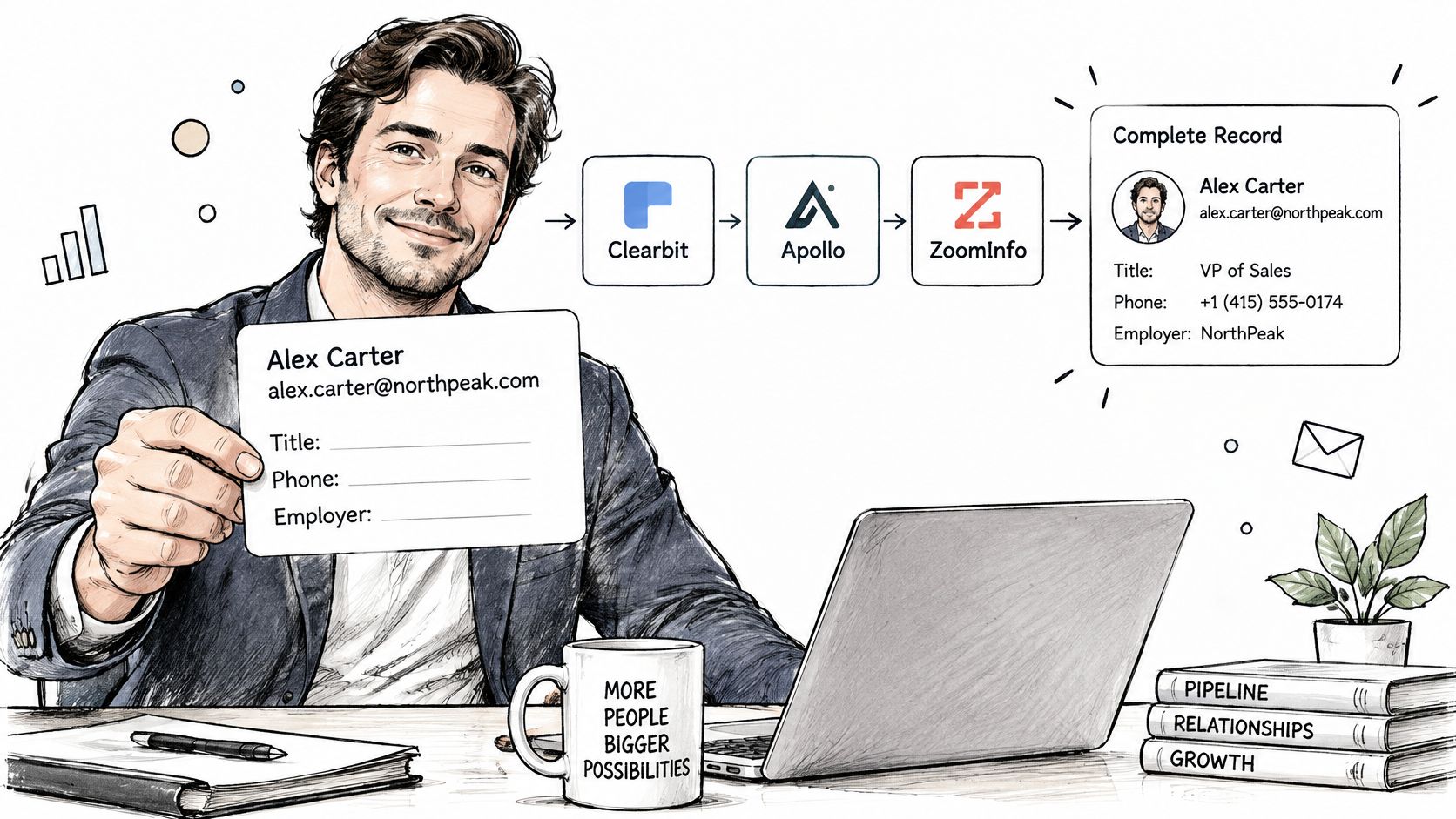
A rep opens a contact record on a Monday morning and finds a name, an email address and a company. No job title. No mobile number. No way to tell whether the email still reaches the person it names.
The record has looked like that since it was created eight months ago. So the rep opens another tab, guesses at the missing pieces, and moves to someone easier to reach. Multiply that by a few thousand records and the cost stops being an inconvenience. Routing sends leads to the wrong rep, sequences land in dead inboxes, and forecasts get built on fields nobody verified.
Waterfall enrichment is the pattern that fills those gaps in a fixed order, starting with the source most likely to be right. What most explanations skip is the part that decides whether it works at all: the rule for stopping.
Table of Contents
- What Waterfall Enrichment Means
- How a Sequential Waterfall Resolves One Record
- Use Cases Where a Waterfall Beats a Single Source
- Coverage Gains and Diminishing Returns
- Deciding When to Stop the Cascade
- Governance and Provenance Across Every Provider
- Confirm Your Waterfall Design Before You Ship
What Waterfall Enrichment Means
A waterfall enrichment chain is a sequence of data sources queried in a set order. The record goes to the first source. Whatever comes back gets checked. Only the fields still missing or still unverified move on to the second source, then the third, and so on until the record passes your rules or the chain runs out.
The analogy that makes it click is calling locksmiths down a list. You call the first one, and if they can't open your door, you call the second. You don't pay five locksmiths to stand in your hallway waiting. Each call is a fallback, and you stop the moment the door opens. Later calls cost money only when earlier ones fall short.
That's different from two approaches some teams start with. Single-source enrichment trusts one provider's answer, which is fine until that provider doesn't cover the person. Cached database lookup returns a stored snapshot, fast and cheap, but the snapshot is only as good as the last refresh.
Freshness is where the difference shows up. IBM's explanation of data freshness defines it as how frequently information is updated, and treats data latency as how long data takes to become available after it's generated or requested. High latency makes data less representative of real-world conditions by the time it's ready to use. IBM also reports that just under 40% of organizations it surveyed in 2025 said they outperform peers on data freshness and related metrics, which tells you freshness is still a differentiator rather than a solved problem.
One clarification before anything else. The term has nothing to do with ecological waterfalls, the kind that block salmon migration and create nutrient boundaries in coastal watersheds. Search for the phrase and you'll find nitrogen-isotope studies alongside vendor pricing pages.
If your starting point is a CRM full of half-empty rows, the practical guide to enrich incomplete CRM records covers how to structure the input before you spend a single credit.
| Approach | Main strength | Main cost | Best when |
|---|---|---|---|
| Single-source enrichment | One provider, one contract and one answer | Coverage limited to that provider | A proven source already covers the field |
| Cached database lookup | Fast return of a stored snapshot | Data can be stale when updated rarely | Records change slowly and freshness matters little |
| Waterfall enrichment | Higher coverage through ordered fallback | Extra cost, latency and documentation per provider | Missing fields must be verified and accuracy drives decisions |
The rest of this article answers three questions in order. How does the sequence run on one record, when should it stop, and what does each extra provider really buy you?
How a Sequential Waterfall Resolves One Record
Take the record from the opening: a name, a work email and a company, with no job title and no mobile number. Here is the chain that fills it, stage by stage, with the condition that has to pass before the value counts.
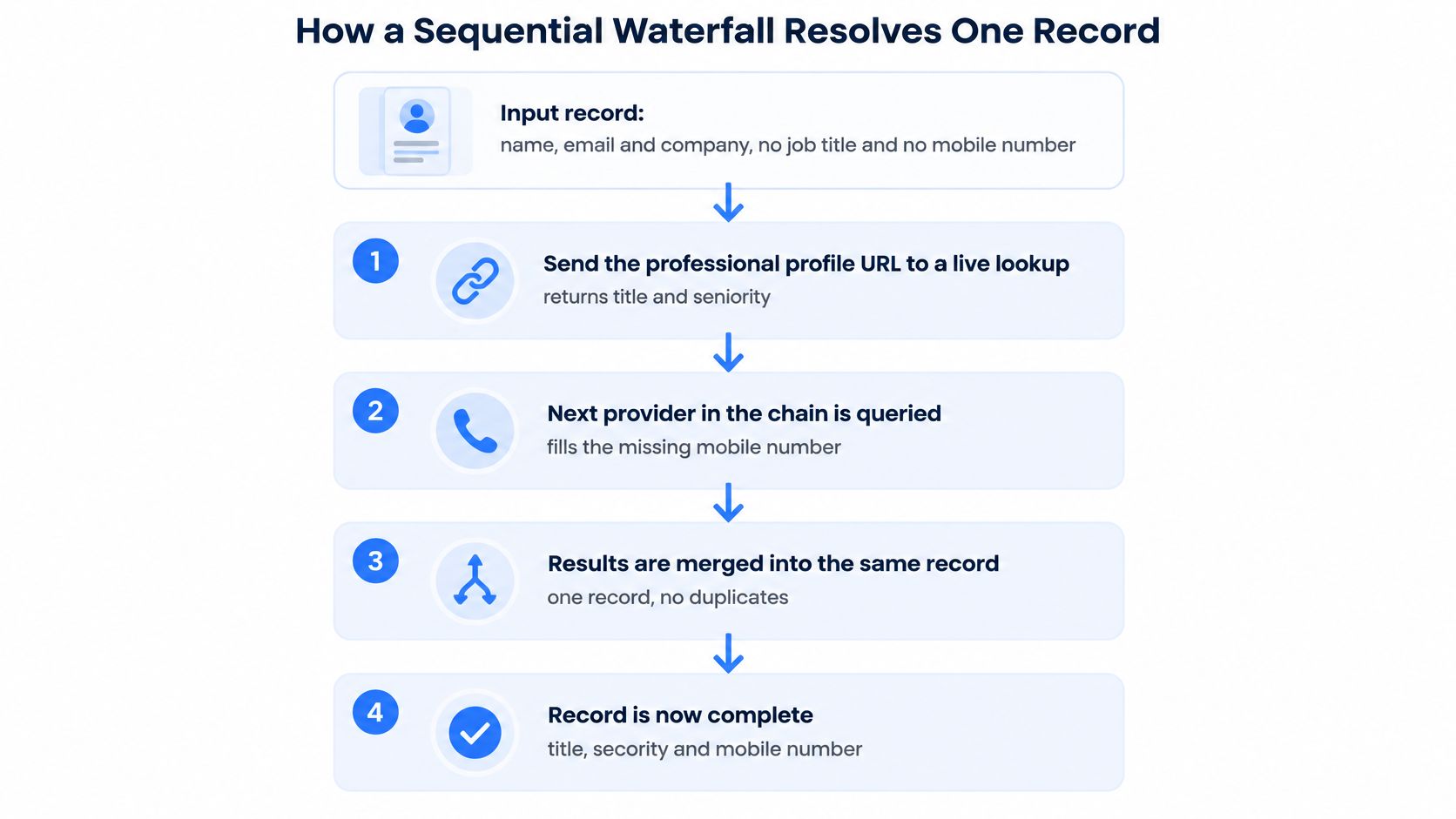
Stage by stage, with a pass condition at every step
1. Resolve identity from a live lookup. Send the professional profile URL to a live fetch that returns title, seniority, employer and location. Pass condition: the profile resolves to the same person, meaning the name and employer agree with what the record already holds.
2. Query provider A for the work email. The returned address is accepted only after a mailbox check, not a syntax check. Pass condition: the mailbox exists and the domain matches the employer on the record.
3. Send the still-missing mobile number to provider B. A number counts only when a second signal ties it to the same person, such as a name match on the line or agreement with a verified profile. Pass condition: mobile or direct line, matched to the person, not a switchboard.
4. Route whatever remains to the remaining providers. Anything unresolved goes down the rest of the chain, and if nothing passes validation, the record is flagged instead of filled with a guess.
That fourth outcome matters as much as the first three. A flagged record tells a rep to verify by hand. A filled record with a wrong value tells a rep nothing and costs them a call.
Why only unresolved fields move forward
The chain doesn't pass the whole record to every source. It passes the gaps. A later provider never gets the chance to overwrite a fresher or better-supported value with its own older copy, which is the failure mode that turns a five-source waterfall into five competing answers.
This is the sequential resolution architecture described in DataMagnet's 2026 enrichment benchmark report: a record is submitted to source A, and only fields that remain unresolved are passed to B, C and later sources. The workflow should stop only when a result satisfies an explicit validation rule, not merely because it returned a syntactically valid email or phone number. Their benchmark of 1,400 U.S. B2B contacts found that the strongest single provider returned raw phone numbers for far more contacts than it could confirm belonged to the right person, which is exactly why a filled field and a verified field aren't the same thing.
Watch a short walkthrough of the same idea in practice.
What the finished record carries
Every accepted field should arrive with four companions in your JSON schema: the source that returned it, the timestamp of retrieval, a confidence score, and a validation status of accepted, rejected or flagged.
Store those per field, not per record. A record whose title came from a live profile lookup two minutes ago and whose mobile came from a database refreshed last quarter is not uniformly fresh, and downstream systems need to see that. When a downstream service can read the validation status, it can refuse to route a lead on an unverified employer. That's a product decision the data layer makes possible, and it's cheap to build in at the start.
Use Cases Where a Waterfall Beats a Single Source
The strongest case for a chain is a record that arrived incomplete and now sits in a workflow where the missing field decides something. CRM enrichment is the classic example: a record lands with a name and an email, and the chain fills role, seniority and employer so the rep knows who they're writing to.
Lead scoring and routing come next. A lead scored without a verified employer or seniority level goes to whichever rep the round-robin picks, not the rep who owns that account tier. The chain's job is to settle those two fields before the routing rule fires.
Where the chain earns its keep
- Recruiting and talent intelligence. A sourcer ranking candidates needs current employer and location. A stored snapshot from last year ranks someone at a company they left.
- Product teams. If you sell a post generator or an analytics dashboard built on professional data, inconsistent fields across thousands of accounts show up as broken charts and empty states in your own UI.
- AI agents. An agent that writes a personalized opening line needs a fact it can trust. A hallucinated job title in an agent's output is a customer-visible error, not a data hygiene note.
Here's a worked example of how targeted the spend can be. Say a database of 10,000 contacts has 30% missing a mobile number. The waterfall runs against that 3,000-record subset only, and the complete records never touch a provider. That's the design difference between a chain and a batch refresh: you pay for gaps, not for volume.
Practical rule: Scope the run to the records that fail your acceptance rules. Enriching a complete record wastes credits and risks replacing a good value with a mediocre one.
Where a waterfall wastes money
Two cases. The first is a field that one trusted source already returns reliably for your market. If you've tested it on your own sample and it wins most of the time, a second and third provider mostly re-buy the same answer. The second is a workflow where no downstream decision depends on accuracy. A dashboard counting signups by country doesn't need a verified mobile number, and paying for one doesn't improve the chart.
The quick test is this: if a wrong value would cost a rep a wasted morning or a customer a broken promise, the extra steps pay for themselves. If a wrong value changes nothing anyone acts on, skip the chain for that field.
Coverage Gains and Diminishing Returns
Read the benchmark rows in order and a pattern appears. Coverage climbs with every added source, and the size of each jump shrinks.
| Benchmark | Single source | Waterfall | Metric |
|---|---|---|---|
| Prompting Company, 2026, 500 contacts | No single-source baseline reported | 59% verified work emails, 69% working mobile numbers | Clay waterfall, verified emails and mobiles |
| Automation Jinn, 2025 | 86.9% best single provider | About 90% five-provider waterfall | Coverage |
| Grou, 2026 | 78% to 88% single-source tools | 90% to 96% waterfall tools | Coverage |
| KeenDai, 2024 analyses | 50% to 62% single-source B2B match rate | Above 90% multi-source | Match rate |
| DataMagnet, 1,400 U.S. B2B contacts | 51% verified right-person match, 87% raw phone coverage | 60% with two providers, 63% with three, 65% with four | Verified right-person match |
Reading the benchmarks row by row
The 2025 benchmark summarized by Automation Jinn puts a five-provider waterfall at roughly 90% coverage against 86.9% for the best single provider tested. Four extra sources bought about three points. That's a real gain if those points are the contacts your team most wants to reach, and a poor trade if you're paying per attempt across the whole chain.
Grou's 2026 benchmark shows waterfall tools reaching 90% to 96% coverage against 78% to 88% for single-source tools. KeenDai's summary of 2024 industry analyses reports single-source B2B match rates of 50% to 62%, rising above 90% with multiple sources. The direction is consistent: stacking helps, and the ceiling sits well short of complete coverage.
Then there's the honesty check. In a 2026 pre-registered test of 500 contacts, Prompting Company reported that Clay's waterfall found verified work emails for 59% of contacts and working mobile numbers for 69%. Useful coverage, well short of the headline numbers, and closer to what a skeptical buyer should budget for on a mixed list.
The row that changes how you buy
The DataMagnet row is the warning. 87% raw phone coverage from the strongest single provider became a 51% verified right-person match. Adding sources lifted verified matching to about 60% with two providers, 63% with three, and 65% with four. The second provider earned nine points. The fourth earned two.
An operator's guide from Pipecorn reports valid-email coverage of 71% to 82% across waterfall systems, with records six to twelve months old landing materially lower, between 60% and 78%. Aged records are where the chain has the most work to do and the least to show for it.
Measure this instead of coverage
Ordering is an optimization problem across coverage, verification quality, latency and marginal cost, not a race to maximize returned fields. The best sequence depends on your geography, industry, seniority mix and record age, so learn it from your own population on a stratified holdout set.
Report four numbers on that holdout: verified-field coverage, false-positive rate, cost per verified record and end-to-end latency. Rerun the test periodically, because stale CRM inputs can change which provider appears to win.
A chain of four providers that costs twice as much per verified record as a chain of two is not an upgrade. It's a more expensive way to reach the same answer.
Deciding When to Stop the Cascade
Most explanations of waterfall enrichment stop at the mechanics: query provider A, then B, then C. They don't answer the question that decides quality and cost, which is whether a returned value is merely present or trustworthy.
Ascentrik's critical review of waterfall enrichment models makes the point sharply. Stacking sources can lift match rates from roughly 50% to 70% with one source to approximately 80% to 95% across three or four, but another reported benchmark found improvement from about 51% to only 65% after four providers. More sources don't automatically produce reliable records. Identity resolution, conflicting values, recency and field-specific validation matter more than provider count.
Four rules that decide each result
Minimum confidence. Set a threshold per field, not per record. A work email that passes a mailbox check clears a higher bar than one that only passes a pattern test.
Source precedence. Decide in advance which provider wins a conflict. The usual answer is the one that fetched live page state at query time, ahead of one serving a stored copy.
Freshness windows. Give each field a maximum age before it must be re-checked. Titles and employers change faster than firmographics, so a title older than a quarter is a re-query, while a headquarters city can sit for a year.
Contradiction handling. When two sources disagree on an employer, don't average them or take the last one in. Flag the field, keep both values with their sources, and let the workflow decide whether to re-query. Teams get confused about freshness of data: freshness isn't a single timestamp on a record, it's a separate clock per field.
Acceptance rules for the fields that hurt
| Field | Accept when | Reject or re-query when | Why it is high risk |
|---|---|---|---|
| Work email | Mailbox check passes and the domain matches the employer | Bounce, doubtful catch-all result or a domain that conflicts with the employer | Bounces damage sender reputation |
| Mobile number | Matched to the same person by a second signal | Only syntax is valid, or sources return conflicting numbers | Wrong numbers waste outreach time |
| Job title and seniority | Profile is inside the freshness window and resolves to the record | Profile is older than the window or conflicts with the CRM | Stale roles misroute leads |
| Company affiliation | Verified domain agrees with the company URL | Providers disagree on the employer | A wrong employer breaks account mapping |
The distinction running through that table is syntax versus identity. A well-formed address on a former employer's domain is syntactically perfect and functionally wrong. Identity match asks a second question: does this value belong to this person, at this company, now?
Bound the chain, then log it
Give every record a provider budget and a deadline. A synchronous request that waits on a slow fourth source is worse than a request that returns three fields and flags the rest. Push unresolved or high-latency cases into asynchronous processing, where a rep isn't staring at a spinner.
Log every attempt, including the misses, and calculate cost per successful verified enrichment rather than cost per request. Failed calls that consume credits inflate the number you're trying to control, so confirm each provider's billing behavior before it joins the chain.
When the business needs current facts, a live page-state lookup at query time usually beats escalating through several stale databases. The chain's purpose is coverage of the missing field, not maximum nominal coverage of the record.
Governance and Provenance Across Every Provider
Coverage benchmarks ignore the layer that decides whether you can keep the chain running: governance. Every added provider brings its own data-processing agreement, its own data-quality risk and its own lineage record, so a four-source waterfall means four sets of documents to assess, monitor and update.
That trade-off is easy to miss because waterfalling is usually presented as a coverage or cost decision. Coffee.ai's analysis of CRM enrichment compliance frames it accurately: a waterfall may improve availability while multiplying the number of sources that must be assessed, documented, monitored and potentially removed when consent or deletion obligations arise.
Map each obligation to a field or a provider
Lawful basis and retention. Store a lawful-basis record and a retention period for every field you keep, not once per integration. At Fetchin, we only retrieve publicly available data, we act as a data processor on behalf of clients for data they submit through our APIs, and we retain API usage logs for up to 24 months.
Deletion propagation. When a person asks to be removed, the deletion has to reach every CRM copy, every cache and every provider that returned the value. Write down that path before you need it, because tracing a value back through four sources under time pressure is not a plan.
Regional routing. State which jurisdiction each step processes data in. If a provider handles EU records from a region your customers haven't approved, that step can't sit in the chain for those records.
Cost ledger matching. Record whether failed requests consume credits, so your spend report and your audit trail describe the same events. data quality checks with Scrappey help, since a validation layer that logs every accept and reject gives you both a quality record and a cost record from the same source.
Public does not mean unrestricted
Publicly visible professional data can still create privacy, accuracy and profiling risks. European Union guidance on the GDPR and CCPA comparison sets out detailed requirements for organizations that collect, store and manage personal data, along with technical and organizational measures and data minimization. Public availability isn't a permission slip.
Apply minimization at the field level. Request only what the use case needs, and delete the rest rather than warehousing it because it was free. Getting the provenance model right is the same exercise described in this guide to what data provenance means in practice, applied per provider rather than per record.
Formatting differences across countries, languages, job titles and company structures add to the burden. A Japanese company name, a German job title and a US subsidiary can all describe the same entity, and inconsistent normalization creates duplicate CRM records that then need reconciling.
Questions to send every provider before it joins
- Where is data processed, and under which jurisdiction?
- How long is each field retained, and can retention differ by field?
- How are deletion and opt-out requests honored, and how quickly do they propagate?
- What is the lawful basis, and can you document it on request?
- Are failed calls billed, and does the invoice distinguish attempts from results?
Confirm Your Waterfall Design Before You Ship
Before you write a line of integration code, answer three questions about the workflow you're building for.
Which fields does this workflow need? Not which fields are available. A routing rule needs employer and seniority. It does not need a personal mobile number.
What does a wrong value cost? In rep time, in a bounced sequence, in a customer who sees their own name attached to the wrong company.
How fast does the underlying data change? Job changes drive most of the decay in professional records. A field that changes quarterly needs a different freshness window than a company's founding year.
If a wrong field is expensive and the records age quickly, build the chain. If one trusted source already returns the field and no downstream decision depends on accuracy, skip the waterfall for that field and spend the credits elsewhere.
Start with one segment, not the whole database
Pick a pilot segment with a clean boundary, such as the CRM records missing a mobile number. Set the acceptance rules, freshness windows, cost cap and latency deadline before the first call, so the pilot produces a number you can compare rather than an impression.
Expand only when verified coverage and cost per verified record hold up on the holdout test. If the second provider adds nine points of verified matching and the third adds two, you've learned where your chain should end.
Where the design depends on current professional profile and company data, put a B2B data API such as Fetchin in the first stage. It returns structured JSON on each call with a median response near one second, delivers data synchronously or asynchronously, and since there's no separate batch API and no job queue, bulk enrichment runs by calling the endpoint concurrently. CRM enrichment, which fills in the fields a record is missing and keeps them current, is the natural first segment for that pilot. The data enrichment API documentation shows how every endpoint fits together before you wire the first stage.
The stopping rule is the design. Provider count is just a consequence of where the rule lands.
Fetchin is a real-time B2B data API that turns professional profile and company URLs into structured JSON, which makes it a natural first stage in a waterfall: current title, seniority, employer and firmographics fetched on every call, returned synchronously or asynchronously, with failed requests not consuming credits. If you're designing a chain and want to see what a live first step returns on your own records, you can start on the free tier with 1,000 credits at Fetchin and measure cost per verified record from day one.