Global advertising and marketing spend surpassed $1 trillion in 2026, and real-time data extraction is now the primary lever for protecting that spend and driving revenue in a tightening market. The companies that connect current professional and company data to marketing, sales, retention, and expansion decisions will get more value from every campaign than teams still operating on stale records.
Marketing and revenue leaders face a measurement problem that has outgrown lead counts. A new contact is only the beginning. The harder commercial questions are whether marketing influenced a qualified opportunity, helped an existing customer expand, or identified a relationship change before it weakened retention.
That shift makes data infrastructure a financial concern, not just an engineering concern. A role change, company event, engagement signal, or account update can alter the right message and the right owner. If that information arrives after a campaign, renewal conversation, or sales handoff, the team may already have lost the moment.
Table of Contents
- The Urgent Need for Real-Time Revenue Precision
- Understanding the Real-Time Data API Advantage
- Segmentation and Personalization That Drive Pipeline Velocity
- Attribution Models and Revenue Intelligence
- Performance Benchmarks and Operational Reliability
- Pricing Models and Strategic Investment Considerations
The Urgent Need for Real-Time Revenue Precision
The $1 trillion milestone changes the standard for marketing accountability. Global advertising and marketing spend surpassed $1 trillion for the first time in 2026, with an implied year-over-year growth rate of roughly 5.1%, according to this 2026 marketing statistics summary. The same source projects that the market could approach $1.4 trillion by 2029, which signals continued expansion in a revenue engine that funds media, brand distribution, demand generation, and customer communication.
That scale creates a paradox. Spending keeps expanding, but leaders still need to defend every allocation with a clear commercial outcome. Historical media economics show why this pressure matters: print represented 62.4% of global advertising expenditures in 1980, television overtook newspapers in advertising revenue in 2001, and print newspapers reached $121.4 billion in global advertising revenue in 2007 before declining to an estimated $22.8 billion in 2023. Those figures, documented in Forbes' analysis of global print advertising revenue, illustrate how quickly value can move when distribution and measurement change.
Static data creates moving revenue risk
A SaaS founder may see the operational failure in a familiar sequence. Marketing builds an account segment from a periodic export. Sales receives contacts matched to the previous employer or role. Customer success prepares a renewal campaign using an account profile that no longer reflects the buying committee. By the time someone notices the mismatch, the team has spent money and attention on the wrong context.
The cost isn't limited to poor prospecting. Existing customers also change. A new executive can alter expansion potential. A departing champion can create renewal risk. A company update can make an old use case more relevant, or make a previous message irrelevant. A static record can't tell the team which condition exists today.
Practical rule: Treat data age as a revenue variable. If a workflow depends on a current role, employer, company identity, or engagement signal, retrieve that information when the decision happens.
Real-time extraction doesn't guarantee a sale, and it doesn't replace positioning, sales judgment, or customer research. It does give those functions a better starting point. A funding event data feed can help teams identify company momentum as one input into account prioritization, provided the signal is validated and connected to the account's existing history.
Marketing must prove more than pipeline
The strongest marketing and revenue programs measure influence after lead creation. They ask whether campaigns improve deal quality, support expansion conversations, reduce avoidable churn risk, or help sales and customer success focus on the accounts where timing matters.
That requires a connected operating model. Marketing needs current identity and firmographic data. Sales needs reliable account and contact matching. Customer success needs signals that explain who matters inside an account and how the relationship is changing. Without shared, current records, each department optimizes a partial version of revenue.
Understanding the Real-Time Data API Advantage
A B2B data API is an on-demand retrieval system. Instead of asking a team to search a stored record and accept whatever age it has, an application sends a professional profile URL or company URL and receives structured information for the workflow running at that moment.
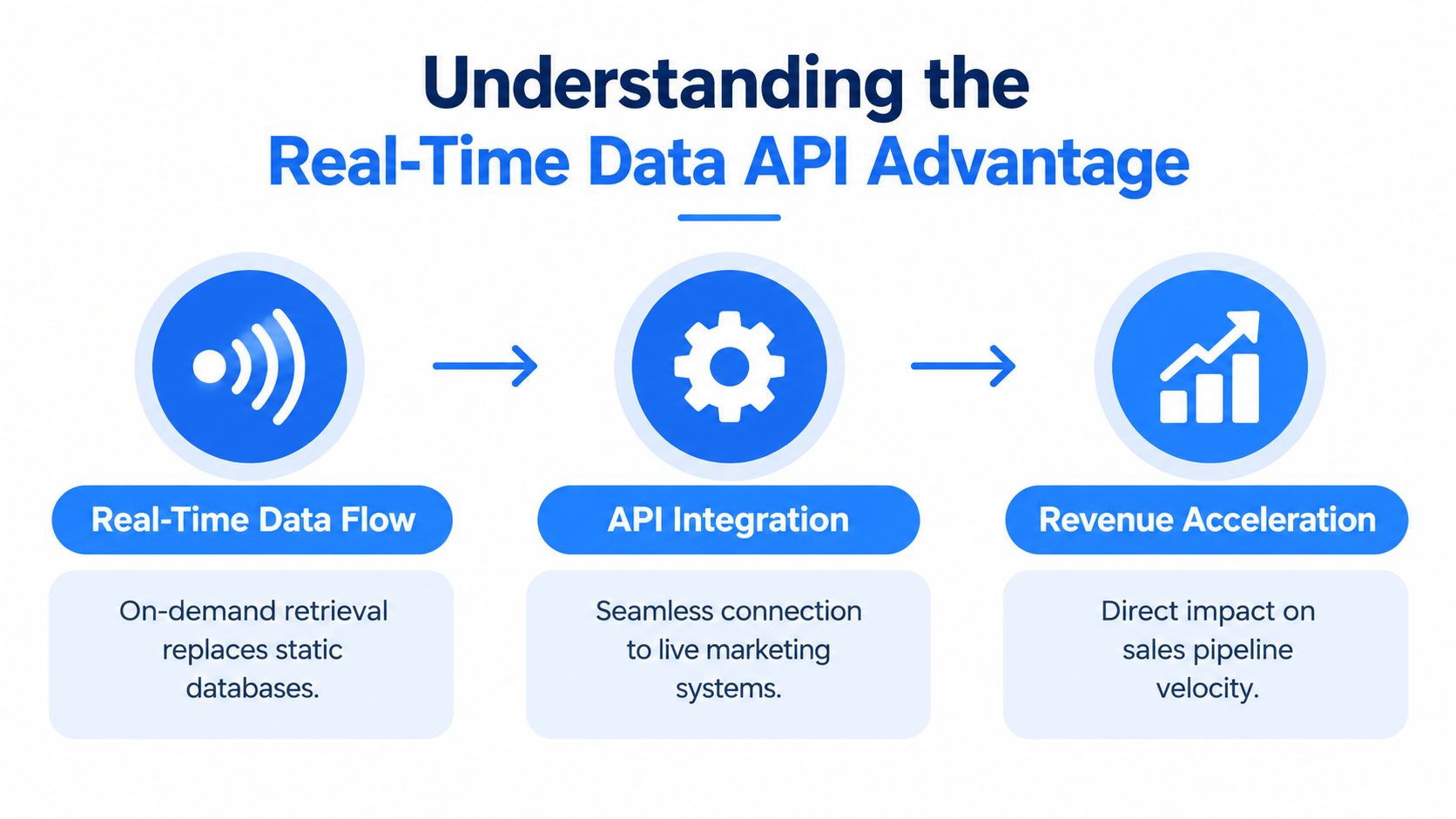
The important distinction is live fetching on each call, rather than serving snapshots from periodic indexing. Modern B2B data tools use this approach to reduce the gap between a record in a system and the public information available when the application requests it.
How synchronous fetching supports revenue workflows
A practical implementation usually follows a simple sequence:
- Capture an input. Your product receives a professional profile URL, company URL, or another public identifier from a CRM, form, account record, or user action.
- Resolve the entity. The API identifies the relevant person or company and returns normalized fields instead of an unstructured page.
- Map the response. Your application writes role, employer, location, company attributes, engagement information, and other permitted fields into a consistent schema.
- Trigger a decision. Marketing changes an audience, sales updates routing, or customer success adjusts an account play based on the current record.
- Preserve provenance. Store the request time, source reference, and matching logic so later attribution and compliance reviews can distinguish current evidence from historical state.
Synchronous delivery matters when the next action depends on the answer. A sales intelligence product may enrich an account before displaying it. An AI agent may need current company context before drafting a message. A customer platform may refresh a contact record when a user opens an account page.
A live response still needs safeguards. Applications should handle timeouts, validate fields, distinguish unavailable data from a negative result, and avoid overwriting trusted first-party information without a defined precedence rule. The right architecture combines freshness with auditability.
For a deeper technical treatment of implementation choices, see this guide to the B2B data API.
Build around stable objects, not isolated fields
A useful schema separates people, companies, events, and relationships. A person object might include current position, prior positions, education, skills, location, and contact fields. A company object might include industry, headcount, headquarters, founding year, and verified domain. Engagement objects can capture posts, comments, and reactions when those signals support a legitimate business purpose.
That structure makes the response useful beyond one campaign. The same profile can support routing, personalization, account mapping, customer expansion research, and revenue attribution. The same company record can connect a website identity to firmographic context and account ownership.
The engineering goal isn't to collect everything. It's to return the fields that change a decision, keep their meaning consistent, and make their age visible to downstream systems.
Segmentation and Personalization That Drive Pipeline Velocity
Broad segments hide the conditions that determine whether a message is timely. A live professional data layer lets a team define audiences around current roles, employers, company attributes, career history, skills, and engagement rather than relying on an old list that treats every contact as unchanged.

The commercial advantage comes from connecting segmentation to an action. A role field matters because it can change the audience, message, owner, or timing. A company attribute matters because it can affect fit, expected buying complexity, or expansion relevance. Data becomes valuable only when the system uses it to make a better next decision.
Segment by business condition
A practical segmentation system can combine several dimensions:
- Current responsibility: Separate executives, functional leaders, practitioners, and adjacent stakeholders so each group receives a message suited to its decision authority and concerns.
- Company context: Use industry, headquarters, headcount, founding year, and verified domain to distinguish account types that need different qualification and customer plays.
- Career movement: Treat a new employer or recent position change as a reason to reassess account ownership, relationship history, and relevance, not as an automatic sales trigger.
- Capability signals: Use education and skills to identify the language, use cases, and product depth most likely to make sense for a particular audience.
- Engagement evidence: Combine recent posts, comments, reactions, and first-party activity carefully. Engagement can inform research, but it shouldn't substitute for consent, intent, or a meaningful business reason to contact someone.
Teams often over-segment before they have reliable activation. A smaller number of well-defined audiences with current fields usually outperforms a complex taxonomy that no campaign can maintain. Every segment should answer three questions: who belongs, what changes for them, and which revenue outcome will be measured.
Personalization should change the decision, not just the copy
Replacing a first name isn't meaningful personalization. A useful variation changes the argument, proof, offer, or route to action based on a real difference in the buyer's situation.
A product-led SaaS company might show a technical workflow to practitioners and an operational outcome to executives. A customer success team might route an expansion conversation differently when a new decision-maker appears in an account. A recruiting platform might adapt its matching logic when current skills and career history indicate a better fit than a title alone.
The system needs controls. Store the field used for personalization, record when it was retrieved, and give users a way to correct or suppress an output. Avoid inferring sensitive traits or making consequential decisions from weak public signals. Precision without governance creates trust and compliance problems that no pipeline report can offset.
The practical pipeline loop is straightforward:
- Retrieve current public professional data.
- Match it to a known person or account.
- Apply explicit segment rules.
- Select a message or workflow.
- Record the touchpoint and resulting revenue event.
- Review performance by segment, not only by campaign.
That final step is essential. If a segment produces activity but not qualified opportunities, the team needs to revise the rule. If it supports expansion or retention, marketing should receive credit for that contribution rather than being evaluated only on new leads.
For a more detailed framework, review these B2B market segmentation methods.
The following visual walkthrough can help product and revenue teams connect data inputs to activation decisions.
Attribution Models and Revenue Intelligence
Revenue attribution is a multi-touch measurement system that assigns revenue value across marketing, sales, and customer interactions instead of giving all credit to the final touch, as explained in this revenue attribution overview. The distinction matters because a campaign can create awareness, a sales interaction can create momentum, and a product or customer success touch can influence the final decision.
Last-touch reporting remains useful for a narrow question, such as which interaction immediately preceded a conversion. It fails when leaders use it to decide which activities deserve investment across a long buying journey or an existing customer relationship.
The fields that make attribution usable
An attribution-ready record needs more than a campaign name. At minimum, teams should normalize:
- Identity: A stable person and company identifier that survives changes in formatting, role, or system ownership.
- Source: The channel, campaign, or originating motion connected to the interaction.
- Touchpoint sequence: The ordered events from first interaction through opportunity and close.
- Event time: The time an interaction occurred and the time it entered the revenue system.
- Deal-stage linkage: The opportunity and stage associated with the contact or account.
- Revenue outcome: Closed-won value, renewal status, expansion, cross-sell, or another defined commercial result.
For a company such as Fetchin, profile, company, and engagement responses become more valuable when normalized into fields such as source, touchpoint sequence, and deal-stage linkage. Downstream SaaS customers can then calculate marketing-sourced pipeline, CAC by channel, and contribution to ARR with less manual reconciliation.
Identity resolution deserves special attention. If a person appears under inconsistent names, employers, or account records, the model may count one journey as several journeys. If an assisted touch isn't connected to the right opportunity, the report understates marketing's influence and rewards the final interaction by default.
Extend the model beyond new logo revenue
Many revenue teams stop measurement when a deal closes. That leaves a large blind spot. Marketing can influence onboarding, adoption, renewal confidence, expansion timing, and cross-sell relevance, even when sales owns the commercial conversation.
The model should therefore connect customer interactions to account outcomes. A current professional profile can help identify a new stakeholder, a departing champion, or a changed responsibility inside an existing customer. A current company record can help explain why an expansion play is relevant now. Those signals don't prove causation, but they can create a measurable touchpoint that the team evaluates alongside product usage, support history, and sales activity.
Attribution should answer not only “which channel created the opportunity?” but also “which motions helped preserve and expand the customer relationship?”
B2B journeys require durable identity and consistent events because the path from initial interest to close can be long and involve multiple stakeholders. Practical use cases for attribution models can help teams compare models, but no model can repair missing events or unreliable account matching.
A good operating rhythm compares conversion between stages, such as MQL to SQL, SQL to opportunity, and opportunity to close. It also examines renewal and expansion outcomes by marketing motion. The purpose isn't to manufacture a perfect credit allocation. It's to identify which inputs repeatedly correlate with better revenue outcomes and deserve more disciplined investment.
Performance Benchmarks and Operational Reliability
A real-time API is only useful if it responds predictably inside the workflow that depends on it. A slow response can block enrichment, delay routing, interrupt an AI agent, or cause a user to abandon an account review. That makes latency a commercial metric as well as a technical metric.
Measure both the typical request and the slow tail. P50, or median response time, describes the normal experience. P95 exposes the outliers that affect a meaningful share of users and often reveal capacity, provider, or integration problems.
Use benchmarks that reflect production reality
Published B2B enrichment API benchmarks commonly target sub-second performance. One production guide recommends 200 to 500 milliseconds at P50 and under 2 seconds at P95, as described in this B2B API performance benchmark.
Those targets aren't a universal contract. They are a useful evaluation baseline. A synchronous enrichment step inside an interactive product needs a different tolerance from a nightly customer data process. The mistake is using an average response time to represent both.
Track these operational signals separately:
- P50 latency: Shows whether the ordinary request fits the user experience.
- P95 latency: Shows whether tail delays disrupt workflows.
- Error rate: Separates unavailable data from transport or service failures.
- Timeout rate: Identifies requests that consume application capacity without producing a response.
- Rate-limit behavior: Shows whether the system fails clearly, queues work, or drops requests without notice.
- Freshness timestamp: Confirms when the returned record was retrieved.
Design for graceful degradation
A resilient integration doesn't make the entire revenue workflow depend on one synchronous call. Use synchronous fetching when the next decision needs an immediate answer. Use asynchronous delivery for higher-latency workflows, large backfills, or enrichment that doesn't block the user.
The application should also define fallbacks. If a profile response times out, preserve the existing first-party record and mark the refresh as incomplete. If a company match is ambiguous, send it to review instead of writing uncertain firmographics into the CRM. If a field is unavailable, don't interpret the absence as proof that the attribute doesn't exist.
Periodic indexing still has a role for historical analysis and cost-controlled bulk processing. It doesn't work well as the sole source for decisions affected by recent role changes, company updates, or current engagement. The trade-off is clear: snapshots can simplify throughput and storage, while live fetching improves recency at the moment of use.
A production test should replay realistic request patterns, including bursts, partial failures, repeated identifiers, and downstream CRM delays. Ask the vendor how performance changes under load, how failed requests are counted, and whether the response includes stable schemas. A fast demo isn't evidence of reliable revenue infrastructure.
Pricing Models and Strategic Investment Considerations
Pricing should reflect how the data enters your product, not just how many records you expect to retrieve. A low headline price can become expensive if failed requests consume credits, limits interrupt workflows, or enterprise capacity requires an early commitment.
Three commercial models appear frequently:
| Model | Works well when | Main trade-off |
|---|---|---|
| Credit-based access | Usage varies and the team wants a visible unit cost | Unused credits, overage terms, and failure handling need close review |
| Pay-as-you-go | Request volume is uncertain or tied to customer activity | Variable bills require monitoring and budget controls |
| Enterprise terms | Sustained throughput, dedicated capacity, and contractual support matter | Negotiation can add commitment before usage patterns are fully understood |
Credit pricing is easiest to govern when one successful extraction maps cleanly to one chargeable unit. Confirm whether retries, empty responses, ambiguous matches, and provider errors consume credits. Also check whether profile, company, and engagement endpoints have separate rates.
Rate limits matter just as much as unit price. A plan that looks economical can become operationally costly if it throttles a customer-facing workflow and forces the team to build queues, retries, and manual recovery. Conversely, dedicated capacity may be unnecessary for a product that processes requests asynchronously and can tolerate variable completion times.
Tie infrastructure spend to customer value
The right decision starts with the revenue motion. For acquisition, measure whether current data improves account qualification and routing. For retention, measure whether customer teams identify stakeholder changes and account risks earlier. For expansion, measure whether enriched company and professional context helps prioritize relevant conversations.
Keep the model honest. Don't claim that a data response caused renewal or expansion unless the business has a defensible experiment or comparison. Instead, track the operational chain: current signal, action taken, account outcome, and revenue value associated with the motion.
Resources on actionable ways to reduce churn in SaaS can complement the data layer, but retention strategy still depends on product value, service quality, and customer execution. Data helps the team act with better timing; it doesn't replace those fundamentals.
Before signing, test a representative workflow, document the fields you need, and compare the full cost of successful calls, failed calls, retries, storage, monitoring, and engineering maintenance. This credit pricing model guide provides useful context for evaluating usage-based structures.
Fetchin provides a real-time B2B data API that turns professional profile and company URLs into structured JSON, with profile, company, and engagement endpoints for enrichment and revenue workflows. Visit Fetchin to evaluate how live public professional data could support more precise acquisition, retention, and expansion decisions.