The most popular advice you will find is simple: pick the cheapest no-contract plan and you will automatically save money. That advice fails on arithmetic. A low headline price can hide an upfront modem, an expiring allowance, and a marginal rate that makes your realized cost per usable gigabyte higher than a fixed plan, especially once you count days you paid for but never used.
A better question is not whether a plan is labeled prepaid. It is how that plan meters you, when it stops you, and what your actual usage costs after equipment and wasted data are included.
Table of Contents
- What Pay As You Go ISP Service Really Means
- How Pay As You Go Internet Pricing Evolved
- Understanding Usage-Based and Two-Part Tariffs
- Comparing Real Pay As You Go Plans and Rates
- Which Households and Small Businesses Benefit Most
- Affordability, Reliability and Subsidy Trade-Offs
- Choosing Between Pay As You Go and Fixed Plans
- Your Next Steps Before You Switch
What Pay As You Go ISP Service Really Means
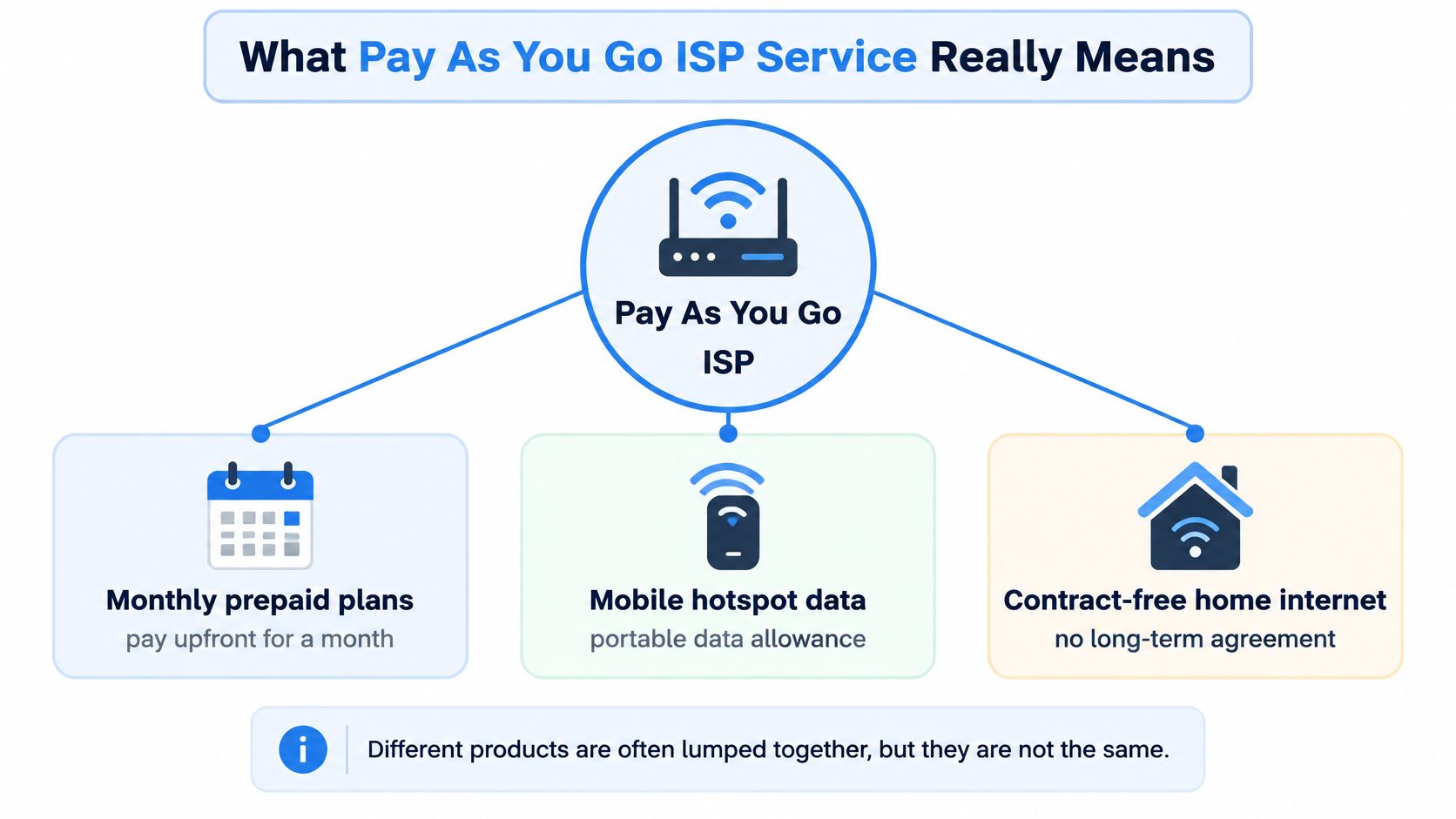
Contract-free and metered are not the same thing. That distinction matters because current comparisons file monthly prepaid plans, mobile hotspot data, and contract-free home internet under one label, even though equipment costs, caps, throttling, portability, and suspension rules differ across the three.
A genuine Pay As You Go ISP charges in proportion to what you consume. You fund credit in advance, usage draws it down, and service stops or slows when the balance runs out. A monthly prepaid plan works differently: you buy an access window, usually a fixed number of days, and the clock runs whether you connect or not. Confusing the two is how sporadic users end up paying subscription prices for occasional access.
The three questions that define the product
- What unit is billed: time, days, sessions, or data determine whether idle days cost you money.
- What triggers extra charges: a threshold, an overage rate, or a renewal decides how price rises after basic use.
- What happens at zero: a hard stop, throttling, or automatic billing produces very different risk.
Cox StraightUp illustrates the gap between the labels. It sells at $50 per month with a 1.25 TB allowance, according to a comparison of prepaid and contract-free internet plans, which makes it a prepaid window rather than per-unit metering. You buy a large monthly allowance. You do not pay per gigabyte.
Hourly metering still survives at the other end of the market. In parts of East Africa, public Wi-Fi vendors sell access by the hour or by the day at modest speeds, a model that fits intermittent demand and tight cash flow. Advertised speed, though, says little on its own about whether a household can work, learn, and stream at once; the billing unit determines what that concurrency costs.
Practical rule: If you cannot name the billing unit and the rule at zero, you don't know what you are buying.
Portability adds a further layer to the definition. A fixed prepaid line serves one address, while a hotspot travels with you. SwiftNet Wifi's prepaid hotspot guide outlines how mobile access differs from a home connection for readers weighing that trade-off.
How Pay As You Go Internet Pricing Evolved
Pay as you go access began as an alternative to fixed monthly subscriptions in the dial-up era. In Jersey, regulators described PAYG dial-up as access through an 0845 number with charges calculated per minute, with earlier data recording a minimum charge of 7 pence for up to 30 minutes followed by pro-rata billing, according to Jersey's 2009 telecommunications statistical review.
That model suited light users and temporary residents. It also punished anyone who stayed online, because every extra minute added cost. Time was the scarce unit, and the meter never paused while a page loaded or a download crawled.
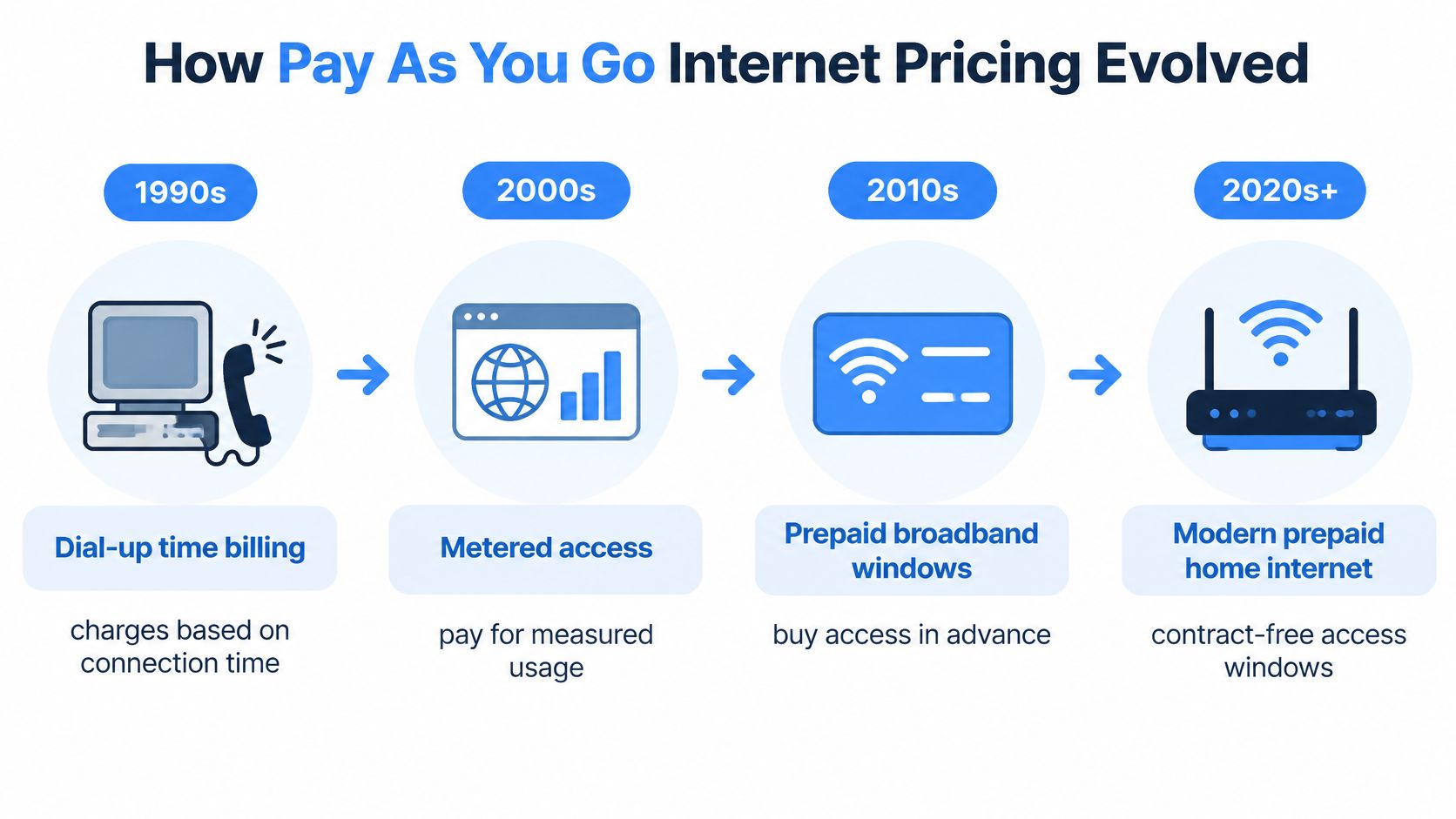
Early prepaid providers tried to soften that exposure by selling hours in bundles. InterpassNet reportedly offered 35 hours of access for $20 in 2001, approximately $0.57 per hour, a structure documented in the same Jersey review already cited. That is not flat-rate broadband. It is prepaid time with a clearer ceiling on what a block of access costs.
From minutes to renewal windows
The decisive shift came when prepaid moved from dial-up minutes to broadband windows. Comcast launched Xfinity Prepaid Internet Service in 2016 and expanded it in 2017, with renewals of seven days at $15 or 30 days at $45 and an $80 starter kit including 30 days of service and a wireless gateway, as coverage of Comcast's Xfinity Prepaid launch and expansion explains.
That service offered speeds up to 10 Mbps down and 1 Mbps up, modest by later standards but enough to mark a break from narrowband. Comcast also planned distribution through approximately 4,000 Boost Mobile stores by the end of 2017, using prepaid retail channels to reach customers who did not want or could not pass a postpaid check.
Verizon offered a competing prepaid FiOS product at speeds up to 25 Mbps for $60 per month, showing prepaid broadband was not confined to one speed tier.
- Dial-up era: You paid for connected time, so slow performance directly raised cost.
- Hour bundles: You prepaid a block, trading open-ended minutes for a defined balance.
- Broadband windows: You prepaid days of access, making cost predictable but charging for idle days too.
The core promise survived each stage. Payment moved upfront, commitment stayed short, and renewal stayed optional. What changed was the unit. Once the unit became a week or a month, cost stopped rising with every minute, but it also stopped falling when you used nothing.
Understanding Usage-Based and Two-Part Tariffs
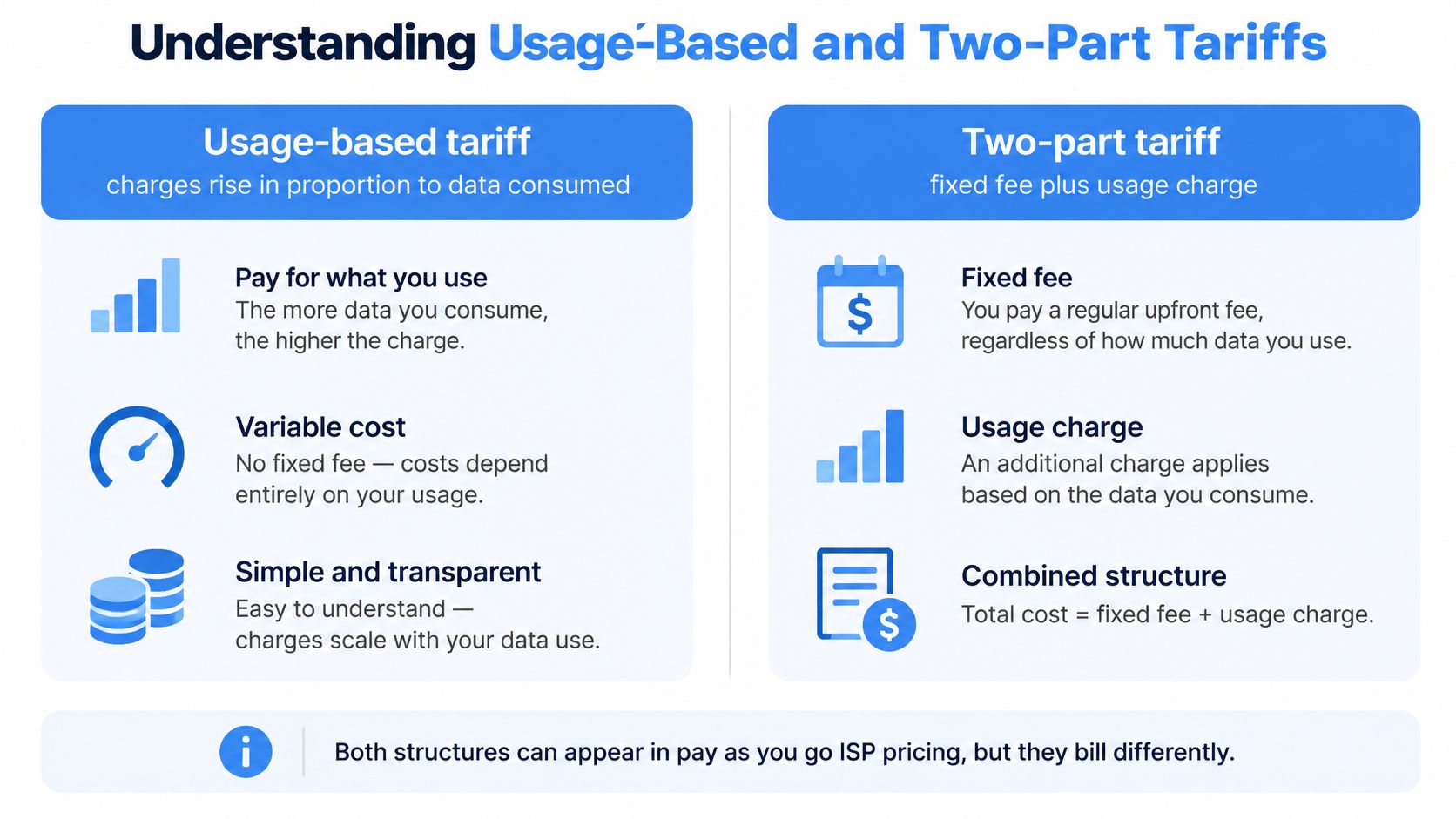
Tariff language sounds abstract until you translate it into a bill. A pure usage-based tariff means you pay in proportion to consumed data or service units, with no recurring lump-sum fee and no included allowance, a definition set out in research modeling pay-as-you-go ISP pricing as a pure usage tariff.
A two-part tariff works differently. You pay a fixed fee, receive an included allowance, and then pay an overage price beyond that cap. In mathematical terms, pure pay as you go is the limiting case where both the fixed fee and the allowance are zero.
Why measurement granularity changes fairness
Billing should record usage at a granular interval, typically bytes, sessions, or time units, and apply a transparent unit price. Coarse rounding raises your effective rate, because partial units get charged as whole ones. Fine measurement does not help if you cannot see your balance while you spend it.
That is why a spend ceiling matters. A hard cap, threshold alerts, and real-time balance updates prevent the classic metered failure, where a background update consumes credit before you notice. Teams evaluating metered digital services face the same design problem, which is why a breakdown of API pricing models is a useful parallel for anyone comparing unit prices against bundles.
- Pure usage pricing: Cost starts at zero and rises with every unit consumed.
- Two-part pricing: Cost starts with a fee, stays flat inside the allowance, then rises.
- Prepaid window: Cost is fixed for a period, so heavy use lowers unit cost and light use raises it.
The trade-off is linear and unforgiving. Pure metering lowers the barrier for infrequent users, but total cost rises directly with consumption. A Ghanaian ISP pricing study described volume-based bundles that customers reload when depleted and warned that aggregate costs under pay-as-you-go can become very high as usage hours increase.
A meter is fair only when the unit price is visible before you consume, not after the balance disappears.
For light use, paying only for units beats subsidizing an unused bundle. For sustained work, streaming, or large downloads, that same meter becomes the expensive option. The tariff has not changed. Your position on its line has.
Comparing Real Pay As You Go Plans and Rates
Headline prices hide the mechanism. Two plans can advertise similar entry costs and produce wildly different bills once you cross a threshold, hit midnight, or let an allowance expire. Compare the billing unit, the allowance, the marginal rate, and the renewal trigger before you compare anything else.
Vodafone's Pay as you go 1 charges £2 for each day the service is used, including 50 MB until midnight, with 10 pence for every additional MB, according to Vodafone's published Pay as you go 1 rates. That structure is transparent, but the marginal rate after the initial allowance is where an ordinary day of browsing can become expensive.
EE takes a different approach. Its mobile broadband allowances expire at the earlier of the end of the allocated period or exhaustion of the purchased data, and access stops without automatic extra charges until you buy another add-on from prepaid credit, as EE's mobile broadband pay as you go price guide states.
Pay As You Go Rate Structures Compared
| Plan example | Billing unit | Included allowance | Marginal rate | Renewal trigger |
|---|---|---|---|---|
| Vodafone Pay as you go 1 | Calendar day of use | Initial daily data to midnight | Per-MB rate after threshold | Next day you use service |
| EE mobile broadband add-on | Prepaid data add-on | Purchased data bucket | No automatic charge at zero | Expiry or exhaustion, whichever is first |
| Prepaid broadband window | Days of access | Access for purchased period | Renewal price for next window | End of paid period |
| Fixed broadband plan | Monthly subscription | Monthly allowance or unlimited use | Overage or throttle policy | Next monthly cycle |
The measurement window deserves close attention. A calendar day ending at midnight is not a rolling day from first use. Start late in the evening and your included allowance may reset soon after, even though your session feels continuous.
- Effective cost per gigabyte: Divide everything you paid, including fees and wasted data, by data you used.
- Bundle break-even point: Find the usage level where a bundle's flat price beats the metered total.
- Expiry loss: Data you bought but did not use before the deadline still counts in your cost.
Credit mechanics shape that calculation, because prepaid balances expire, roll over, or reset under different rules. A guide to the credit pricing model explains why those expiry and consumption rules matter as much as the sticker price in any credit-based system.
Research on tariff choice found median overpayment of 26% and mean overpayment of 37%, showing that customers frequently pick economically inferior plans when usage is uncertain, as research on network-service tariffs and customer overpayment reports. That is not carelessness. It is what happens when providers sell allowances that are hard to map onto real behavior.
Which Households and Small Businesses Benefit Most
Usage intensity, not household size alone, predicts who benefits. A small household that streams in high definition every evening can be a heavy user, while a larger household that mostly messages and browses may not be. Start with behavior, then look at labels.

A light user who goes online a few evenings a week fits metered pricing well. On unused days, a daily or pure usage model can cost little or nothing, while a monthly window charges the same regardless. The savings come from absence, not from a clever discount.
A temporary resident on a short lease faces a different calculation. Avoiding a long contract helps, but a required equipment purchase spreads poorly over a short stay. If you will leave before that equipment cost is amortized, portable access or a plan with minimal hardware may produce a lower true cost despite a higher unit price.
Profiles where the fit breaks down
- Remote worker on video calls: Predictable daily demand quickly pushes a metered bill past bundle territory, and a hard stop during work carries a real cost.
- Household with shared devices: Background updates, streaming, and simultaneous use make consumption harder to control or attribute.
- Seasonal small business: A pop-up or site office benefits from short activation, but only if address availability, setup time, and suspension rules match the trading period.
A household that cannot pass a credit check may value prepaid access even at a higher unit cost. Access you can obtain beats a cheaper postpaid plan you cannot start. That is a rational trade, as long as you price it accurately and do not mistake eligibility for affordability.
Speed also constrains the fit. A connection that handles browsing and one video call may strain once another person starts streaming, joining a class, or uploading large files. Cloud gaming and multiple simultaneous workers expose both bandwidth and allowance limits faster than casual use does.
Analyst view: Pay as you go rewards irregular demand. It penalizes routine, unavoidable demand.
Small businesses should apply the same test. If connectivity supports occasional card payments and email, prepaid flexibility is valuable. If it supports daily operations, customer Wi-Fi, and cloud tools, interruption risk and rising unit costs usually outweigh contract freedom.
Affordability, Reliability and Subsidy Trade-Offs
Affordability and reliability are not the same metric. A plan can be cheap in a month when you barely connect and still fail you on the day you need a job application, a telehealth appointment, or a school assignment submitted. Measure price per month and price per successfully connected day.
Lifeline can reduce qualifying internet bills by up to $9.25 per month, or $34.25 on Tribal lands, and the benefit may apply to prepaid and no-contract plans, according to coverage of no-contract providers and Lifeline discounts. That discount matters, but it does not apply automatically just because a plan is prepaid.
Questions a subsidy does not answer for you
- Eligibility verification: Confirm you qualify and can complete the provider's verification process before relying on the reduced price.
- Provider participation: Check that your chosen provider applies the benefit to the specific prepaid product you want.
- Renewal interaction: Ask how the discount is applied when service is bought in short windows rather than billed monthly.
- Mid-cycle exhaustion: Clarify whether extra data or an early renewal also receives support or is charged at the standard rate.
Rural availability adds another constraint. Satellite service may reach places without cable or fiber, but it can require equipment, unobstructed sky access, and tolerance for higher latency. Mobile service avoids some installation barriers, yet it depends on local tower capacity and signal quality at the exact address, not on a coverage map's broad shading.
Now price interruption. Add emergency top-ups, travel to public Wi-Fi, lost work time, and device-sharing friction to the plan price. A household that repeatedly pays to restore access after an allowance ends is not saving the headline difference. It is buying connectivity in expensive fragments.
Prepaid access can still reduce harm. Paying upfront avoids debt building in the background and removes some credit barriers. The risk is that usage-based pricing charges most heavily when need is greatest, during intensive job searches, remote work, or study. Flexibility helps cash flow, but it should not be confused with a low total cost of staying connected.
Choosing Between Pay As You Go and Fixed Plans
Choose by cohort, not by slogan. Light and intermittent users should start with metered or short-window prepaid options. Medium users should calculate the break-even point before choosing. Heavy and multi-user households should default to a fixed plan unless their measured usage proves otherwise.
That recommendation follows from the tariff geometry. Metered cost rises with use, fixed cost falls per gigabyte as use rises. Somewhere those lines cross, and your actual consumption determines which side you are on. Guessing that crossing point is how households overpay.
Use disclosure labels to force a fair comparison
In the United States, the FCC requires providers to disclose a plan's data allowance and the consequences of exceeding it, including additional charges or reduced service quality, the size of any extra-data increment such as each extra 50 GB, and monthly pricing shown separately from discounts, taxes, and fees, under the FCC broadband label data specifications.
Use those fields as a checklist for any Pay As You Go ISP, even outside that framework. You need the allowance, the trigger, the measurement unit, and the consequence. If a seller cannot state those four items plainly, you cannot model the plan.
- Light use: Metering wins when many days have no or minimal consumption.
- Medium use: Compare your realized unit cost against the cheapest suitable bundle, including equipment.
- Heavy use: A fixed plan usually wins because predictable high volume destroys metered economics.
The same logic governs how businesses should buy other usage-based services. A B2B data API or professional data API that fetches live public professional data on demand should expose its unit price, credit rules, and failure policy before you build on it. Teams comparing that model can use a comparison of pay-as-you-go and pay-as-you-use pricing to separate paying for access time from paying for successful consumption.
Look for that clarity in a professional data API. Structured results from a professional profile URL or company URL, transparent credits, and no charge for failed requests mirror what a fair metered ISP should offer. You pay for delivered units, you can see the balance, and errors do not eat your budget without you noticing.
Fixed plans are not automatically superior. If your usage is sporadic, a fixed fee buys many unused gigabytes. The error is assuming your usage is sporadic without measuring it. Once demand becomes daily and essential, flexibility stops looking cheap and starts looking like expensive uncertainty.
Your Next Steps Before You Switch
Start with evidence, not offers. Pull your recent usage from your current provider, router, or devices, then divide your total charges by data consumed. That gives you a realized unit cost you can compare across metered, prepaid, and fixed structures.
Next, inspect each candidate plan's measurement window, allowance, marginal rate, and behavior at zero. A hard stop protects your wallet but can interrupt work, a throttle preserves basic access at reduced quality, and automatic overage preserves speed while exposing you to extra charges.
Then verify any subsidy eligibility and provider participation directly. Do not build a budget around a discount until you know it applies to that exact plan and renewal pattern. Add equipment cost, taxes, fees, renewal timing, and likely unused-data loss to reach an effective monthly figure.
Finally, apply the crossing-point rule. If your usage is predictable and above the bundle break-even, choose fixed. If it is intermittent and below that point, choose metered or prepaid. Either way, decide from calculated cost per usable gigabyte, not from the words no contract.
If you apply the same unit economics to data infrastructure, Fetchin offers a professional data API that extracts live public professional data from profile and company URLs into structured JSON, with pay-as-you-go credits and no credit consumption on failed requests. Try Fetchin to price data extraction by delivered results rather than by idle access time, just as a fair metered connection should price connectivity by what you use.